Showing posts with label Aikido. Show all posts

Thursday, November 11, 2021

Core of All Learning and Martial Arts/Self-Defence Instruction


My last post concerned the PTSD story based on my work for a chapter in my book, Fear and Fight: Understanding Our Natural and Learned Responses to a Threat. That chapter has been put on hold as I returned to the chapter on The Strategic Use of Emotion to Counter Fear in War. The book is a process and product of learning and insight. As I learn more and gain more insights, it impacts on previously written chapters that produced that learning and insights, and thus a re-think and re-write is required.

This post, however, is a return to the core of all learning. The core of all learning is the second chapter in my The Science Behind All Fighting Techniques because it is such an important concept. This has become so obvious in the past few weeks based on discussions with various martial artists.

In their book on research-based strategies for increasing student achievement, Marzano, Pickering, and Pollock (2001) explain that the identification of similarities and differences may be considered the core of all learning. Marzano, Pickering, and Pollock explain that research has identified four highly effective forms of identifying similarities and differences: comparing, classifying, creating metaphors, and creating analogies. 

We use the identification of similarities and differences to make sense of our world every single day. Understanding this concept enables us to use it consciously and deliberately rather than unconsciously and accidentally.


The martial arts is the very definition of the use of the core of all learning. The Karate Kid's 'wax on, wax off' is the very definition of the use of metaphors to teach karate techniques. Housner and Griffey (1994) use this movie as an example of the use of metaphor in motor skill instruction.

'Horse-riding' stance is another use of metaphor to teach martial arts techniques. In each case, as is the case with the identification of similarities and differences generally, the known is used to teach/understand the unknown. 

Of course the use of metaphor to teach martial arts techniques has its limitations for a variety of reasons. For instance, wing chun's 'goat gripping' stance does not help me understand this stance given that I have never seen anyone try and grip a goat. Ditto with Mas Oyama's birin, 'tail of dragon' stance. Even after watching Game of Thrones I have no idea what a tail of dragon stance would look like, not initially anyway.

How do you explain aikido? 'It's like jujutsu, but ...' What is pencak silat? 'It's an Indonesian form of karate.' Using the known to understand the unknown by identifying similarities and differences.

One of Jan de Jong's favourite theory questions in his jujutsu shodan grade was, 'What is the difference between o soto gari, o soto otoshi, and o soto guruma?' A more complete and insightful question would have been, what are the similarities and differences between those three techniques. 

The very reason for Minoru Mochizuki's kentai ichi no kata (kata of sword and body) is to demonstrate the similarities between sword and unarmed defences (see here). A sword defence is demonstrated followed with a similar but different (unarmed) defence. A more complete kata would be to focus on the similarities and differences because unarmed techniques can be/are compromised in order to fit with the theme of the kata, that being to demonstrate the similarities between sword and unarmed techniques.

In the current chapter I'm working on, one of the strategic uses of emotion to counter fear in war is the 'inculcation of hope.' Petersen and Liaras (2006), whose paper the chapter is based upon, use fear to understand hope. When those who argue that hope is not an emotion, they base their argument on a comparison between hope and the concept of emotions generally.


I was training some students in certain shime waza (strangulation techniques) from a prescribed attack and one technique did not 'feel' right. These shime waza are the same as those taught in judo so I studied the judo version. What I found was the judo techniques are applied with tori (the applyer) already behind uke (the applyee). The JDJ method was from a high punch where tori started off in front of uke and had to find a way to get behind them in order to apply the technique. This leads to all sorts of questions, however, knowledge and insight was gained through comparing those same techniques used in judo and JDJ's jujutsu.

I was reflecting on JDJ's jujutsu grading system and did so by comparing it to that of his aikido and other aikido, jujutsu, and karate grading systems. Far more insights were gained by doing so then if I'd simply attempted to study that grading system in isolation. In fact, the very concept of 'best practice' is based on comparison.


In another part of my life, I am a financial and corporate governance professional. What is the purpose of financial statements? It's to inform. How does it do so? Through the identification of similarities and differences. FSs are comprised of income, expenses, assets, liabilities, and owner's equity. Those are all classes of financial transactions. To better understand financial performance and financial position, you compare. Compare month to year-to-date, current year to previous year, other companies in the same industry, etc.

While most martial artists are comfortable with this concept, they often baulk at classification. This becomes very evident when I raise the issue that most, if not all, martial arts acknowledge the existence of throwing and takedown techniques but do not know how they are different. The common response is that the difference is academic and/or classification is an administrative exercise and serves no useful purpose (even though the very idea of throwing techniques and takedown techniques is an exercise in classification). Not so.

'Classification is often thought of as an administrative exercise and treated with disdain within the martial arts community. Lakoff (1987) warns against such a dismissive attitude. He suggests that there is nothing more basic to our thought, perception, action, and speech than classification and that without the ability to classify we could not function at all, either in the physical world or in our social and intellectual lives' (extract from my book).


Kano, the founder of Kodokan judo, was an educator (teacher). It is no wonder that he developed a classification system for judo. The idea of classification of techniques is seen in some aikido systems where their founders were also students of Kano.

One example, albeit a good example, of the benefits of classification is its use in 'previewing'. By previewing techniques, whether by classification or comparison, the student already knows what to look for in a defence before they even see it. They can call on their prior knowledge of similar techniques to help in learning the new technique efficiently and effectively.

Learning to think, teach, learn, and explain in terms of similarities and differences improves with practice. You'll notice the improvements in teaching, learning, and correcting/improving performances.


References:

Housner, L.D. and D.C. Griffey. 1994. Wax on, wax off: Pedagogical content knowledge in motor skill instruction. Journal of Physical Education, Recreation & Dance 65: 63-68.

Marzano, R.J., D. Pickering and J.E. Pollock. 2001. Classroom Instruction That Works: Research-Based Strategies for Increasing Student Achievement. Alexandria, Virginia: ASCD.

Petersen, R. and E. Liaras. 2006. Countering fear in war: The strategic use of emotion. Journal of Military Ethics 5(4): 317-333.

Monday, March 25, 2019

Ken Tai Ichi no Kata and The Core of All Learning

The following is a link to a post on my Shihan Jan de Jong OAM 9th Dan blog where I use Yoseikan's ken tai ichi no kata to discuss the core of all learning which is the second chapter in my The Science Behind All Fighting Techniques.

Thursday, February 28, 2019

Happoken no Kata

I published a post on my The School of Jan de Jong blog which uses the theory presented in my The Science Behind All Fighting Techniques to analyse the Happoken no Kata taught by Jan de Jong jujutsu, Yoseikan Budo, and Yoseikan Aikido.

The post is an example of the use of theory to gain understanding and insights into practice. It is also an example of the necessity to always question your teacher's instruction, but only when you understand the theory and the instruction does not stack up to the theory.

Sunday, January 22, 2017

Throws and Takedowns

I'm finally finalising my book on the science behind fighting techniques.

One chapter in that book is on throws and takedowns. Despite the common meaning of the terms provided by the Oxford Dictionary, it appears the martial arts has managed to confuse the meaning of the terms as applied to marital arts techniques.

I provide a biomechancially based classification for all techniques that are designed to cause a person to fall to the ground. It's based on the biomechanics of balance and stability. A person is stable if their centre of gravity (CoG) is located over their base of support (BoS) and balanced if they possess control of their CoG with respect to their BoS.

It was interesting reviewing the literature on the throws and takedowns of various martial arts. Books dedicated to throws and takedowns of various martial arts did not distinguish between the two, and in fact often only referred to throws.

Judo, according to Kano's classification of Judo techniques, does not teach takedowns.

A throw is a technique were forces are applied to cause both of the opponent's feet to leave the ground. The biomechancial target of the applied forces is the opponent's BoS.

A takedown is a techniques were forces are applied to cause an opponent's CoG to fall outside of their BoS and a balance recovery is prevented. Takedowns can be subclassified as 'one-legged' or 'two-legged' (for want of a better description) takedowns. The biomechancial target for one-legged takedowns is a person's foot in contact with a support surface. For instance, a foot sweep is a one-legged takedown.

The biomechanical target of a two-legged takedown is an opponent's CoG. Forces are applied to cause an opponent's CoG to fall outside of their BoS and a balance recovery is prevented. A hiki-otoshi (elbow drop) is an example of a two-legged takedown.

Irimi-nage and Mukae-daoshi are good examples of the confusion held within the martial arts over this issue. Irimi-nage is 'entering throw' taught by aikido.


Image result for irimi nage

Mukae-daoshi is 'meeting takedown' taught by Yoseikan Budo/Aikido and Jan de Jong.


Using Kano's division of judo techniques (kuzushi, tsukuri, kake), the same kuzushi and tsukuri result in different kake depending on the direction of the applied forces in the kake phase. The same unbalancing and positioning results in a throw or takedown depending on the direction of the applied forces in the execution phase of the technique.

The irimi-nage/entering throw is in fact a takedown while the mukae-daoshi/meeting takdown is in fact a throw. What that also means is that the latter is entirely dependent on the momentum generated during the kuzushi phase of the technique.

It also means that the applied forces for a throw are upward whilst the applied forces for a takedown are downward. A biomechanical understanding of these techniques enables a student to know what to look for in learning and training these techniques as does the instructor. It makes better students of students and better instructors of instructors.


Wednesday, June 17, 2015

FOOSH Revisited

I started off this blog with an article on FOOSH injuries - Fall On OutStretched Hand injuries.

More than 85% of all injuries t the upper limb are the result of a fall onto an outstretched hand.

Ukemi waza (breakfalling techniques) are techniques designed by jujutsu and its derivative arts of judo and aikido to prevent and control injuries arising from a fall, including FOOSH injuries.

The injury to the right was the result of a fall by Sally Pearson, the Australian champion hurdler, during a race recently.

I've seen a FOOSH injury while assisting Shihan Jan de Jong OAM 9th Dan when conducting a seminar in Gottenburg, Sweden. A highly graded student put his hand down while going over his partner's hips who was executing a koshi gaeshi (hip turn) technique. The jujutsuka shattered both his radius and ulna requiring plates in both.

Another interesting, for me, issue associated with the prevalence of FOOSH injuries is that the medical literature is virtually useless in terms of understanding the injuries associated with kansetsu waza (joint techniques) as the forces are applied in different directions with FOOSH injuries and kansetsu waza.

However, I have been able to generate an anatomical explanation of many kansetsu waza and the possible injuries that may arise from their application. The ones I am lacking are the techniques applied to the wrist. If anyone can assist in this regard it would be most appreciated. It would also be a genuine and unique contribution to the general body of knowledge.

Tuesday, February 12, 2013

Sensei

This is a mediation on instructing and teaching. It was brought about when considering the objective of my book: to teach both teachers and students.

What does Sensei mean? Apparently it is translated as 'one who is born before.' This may be used in a literal or metaphorical sense. The person standing in front of the class was 'born' in that martial art before the students in front of them.

Sensei is also used to refer to a teacher and to show respect to someone who has achieved a certain level of mastery in an art form or some other skill. Teaching and mastery are very different qualities. A distinction that is lost on so many, including many sensei.

Those who know, do. Those that understand, teach.

Who do you want to be taught by? Those who can do or those who understand? The two are not necessarily related.

Morehei Ueshiba, founder of Aikido, was a brilliant practitioner. Reading some of the interviews or biographies of instructors that came after him commonly refers to confusion surrounding his teaching. On the other hand Jigoro Kano, founder of Kodokan Judo, is often considered a mediocre practitioner but without exception a great teacher.

Jan de Jong knew, and he did. He understood, and he taught. But was he a good teacher? A professional teacher who was also a senior instructor of De Jong's would explain to me that, technically, De Jong was not a good teacher.

'The mediocre teacher tells. The good teacher explains. The superior teacher demonstrates. The great teacher inspires.'

Using the above criteria, it cannot be questioned that De Jong was a great teacher. He inspired, not like modern coaches with pep talks and rousing speeches, nor 'tough love,' but through his sheer enthusiasm, interest and joy of what he taught and wanted to share with others.

Technically, I am a better teacher than De Jong. Inspiration wise, I'll never come close.

I know some experienced and knowledgeable martial artists and they worship practical ability while dismissing theory. There is a reason why many elite athletes do not go on to become coaches. They can do but they don't understand. Would you seek out Roger Federer to coach you in tennis or the coaches that produced Roger Federer?

'The best teachers are those who show you where to look, but don't tell you what to see.'

I may not be the inspirational teacher that De Jong was, but my work (including my book) most definitely is targeted at showing the teacher and student where to look. Most instructors only know how to do a particular move, they don't know the 'why' and therefore, if the student cannot replicate the instructor's actions the instructor is lost.

'Before I started (college), that's the advice my dad gave me. He said to pick classes based on the teacher whenever you can, not the subject...his point was that good teachers are priceless.'

Choose your instructor wisely. Be discerning. The teacher's ability is separate from their practical ability.

A practitioner has a 'use-by date,' a teacher with understanding does not.

Wednesday, July 11, 2012

Happo no Kuzushi and Kuzushi

Happo no Kuzushi is commonly translated as being the eight directions of off-balance. It is often seen as being the pinnacle of kuzushi theory.

The US Marines Close Combat manual, along with many others in the martial arts and other activities associated with preparing a person to survive a violent encounter, refer to the happo no kuzushi concept. People; happo no kuzushi is simply a device to indicate direction when explaining kuzushi techniques. It is a compass. A watch is a little more precise than the happo no kuzushi compass. And a watch is just as insightful into kuzushi as is happo no kuzushi.

Kuzushi is commonly referred to as unbalancing or off-balancing. It is not. Even though The Overlook Martial Arts Dictionary (Farkas and Corcoran) refer to the happo no kuzushi concept in their definition of kuzushi, they quite rightly translate kuzushi as 'breaking' or 'upsetting.' It is not the 'destruction' of balance as the term is so often translated.

What is balance? McLester and St Pierre (Applied Biomechanics: Concepts and Connections 2008) explain that balance implies coordination and control, and that balance is a neuromuscular reference whereas stability is a mechanical term. The reference to 'mechanical term' is a reference to a number of physical variables that can be varied to increase or decrease the degree of stability and mobility. Knudson (Fundamentals of Biomechanics 2007) explains that balance is the control of stability and the ability to move. The ability to move is the definition of mobility, so balance is the control of stability and mobility. Carr (Sport Mechanics for Coaches 2004) explains stability in terms of how much resistance a person 'puts up' against having their balance disturbed. The resistance is against destabilising forces.

Technically, unbalance refers to losing control of stability which means falling to the ground. Kuzushi is not designed to cause an opponent to fall to the ground. Nage waza (throwing techniques) and taoshi waza (takedown techniques) are designed to cause a person to fall to the ground, but kuzushi is not. Kuzushi is a facilitator. It faciliates the execution of techniques, including nage waza and taoshi waza. It facilitates the execution of techniques by destabilising the opponent, not by unbalancing them. Kuzushi applies forces to cause the opponent's centre of gravity to move outside of their base of support, but not irretrievably so. This is a subtle but important difference between kuzushi and unbalancing.

Jan de Jong and his instructors would often, as many others do, describe the 'direction of unbalance' as being the direction described by the right angle of the centre of an imaginary line drawn between the heels of both feet. This is simply the direction where the least amount of force has to be applied in order to move a person's centre of gravity outside of their base of support. A person's centre of gravity may be moved outside of their base of support in any direction. It simply means that more force has to be applied in that direction if not applied in the direction of least resistance.

Then there is the three dimensional element that the 'dynamic sphere' theory of aikido attempts to overlay on the happo no kuzushi theory. Not only are the forces applied in a linear direction, they are also applied in a three dimensional direction.

If the martial arts and all activities associated with preparing a person to survive a violent encounter are to advance their theoretical understanding of their methods, they have to move on from the naive and simplistic happo no kuzushi concept. The mechanical concepts of stability and forces provide that advancement.

Sunday, February 13, 2011

Jan de Jong Pt 11 - His Grading System Pt 2

My first blog on the Jan de Jong jujutsu grading system has received a record number of pageviews. It seems his grading system is of interest, so I'll continue on with this series.

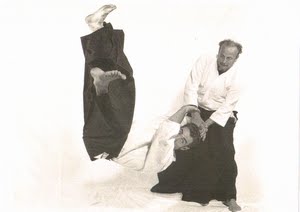
The photograph to the right is of the late Greg Palmer executing a mukae daoshi (meeting takedown) on the 'hapless John Coles' (as I was referred to in one published article interviewing Jan de Jong) during his second dan demonstration grading (see below). As an aside, this same technique is referred to as irimi nage (entering throw) within aikido circles and those that follow their terminology. It is performed differently in most cases in these instances. I argue in my book Throwing Techniques and Takedown Techniques of ALL Martial Arts that De Jong's and Mochizuki/Yoseikan's mukae daoshi (meeting takedown) is in fact a throw and the aikido and related parties irimi nage (entering throw) is in fact a takedown. Ironic, isn't it.

The Jan de Jong jujutsu grading system can be divided into three parts. This, as will be seen, also reflects the three stages of the development of his jujutsu grading system. The three parts are the mon grades, kyu grades, and dan grades.

Mon Grades
Grade (Belt)
1st Mon (Yellow and White)
2nd Mon (Blue and White)
3rd Mon (Green and White)
4th Mon (Orange and White)
5th Mon (Purple and White)
9th Kyu (Brown and White)
8th Kyu (Red and White)
7th Kyu (Red)

These are the entry level gradings that De Jong introduced in 1978. Students under 12 years of age commence at 1st mon; 12-15 years of age at 3rd mon; and over 15 years of age at 9th kyu. De Jong obviously differentiated the 'adult' grades from the children's grades by referring to the latter as mon and the former as kyu. Nonetheless, all the grades follow the same format and are designed to introduce the students to the fundamentals of his jujutsu and his systems thinking approach to understanding and studying his jujutsu.

Kyu Grades
Grade (Belt)
6th Kyu (Yellow)
5th Kyu (Blue)
4th Kyu (Green)
3rd Kyu (Orange)
2nd Kyu (Purple)
1st Kyu (Black and White)

As will be explained in further detail in a later blog, this was the original grading system prior to the introduction of the dan grades. 2nd kyu/purple belt consists of two parts - a revision part and a practical part.

At the heart of Jan de Jong jujutsu training methods is shinken shobu no kata. This is a unique method of training (and grading) which is, in my opinion, one of the most significant points of differentiation between Jan de Jong jujutsu and other martial arts. Shinken shobu means sword spirit, or earnest or serious competition. It is not a kata in the traditional sense of the word. It is a blend of randori and kata, free practice and pattern practice. Major Greg Mawkes makes special mention of this training method in connection with his endeavours to develop a close combat system for the Australian Army and SAS. From 6th to 3rd kyu gradings are all shinken shobu no kata format. The practical grading in 2nd kyu likewise adopts this format.

A black and white belt is a little confusing for many. Women used to be awarded a black and white belt instead of a black belt in Kodokan judo. I don't know of anyone else who uses a black and white belt within their grading system. I was warned by Peter Clarke that I would be questioned as to my grade when I wore my black and white belt to the first seminar I attended in Europe. Sure enough, I didn't even make it out of the change rooms without being questioned what grade it represented. It suited me because the seminar organisers didn't know how to classify me so I was free to attend all classes for dan and lower grades.

The 1st kyu/black and white grade is the first serious hill the student encounters. Seven separate gradings: (1) revision; (2) practical (shinken shobu no kata format); (3)demonstration of sword basics and kata; (4) oral examination of history of jujutsu and briefly of other martial arts, as well as Japanese terminology used in 1st mon to 3rd kyu grades and weapons used within the Japanese martial arts; (5) oral examination on technical aspects of any technique in 1st mon to 3rd kyu grades; (6) examination on ability to teach grades from 1st mon to 3rd kyu; and (7) first aid certificate.

My blogs of recent times concerning injury and injury science highlights my view that there should not be an instructor of martial arts, self defence, close combat, or whatever other term you want to use, that does not have at least a first aid certificate. That, in my opinion, is a gross breach of a moral, if not legal, duty of care (which is discussed in my book on injury science and the martial arts).

Dan Grades
1st Dan consists of nine separate grades: (1) revision; (2) and (3) practical (shinken shobu no kata format); (4) suwari waza no kata (kata with partner while both are kneeling) and kentai ichi no kata (kata demonstrating sword techniques and their unarmed applications); (5) shiai (free fight; unarmed vs knife, unarmed vs short stick, then swap roles); (6) oral examination of technical aspects in all grades up to and including 1st kyu, and, oral examination of Japanese terminology used in these gradings and that used for Japanese martial arts weapons; (7) essay on the history of jujutsu and one aspect of jujutsu; (8) examination of ability to teach all grades to 1st kyu; and (9) regulated period of time assisting grading students.

I remember one training partner, Gerald Woods, a warm, friendly, and very funny person. When I discussed the essay requirements with him, it came as a bit of a shock to him that the essay was suppose to be in two parts, one history and the other one aspect of jujutsu. He had written his entire essay, meeting the minimum required length, on the history of jujutsu. He rationalised his approach in that he had written the first half of the essay on the history of jujutsu, as required, and the second half on one aspect of jujutsu which he selected to be the history of jujutsu.

2nd Dan consists of nine separate grades; (1) revision; (2) arrange a demonstration using eight lower grades to demonstrate our jujutsu to the public with 20 minutes explanation type and 10 minutes fast action (see photo above); (3) practical (shinken shobu no kata format); (4) hantachi waza no kata (kata with one kneeling and one standing) and kentai ichi no kata (see 1st dan although different techniques); (5) demonstration of defences with tanbo (short stick) and separately unarmed against jo (short staff); (6) demonstration of knowledge of pressure points; (7) shiai (knife vs knife); (8) oral examination conducted with at least two other candidates discussing technical aspects of any technique selected by De Jong; and (9) essay on a topic approved by De Jong.

My essay in satisfaction of the last requirement of 2nd dan was a plan on how to take advantage of the Chinese-Indonesian entrepreneur's opportunity and franchise Jan de Jong jujutsu world-wide (see the Indonesian trip blog).

3rd dan consists of 12 separate grades: (1) revision; (2) arrange a 10 minute demonstration using only yudansha (black belts) on a topic given by De Jong with only 20 minutes preparation; (3) taisabaki no kata (kata of bodymovements); (4) demonstration of 20 sacrifice throws and 20 takedown techniques and answer any questions raised by De Jong; (5) kodachi no kata (kata with short sword); (6) hojo jutsu (demonstration of use of rope to tie up an opponent); (7) demonstration of arresting techniques when the subject is sitting or standing; (8) demonstration of searching and handcuffing techniques; (9) demonstration of tobitanbo (jumping stick; and the size of a large baton) and jo against various attacks; (10) demonstration of use of manrikigusari (chain with weights on either end); (11) shiai (short stick vs knife, and then change roles); and (12) complete a project assigned by De Jong.

De Jong credited me with the last requirement of the 3rd dan gradings with my writing the booklet: Jan de Jong: The man, his school and his ju jitsu system. Prior to the writing and printing of this booklet, De Jong (or his family) would compile a small folder of information for distribution at his national and international seminars. This printed booklet provided a professional looking document which contained information on his history and grading system, among other things. It proved highly successful, demonstrating the demand for De Jong related information, as it has been sold throughout Western Europe, Australia, and in various Asian countries. I fondly recall that De Jong was so happy with this booklet that he pulled over to the side of the autobahn (or motorway, I can't remember if he was in Europe or the UK) to phone me and thank me, and tell me how happy he was with the finished product.

With regards to the fourth grading in 3rd dan, I wish De Jong was still alive so I could bring my theories and concepts regarding throwing techniques and takedown techniques to the table. Based on my biomechanical classification of these types of techniques, I would challenge at least 25% of the techniques classified as takedown techniques within that grading and reclassify them as throwing techniques. This grading (and another in 1st dan) demonstrates that there is a difference between the two types of techniques, that it is important enough to include in gradings, but that the difference or distinction is not understood. It's telling that the most obvious theoretical question to raise in this grading is, 'what is the difference between a throw and a takedown', and that is the one question that was never asked of the five people who attempted the grading and completed the technical grading system.

All higher gradings are honorary in the Jan de Jong jujutsu grading system, based on age and contribution to the school or jujutsu. Further aspects of the grading system will be discussed in future blogs.

Tuesday, December 14, 2010

Jan de Jong Pt 7 - Yoshiaki Unno

Yoshiaki Unno is a fascinating off-shoot from the Jan de Jong story. The photograph to the right is a rare photograph of a young Unno presenting Branco Bratich with his 1st dan certificate in Yoseikan karate in March 1976 (more on Bratich below).

After De Jong returned from Japan in 1969-70, he asked Minoru Mochizuki to send an instructor to Perth. Mochizuki sent Unno who was a personal student of his, and a seriously credentialed martial artist. He's been credited with 6th or 7th dan Yoseikan aikido, 6th dan Yoseikan karate, 6th dan jujutsu, 5th dan kobodo, 5th dan iaido, 4th dan Nihon den kempo (Takushoku University), 4th dan Shotokan karate, and 2nd dan judo.

Unno was born in February 1950 and arrived in Perth in 1974. He is known for teaching aikido and karate for De Jong, however, some students of those classes have said he taught an eclectic mix of martial arts in the Yoseikan Budo tradition.

Bratich provides further information on the Unno story in an article published in Bujutsu International (Jan/Feb 2006) and which is available on his website (http://www.yoseikan-ryu.net/downloads/bujutsu_branco.pdf).
Sensei Unno taught six days a week for Jan de Jong. Wherever Sensei Unno taught, Branco was there to assist and learn. It was under Unno Sensei that Branco first studied kobudo and aikido and dabbled in judo.
The Yoseikan Budo way teaching eclectically. Unno was to teach for De Jong for two years. During that time, De Jong and his son, Hans, trained with him six days a week from 7am to 9am. Hans refers to Unno as his aikido teacher on his website: http://www.hansdejong.biz/aikido4.htm.

Bratich (8th dan) has built Yoseikan-ryu Karate Australia into an Australia wide organisation. He opened his first club in 1978. His introduction to karate started in 1973 at Jujutsu Kan, Perth (De Jong's school). The article states that his initial interest was in karate closely followed by jujutsu. It also states that in later years he realised that the jujutsu training made it easier for him to understand and appreciate the 'bunkai' of kata.
After two years training, Jan de Jong, founder of Jujutsu Kan, approached Branco about teaching karate and Branco accepted becoming increasingly aware of his great enjoyment of teaching karate even though he felt his knowledge was limited.
What karate? I asked Bratich was it Shotokan karate or was it pencak silat. He said it was pencak silat although De Jong called it karate. You can see on the old signage of the 996 Hay Street School photograph in my blog 'The Perth Years' advertising teaching jujutsu, karate, aikido, and self defence.

Bratich also informed me that a visiting Indonesian instructor said what De Jong was teaching was not pencak silat. I'd heard that said before myself. He was teaching pencak silat, it's just that it 'looked' different. In Budo Masters: Paths to a Far Mountain by Michael Clarke, De Jong is quoted as saying with regards to teaching pencak silat: 'I found I that I had to modify things a little for Australian students ... so I changed the way I taught to suit them, and by doing so I got them to understand what I was trying to teach' (2000: 135-136) De Jong told me this same thing. Rather than Westernising pencak silat, I think of it as Japanising it which, paradoxically, made it more acceptable to the Western audience. I did most of my formative pencak silat training outside of De Jong's school, particularly with Richard de Bordes in London (some of the toughest training I have ever done). Their pencak silat was trained in the 'Indonesian way'. In the latter part of the 1990s, De Jong started to reintoduce this style into his pencak silat. Even though I was lowly graded in his pencak silat I was invited into the instructors class because, among other things, I was more familiar with this method than anyone in the school. I refer anyone interested in pencak silat to the Dutch book, Pencak Silat: De Indonesische Vechtsport by Joep Caverle & Franc Van Heel.
It was in the latter part of 1976 that Sensei Unno opened his own Yoseikan Budo dojo in William St Perth. It was a small dojo. The training was still rigorous. It was surprising that any student would let them self be subjected to the brutal kumite training that was done in those days.
Unno also taught aikido at the University of Western Australia as John Langley (7th dan)(http://www.ioaikido.com.au/resource/aboutSensei.html) explains:
Sensei Yoshiaki Unno taught Yoseikan Budo. He held the Grades of 7th dan aikido, 7th dan karate, 6th dan kobudo (weapons), 4th dan bojutsu and 2nd dan judo. He also taught kenjutsu. His Sensei was Kancho Minoru Mochizuki (10th dan) as Yoseikan Budo Hombu Dojo, Shizuoka City, Japan. After several years, Sensei Yoshiaki Unno left UWA.
Many aikido instructors in Perth reference training under Unno in their biographies. Both De Jong and Unno have had a significant influence on the martial arts scene in Perth.

I didn't know much about Unno until I undertook research for my originally conceived book. I only had the opportunity of meeting him once, and that was sheer coincidence. A friend of a friend, totally unrelated to the martial arts, invited me to a Christmas breakfast a couple of years ago. Lo and behold I was introduced to Unno who was a guest at the same breakfast. Unfortunately I did not get to have the depth of conversation I'd have liked. He passed away in June 2006.

[Appreciation is extended to Branco Bratich for his permission to reproduce his photograph and for his information on his time with Jan de Jong]

Wednesday, December 8, 2010

'Can martial arts falling techniques prevent injuries?'


I'm currently working on chapter 10 in my tentatively titled Throwing Techniques and Takedown Techniques of ALL Martial Arts. This chapter concerns breakfalling techniques (ukemi waza). A GREAT deal of research has gone into this chapter. I thought I'd share just a little at this stage to hopefully garner further interest in my work and some comments.

The World Health Organisation has this to say on falls:
Globally, falls are a major public health problem. An estimated 424,000 fatal falls occur each year, making it the second leading cause of unintentional injury death, after road traffic injuries. … Though not fatal, approximately 37.3 million falls are severe enough to require medical attention occur each year. Such falls are responsible for over 17 million DALYs (disability-adjusted life years) lost. … In addition, those individuals who fall and suffer a disability, particularly older people, are at a major risk for subsequent long-term care and institutionalization. The financial costs from fall-related injuries are substantial.
Human movement specialist, Arthur A. Chapman, is a big fan of teaching techniques for landing safely from a fall to the wider community. In Biomechanical Analysis of Fundamental Human he describes the two basic landing strategies taught by the martial arts and suggests 'all good school physical education classes should teach [these techniques]' (2008: 88). In their chapter entitled 'Biomechanics of Combatives' in Biomechanics of Human Movement, Marlene J. Adrian and John M. Cooper likewise recommend the benefits of teaching breakfalling techniques to the wider community: 'Falling and landing effectively with a minimum of injury are also necessary skills to attain longevity in sports, industry, and daily living' (1995: 279).

Injury Science published a research letter submitted by Dr. Frank J. Leavitt (Faculty of Health Sciences, Ben Gurion University of the Negev, Beer Sheva, Israel) titled 'Can martial arts falling techniques prevent injuries?' (2003: 284). I'd like to take this opportunity to inform the reader that there is some professionally researched works related, or which can be related, to the martial arts which unfortunately are hidden away in academic journals and would never see the light of day in the normal course of events. Secondly, I'd like to use this article to inform the reader of some of the work they can expect in this chapter.

Leavitt explains that 'although falling techniques are taught to martial artists, athletes and paratroopers, a BMJ search of Highwire listed journals has discovered no mention of "falling correctly", "safe falling", etc.'. My research has revealed there is very little research published on fall-arrest techniques (falling techniques are pretty simple but landing safely is the tricky bit) - but there is some. I start out my chapter with a paper investigating the natural (evolved) way humans try to land safely from falls to the front, rear, and side. I refer to these as 'nature's breakfalling techniques'. Part of nature's breakfalling techniques is the use of landing on outstretched hands which often results in a FOOSH (Fall On OutStretched Hand) injuries (see a previous blog). I then intend to write about the studies that have investigated proposed improved methods of falling safely from falls to the front, rear, and side.

'Although correct falling is neglected in the medical literature, there is much semi-scientific literature by martial arts masters.' Fall-arrest strategies are virtually, not totally, ignored in the medical literature as the abovementioned published papers demonstrate. I would take issue with the suggestion there is much semi-scientific literature by martial arts masters. There is a veritable dearth of such work within the martial arts. One notable exception is Attilio Sacripanti's Advances in Judo Biomechanics. This veritable dearth in semi-scientific or scientific literature in the martial arts is one of the driving forces behind my work.

'The ease with which martial artists take even very hard falls suggests the hypothesis that falling practice while relatively young can prevent injury from falls incurred later in life.' Here's hoping this is true given I'm entering the later in life period of my life.

'A Japanese study of 11 deaths and serious injuries in aikido from 1972-75 listed eight due to falling. Most of the victims were relative beginners, suggesting that those who practice over long periods are more protected.' Since commencing training in 1983, oh so long ago, I've seen relatively few injuries due to falling. The most severe was in a seminar conducted in Sweden in the 90s. We (Jan de Jong and myself) were teaching a throwing technique (definitely not a takedown technique)and one of the seminar participants, a yudansha (black belt holder), used an outstretched hand to arrest his fall. Both the radius and ulna were shattered requiting plates on both bones.

'Martial arts tend to have rather specialised falling techniques. Aikido falls may not protect you in cases where judo falls will be effective.' Too true. The types of ukemi waza taught reflect the types of techniques taught. Aikido tends to 'project' (a term that is often used in aikido to refer to throws) so rolling ukemi waza tend to dominate. Judo tends to throw down so 'flat falls' tend to dominate. Interestingly enough, virtually nobody teaches a sideways roll. They teach a forwards, backwards, and sideways flat fall, and a forward and backwards roll, but not a sideways roll. Again, this tends to reflect the types of falls initiated by the throws and takedowns taught within these schools. Jan de Jong jujutsu is relatively unique in teaching a sideways roll. Very useful when practicing ukemi waza by leaping from a scooter as Jan de Jong demonstrated in one of my past blogs. The ukemi waza of Jan de Jong jujutsu will also be included in this chapter.

'There is plenty of anecdotal evidence of martial artists coming out safely from quite dangerous falls.' A previous blog of mine added to the anecdotal evidence when I described Greg Palmer's use of ukemi waza to survive a motor cycle accident and Hans de Jong's use when falling from a tree while tree lopping.

'It remains to be seen whether safe and enjoyable methods might be developed to teach selected falling techniques to the general population.' They have been developed. Only Brenda Groen and her Dutch colleagues have studied martial arts techniques to reduce the severity of falls. Her PhD thesis which she finished this year and which she kindly sent me a copy, is entitled 'Martial arts techniques to reduce fall severity'. The technique she studies is included in an expansive fall prevention program currently being taught to the elderly in Holland. There have also been studies published which have investigated the efficacy of this technique within this program and participants. I'm intending to include discussion of these studies within this chapter as well.

Any and all comments are appreciated. My work can only improve with these comments. Thank you.

Monday, August 9, 2010

Facilitating the Understanding and Study of Martial Arts Tactics and Techniques

Peter Clarke was a senior instructor of jujutsu and pencak silat at the Jan de Jong Self Defence School. He has since gone on to develop his own style of jujutsu which he calls Tsutsumi Jugo Ryu and which he is teaching nationally and internationally (see www.jujutsu.net). Peter was one of my instructors and is the only instructor other than Jan de Jong who I requested to assist teaching in order to learn from. In my opinion he was the best practitioner of my 20-plus-year era at the school. We later became fellow instructors and I now count myself fortunate that I have the opportunity of being able to discuss my ideas with one of the more thoughtful practitioners in terms of theory and practice.

I sent a first draft of my chapter on stances to Peter for his comments. I did so with some degree of concern as I now fully appreciated Ernest Hemingway's dictum, 'all first drafts are shit.' Peter's comments, when we did discuss the chapter, were (a) well researched, and (b) not sure what I was trying to say. I agree.

This book is evolving. Given my professional background I am very aware of the benefits of planning. The courses I've undertaken and the research I've done on writing any book reinforces the benefits of planning when writing a book. A former pupil of mine who did regular private lessons with me for more than half a decade, now friend, marketing professional, former journalist, and published author also discussed and advised on having a plan when writing this book. I now understand; how can I plan when I don't know what I don't know? My research on the subject matter often reveals so much which has hitherto never before been considered in the context of the martial arts let alone in the context of any discipline interested in the practical aspects of interpersonal violence. Each chapter evolves, and with each chapter my book evolves.

I had an answer for Peter when he provided his comments. When researching my chapter on the difference between throwing techniques and takedown techniques I'd come across the work of Attilio Sacripanti. He is, among other things, the Chair of Biomechanics of Sports at the University of Rome Tor Vergata and author of the 2010 published Advances in Judo Biomechanics Research. When providing a very interesting analysis of the different classifications of judo nage waza which have been proposed by various individuals over the past 130 years, he explains that the classification of these techniques is 'for an easier understanding and useful systematic study.' This has become the guiding principle in the writing of my book:

Guiding principle of my book: To facilitate the understanding and study of the tactics and techniques of the martial arts.

If what I'm writing is interesting but does not facilitate the understanding and study of the tactics and techniques of the martial arts - I lose it. Peter was the one who 'motivated' me to find out why classification is important. When discussing the ideas I had on the differences between throwing techniques and takedown techniques, he'd sceptically ask, 'why? Who cares? What does classification do to help the average punter who is only interested in learning how to do the technique?' Obviously not verbatim. I intuitively knew it was important, but Peter's comment caused me to go in search of an answer to why classification facilitates the understanding and study of the tactics and techniques of the martial arts. And an answer I did find. An answer which goes beyond my wildest dreams of facilitating an understanding and study of the tactics and techniques of the martial arts.

I am acutely aware that the blogs todate which have been posted do not contain information which facilitates your understanding and study of the tactics and techniques of the marital arts. Ok, 'Wax On Wax Off' does. I am currently trying to juggle the imperatives of encouraging interest in my work and not revealing too much until my book is actually published. I subscribe to the emotional contract I am attempting to establish with the readers and followers of my blog, so, the next blog will contain information that will be aimed at facilitating your understanding and study of the tactics and techniques of the martial arts. I think I'll publish a post on the relatively new science, Injury Science, and how it facilitates the understanding and study of the martial arts. And how it blows away all previous attempts at explaining striking and kicking techniques in terms of physics.

Until next time.