What is kaizen?
Kaizen is a Japanese term made up two characters that mean 'to change' and 'for the better.' Kaizen has been embraced by Western business as 'continuous improvement,' but kaizen is much more than just a mere business concept. It is a way of thinking. It involves exploring, knowledge, learning, growth, reflection, change, and improvement.
I am currently the finance director on a not-for-profit organisation and engaged in a 'discussion' with fellow board members and management over governance issues. I have applied kaizen to develop strategy and tactics that promote continuous improvement in real terms. This direction is being resisted as the imperative of fellow board members, as it is with many boards, is to maintain the status quo all the while paying lip service to the principal of continuous improvement.
I shared my frustrations with a local shopkeeper who I frequent regularly. He brought up the issue of kaizen without my prompting. I was very surprised. He explained how he knew of the concept because his son is being taught traditional jujutsu and the instructor refers to the concept.
The managing director particularly, but all of the directors generally, pay lip service to the concept of kaizen. They do not explore, gain knowledge, learn, and MOST importantly, reflect. Reflection should never be underestimated. In addition, the managing director mistakes expending energy for movement in a direction.
In a martial arts sense, simply training will only get you so far. In order to continuously improve you need to explore, gain knowledge, learn, and reflect. Reflection is critical to the growth process. Many in the martial arts are action oriented. That is not a commitment to continuous improvement.
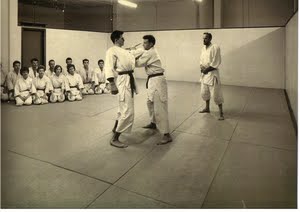
KOJUTSUKAN: The place for the study of martial art skills
Showing posts with label Kojutsukan. Show all posts
Showing posts with label Kojutsukan. Show all posts
Monday, April 7, 2014


Saturday, December 15, 2012
What Does A Black Belt Mean?

One of my more popular posts concerns this issue with reference to Jan de Jong's shodan gradings. In that post I refer to a number of authorities who describe the black belt as the beginning of the study of that martial art. That a minimum proficiency is gained prior to shodan and then the study really begins.
I recall a senior instructor of De Jong's (who now has his own school) telling me how his 'eyes were opened' when he trained shodan. Why were this instructors 'eyes opened' by the shodan gradings? Because he was learning the 'patterns that connect.'
When I discuss this issue with the abovementioned shodan candidates, I will explain that up until the shodan gradings they were 'trained monkeys.' They know some 'tricks,' otherwise known as defences. Shodan teaches them the patterns that connect so that they can see a system rather than a collection of techniques.
The difference in thinking is between analytical thinking and synthetical thinking. Analytical thinking involves identifying differences and learning single defences. Synthetical thinking involves identifying similarities and learning a fighting system. Remember, the core of all learning is the identification of similarities and differences. The kyu grades are about differences, analytical thinking. The dan grades are (or should be) about similarities, synthetical thinking.
It has been said that with analysis you gain knowledge but with synthesis you gain understanding. The dan grades should be about gaining understanding.

The consideration of the question, what does a black belt mean?, raised a number of issues. The abovementioned former De Jong senior instructor with his own school has dropped the mon grades from his grading system. He explains that decision as going back to the original Tsutsumi Hozan ryu jujutsu. The issue of original or Tsutsumi Hozan ryu is another issue, but, was dropping the mon grades a good thing or a bad thing?
You could argue to train in the traditional manner. Teach the monkeys tricks in the kyu grades, then teach them to see the essence of the system in the dan grades. Whether or not the dan grades of most martial arts teaches the person to see the essence of their system is another matter.
Should you be teaching analytical and synthetical thinking from day one? Another interesting question. My approach is to teach a person to 'think' and then teach consistently using this way of thinking. This produces efficiencies and efficacy. Rather than giving the student a fish, this approach teaches them how to fish.
My theory grading goes beyond anything ever produced in the martial arts. It could be used to understand and study any martial art, and would produce greater insights into those martial arts. If shodan is the beginning of a student's study of their martial art, should this theory grading be distributed over a number of dan grades?
It was often suggested that most martial arts consider shodan to be the commencement of a student's study but the De Jong shodan signified mastery. That was because the shodan grading was one of the most comprehensive in the martial arts world and focused on a systems view of his jujutsu (although the latter was not explicitly appreciated until now). If this view is adopted, then my theory grading should be retained in the shodan grading as it provides a way of thinking and viewing not only the martial art being studied, but all martial arts.
It could of course be argued that this level of understanding is not required at shodan, but can be gained when studying higher dan grades.
'What does a black belt?' is a question that raises a good many questions. There are no right or wrong answers to this question, only the opportunity of gaining a deeper understanding of a martial art being studied.
Tuesday, October 2, 2012
What connects the 2012 AFL grand final to Kodokan Judo to Kojutsukan?

For the international readers of this blog, 'AFL' refers to the Australian Football League. Australian football is the most exciting football code in the world :).
Hawthorn (Hawks) and Sydney (Swans) battled out the 2012 AFL grand final on Saturday. The Hawks were favourites with a couple of out-and-out stars playing for them. The Swans were the underdogs with no stars of the same calibre as the Hawks. The Swans playing list was generally acknowledged as being inferior to the Hawks.
The Hawks won virtually every statistical category, and lost. The Swans lost virtually every statistical category, and won. This result can be explained as the triumph of systems thinking over analytical thinking.
Analysis is about breaking things down to understand them. Systems thinking is about synthesis, putting them back together, and understanding their interconnections. Analysis is about seeing the trees. Systems thinking is about seeing the trees and the forest.
Systems thinking is about understanding that everything is connected. The connections are what is important.
One of the fathers of systems thinking, Gregory Bateson, implored us to look for the 'patterns that connect.' Genius has been described as being able to see the patterns that connect things.
Jigoro Kano was frustrated that his jujutsu instructors simply taught a collection of techniques with no understanding of their relationship with one another. He sought the 'essence' of all jujutsu techniques. While he did not find the essence of jujutsu techniques that connected them together, he developed an essence which he applied to select jujutsu techniques to be included in his Kodokan judo. By default and design, Kano's essence is what connects all judo techniques.
Kojutsukan philosophy is all about understanding the patterns that connect. Not only the techniques taught by Kojutsukan, but techniques taught by all activities associated with preparing a person to survive a violent encounter and those used in violence generally.
Look for the patterns that connect.
Friday, June 1, 2012
Producing Better Teachers and Students

Number three in the top ten was: What Does a Black Belt Mean? This suggests to me that there is a lot of interest in understanding what a black belt is suppose to signify. I came across the following again while editing my articles to be submitted for publication:
In virtually all martial arts, black belt denotes the highest level of achievement. ... By the time the student attains a black belt his [or her] knowledge and skill are of the highest class. In addition, his [or her] depth of knowledge makes him [or her] a fully qualified teacher. Rather than merely knowing how to perform the moves, the black belt is expected to know why a given move works. That is, he [or she] understands the biomechanical principles that underlie the move. ... The deeper knowledge makes him [or her] a far better than someone who merely recounts a series of moves. Moreover, such knowledge allows him to invent new moves and combinations and so develop a more personalised [martial art].(Gracie and Gracie, Brazilian Jiu-Jitsu: Theory and Technique, 2001: 17)
The Gracies' principle is sound, however the practice falls far short. If the black belt does understand the why of techniques, the biomechanical principles that underlie techniques, they did not obtain their knowledge from current biomechanical or martial arts texts.
Jigoro Kano, the founder of Kodokan Judo, when explaining his motivation for developing judo lamented that the many eminent jujutsu masters he studied under did not know the underlying principles of there methods and that they just taught a collection of techniques. I'd suggest not a lot has changed from then to today. This is evident when I am greeted with the bemused question, 'why bother,' when discussing the difference between throwing techniques and takedown techniques. The difference goes to the very essence of these techniques, which I'd suggest is not understood by the question raisers.
The Gracies principle that a black belt denotes a qualified teacher, and that the teacher should know the why-to in addition to the how-to is the mission that is crystallising for me and my kojutsukan.

Carr, in Sport Mechanics for Coaches (2004), suggests that coaches are reluctant to study sports mechanics because it means tackling dry, boring texts loaded with formulas, calculations, and scientific terminology. Further, he suggests that these texts have failed to explain the relationship of good technique to the principles of mechanics in a manner that is meaningful to coaches and sports enthusiasts. All too true and more so when it comes to the martial arts. In fact, in certain instances, those who have attempted to explain the science behind striking and kicking techniques (the article I'm currently working on) have either confused the issue or misdirected the reader.

I have just had one of my articles reviewed by the head of a sports biomechanics faculty at a prestigious university, who will remain nameless for the moment. He commended me on using biomechanics to inform practice for the general public, and more importantly that I had got the science right. Given I am a self taught biomechanist, that was a huge relief.
The four articles cover the science behind stances, movement (footwork), throwing, takedown, striking, kicking, breakfalling, and unbalancing techniques. They also cover the most fundamental principle that applies to all techniques, forces, and this facilitates the understanding and study of joint techniques. Referring to biomechanical principles is looking at the very essence of the techniques; what actually makes them work. As Carr explains, 'all the fundamental actions an athlete makes in technique are founded on mechanical principles. In other words, technique is based on mechanical laws' (155). All the techniques taught in the martial arts or used in violence generally are based on biomechanical laws. Understanding these laws, or principles, allows the teacher and student to focus on what is important from the get go.
The articles provide a few simple biomechancial concepts that can be used to focus on what actually makes the techniques work. They also provide a method of analysing techniques that can facilitate their analysis to improve performance and to teach the techniques. I always say, first teach the student how to learn, then teach them the subject matter. Teaching a student how to learn accelerates their learning, a goal that McGinnis identified when explaining the benefits of studying biomechanics.
These four articles are now forming the basis for a book on the science behind the tactics and techniques of the martial arts or those used in violence generally. What would be added is the information I have gathered on strangulation techniques, our evolved survival mechanism (Beyond Fight-or-Flight), and pain. What is missing is the physiology explaining joint techniques, but that is difficult to obtain authoritative information given that more than 85% of all injuries to the upper arm are as a result of falls on outstretched hands where forces are applied very differently to the forces applied when executing a joint technique.
Saturday, July 10, 2010
Introduction
Hello
Allow me to introduce myself. My name is John Coles and I am an instructor of the late Jan de Jong. I was a full-time instructor of his for a number of years and I am one of only five people who have completed the technical grades of De Jong's jujutsu grading system. I have accompanied De Jong on numerous teaching tours of Western Europe, Australia, and even Java, Indonesia. I was the first of his instructors to conduct a seminar overseas which was more a reflection of the esteem with which De Jong and his teachings are held than for the esteem which I am held. I was shodan (first dan) at the time, which is unheard of in Europe for conducting a seminar. Shodan is often considered the commencement of the study of a martial art rather than the culmination of a study. In De Jong's jujutsu, shodan is an entirely different proposition (which will be clarified in a later blog). The seminar was in honour of a milestone anniversary of Wim Mullens' predominantly Shotokan karate school in Rotterdam, Netherlands. It was a humbling experience to find participants attending from the Netherlands, Germany, Belgium, and Denmark, more than half of which were higher graded than me. Again I reiterate, it is a reflection of the esteem with which Jan de Jong and his teachings are held that these participants attended this seminar.
This blog has been started to introduce my work. I was originally engaged in writing a how-to book on the tactics and techniques of Jan de Jong Jujutsu (a future blog will discuss the name of the style of jujutsu). The goal of this how-to book was to (a) preserve for posterity the teachings of Jan de Jong, and (b) to contribute to the general body of knowledge. The first goal is associated with the 'fact' that if it's not documented it didn't happen. I was confident the second goal could be achieved because of the interest and world wide demand for De Jong and his teachings.
The original idea was to put a little 'science' behind each chapter in order to provide a deeper understanding and appreciation of the how-to instruction. I also have various undergraduate and postgraduate business related degrees and qualifications which have provided me with research, analytical, and conceptual skills and abilities. My research for the 'little science' provided hitherto unreferenced and unconsidered information which generated unique insights and concepts. The 'little science' came to overshadow the how-to instruction and thus, a new book was born.
I've been working full-time on a book dedicated to the science behind all the tactics and techniques of all the martial arts, combat sports, close quarter combat systems, and self defence systems for over three years now. Nearly seven days a week, twelve hours plus a day, over that period of time. It has been an amazing journey. While the book is a little while off, I thought it is time to share some of what I've learnt and developed and start to generate interest in my work. Also, after repeated pressure to recommence teaching, I am now beginning to be in a position to do so. My ideas and concepts are reshaping the grading system and teaching methods used by De Jong. They enhance his work. How can I do that with the work of a master? As Isaac Newton said, 'if I can see further it's because I stood on the shoulders of giants.' I AM standing on the shoulders of giants, and it would be very disappointing if I could not see further than my venerable master, and good friend, Jan de Jong.
What does kojutsukan mean? In my research I've come to appreciate the genius of Jigoro Kano, the founder of judo and specifically Kodokan judo. He named his martial art Kodokan. 'Ko' is said to refer to lecture, to study, or to spread information. 'Do' is the way compared to 'jutsu' which refers to skill, technique or art. 'Kan' is training hall, dojo, or school. Kodokan is said to mean the a place for the study of the way. My approach, encouraged by the Jan de Jong Jujutsu methods, and fostered by my mentor, instructor, fellow instructor, training partner, and dear friend, Greg Palmer, is the study of the skill or technique. In homage to both Kano who transformed the martial arts world, De Jong and Palmer, and to reflect my approach to the martial arts, I'm considering naming my school Kojutsukan.
Hello. This is my introduction to my blog. I hope you find my work as interesting and informative as I do.
John Coles
Allow me to introduce myself. My name is John Coles and I am an instructor of the late Jan de Jong. I was a full-time instructor of his for a number of years and I am one of only five people who have completed the technical grades of De Jong's jujutsu grading system. I have accompanied De Jong on numerous teaching tours of Western Europe, Australia, and even Java, Indonesia. I was the first of his instructors to conduct a seminar overseas which was more a reflection of the esteem with which De Jong and his teachings are held than for the esteem which I am held. I was shodan (first dan) at the time, which is unheard of in Europe for conducting a seminar. Shodan is often considered the commencement of the study of a martial art rather than the culmination of a study. In De Jong's jujutsu, shodan is an entirely different proposition (which will be clarified in a later blog). The seminar was in honour of a milestone anniversary of Wim Mullens' predominantly Shotokan karate school in Rotterdam, Netherlands. It was a humbling experience to find participants attending from the Netherlands, Germany, Belgium, and Denmark, more than half of which were higher graded than me. Again I reiterate, it is a reflection of the esteem with which Jan de Jong and his teachings are held that these participants attended this seminar.
This blog has been started to introduce my work. I was originally engaged in writing a how-to book on the tactics and techniques of Jan de Jong Jujutsu (a future blog will discuss the name of the style of jujutsu). The goal of this how-to book was to (a) preserve for posterity the teachings of Jan de Jong, and (b) to contribute to the general body of knowledge. The first goal is associated with the 'fact' that if it's not documented it didn't happen. I was confident the second goal could be achieved because of the interest and world wide demand for De Jong and his teachings.
The original idea was to put a little 'science' behind each chapter in order to provide a deeper understanding and appreciation of the how-to instruction. I also have various undergraduate and postgraduate business related degrees and qualifications which have provided me with research, analytical, and conceptual skills and abilities. My research for the 'little science' provided hitherto unreferenced and unconsidered information which generated unique insights and concepts. The 'little science' came to overshadow the how-to instruction and thus, a new book was born.
I've been working full-time on a book dedicated to the science behind all the tactics and techniques of all the martial arts, combat sports, close quarter combat systems, and self defence systems for over three years now. Nearly seven days a week, twelve hours plus a day, over that period of time. It has been an amazing journey. While the book is a little while off, I thought it is time to share some of what I've learnt and developed and start to generate interest in my work. Also, after repeated pressure to recommence teaching, I am now beginning to be in a position to do so. My ideas and concepts are reshaping the grading system and teaching methods used by De Jong. They enhance his work. How can I do that with the work of a master? As Isaac Newton said, 'if I can see further it's because I stood on the shoulders of giants.' I AM standing on the shoulders of giants, and it would be very disappointing if I could not see further than my venerable master, and good friend, Jan de Jong.
What does kojutsukan mean? In my research I've come to appreciate the genius of Jigoro Kano, the founder of judo and specifically Kodokan judo. He named his martial art Kodokan. 'Ko' is said to refer to lecture, to study, or to spread information. 'Do' is the way compared to 'jutsu' which refers to skill, technique or art. 'Kan' is training hall, dojo, or school. Kodokan is said to mean the a place for the study of the way. My approach, encouraged by the Jan de Jong Jujutsu methods, and fostered by my mentor, instructor, fellow instructor, training partner, and dear friend, Greg Palmer, is the study of the skill or technique. In homage to both Kano who transformed the martial arts world, De Jong and Palmer, and to reflect my approach to the martial arts, I'm considering naming my school Kojutsukan.
Hello. This is my introduction to my blog. I hope you find my work as interesting and informative as I do.
John Coles
Subscribe to:
Posts (Atom)