I published a post on my The School of Jan de Jong blog which uses the theory presented in my The Science Behind All Fighting Techniques to analyse the Happoken no Kata taught by Jan de Jong jujutsu, Yoseikan Budo, and Yoseikan Aikido.
The post is an example of the use of theory to gain understanding and insights into practice. It is also an example of the necessity to always question your teacher's instruction, but only when you understand the theory and the instruction does not stack up to the theory.
Showing posts with label Analytical Approach. Show all posts
Thursday, February 28, 2019
Tuesday, January 1, 2019
2+2=?
Saw an episode of Silent Witness last night were a highly acclaimed pathologist asked his class, attended by another highly acclaimed pathologist, and as a lesson, what 2 + 2 equals.
Come on. What does 2 + 2 equal? 4!
What does 4 equal? :)
Infinity. There are an infinite number of answers to 4.
It's not the answer that is important. It's the question that is important.
It's the questions where insight lies.
Too many in the martial arts are about answers. Very few are about questions. That's why so few in the martial arts have insights.
Wednesday, March 15, 2017
Magnitude of force to change direction or stop a moving object.
I am researching an issue I need explained in my chapter on blocking techniques in my book on the science behind fighting techniques.
I am calling to all readers of this blog and beyond.
Please explain in biomechanical/mechanical/physics terms why it takes less force to deflect an object than to stop an object. Please be technical in your explanation. If you wish privacy, please email me at jfcoles101@gmail.com.
I am calling to all readers of this blog and beyond.
Please explain in biomechanical/mechanical/physics terms why it takes less force to deflect an object than to stop an object. Please be technical in your explanation. If you wish privacy, please email me at jfcoles101@gmail.com.
Sunday, January 22, 2017
Throws and Takedowns
I'm finally finalising my book on the science behind fighting techniques.
One chapter in that book is on throws and takedowns. Despite the common meaning of the terms provided by the Oxford Dictionary, it appears the martial arts has managed to confuse the meaning of the terms as applied to marital arts techniques.
I provide a biomechancially based classification for all techniques that are designed to cause a person to fall to the ground. It's based on the biomechanics of balance and stability. A person is stable if their centre of gravity (CoG) is located over their base of support (BoS) and balanced if they possess control of their CoG with respect to their BoS.
It was interesting reviewing the literature on the throws and takedowns of various martial arts. Books dedicated to throws and takedowns of various martial arts did not distinguish between the two, and in fact often only referred to throws.
Judo, according to Kano's classification of Judo techniques, does not teach takedowns.
A throw is a technique were forces are applied to cause both of the opponent's feet to leave the ground. The biomechancial target of the applied forces is the opponent's BoS.
A takedown is a techniques were forces are applied to cause an opponent's CoG to fall outside of their BoS and a balance recovery is prevented. Takedowns can be subclassified as 'one-legged' or 'two-legged' (for want of a better description) takedowns. The biomechancial target for one-legged takedowns is a person's foot in contact with a support surface. For instance, a foot sweep is a one-legged takedown.
The biomechanical target of a two-legged takedown is an opponent's CoG. Forces are applied to cause an opponent's CoG to fall outside of their BoS and a balance recovery is prevented. A hiki-otoshi (elbow drop) is an example of a two-legged takedown.
Irimi-nage and Mukae-daoshi are good examples of the confusion held within the martial arts over this issue. Irimi-nage is 'entering throw' taught by aikido.

Mukae-daoshi is 'meeting takedown' taught by Yoseikan Budo/Aikido and Jan de Jong.
Using Kano's division of judo techniques (kuzushi, tsukuri, kake), the same kuzushi and tsukuri result in different kake depending on the direction of the applied forces in the kake phase. The same unbalancing and positioning results in a throw or takedown depending on the direction of the applied forces in the execution phase of the technique.
The irimi-nage/entering throw is in fact a takedown while the mukae-daoshi/meeting takdown is in fact a throw. What that also means is that the latter is entirely dependent on the momentum generated during the kuzushi phase of the technique.
It also means that the applied forces for a throw are upward whilst the applied forces for a takedown are downward. A biomechanical understanding of these techniques enables a student to know what to look for in learning and training these techniques as does the instructor. It makes better students of students and better instructors of instructors.
One chapter in that book is on throws and takedowns. Despite the common meaning of the terms provided by the Oxford Dictionary, it appears the martial arts has managed to confuse the meaning of the terms as applied to marital arts techniques.
I provide a biomechancially based classification for all techniques that are designed to cause a person to fall to the ground. It's based on the biomechanics of balance and stability. A person is stable if their centre of gravity (CoG) is located over their base of support (BoS) and balanced if they possess control of their CoG with respect to their BoS.
It was interesting reviewing the literature on the throws and takedowns of various martial arts. Books dedicated to throws and takedowns of various martial arts did not distinguish between the two, and in fact often only referred to throws.
Judo, according to Kano's classification of Judo techniques, does not teach takedowns.
A throw is a technique were forces are applied to cause both of the opponent's feet to leave the ground. The biomechancial target of the applied forces is the opponent's BoS.
A takedown is a techniques were forces are applied to cause an opponent's CoG to fall outside of their BoS and a balance recovery is prevented. Takedowns can be subclassified as 'one-legged' or 'two-legged' (for want of a better description) takedowns. The biomechancial target for one-legged takedowns is a person's foot in contact with a support surface. For instance, a foot sweep is a one-legged takedown.
The biomechanical target of a two-legged takedown is an opponent's CoG. Forces are applied to cause an opponent's CoG to fall outside of their BoS and a balance recovery is prevented. A hiki-otoshi (elbow drop) is an example of a two-legged takedown.
Irimi-nage and Mukae-daoshi are good examples of the confusion held within the martial arts over this issue. Irimi-nage is 'entering throw' taught by aikido.
Mukae-daoshi is 'meeting takedown' taught by Yoseikan Budo/Aikido and Jan de Jong.
Using Kano's division of judo techniques (kuzushi, tsukuri, kake), the same kuzushi and tsukuri result in different kake depending on the direction of the applied forces in the kake phase. The same unbalancing and positioning results in a throw or takedown depending on the direction of the applied forces in the execution phase of the technique.
The irimi-nage/entering throw is in fact a takedown while the mukae-daoshi/meeting takdown is in fact a throw. What that also means is that the latter is entirely dependent on the momentum generated during the kuzushi phase of the technique.
It also means that the applied forces for a throw are upward whilst the applied forces for a takedown are downward. A biomechanical understanding of these techniques enables a student to know what to look for in learning and training these techniques as does the instructor. It makes better students of students and better instructors of instructors.
Thursday, April 11, 2013
Do We Need Explicit Knowledge of Techniques?
One of the shodan gradings in Jan de Jong's jujutsu grading system is a theory grading. The theory grading is an oral examination of the candidate's technical knowledge. A common question De Jong posed was: 'What are the forces involved in a tai gatame ude kujuki (body set are breaking)?' The candidate was required to answer the question verbally with no physical demonstration.This is an example of explicit learning or explicit knowledge. The Australian Institute of Sport provide the following explanation of explicit learning which is contrasted with implicit learning:
Explicit learning can be related to traditional coaching approaches where verbal instruction is used to coach a learner about how to perform a skill. This process typically results in the learner being able to verbalise how to perform the skill, although it does not guarantee the learner can physically execute the skill. In contrast, implicit learning methods typically contain no formal instruction about how to perform the skill yet result in a learner being able to perform the skill despite being unable to verbally describe how they do it.Do we need explicit knowledge of techniques? De Jong obviously thought so given he included an explicit knowledge grading within his shodan grades. The 'traditional' teaching method of Asian martial arts involves implicit learning where techniques are demonstrated and the student attempts to imitate them. Does the student need to be able to verbally describe techniques in addition to being able to perform them? Does the instructor?
De Jong saw his dan grades as producing instructors in addition to practitioners. He expected his instructors to possess an explicit understanding of techniques. Many others in the martial arts do not expect either their students or instructors to possess an explicit understanding of their techniques. One possible explanation for the traditional Asian martial arts teaching model being based on implicit learning may be because the instructors did/do not possess an explicit understanding of the techniques. If you come up under an implicit learning model, where do you gain the explicit knowledge?
Why would an instructor need to have an explicit understanding of techniques if they use implicit learning methods when teaching? One reason is that it provides a through understanding of the mechanics of the technique. It enables the instructor to analyse techniques and provide instruction to correct errors and improve performances. The problem is that an explicit explanation of techniques is hard to come by in the martial arts.
Let's return to De Jong's question; 'what are the forces involved ...?' De Jong intuitively knew that forces are important in understanding how a technique works. Unfortunately, neither he nor the candidates knew much about forces. My work remedies that shortcoming.
Forces are what causes every technique taught by every martial art work. The good thing is that forces is a simple concept for the layperson to understand and apply. First you identify all points of contact between the 'defender' and the 'attacker.' Next you determine if the force applied at each point of contact is a push or a pull. Then you describe the direction and relative magnitude of each of the forces. Finally you determine the intended effect of the applied net forces. This approach provides an explicit understanding of every technique taught by every martial arts.
A very good and rare example of this approach at work is with Jigoro Kano's Kodokan Judo. When you understand the concept of forces and adopt the approach described above, you'll see that Kano consistently describes all his methods in these terms. In this way, Kano focuses on the important elements in the techniques to provide an explicit understanding of judo techniques for the reader.
Saturday, December 15, 2012
What Does A Black Belt Mean?
The final two questions in my redesigned theory grading are:(a) what does a black belt mean to you?, and (b) what does a black belt mean for Kojutsukan (me)? I put these questions to two shodan candidates. Their responses demonstrated that this question - what does a black belt mean? - is a very important and revealing question.
One of my more popular posts concerns this issue with reference to Jan de Jong's shodan gradings. In that post I refer to a number of authorities who describe the black belt as the beginning of the study of that martial art. That a minimum proficiency is gained prior to shodan and then the study really begins.
I recall a senior instructor of De Jong's (who now has his own school) telling me how his 'eyes were opened' when he trained shodan. Why were this instructors 'eyes opened' by the shodan gradings? Because he was learning the 'patterns that connect.'
When I discuss this issue with the abovementioned shodan candidates, I will explain that up until the shodan gradings they were 'trained monkeys.' They know some 'tricks,' otherwise known as defences. Shodan teaches them the patterns that connect so that they can see a system rather than a collection of techniques.
The difference in thinking is between analytical thinking and synthetical thinking. Analytical thinking involves identifying differences and learning single defences. Synthetical thinking involves identifying similarities and learning a fighting system. Remember, the core of all learning is the identification of similarities and differences. The kyu grades are about differences, analytical thinking. The dan grades are (or should be) about similarities, synthetical thinking.
It has been said that with analysis you gain knowledge but with synthesis you gain understanding. The dan grades should be about gaining understanding.
The mon grades that De Jong developed and installed at the front of the kyu grading system introduced the student to a synthetical view of his jujutsu. They offered the potential of gaining understanding through their study. These lessons were lost on novice students. In fact, the lessons were lost on many of the shodans and instructors as well. Possibly they were lost on the novice student because their instructors had not gained the understanding offered by the mon grades.
The consideration of the question, what does a black belt mean?, raised a number of issues. The abovementioned former De Jong senior instructor with his own school has dropped the mon grades from his grading system. He explains that decision as going back to the original Tsutsumi Hozan ryu jujutsu. The issue of original or Tsutsumi Hozan ryu is another issue, but, was dropping the mon grades a good thing or a bad thing?
You could argue to train in the traditional manner. Teach the monkeys tricks in the kyu grades, then teach them to see the essence of the system in the dan grades. Whether or not the dan grades of most martial arts teaches the person to see the essence of their system is another matter.
Should you be teaching analytical and synthetical thinking from day one? Another interesting question. My approach is to teach a person to 'think' and then teach consistently using this way of thinking. This produces efficiencies and efficacy. Rather than giving the student a fish, this approach teaches them how to fish.
My theory grading goes beyond anything ever produced in the martial arts. It could be used to understand and study any martial art, and would produce greater insights into those martial arts. If shodan is the beginning of a student's study of their martial art, should this theory grading be distributed over a number of dan grades?
It was often suggested that most martial arts consider shodan to be the commencement of a student's study but the De Jong shodan signified mastery. That was because the shodan grading was one of the most comprehensive in the martial arts world and focused on a systems view of his jujutsu (although the latter was not explicitly appreciated until now). If this view is adopted, then my theory grading should be retained in the shodan grading as it provides a way of thinking and viewing not only the martial art being studied, but all martial arts.
It could of course be argued that this level of understanding is not required at shodan, but can be gained when studying higher dan grades.
'What does a black belt?' is a question that raises a good many questions. There are no right or wrong answers to this question, only the opportunity of gaining a deeper understanding of a martial art being studied.
Thursday, November 1, 2012
Plan a Violence Prevention Program
There is a saying about writing a book: it's like drinking an ocean and pissing a cup. That is so very true in my experience. I have drunk the ocean, and pissed a barrel. I'm now in the process of drinking the barrel in the hope of pissing a cup. This is a rather crude way of saying I'm in the redrafting process.
In Hostility and Aggression, Zillmann defines aggressive behaviour as being 'any and every activity by which a person seeks to inflict bodily damage or physical pain upon a person who is motivated to avoid such infliction.' He distinguishes between offensive and defensive aggression. Offensive aggression is when a person seeks to inflict injury or pain upon a person who is not attempting or has not been attempting to inflict injury or pain upon him or her. Defensive aggression is when a person seeks to inflict injury or pain upon a person who is attempting or has been attempting to inflict injury or pain upon him or her.
Zillmann is describing the very essence of all activities associated with preparing a person to survive a violent encounter. Injury and pain are at the very heart of those activities. What are the two subjects that are never explicitly studied in any text associated with these activities? Injury and pain. My current work uniquely studies both injury and pain.
I came across a relatively new science that studies injury when attempting to understand the science behind striking and kicking techniques. The martial arts and biomechanics literature do a very poor job of relating biomechanical principles to technique in any meaningful way. It was when I decided to tackle the problem from the opposite direction and asked, 'What causes an injury?', that I discovered injury science.
No text associated with preparing a person to survive a violent encounter has referred to injury science to date.
To give you a taste of what is to come, and what is possible, the following link is a good example of what injury science has to offer. It uses injury science theory to develop a violence prevention program for emergency departments.
The Haddon Matrix is a powerful tool to help us consider all factors that contribute to a non-fatal or fatal, unintentional or intentional injury. The above is an example of its use.
Anyone who is teaching self defence (contrasted with martial arts) and are not referring to the Haddon Matrix is doing themselves and their students a disservice. Anyone who is teaching scenario based training or reality based training that is not referring to the Haddon Matrix is doing themselves and their students a disservice. Anyone who is teaching security, prison service, law enforcement or the military and are not referring to the Haddon Matrix are doing themselves and their personnel a disservice. Anyone teaching a women's self defence course that does not refer to the Haddon Matrix are doing themselves and their students a disservice. Anyone developing any course or training for any of those activities that do not refer to the Haddon Matrix are doing themselves and their students a disservice.
This tool not only assists in developing strategies, tactics and techniques, it can also be used to satisfy the 'duty of care' associated with teaching and training those strategies, tactics and techniques.
Monday, October 8, 2012
Blocking Techniques
What is a blocking technique? The Overlook Martial Arts Dictionary defines blocking techniques as 'any technique that hinders, checks, neutralises or nullifies an opponent's attack, using any part of the body'
That definition, it has to be said, is a very broad and vague definition of blocking techniques. It is broad and vague by necessity given certain ambiguity surrounding blocking techniques. An ambiguity that only comes to light when the various conceptualisations of blocking techniques that are espoused by different martial arts are studied.
Moclair, in Jujutsu: A Comprehensive Guide, defines blocking techniques in terms of the use of an arm or arms to stop an attacker from striking a person with a blow from their hands, fists, knees or other parts of their body. Moclair’s definition explicitly, and with clarity, refers to the common and traditional conception of blocking techniques as being techniques that are used to stop an attacker from hitting or kicking a person.
In The Textbook of Modern Karate, Okazaki and Stricevic provide the following definition of blocking techniques: 'A block is a karate technique directed at a certain target – the opponent's hand, foot, leg or arm – for the purpose of arresting or deflecting his attack.' Okazaki and Stricevic’s definition informs us that blocking techniques are directed at the opponent's body part that is attempting to hit or kick the blocker. It also provides a description of how blocking techniques stop the opponent from hitting or kicking the blocker: by arresting or deflecting the attacking body part.
It should be noted that some martial arts or martial artists distinguish between blocking techniques and deflection or parrying. In this case, blocking techniques are isolated to those techniques that arrest an attack to avoid being hit or kicked. Deflection or parrying serve the same purpose but by a different means.
Blocking and Evasion
In Mastering Jiu-Jitsu, Gracie and Danaher distinguish between evasion and blocking to avoid being hit or kicked. Evasion does not involve contact with the opponent's attacking body part. Evasion can be basically subdivided into two types: those that involve moving the feet and those that involve moving just the upper body or head. Japanese martial arts refer to the former as taisabaki (body movement). Boxing teaches both methods with the former referred to as footwork and the latter bobbing and weaving.
If a body movement of any description is used in conjunction with a blocking (or deflection) technique, there are two questions that should always be asked. Firstly, was the body movement not sufficient to qualify as an evasion. Secondly, if the answer to the first question is affirmative, what was the purpose of the blocking technique. After all, the evasion took care of the problem of getting hit or kicked.
Blocking Possibilities
Nakayama, in the karate classic Dynamic Karate, suggests that, while blocking, you must attempt to seize the initiate and turn the opponent's attack to your advantage. He provides six methods that he suggests illustrates the various possibilities in blocking:
1. Block the opponent's arm or leg with sufficient force to discourage further attack. In a sense, this kind of block can be called an attack.
Nakayama does not define block. If we assume it involves a technique that is designed to avoid being hit or kicked, then this type of block serves two purposes. Firstly, to avoid being hit or kicked, and secondly, to apply sufficient force to cause pain and/or injury. If the block is used in conjunction with an evasive movement then it only serves the latter purpose. This is a possible answer to the question posed above.
2. Block the opponent's attack with only enough force to parry or deflect it. This
would be termed a light block in #1.
A deflection or parry changes the direction of the attack. If an evasive movement is used to avoid being hit or kicked there is no need to change the direction of the attack. If the attack is deflected in these circumstances, the question has to be asked and answered, why?
A 'brushing block' refers to a technique where the attack is brushed past the defender with no change in direction of the attack. This implies an evasive movement was used to avoid being hit or kicked. The question has to be asked as to the purpose of the brushing block.
3. Block and attack. Block the opponent's attack and immediately counter-attack. It is also possible to block and counterattack at the same instant.
Nakayama's solitary example of blocking and counterattacking at the same instant is unconvincing. The pencak silat I studied contained wonderful examples of the use of this strategy. However, it also contained wonderful examples of the use of brushing blocks in conjunction with evasive movements. Each brushing block now bears investigation as to purpose.
4. Unbalance the opponent with your block.
Jan de Jong jujutsu makes extensive use of taisabaki to avoid being hit or kicked, as well as to reposition to attack. It also makes use of blocking techniques which is explained by their use to unbalance the opponent.
The unbalancing is physical and 'mental.' The physical unbalancing involves applying forces to cause the opponent's centre of gravity to be located outside of their base of support. The 'mental unbalancing' involves applying forces that do not physically unbalance an opponent but stuns, causes sudden loss of motion, or pain. In this way, they are similar to Nakayama's blocking possibility #1.
5. Block the opponent's attack as it is about to begin. To do this you must anticipate his attack.
6. Block and then retreat to a safe position until a chance to counter presents itself.
Blocking possibility #5 is the very definition of seizing the initiative, whereas blocking possibility #6 is not so much.
Direct and Indirect Blocks
In two books dedicated to the mechanics of martial arts, Starr distinguishes between direct and indirect blocks. Direct blocks are described as being applied directly against the force of the opponent's attack. Starr suggests that this form of blocking often requires the blocker to be physically stronger than the opponent, and the risk of injury to the blocking body part is high if the opponent's attack is very powerful. Indirect blocks are described as being sometimes referred to as deflections. Starr suggests that because indirect blocks do not directly oppose the opponent’s attacking force, they require very little strength to apply and the risk of injury is minimised. Starr is correct, in so far as it goes.
Starr's examples of indirect blocks includes the standard karate, high, middle and low blocks. These blocks do not involve applying force directly against the force of the opponent's attack. They do not involve applying force in the opposite direction to the force of the opponent's attack. You will find that the vast majority of karate's blocking techniques are designed to apply force to the opponent's attacking limb at an angle to the force of the opponent's attack. They apply a force to an attacking body part at an angle which results in a deflection rather than the attack being arrested.
This is a common misconception, that and traditional blocks are designed to oppose force directly, espoused by many who attempt to extol the virtues of their soft blocking methods over hard blocking methods.
Given that deflections generally require less force than techniques designed to arrest an attack, why then do karate practice applying a great deal of force in their blocking methods. The answer's may lay in Nakayama's blocking possibilities #1 and #4.
Absorption Blocks
Gracie and Danaher refer to blocks absorbing the forces of the attacker's attacking body part. This is typical boxing style blocks, and can be seen in shin blocks etc. In this case, the blocking techniques are not so much designed to avoid getting hit or kicked as they are to manage what body parts are hit or kicked.
Karate style blocking techniques do not tend to absorb the force of the attacker's attacking body part as they are designed to apply forces to an opponent's attacking body part.
Forces
Forces cause all bodies and objects to change direction or shape. Forces applied in different ways result in different outcomes. Even when the points of contact between two bodies (defender and attacker) are similar, the direction and magnitude of the force can produce a different outcome. It is important for the martial artists to understand specifically what they are trying to achieve, and why they are trying to achieve that, in order to better understand how the forces are to be applied to achieve that outcome.
*************
PS: Dear Reader
Okazaki and Stricevic make the following statement when discussing the forces involved in blocking techniques: 'The amount of force necessary to deflect an object is generally less than the force needed to initiate its motion.'
I am having some difficulty in supporting or correcting that statement in mechanical/physics terms. If any reader has mechanical or physics background and can help out in this regard, I'd be very grateful.
Thank you.
Tuesday, October 2, 2012
What connects the 2012 AFL grand final to Kodokan Judo to Kojutsukan?
How is the 2012 AFL grand final related to Jigoro Kano's Kodokan judo and Kojutsukan?
For the international readers of this blog, 'AFL' refers to the Australian Football League. Australian football is the most exciting football code in the world :).
Hawthorn (Hawks) and Sydney (Swans) battled out the 2012 AFL grand final on Saturday. The Hawks were favourites with a couple of out-and-out stars playing for them. The Swans were the underdogs with no stars of the same calibre as the Hawks. The Swans playing list was generally acknowledged as being inferior to the Hawks.
The Hawks won virtually every statistical category, and lost. The Swans lost virtually every statistical category, and won. This result can be explained as the triumph of systems thinking over analytical thinking.
Analysis is about breaking things down to understand them. Systems thinking is about synthesis, putting them back together, and understanding their interconnections. Analysis is about seeing the trees. Systems thinking is about seeing the trees and the forest.
Systems thinking is about understanding that everything is connected. The connections are what is important.
One of the fathers of systems thinking, Gregory Bateson, implored us to look for the 'patterns that connect.' Genius has been described as being able to see the patterns that connect things.
Jigoro Kano was frustrated that his jujutsu instructors simply taught a collection of techniques with no understanding of their relationship with one another. He sought the 'essence' of all jujutsu techniques. While he did not find the essence of jujutsu techniques that connected them together, he developed an essence which he applied to select jujutsu techniques to be included in his Kodokan judo. By default and design, Kano's essence is what connects all judo techniques.
Kojutsukan philosophy is all about understanding the patterns that connect. Not only the techniques taught by Kojutsukan, but techniques taught by all activities associated with preparing a person to survive a violent encounter and those used in violence generally.
Look for the patterns that connect.
Friday, June 1, 2012
Producing Better Teachers and Students
I received a couple of comments with regards to my Best of Kojutsukan Posts. They requested that I link the posts referred to in that post to the actual posts. As you can see from my linking of the Best of Kojutsukan Posts, I have learned the technique to do so, and the previous post has been likewise updated.
Number three in the top ten was: What Does a Black Belt Mean? This suggests to me that there is a lot of interest in understanding what a black belt is suppose to signify. I came across the following again while editing my articles to be submitted for publication:
The Gracies' principle is sound, however the practice falls far short. If the black belt does understand the why of techniques, the biomechanical principles that underlie techniques, they did not obtain their knowledge from current biomechanical or martial arts texts.
Jigoro Kano, the founder of Kodokan Judo, when explaining his motivation for developing judo lamented that the many eminent jujutsu masters he studied under did not know the underlying principles of there methods and that they just taught a collection of techniques. I'd suggest not a lot has changed from then to today. This is evident when I am greeted with the bemused question, 'why bother,' when discussing the difference between throwing techniques and takedown techniques. The difference goes to the very essence of these techniques, which I'd suggest is not understood by the question raisers.
The Gracies principle that a black belt denotes a qualified teacher, and that the teacher should know the why-to in addition to the how-to is the mission that is crystallising for me and my kojutsukan.
I am writing four (at the moment) articles that I intend to submit for publication in the Journal of Asian Martial Arts (JAMA). JAMA is a semi-academic journal, and my work is designed to be at that level. The purpose of an MBA, as it was explained to us in our first lecture, is to bridge research and practice. To advance practice by applying research and theory. This is my goal. To have theory inform practice so practice is better. As McGinnis writes in Biomechanics of Sport and Exercise, 'the best outcome of studying and using biomechanics will be improved performances by your athletes or the accelerated learning of new skills by your students' (2005: 1).
Carr, in Sport Mechanics for Coaches (2004), suggests that coaches are reluctant to study sports mechanics because it means tackling dry, boring texts loaded with formulas, calculations, and scientific terminology. Further, he suggests that these texts have failed to explain the relationship of good technique to the principles of mechanics in a manner that is meaningful to coaches and sports enthusiasts. All too true and more so when it comes to the martial arts. In fact, in certain instances, those who have attempted to explain the science behind striking and kicking techniques (the article I'm currently working on) have either confused the issue or misdirected the reader.
I am not interested in the science for the sake of the science. I am not interested in using science to support a particular way of doing things. I am not interested in using science to try and differentiate my teachings from others, such as some do in order to sell books in an over saturated market. As a teacher and student of the martial arts, I am only interested in the science in so far at it facilitates the understanding and study of martial arts techniques or those used in violence generally in a practical way.
I have just had one of my articles reviewed by the head of a sports biomechanics faculty at a prestigious university, who will remain nameless for the moment. He commended me on using biomechanics to inform practice for the general public, and more importantly that I had got the science right. Given I am a self taught biomechanist, that was a huge relief.
The four articles cover the science behind stances, movement (footwork), throwing, takedown, striking, kicking, breakfalling, and unbalancing techniques. They also cover the most fundamental principle that applies to all techniques, forces, and this facilitates the understanding and study of joint techniques. Referring to biomechanical principles is looking at the very essence of the techniques; what actually makes them work. As Carr explains, 'all the fundamental actions an athlete makes in technique are founded on mechanical principles. In other words, technique is based on mechanical laws' (155). All the techniques taught in the martial arts or used in violence generally are based on biomechanical laws. Understanding these laws, or principles, allows the teacher and student to focus on what is important from the get go.
The articles provide a few simple biomechancial concepts that can be used to focus on what actually makes the techniques work. They also provide a method of analysing techniques that can facilitate their analysis to improve performance and to teach the techniques. I always say, first teach the student how to learn, then teach them the subject matter. Teaching a student how to learn accelerates their learning, a goal that McGinnis identified when explaining the benefits of studying biomechanics.
These four articles are now forming the basis for a book on the science behind the tactics and techniques of the martial arts or those used in violence generally. What would be added is the information I have gathered on strangulation techniques, our evolved survival mechanism (Beyond Fight-or-Flight), and pain. What is missing is the physiology explaining joint techniques, but that is difficult to obtain authoritative information given that more than 85% of all injuries to the upper arm are as a result of falls on outstretched hands where forces are applied very differently to the forces applied when executing a joint technique.
Number three in the top ten was: What Does a Black Belt Mean? This suggests to me that there is a lot of interest in understanding what a black belt is suppose to signify. I came across the following again while editing my articles to be submitted for publication:
In virtually all martial arts, black belt denotes the highest level of achievement. ... By the time the student attains a black belt his [or her] knowledge and skill are of the highest class. In addition, his [or her] depth of knowledge makes him [or her] a fully qualified teacher. Rather than merely knowing how to perform the moves, the black belt is expected to know why a given move works. That is, he [or she] understands the biomechanical principles that underlie the move. ... The deeper knowledge makes him [or her] a far better than someone who merely recounts a series of moves. Moreover, such knowledge allows him to invent new moves and combinations and so develop a more personalised [martial art].(Gracie and Gracie, Brazilian Jiu-Jitsu: Theory and Technique, 2001: 17)
The Gracies' principle is sound, however the practice falls far short. If the black belt does understand the why of techniques, the biomechanical principles that underlie techniques, they did not obtain their knowledge from current biomechanical or martial arts texts.
Jigoro Kano, the founder of Kodokan Judo, when explaining his motivation for developing judo lamented that the many eminent jujutsu masters he studied under did not know the underlying principles of there methods and that they just taught a collection of techniques. I'd suggest not a lot has changed from then to today. This is evident when I am greeted with the bemused question, 'why bother,' when discussing the difference between throwing techniques and takedown techniques. The difference goes to the very essence of these techniques, which I'd suggest is not understood by the question raisers.
The Gracies principle that a black belt denotes a qualified teacher, and that the teacher should know the why-to in addition to the how-to is the mission that is crystallising for me and my kojutsukan.
I am writing four (at the moment) articles that I intend to submit for publication in the Journal of Asian Martial Arts (JAMA). JAMA is a semi-academic journal, and my work is designed to be at that level. The purpose of an MBA, as it was explained to us in our first lecture, is to bridge research and practice. To advance practice by applying research and theory. This is my goal. To have theory inform practice so practice is better. As McGinnis writes in Biomechanics of Sport and Exercise, 'the best outcome of studying and using biomechanics will be improved performances by your athletes or the accelerated learning of new skills by your students' (2005: 1).
Carr, in Sport Mechanics for Coaches (2004), suggests that coaches are reluctant to study sports mechanics because it means tackling dry, boring texts loaded with formulas, calculations, and scientific terminology. Further, he suggests that these texts have failed to explain the relationship of good technique to the principles of mechanics in a manner that is meaningful to coaches and sports enthusiasts. All too true and more so when it comes to the martial arts. In fact, in certain instances, those who have attempted to explain the science behind striking and kicking techniques (the article I'm currently working on) have either confused the issue or misdirected the reader.
I am not interested in the science for the sake of the science. I am not interested in using science to support a particular way of doing things. I am not interested in using science to try and differentiate my teachings from others, such as some do in order to sell books in an over saturated market. As a teacher and student of the martial arts, I am only interested in the science in so far at it facilitates the understanding and study of martial arts techniques or those used in violence generally in a practical way.
I have just had one of my articles reviewed by the head of a sports biomechanics faculty at a prestigious university, who will remain nameless for the moment. He commended me on using biomechanics to inform practice for the general public, and more importantly that I had got the science right. Given I am a self taught biomechanist, that was a huge relief.
The four articles cover the science behind stances, movement (footwork), throwing, takedown, striking, kicking, breakfalling, and unbalancing techniques. They also cover the most fundamental principle that applies to all techniques, forces, and this facilitates the understanding and study of joint techniques. Referring to biomechanical principles is looking at the very essence of the techniques; what actually makes them work. As Carr explains, 'all the fundamental actions an athlete makes in technique are founded on mechanical principles. In other words, technique is based on mechanical laws' (155). All the techniques taught in the martial arts or used in violence generally are based on biomechanical laws. Understanding these laws, or principles, allows the teacher and student to focus on what is important from the get go.
The articles provide a few simple biomechancial concepts that can be used to focus on what actually makes the techniques work. They also provide a method of analysing techniques that can facilitate their analysis to improve performance and to teach the techniques. I always say, first teach the student how to learn, then teach them the subject matter. Teaching a student how to learn accelerates their learning, a goal that McGinnis identified when explaining the benefits of studying biomechanics.
These four articles are now forming the basis for a book on the science behind the tactics and techniques of the martial arts or those used in violence generally. What would be added is the information I have gathered on strangulation techniques, our evolved survival mechanism (Beyond Fight-or-Flight), and pain. What is missing is the physiology explaining joint techniques, but that is difficult to obtain authoritative information given that more than 85% of all injuries to the upper arm are as a result of falls on outstretched hands where forces are applied very differently to the forces applied when executing a joint technique.
Saturday, March 19, 2011
Jan de Jong Pt 14 - The Mon Grades

Jan de Jong introduced the mon system at the front end of his grading system in 1978. I am of the opinion that this is the pinnacle of the Jan de Jong school of thought.
In an article written by Mike Clarke for Australasian Fighting Arts in 1991, De Jong provides the following answer to Clarke's question, 'Do you think that was a good idea, to change the system to suit the students?':
Yes. I know what you're saying, but you know you can learn all the time. And if the results are better one way than the other, why carry on in a way that gives poorer results? I'll give you an example. In 1978 a Major Greg Mawkes MBE asked me if I would go and teach the army self-defence. I said okay and soon afterwards found myself teaching members of the SAS and the Commandos. Shortly after I had started to to do this the Major and I had a discussion about things. He told me that he thought the method of fighting was really good and he was pleased with that. But he said the men were having some difficulty understanding it all. I said this was the usual way of things and that my students were the same. He then explained the army did not have unlimited time to spend on this and that what he needed was quick results.This answer speaks volumes for De Jong on so many levels.
So it was at this point I had to think things through and see what I could come up with. I looked at the usual way the army taught things and decided I would alter the way I was teaching and come more in line with the army way of doing things. Well, do you know, the people started to pick things up much faster then before, and they could do the techniques much better than before! So I had a talk with my instructors and said I thought that we should change things so that we were teaching everyone like this. And at that time we changed the way we taught the students. The techniques were the same, it was only the method of teaching them that was different. And since then things have been much better.
Prior to the introduction of the mon grades, the first gradings were the kyu grades (see a previous blog). The kyu grades are specified defences against specified attacks, albeit graded in shinken shobu no kata format (see previous blogs). The mon gradings consist of eight grades. Students 12 years and under start at first mon, 13-15 years start at 3rd mon, and over 15 years at 9th kyu. The reference to kyu in the mon system reflects De Jong's conceptualisation that mons are for children and kyus are for adults, however, the ninth to seventh kyu grades are part of the mon system and adopt the mon format. Lets look at the final grading of the mon system, seventh kyu, as an example of this format.
Breakfalls (Ukemi Waza) - demonstrate specified breakfalls.
Wakai no Kata - demonstrate a kata De Jong designed to introduce punching, kicking, and blocking at this level.
Throwing techniques (Nage Waza) - demonstrate specified throwing techniques from specified attacks.
Bodymovements (Taisabaki) - demonstrate specified bodymovements.
Unbalancing (Kuzushi) - demonstrate specified unbalancing techniques from specified attacks.
Locking techniques (Kansetsu Waza) - demonstrate specified joint-locking or joint techniques from unspecified attacks.
Basic blocks and attacks (Uke and Atemi) - demonstrate specified blocks and punches from specified attacks.
Reflex (Shinken Shobu no Kata) - see previous blogs.
I'll speak from a jujutsu perspective, although, many of the observations are applicable to most other martial arts. A review of the jujutsu literature will quickly reveal that the art is taught as defences against attacks. As tricks, which is in fact how H. Irving Hancock and Katsukuma Higashi describe each of their defences in The Complete Kano Jiu-Jitsu.
Gerry Carr, in Biomechanics for Coaches, advises breaking down sport skills into phases. This reduces the possibility (probability) of the student being overwhelmed by the complexity and speed of the skill they are trying to learn, and makes it much easier to look for errors in their performance. He suggests that many skills can be broken down into the following four phases: (1) Preparatory movement (set up) and mental set, (2) windup, (3) force-producing movements, and (4) follow-through (or recovery).
Masatoshi Nakayama, in the classic Dynamic Karate, is a rare example of a martial artist dividing his skills into phases. When discussing the height of stances, he explains that 'the form of a particular stance is different in the ready position from its form at the time a technique is applied. The form of the stance immediately after the technique has been applied again differs from the preceding two. There is a delicate change at each stage, although the form looks almost the same.' Interestingly, for me at least, this reflects the injury science division of the injury production process by William Haddon into pre-event/pre-injury, event/injury, and post-event/post-injury phases. This is included in my book on the application of injury science and pain to the martial arts tactics and techniques.
Jigoro Kano, of course, is very well known for his division of judo throwing skills into kuzushi-tsukuri-kake, unbalancing-fitting in-execution. Tadao Otaki and Donn F. Draeger, in Judo: Formal Techniques, suggest this division is not only used for throwing techniques but also for techniques used in 'grappling situations'. However, I've never seen it used outside of throwing techniques.
What is De Jong's division of his jujutsu's skills? Based on the mon grades it is taisabaki-kuzushi-waza, bodymovement-unbalancing-technique. He had difficulty in separating the three, particularly when I discussed this division with him when writing Jan de Jong: the man, his school, and his ju jitsu system for him. But they can be divided into these three tactical components for analytical purposes (I refer to them as tactics as the technique is the end part of the tactic). Even De Jong did not fully appreciate the insights he'd achieved and the power of those insights.
We were teaching in Sweden one year and De Jong asked me what he should teach. I said bodymovments. He was very much opposed to the idea based on the grounds that the seminar participants would be bored with this 'mundane' exercise. I argued my case, and as a reflection of De Jong, he did teach bodymovements (albeit at the speed of light). At the end of the seminar we ended up with approximately ten instructors/black belt students requesting private lessons. Not in any of the techniques we'd taught, but in the bodymovements. They could see the uniqueness of this approach and the power of the division of tactics.
Another example of the utility of this approach. When living in London I attended Richard De Bordes pencak silat classes. Their pencak silat was very, very different (and highly recommended) to what I'd seen at De Jong's school. They didn't break their skills into phases of any description, however, I did. Even though they don't use the same bodymovements, nor unbalancing to any great extent, I could still apply this analytical approach to understand and study tactics taught in a relatively foreign martial art. I may not have been immediately proficient, but I knew what I was trying to do. I could practice the component parts of the tactic.
As a full-time instructor working at the Jan de Jong Self Defence School, I was engaged to teach more private lessons than any other instructor in the school. My approach in analysing and teaching techniques/tactics was taisabaki-kuzushi-waza. As Carr suggests, 'errors occurring during an early phase of a skill are bound to affect all the phases that follow. So when something goes wrong at the end of a skill, examine not only the last phase but also earlier phases to see if the root of the problem lies there.' I found that the vast majority of the corrections of a private lesson student's technique lie in the bodymovement. Fix the bodymovement and the unbalancing and technique took care of themselves. I suppose the students paid for my understanding of this methodology as much as they did in my expertise in executing these techniques.
Based on my study of the martial arts tactics and techniques, among other 'scientific' concepts and theories, for my book, I now divide the tactics of any martial art into kamae-taisabaki-kuzushi-waza, ready position-bodymovement-unbalancing-technique. This is a method of analysing the tactics, even when the tactic may not incorporate an element.
But breaking down a skill into phases is just analytical thinking. De Jong uniquely went beyond analytical thinking. Systems thinking has been described as the art of seeing the forest and the trees. According to Russell Ackoff, one of the founding fathers of the systems thinking movement, the difference between analytical and systems thinking is not that one analyses and the other doesn’t, but rather that systems thinking combines analysis with synthesis: analysis, taking things apart, and synthesis, putting things together and understanding how they work together. The fundamental assumption on which the systemic thinking concept is based is that everything is systemic. Everything interacts with (affects and is affected by) the things around it. This is not unlike the worldview adopted by many eastern philosophies.
De Jong broke his tactics down into their analytical elements in the mon grades. He would then teach exercises where the different elements were mixed. Different bodymovements were used with an unbalancing method to execute a technique. Different unbalancing methods were used with a bodymovement to execute a technique. Different techniques were executed using a bodymovement and unbalancing method. De Jong's 'thinking' evolved into systems thinking that was reflected in his mon grades.
One (nameless) instructor who now has is own school has dispensed with the mon grades. Don't throw out the baby with the bathwater. The mon grades have a degree of circularity that was influenced by Minoru Mochizuki's teachings. The kyu grades are more linear and direct, possibly reflecting the Saito brother's original approach. I would argue in favour of not going back to teaching 'tricks' but rather to embrace the systems thinking approach that De Jong adopted, even though he was unaware of it. It has to be said, the De Jong grading system is not seamless. The mon grades prepare the student for the dan grades more than they do the kyu grades. Having said that, they provide the student with the analytical and systems mindset to understand and study the 'tricks' in the kyu grades.
I've found a lot can be learnt from studing De Jong's grading system than simply studying the gradings. Even before I discovered the concept of systems thinking, I knew there was a more holistic approach being taught by De Jong. He wasn't just teaching a martial art, he was teaching a martial arts system. As Ackoff said: 'System is more than just a concept. It is an intellectual way of life, a worldview, a concept of the nature of reality and how to investigate it – a weltanschauung.'
Tuesday, March 1, 2011
Jan de Jong Pt 12 - The Kyu Grades
Recall from recent blogs that Jan de Jong's jujutsu grading system can be broken down into three sub systems - the mon system, kyu system, and dan system. Also recall that the kyu gradings were all that were available until the mid to late 70s. This blog will look at the kyu grades.The kyu grades consist of six grades commencing at 6th kyu (yellow belt) and ending with 1st kyu (black and white belt). Sixth to 3rd kyu only have one grading whereas 2nd kyu has two parts and 1st kyu has seven parts. The 6th to 3rd kyu gradings use the shinken shobu no kata format as described in earlier blogs, with approximately 30 techniques apiece. Third kyu includes an additional section where five specified throwing and joint-locking techniques are required to be executed against a single handed strangle and double handed strangle separately. Additional pressure is added in that the attacks are continuous and executed by two attackers.
Second kyu is made up of two parts, one of which is shinken shobu no kata consisting of 31 techniques. In addition, it also has a section where 10 techniques have to be executed while blind folded (random attacks), four renko waza (changing techniques) demonstrated, and five joint-locking techniques demonstrated following a shoulder throw and a hand wheel separately conducted in the same format as described in the last section above.
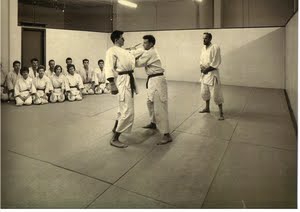
There is evidence of 'intelligent design' when these shinken shobu no kata gradings are analysed. For instance, the tomoe nage (whirl throw or more commonly stomach throw) illustrated in the photograph above is first introduced in 6th kyu against a two handed strangle from the front. There is no follow up technique required and the candidate simple throws the attacker away. That is the first and last time they do not retain control of the attacker after the throw and apply a follow up techique (usually a joint-locking technique). In 4th kyu the defender continues to roll and finishes on top of the thrown attacker, and applies an arm lock. It is then included as one of the techniques required to be executed under pressure against a single handed and double handed strangle in 3rd kyu. In 2nd kyu a 'what-if' arises in that the defender sidesteps the initial technique and a side stomach throw is executed, and another what-if scenario is included in 1st kyu.
This progression can be seen to be common in these gradings. Simple execution of the technique followed by follow up techniques (usually joint-locking techniques) in later gradings and then what-if scenarios.
The second part of 2nd kyu is referred to as kime no kata (kata of agreement). It is a kata only in the sense that it is demonstration. Three different versions of each ukemi waza (breakfalling techniques), three different versions of kuzushi (unbalancing) from hand holds are required to demonstrated. Five of the basic nine joint-locking techniques are to be demonstrated against two attackers who attack at random with any applicable attack. Then Isutsu no Kata (Kata of Five) is required to be demonstrated. This kata is a true kata. The 'five' refers to the five basic taisabaki (bodymovements). Each of the bodymovements are demonstrated with a technique being executed from an 'inside' and 'outside' position relative to the attackers attacking limb.
In this grading we get a hint of Minoru Mochizuki's influence on De Jong. The unbalancing from the four basic hand holds are not seen until this grading. However, they are seen in Mochizuki's teachings. The bodymovements and techniques in Itsutsu no Kata are also seen in Mochizuki's teachings, although Mochizuki only includes one technique for o irimi senkai (major outer rotation) whereas De Jong completes the balance and includes two. These can all be seen in Mochizuki's Nihonden Jujutsu translated as 'Traditional Japanese Jujutsu'. I do not know when this grading was introduced, however, I am going to be given a complete set of the gradings by a senior instructor who was instructing at the school in the 60s and 70s, and I have been invited to discuss this grading and the development of the black and white gradings which he tantalisingly suggested he and his fellows put down on paper.
Second kyu also includes Wakai no Kata (New Kata) which De Jong developed himself. It is a one person kata designed to introduce more punching, blocking, and kicking skills to the student. The influence of pencak silat is evident in some of the moves which evade and set one up for a kick or other technique in such a smart way. I do marvel at pencak silat at times and they way their methods are designed to evade and position for an attack.
First kyu is an instructors grading. Part 1, kime no kata, is a revision grade where over 85 techniques are required to be demonstrated, all of which are taken from the previous grades. Part 2, shinken shobo no kata - >55 techniques, along with blindfold defences, and free fighting against two attackers. Part 3 is a grading designed by Greg Palmer and introduced by De Jong. First to 3rd dan include sword gradings, however, the basics of sword work (drawing, cutting, sheathing, etc) were never examined. As a logical progression, these basics are taught and examined prior to the student engaging in later sword gradings. This logical progression was obvious to Palmer who was a qualified teacher by profession. Part 4 is broken into two parts; the first being an oral history examination and the second an oral terminology examination on the Japanese terminology used in previous gradings. Part 5 is an oral examination of the technical aspects of the techniques taught to 5th kyu. Part 6 is a teaching examination where De Jong assesses the candidates teaching ability in a class of students up to 5th kyu. The final part is obtaining a first aid certificate. It has been suggested that the kime no kata now in 2nd kyu was originally in 1st kyu and was moved to introduce this 'systems approach' at an earlier stage.
When I came to form a view that Mochizuki's teachings significantly influenced De Jong's teachings, and that his mon and dan gradings systems reflected that, I questioned a couple of techniques in 6th kyu that utilised a circular unbalancing from a hand hold. This circular unbalancing is a feature of the unbalancing methods demonstrated in kime no kata in 2nd kyu. De Jong explained he'd replaced two original techniques with new techniques in an effort to introduce this type of, and emphasis on, unbalancing at an earlier stage in his grading system. Remember, this was prior to the mon system being introduced.
Firstly, the two replaced techniques involved disgengagement and not unbalancing. Secondly, these techniques made up a set of three that demonstrated a tactical imperative. The attack is with both hands holding the forearm of a defender, in a manner which would be common when attempting to prevent someone from drawing a sword. The original defences were simple disengagements which repositioned the defender to the right, left, or away from the front of the attacker. The set are beautiful and elegent as it takes into account any tactical situation imposed by a second attacker, surroundings, or different intent. In latter years, De Jong and Palmer were developing this tactical positioning approach to a greater degree.
The kyu gradings, as I hope I've demonstrated, reflect 'intelligent design' with logic and progression (which only becomes obvious when the grading system itself is studied). The 2nd kyu kime no kata introduces the 'systems approach' that comes to form De Jong's school of thought (see a previous blog). The 1st grading attends to both the practical fighting skills as well as starting to shape instructors. As focussed on in previous blogs, a requirement of the grading specifically addresses the duty of care issue that should be one of the highest priorities (but sadly is not in many instances) of all martial arts instructors. With Mochizuki's influence beginning to seep through (if my conclusions are correct), De Jong is seen to not simply be copying someone else to add content, but cherry picking 'things' to develop his instructors and his school of thought.
PS: Most of the above information is contained within Jan de Jong: the man, his school, and his ju jitsu system which may or may not be available through the now renamed Jan de Jong Martial Arts Fitness.
Monday, December 6, 2010
Update on Throwing Techniques and Takedown Techniques of ALL Martial Arts
You may or may not recall I'm in the process of writing a book tentively entitled Throwing Techniques and Takedown Techniques of ALL Martial Arts. Here is an update on my work and progress.
I am now 70% of the way through the first draft.
Today I completed the first draft of chapter eight 'Judo Classifications.' Jigoro Kano proposed a classification system for judo techniques including judo throwing techniques. This classification continues to be used more than 100 years later by the Kodokan and most judo organisations and has been adopted by many other martial arts which include throwing techniques in their curriculum. I was unaware that there have been many other classifications proposed over the years until I researched this book. This chapter looks at a number of these classifications. 'Why?', I hear the doubters of my work ask.
The answer to the question raised by my doubters lies within chapter two which I have completed the first draft. The identification of similarities and differences have been referred to as 'basic to human thought' and the 'core of all learning'. Cognitive science researchers have identified four main 'forms' of identifying similarities and differences which have proved highly effective: comparision, classification, creating metaphors, and creating analogies.
The different classifications which have been proposed are based on what the authors of the classification consider important shared and distinctive characteristics of these techniques. By looking at their classifications we get to see what these authoritative teachers thought to be the important characteristics of these techniques. By comparing the different classifications we get to learn more about these techniques then if we looked at them individually or looked at them through just one classification.
The draft of chapter three has also been completed. This chapter looks at how many organisations, authors, and different martial arts have distinguished between throwing techniques and takedown techniques. MOST DON'T, even though they use both terms when describing the types of techniques they teach.
Chapter four has also been drafted. This chapter looks at how to analyse a sport skill, in this case martial arts techniques including throwing techniques and takedown techniques, in order to teach and correct them. As Gerry Carr explains in Sport Mechanics for Coaches: 'If you don't have a well-planned approach, you're likely to be overwhelmed by the complexity and speed of the skill you are trying to analyse.' I'm sure we've all experienced this, and this experience can be minimised by applying the principles contained in this chapter.
Chapter five has been drafted as well and is the raison detre for the book. It definitvely distinguishes between throwing technique and takedown techniques based on biomechanical principles, and, for the first time ever, proposes a classification of takedown techniques.
Chapter seven has been drafted. It looks at unbalancing kuzushi) and specifically addresses the nebulous issue of mental unbalancing. Only one other author has attempted this to the best of my knowledge and that is George Kirby. My work builds on his which hopefully means that, as Issac Newton said, I can see further because I am standing on the shoulders of giants.
I'm now starting work on chapter ten which looks at unbalancing. I've mostly completed this chapter based on my work for my originally conceived book on the science behind the martial arts. I hope to complete this in a week. Among other things, it'll include research done on martial arts falling techniques by researchers in Holland and to which I've referred in previous blogs. It'll also contain the breakfalling techniques taught by Jan de Jong jujutsu, including the relatively rare sideways rolling technique.
Then only two more chapters to draft. Ernest Hemmingway suggests that 'the first draft of anything is shit', so, it would appear my writing work begins in earnest ( :) ) once the first draft is completed.
Friday, December 3, 2010
Jan de Jong Pt 6 - Mochizuki

Recall from the last blog that after training with Phillipe Boiron, Jan de Jong developed an ambition to visit Japan to train. In 1969, at the age of 48, he realised that ambition. While in Japan, De Jong was a uchideashi (live-in student) of Minoru Mochizuki. The photograph to the right is of De Jong and Mochizuki during this time.
Minoru Mochizuki
Mochizuki was a remarkable man. He trained under many modern day martial art greats, including Morehi Ueshiba (founder of aikido), Jigaro Kano (founder of judo) and Gichin Funakoshi (founder of Shotokan karate). He was graded 10th dan aikido, 9th dan jujutsu, 9th dan judo, 8th dan iaido, 5th dan kendo, and 5th dan karate, in addition to the various traditional certifications of mastery he received. Mochhizuki was the first to teach aikido outside of Japan when he taught in France in 1951. He developed his own composite martial system named Yoseikan Budo which includes elements of judo, aikido, karate, and kobudo. Even though he is not well known for teaching jujutsu, the only book he ever wrote was entitled Nihonden Jujutsu.
Mochizuki was born in Shizuoka, Japan on 7 April, 1907. He commenced learning judo at the age of five. He explains how he came to learn Gyokushin-ryu jujutsu in Stanley A Pranin's Aikido Masters: Prewar Students of Morihei Ueshiba:
I also practiced an old-style jujutsu art called Gyokushin-ryu jujutsu. This system used a lot of sacrifice techniques and others that were very similar to those of aikido. At that time, the Gyokushin-ryu teacher Sanjuro Oshima lived very near my sister. The teacher was quite saddened to see the classical styles of jujutsu disappearing one by one and was determined to see to it that his own art was preserved - so much so that he requested that I learn it from him. I would go to his house and would be treated to a fine meal. I didn't have to pay any fees to study and they actually gave me dinner. That is how I came to study jujutsu.Mochizuki explains that Gyokushin is written with characters which mean 'spherical school'. He quotes his former teacher when explaining the significance of the name:
A ball will roll freely. No matter which side it is pushed from it will roll away. Just this sort of spirit is the true spirit that Gyokushin-ryu seeks to instill in its members. If you have done this nothing in this world will upset you.The Yoseikan dojo was established in Shizuoka in November 1931. Mochizuki had been ill with pleurisy and pulmonary tuberculosis and his brother and some others built the dojo to encourage him to stay in Shizuoka rather than return to Tokyo once he got out of hospital. Yoseikan can be loosely translated as 'the place where the right path is taught' (The Art of Jujutsu: The legacy of Minoru Mochizuki's 'Yoseikan' by Edgar Kruyning).
Mochizuki explains how he discussed his composite approach with Ueshiba (who was less than impressed with his emphasise on combat victory):
I went overseas to spread aikido and had matches with many different people while I was there. From that experience I realised that if was very difficult to win with only the techniques of aikido. In those cases I instinctively switched to jujutsu, judo, or kendo techniques and was able to come out on tope of the situation. No matter how I thought about it I couldn't avoid the conclusion that the techniques of Daito-ryu jujutsu were not enough to decide the issue.

The first copy of the brilliant but now defunct magazine, Fighting Arts International, I purchased had Mochizuki on the front cover. I'd never seen a photograph of him before but I knew instinctively it was him because he was so similar to De Jong in many ways. In the article by Harry Cook, he explains that 'to recieve a black belt from the Yoseikan it is necessary to study at least three of the major arts and have a working knowledge of as may systems as possible.' I've never really understood how that works as there is Yoseikan budo, Yoseikan aikido, and Yoseikan karate being taught around the world. In any event, De Jong said he was awarded shodan in Yoseikan aikido and Shotokan karate and that he also trained various weapon arts including kenjutsu.
After having been training at the Yoseikan for a couple of weeks, De Jong was summoned down from the living quarters upstairs to watch some students do a grading one morning. The student seated next to De Jong nudged him and told him to pay attention as he was next. Remember, in those days they didn't have grading sheets to refer to, it was all rote learning. When it was his turn, De Jong undertook the examination and passed. When he sat down the same gentleman nudged him again and advised him to pay attention to the next grading as well. That day he successfully graded three grades in Yoseikan aikido.
It wasn't all hard work. De Jong explained that his Japanese fellow students would go into town to have dinner and a few drinks. They were impressed with his drinking ability which didn't say a great deal as De Jong suggested they couldn't hold their alcohol. He said he had to support, if not carry, some of his training partners back to the dojo on more than one occasion.
Recall from the war years that De Jong had an aversion to cold weather due to his Hunger Winter experience following WWII. It reared its head in Japan when his fellow uchideashi opened the window at night for some fresh air, which was a little too 'fresh' for De Jong who would close the window.
De Jong explained that the aikido/budo which Mochizuki taught had a lot in common with the jujutsu he had learnt from the Saitos (see previous blogs). He recognised the bodymovements (taisabaki) which Mochizuki taught in an analytical appoach based on Kano's analytical approach. Gerry Carr, in Sport Mechanics for Coaches, provides an analytical approach to teaching and correcting sports skills. Step 4 is to divide the skill into phases. Kano did this with his kuzushi-tsukuri-kake (unbalancing-fitting in-technique execution) phases of judo throwing techniques. De Jong did this after returning from Japan in his taisabaki-kuzushi-waza (bodymovement-unbalancing-technique) approach (more will be explained on this in future blogs). De Jong said that Mochizuki preferred his o irimi senkai (major entering rotation) and changed his to that of De Jong's while De Jong preferred Mochizuki's and changed his to that.
De Jong only trained with Mochizuki for less than six months. However, he would later request an instructor be sent from the Yoseikan to Perth and his jujutsu grading system would be significantly influenced by his Yoseikan experience. These will all be the subject of future blogs.
Mochizuki pasted away on 30 May 2003 age 96. De Jong passed away the same year on the 5th of April age 82. Two giants of the martial arts world, upon whose shoulder's I'm attempting to stand and see further, coincidentally passing away within months of each other.
Nihonden Jujutsu
Recall from above that Nihonden Jujutsu was the only book Mochizuki, the budo/aikido/judo master ever authored. The title is translated as 'Traditional Japanese Jujutsu' and it was published in 1978. I recently saw a copy of this book on ebay with an asking price of US$4,000.
De Jong, Maggie (his daughter), and myself had been teaching for Jan-Erik Karlsson in Lund, Sweden. An annual event, both the European teaching tours and teaching in Lund. We had a rare day without teaching and De Jong, being older and always pushing himself on these tours, was taking the opportunity of relaxing in the sun outside Karlsson's house with its sea views. I on the other hand was taking the opportunity of rummaging through his martial arts library. Lo and behold, I found a photocopy of a book with Mochizuki's photograph on the front which I recognised from the abovementioned magazine article. It was in Japanese, but, I couldn't help but recognise so much of the content with what we'd been taught by De Jong and which made up so much of the grades De Jong had introduced. I felt like Indiana Jones finding the Ark of the Lost Covenant. De Jong's teachings were much sought after around the world and here was a book with some of them in it
Karlsson was most generous in giving the copy of this book to me once I'd gushed over it. When we returned to the land of Oz (Australia), I gave a copy to De Jong. Again, lo and behold, a few years later he began teaching a third dan grading which included 20 sacrifice throws and 20 takedown techniques in the instructor's class held every Friday night. He would give all the attendees a photocopy of the techniques he was going to teach that night, which, I recognised as coming from Nihonden Jujutsu. I never spilled the beans and we would often exchange rye smiles as he introduced these new techniques. The existence of the book was never disclosed to his instructors and, often much to the surprise of the instructors including the senior instructors who had been my instructors, De Jong would often get me to demonstrate the techniques when introducing them to the instructors class for the first time. I would like to think he selected me because my technique and understand was so good, however, I suspect it was because he knew I'd seen the techniques before and had been playing with them over the years
A few years ago I acquired a rare two set DVD produced of Mochizuki's teachings. Again, this is so exciting because it is another reference point for many of the things De Jong taught. You can see similarities and differences, which, as explained in a previous blog, the identification of is the core of all learning.
These DVDs also demonstrates one other thing. The training we received at the Jan de Jong Self Defence School, and the capabilities of some of its students/instructors, was world class. There is a DVD of Greg Palmer's second dan demonstration grading which involved six of his students, all non-black belts, which I would consider at least technically equivalent of the Mochizuki DVD performed by black belts. De Jong was always one for precision. Twitch a foot in a particular technique and you'd fail that technique in a grading.
Subscribe to:
Posts (Atom)


