You will not see a better example of a heel palm strike and its effects than Dom Sheed's use in the West Coast Eagles vs Collingwood match on 26 July 2020. :)
https://www.afl.com.au/news/476686/match-review-bomber-eagle-and-lion-cops-bans?ref=BP_RSS_afl-news_0_match-review--bomber--eagle-and-lion-cops-bans_270720
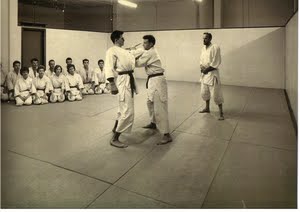
KOJUTSUKAN: The place for the study of martial art skills
Showing posts with label Percussion Techniques. Show all posts
Showing posts with label Percussion Techniques. Show all posts
Tuesday, July 28, 2020


Monday, March 25, 2019
Ken Tai Ichi no Kata and The Core of All Learning
The following is a link to a post on my Shihan Jan de Jong OAM 9th Dan blog where I use Yoseikan's ken tai ichi no kata to discuss the core of all learning which is the second chapter in my The Science Behind All Fighting Techniques.
Sunday, March 18, 2018
The Science Behind Kiai
 Kiai is a Japanese term that is used to refer to a short yell or shout uttered when performing an attacking move. Why kiai?
The following is a draft of a passage included in the conclusion to my The Science Behind Fighting Techniques which is in the process of being submitted to a publisher. The conclusion calls on others to build on my work in building a body of knowledge about why a technique works in addition to how to perform the technique.
As I was in the process of concluding this book, Australian Ashleigh Barty played Belorussian Aryna Sabalenka in the 2018 Australian Open (tennis). The Belorussian’s powerful hitting and loud ‘grunting’ was cause for numerous articles on the issue to be published, one of which was by Damian Farrow (2018), professor of sports science at Victoria University: ‘All the racquet: What science tells us about the pros and cons of grunting in tennis.’ He reports that a number of studies have shown that ball velocity increases with hits accompanied by grunting. Can the findings in those studies be extended to kiai, a short yell or shout uttered in Japanese martial arts when performing an attacking move? Increased ball velocity means increased force is being applied when hitting the ball accompanied by a grunt. Can those findings be extended to prove that punches accompanied by a kiai apply increased force on impact? If so, how does a grunt/kiai generate more force on impact with a punch? This is an example of the current lack of biomechanical information associated with martial arts methods and how we may need to be inventive in developing that knowledge base in the absence of direct research.
There are those, many, who will have opinions on this martial arts question, however, they are only opinions. Uninformed opinions at that. My book is designed to turn the many uninformed opinions into informed opinions, which in the process will debunk many opinions.
The studies associated with tennis grunting confirm the increased
velocity of the tennis ball accompanied by grunting. They do not explain
where the additional force that was applied to the tennis ball was
generated from.
The answer to the increased force on impact lies within the concept of kinetic energy. KE is the energy of motion which is transferred on impact. KE is calculated as one half of the product of mass and velocity squared. So which one of the variables of KE does grunting/kiai impact on in order to increase the KE of the arm/racket thereby increasing the force on impact?
The tennis studies limited explanation is highly technical/incomprehensible, however, it would appear to point to grunting tightening the body core which increases the mass behind the tennis strike thereby increasing the force on impact resulting in the increased velocity of the tennis ball. In like manner, a kiai when punching might tighten the body core thereby increasing the mass behind a punch and the force on impact.
This would fit in with other studies on punching techniques in the martial arts that confirm that the difference in the velocities of punches by experienced and inexperienced practitioners is insignificant but the difference in the force applied on impact is significantly different. This difference is down to the experienced practitioners knowing how to contribute more mass behind their punches.
1. The findings in the studies above goes against everything that has been advised in martial arts and biomechanical texts in relation to punching techniques when referring to the biomechanical concept of KE.
2. There is a study published on the effects of kiap, the Korean equivalent of kiai, on gripping strength. A martial arts 'authority' refers to this study to confirm that kiap increases punching force on impact. It does not, as even the authors of the study acknowledge. It simply confirms that kiap increases gripping strength, so kiap away when grabbing someone. The tennis studies have more to suggest that kiai increases the force on impact than does the kiap study.
3. All of the above is an example of the mindset that is required when attempting to use science to explain martial arts practice. A mindset that is sadly lacking in current martial arts literature. That mindset will be the subject of the next post.
Tuesday, December 19, 2017
Blitz Australasian Martial Arts Magazine - Feature Story
The latest edition of Blitz Australasian Martial Arts Magazine (Vol 31 No 6/Dec '17 - Jan '18) published my 'Why do we punch? How human hands evolved for punching' as their feature story.


Monday, August 28, 2017
Fractured Hyoid Bone and Martial Arts Practice

The biggest non-fatal injury risk associated with the use of neck restraints is damage to the airway. Force applied to the front of the throat can cause haemorrhaging in the neck and fractures of the hyoid bone and/or larynx. Are these fractures fatal? DiMaio and DiMaio[i] suggest that these fractures and associated hematomas are not necessarily fatal and are merely markers of force applied to the neck.
An example of DiMaio and DiMaio’s nonfatal injuries to the neck as a result of forces applied with a strangulation technique is the injury I sustained doing a demonstration with Shihan Jan de Jong OAM 9th Dan (see Appendix) at the conclusion of a summer camp in Norway. De Jong was demonstrating defences using a jo, a wooden staff approximately 1.27m (4.2ft) in length. His timing on my punch was off a bit but he took me down anyway and wedged the jo across my throat as the defence requires. He applied a little more force than normal to make up for the timing problem which resulted in an injury to my throat structures. According to my GP (general practitioner), the injury may have been a fractured hyoid bone as I had trouble swallowing and painful swallowing for some period of time and the hyoid bone is often fractured in strangulations.
When investigating my GP’s suggested diagnosis, I came across a case report[ii] of a thirteen year old taekwondo athlete who collapsed after receiving a kick to the anterior neck. Lateral radiographs revealed fracture of the hyoid. Based on their review of the literature, the authors of the report suggest that striking and choking techniques commonly employed in martial arts provide potential mechanisms for hyoid bone fractures. Disturbingly, given that I did not seek treatment for the injury, the authors of the report also suggest that all patients suffering a hyoid bone fracture must be observed for a 48-72 hour period as previously asymptomatic patients may develop rapid hemoptysis, edema, ecchymosis and spasm resulting in life threatening asphyxia, requiring a tracheostomy and retro-pharyngeal drainage.
[i] DiMaio and DiMaio, op cit n 7.
[ii] J. Porr, M. Laframboise, M. Kazemi,
Traumatic hyoid bone fracture – a case report and review of the literature, The Journal of the Canadian Chiropractic
Association, 56(4), 2012, pp 269-274.
Thursday, March 23, 2017
More force needed to stop an attack than to start one

My last post, Magnitude of Force to Change Direction or Stop a Moving Object, appealed to readers for technical information concerning the amount of force required to deflect a moving object (e.g. a punch). That appeal is still current, for the time being.
I'm working on Okazaki and Stricevic's 'Principles of Motion' in The Textbook of Modern Karate, that they say is helpful to understand in order to deal with a punch a kick. The second principle is:
To stop an object's motion requires a force greater than the one that set the object in motion. This has special relevance to blocking techniques when the objective is to arrest [(stop)] an attack.
An exploration of the concept of blocking techniques in the martial arts requires a chapter, so, I will only focus on the above PoM.
Firstly, Okazaki and Stricevic leave out one vital piece of information when explaining their second PoM. Force has magnitude, direction, and point of application. The direction of a force applied by a blocking technique has to be applied in the opposite direction to motion of the object/opponent's attacking body part in order to stop its motion. That is an important but often overlooked detail when many distinguish blocking techniques into two types: hard-soft, arresting-deflection, blocks-deflection, direct-indirect, etc.
Secondly, magnitude. Okazaki and Stricevic suggest more force is required to stop a moving object/opponent's attacking body part, than was needed to start it in motion. I initially thought that this might not be true; that only an equal an amount of force as that needed to initiate motion in an object was required to be applied in order to stop that object. In fact, I thought that if you applied more force to an object in motion than was applied to initiate its motion that it would cause the object to move in the direction of the greater force, e.g. backward. What do you think? Sounds reasonable.
As is so often the case in developing the theory in my book, I didn't rely on my assumptions/opinions and went in search of an authoritative answer to this question. I didn't find one per se, however, I was able to develop one from an equation for how much force is required to start an object in motion.
Force can be calculated by the equation change in momentum divided by time. Momentum is calculated as the product of mass and velocity. Force is measured in Newtons (N). What force is required to get a 10 kg object moving at 12 m/s in 5s?
Momentum at start = 10 x 0 = 0 kg m/s
Momentum at end = 10 x 12 = 120 kg m/s
Change in momentum = 120 - 0 = 120 kg m/s
Force = change in momentum/time = 120/5 = 24 N
How much force is needed to stop the above object in motion nearly instantaneously, say in 1s?
Momentum at start = 10 x 12 = 120 kg m/s
Momentum at end = 10 x 0 = 0 kg m/s
Change in momentum = 0 - 120 = -120 kg m/s
Force = change in momentum/time = -120/1 = -120 N
The time was chosen for an instantaneous stopping action. The negative value reflects force applied in the opposite direction. Five times as much force as initiated the motion of that object/attack is required to to be applied to stop that moving object/attack in that time frame.
This equation is also used to describe Impulse and explain how increasing the time that force is applied decreases the average amount of force required to stop an object. E.g. pulling your hands back as you catch a moving ball.
Now, working on how much force is required to deflect a moving object. Anyone?
Friday, October 23, 2015
Human Hands Evolved to Fight

What's interesting is that I reported on that study in 2012-13.
It's good to see that I am ahead of the game :).
What is also interesting is that there are studies being conducted that are useful in explaining practice but they remain hidden in academic journals. My book will introduce readers to some of those studies and hopefully encourage others to access those types of studies and share them with those who are engaged in the practice of those techniques.
Tuesday, June 3, 2014
Kiai

The TV show Sports Science investigated the practical benefits of a shout/yell when breaking bricks (aka kiai). They found that a shout/yell increased the force applied to the bricks by 25 percent. They then go on to explain how. It has to do with an adrenalin increase associated with the kiai. But how does that work?
I've written before about Facial Feedback Hypothesis (FFH). FFH postulates that an emotion can be elicted by physically simulating the actions associated with that emotion. Emotions for the emotion discipline is not just subjective feelings. They are a feeling, physiological and action tendency responses to a stimulus. The physiological respone prepares the body for the action tendency associated with the emotion.
Shouting/yelling is associated with anger. The physiological response prepares the body to fight which includes an adrenalin release along with blood being shunted to the arms and hands in readiness to fight.
The same works for beating the chest with fists, making fists, putting on a 'war face.'
Monday, May 27, 2013
Teach the Essence of All Martial Arts Techniques
What is the essence of all martial arts techniques? What makes them work?
Forces account for the changes in motion and shape of all things in the environment, including the body and body segments (collectively body).
Any time a body starts, stops, speeds up slows down or changes direction, a force has been applied. A change in shape refers to deformation. Deformation of body tissues can cause pain and injury. Think about all the techniques taught in any martial art and you will see that they are designed to change the motion of an opponent or deform their tissues to inflict pain or injury.
The beauty of it all is that force is a biomechanical concept that is easy for the layperson to understand and apply.
Without providing the full explanation, the following is how you teach and learn by referring to forces, the essence of all techniques:
1. Identify the points of application of the forces - all contact points between the two bodies.
2. Forces are a push or a pull. Determine if it is a push or a pull at each point of contact.
3. Determine the direction of the force.
4. Determine the relative magnitude of the force.
5. Determine the objective of the combined forces (change the motion or shape (deformation) of the opponent's body).
First teach students about forces, then consistently teach using a force based approach. Students will be taught to, and will, focus on the essence of techniques; what actually makes them work. When they come to correct errors in their performance they will go directly to the essence of the technique.
While the above might appear to have limited potential to improve on teaching striking and kicking techniques, it does not when the third law of motion is also understood. For every action there is an equal and opposite reaction. Action refers to forces. When we hit a body, that body 'hits' us back with a force that is equal in magnitude and opposite in direction.
When we hit or kick an opponent or some training devise, or block an opponent's attack, we must deal with reaction forces. What is being done in terms of posture and stance to increase our stability and ability to absorb those reaction forces?
Those martial arts that describe their stances in terms of mobility (which means less resistance to forces), what are they doing to increase stability when contact is made and forces are experienced?
Everybody understands what a push or a pull is. If a student is told to push or pull in a certain direction they will do so. If that instruction is not an accurate or complete description of the forces involved in the execution of a technique, do not be surprised if the student experiences difficulty in performing the techniques. A force-based approach 'forces' us to consider each and every point of contact where a force may be applied. All of those forces contribute to, or at times hinder, the execution of a technique. A complete analysis of the forces involved in the technique avoids these issues and demonstrates a thorough understanding of the technique. And a complete analysis of the forces involved in a technique is so simple.
Forces account for the changes in motion and shape of all things in the environment, including the body and body segments (collectively body).
Any time a body starts, stops, speeds up slows down or changes direction, a force has been applied. A change in shape refers to deformation. Deformation of body tissues can cause pain and injury. Think about all the techniques taught in any martial art and you will see that they are designed to change the motion of an opponent or deform their tissues to inflict pain or injury.
The beauty of it all is that force is a biomechanical concept that is easy for the layperson to understand and apply.
Without providing the full explanation, the following is how you teach and learn by referring to forces, the essence of all techniques:
1. Identify the points of application of the forces - all contact points between the two bodies.
2. Forces are a push or a pull. Determine if it is a push or a pull at each point of contact.
3. Determine the direction of the force.
4. Determine the relative magnitude of the force.
5. Determine the objective of the combined forces (change the motion or shape (deformation) of the opponent's body).
First teach students about forces, then consistently teach using a force based approach. Students will be taught to, and will, focus on the essence of techniques; what actually makes them work. When they come to correct errors in their performance they will go directly to the essence of the technique.
While the above might appear to have limited potential to improve on teaching striking and kicking techniques, it does not when the third law of motion is also understood. For every action there is an equal and opposite reaction. Action refers to forces. When we hit a body, that body 'hits' us back with a force that is equal in magnitude and opposite in direction.
When we hit or kick an opponent or some training devise, or block an opponent's attack, we must deal with reaction forces. What is being done in terms of posture and stance to increase our stability and ability to absorb those reaction forces?
Those martial arts that describe their stances in terms of mobility (which means less resistance to forces), what are they doing to increase stability when contact is made and forces are experienced?
Everybody understands what a push or a pull is. If a student is told to push or pull in a certain direction they will do so. If that instruction is not an accurate or complete description of the forces involved in the execution of a technique, do not be surprised if the student experiences difficulty in performing the techniques. A force-based approach 'forces' us to consider each and every point of contact where a force may be applied. All of those forces contribute to, or at times hinder, the execution of a technique. A complete analysis of the forces involved in the technique avoids these issues and demonstrates a thorough understanding of the technique. And a complete analysis of the forces involved in a technique is so simple.
Saturday, January 12, 2013
Professional Combat Sports Amendment Act 2011
The Professional Combat Sports Amendment Bill 2009 was passed by Parliament in October 2011. This new legislation establishes broader regulatory coverage of combat sports in WA and ensures that all combat sports contestants enjoy the same level of health and safety controls that have been enjoyed by professional contestants under the Professional Combat Sports Act 1987.
The new legislation was to come into effect on 1 July 2012 however some delays have been encountered with the finalisation of the regulations and the approval of rules. At this time the current unamended version of the Professional Combat Sports Act 1987 is still in effect with the new legislation coming into force in the coming months.
It should be noted that this new legislation only applies to actual combat sport contests as defined by the legislation. The legislation does not apply to training sessions, in gym sparring, martial arts classes or fitness classes with a combat sport feel.
The Department of Sport and Recreation and the Professional Combat Sports Commission (PCSC) will work with the industry to ensure that all parties are educated, informed and supported through the transitional phase leading up to the roll out of the new legislation.
Should you have any queries regarding the legislation please contact Greg McGuire at the Department of Sport and Recreation on 9492 9746 or via email at combatsport@dsr.wa.gov.au
I have a question for Mr McGuire. Does the Commission actually know what they are doing?
Don't get me wrong. I am no anti government, big brother, conspiracy theory type. I simply object to ignorance and stupidity.
The Commission's 2012 annual report states that 'the structure of the Commission is a vital enabling element of the broader governance system. The structure refers to the size and composition of the Commission, including independence, the presence of commissioners and has regard for the balance of gender, cultural diversity, skills and experience.' Apparently actually knowing anything about the safety of combat sport participants is secondary to the Government mandate for political correctness and equality.
The 2012 annual report lists the Commission representatives. What is the one position that is vacant?: Nominee of the medical of the Australian Medical Association. There is not one member on the Commission that has any detailed knowledge of possible injuries.
The Chair is a lawyer. He specialises in criminal law. The previous Chair was a lawyer who likewise specialised in criminal law. I met him and he is simply an ambitious lawyer using the Commission for ambitious purposes. How is it that lawyers insinuate themselves into the nooks and crannies of everyday life? They are like rats. At the very heart of their profession is disingenousness. They do not argue a position because they believe in it, they argue it for the sake of arguing it.
We then have a representative from the WA Police Force. Why? Surely the legal aspect of governance is covered by the lawyer.
Next we have the Nominee of the Director General of the Department of Sport and Recreation. Fair enough. You have to have a department representative, even if they know nothing about the actual thing that is attempting to be governed.
Next we have industry representatives. Seriously?!? The martial arts and combat sports are bereft of understanding of the 'why' of what they do. They are very good at the how, but the physiological or anatomical effects of their techniques, they haven't a clue. All you have to do is reference the literature associated with these activities to see the desert that is the knowledge associated with these activities. Even scratch the surface of the literature that has attempted to explain the physiological or anatomical effects of these methods and you will see that they are uninformed.
Of the many, many questions the Commission should be considering is the use of neck holds/shime waza. If forensic pathology and law enforcement authorities around the world consider these techniques to be lethal force, how can they be sanctioned in competition. It is illegal to use lethal force in competition. And please reader, do not simply refer to the ignorant public who influence policy. If you read the research and literature on this subject you'll understand their stance is not influenced by public opinion.
Do not get me wrong, I am not arguing for or against the use of these techniques. What I am arguing is that this is an obvious quandary that any proper Commission should be considering, but because of the uninformed nature of this Commission, they don't even recognise it is an issue.
Good luck combat sports, for you are now governed by an uninformed Commission.
Wednesday, January 2, 2013
Fist or Open Hand?

One of the things studied in that study was the difference between striking with a fist or an open hand.
The force and force impulse of both forward and overhead strikes were not different when the subjects struck with a fist or an open palm.
Although the forcefulness of a strike can be important to the outcome of a fight (e.g. accelerating the body, knocking an opponent off their feet; or accelerating the head, causing unconsciousness or a concussion), local tissue damage, such as bone fracture and contusion, is produced not by force but by stress (force per area)
The striking surface area of a fist is less than one-third the area of the whole hand and ~60% of the area of the palm. This means that if the total force applied in a strike is the same, then the stress in the targeted tissue will be 1.7 to 3.0 times greater in a fist strike than in a palm strike. Thus, although striking with a fist appears not to result in more forceful strikes, fists increase the peak stresses that are imposed on the target and, therefore, the potential for injury.
One thing that is not lacking in the martial arts is opinions. One thing that is lacking is authoritative facts. Studies like this, and hopefully my work, goes towards increasing the martial arts body of knowledge with facts rather than more opinions.
Saturday, December 22, 2012
Our Hands Evolved For Punching & Isshinryu Karate Fists

I'm only going to touch on one small aspect of the paper.
Humans buttress – strengthen and stabilize – fists in two ways that apes cannot: The pads of the four fingertips touch the pads at the top of the palm closest to the fingers. And the thumb wraps in front of the index and middle fingers, and to some extent the ring finger, and those fingers are locked in place by the palm at the base of the thumb.
The second and third experiments found that buttressing provided by the human fist increased the stiffness of the knuckle joint fourfold (or reduced flexing fourfold), and also doubled the ability of the fingers to transmit punching force, mainly due to the force transferred from the fingers to the thumb when the fist is clenched.

Based on the abovementioned study, it could be argued the Isshinryu karate fist configuration is biomechanically less efficient than nature's configuration which most other martial arts have adopted. Is there any explanation why Isshinryu karate may have adopted this unique fist configuration?
A possible explanation lies within an obscure but interesting paper published in American Anthropologist. The researchers investigated the relationship between commonly occurring types of violence and those that are popular in sport. They found that common injuries to the hand in modern society where boxing is popular is to the little finger and ring finger bones in the hand, which is commonly known as a boxer's fracture.
The researchers gained access to the 857 bodies when a cemetery was being excavated in England. The bodies were buried between 1750 and 1850. They found significantly more fractures of the thumb than boxer's fractures. This puzzled them because boxing was popular during that time.
They suggest a possible explanation might be found in the style of fighting employed by boxers during the period when the burials were made. Boxing was bareknuckles and boxers used vertical fists rather than the horizontal fist of the modern day boxer. A boxer's fracture often occurs then the little finger side of the fist impacts rather than the intended pointer finger side of the fist. A similar argument applies the to ancient boxers using vertical fists. If the boxer misses with the intended part of the fist the thumb impacts resulting in an injury.
Isshinryu karate may be sacrificing biomechanical efficiency in order to reduce the risk of injury when using a vertical fist to punch. Now there is support if any Isshinryu karate exponent argues the safety aspect of their unique fist configuration.
Monday, October 8, 2012
Blocking Techniques

That definition, it has to be said, is a very broad and vague definition of blocking techniques. It is broad and vague by necessity given certain ambiguity surrounding blocking techniques. An ambiguity that only comes to light when the various conceptualisations of blocking techniques that are espoused by different martial arts are studied.
Moclair, in Jujutsu: A Comprehensive Guide, defines blocking techniques in terms of the use of an arm or arms to stop an attacker from striking a person with a blow from their hands, fists, knees or other parts of their body. Moclair’s definition explicitly, and with clarity, refers to the common and traditional conception of blocking techniques as being techniques that are used to stop an attacker from hitting or kicking a person.
In The Textbook of Modern Karate, Okazaki and Stricevic provide the following definition of blocking techniques: 'A block is a karate technique directed at a certain target – the opponent's hand, foot, leg or arm – for the purpose of arresting or deflecting his attack.' Okazaki and Stricevic’s definition informs us that blocking techniques are directed at the opponent's body part that is attempting to hit or kick the blocker. It also provides a description of how blocking techniques stop the opponent from hitting or kicking the blocker: by arresting or deflecting the attacking body part.
It should be noted that some martial arts or martial artists distinguish between blocking techniques and deflection or parrying. In this case, blocking techniques are isolated to those techniques that arrest an attack to avoid being hit or kicked. Deflection or parrying serve the same purpose but by a different means.
Blocking and Evasion
In Mastering Jiu-Jitsu, Gracie and Danaher distinguish between evasion and blocking to avoid being hit or kicked. Evasion does not involve contact with the opponent's attacking body part. Evasion can be basically subdivided into two types: those that involve moving the feet and those that involve moving just the upper body or head. Japanese martial arts refer to the former as taisabaki (body movement). Boxing teaches both methods with the former referred to as footwork and the latter bobbing and weaving.
If a body movement of any description is used in conjunction with a blocking (or deflection) technique, there are two questions that should always be asked. Firstly, was the body movement not sufficient to qualify as an evasion. Secondly, if the answer to the first question is affirmative, what was the purpose of the blocking technique. After all, the evasion took care of the problem of getting hit or kicked.
Blocking Possibilities
Nakayama, in the karate classic Dynamic Karate, suggests that, while blocking, you must attempt to seize the initiate and turn the opponent's attack to your advantage. He provides six methods that he suggests illustrates the various possibilities in blocking:
1. Block the opponent's arm or leg with sufficient force to discourage further attack. In a sense, this kind of block can be called an attack.
Nakayama does not define block. If we assume it involves a technique that is designed to avoid being hit or kicked, then this type of block serves two purposes. Firstly, to avoid being hit or kicked, and secondly, to apply sufficient force to cause pain and/or injury. If the block is used in conjunction with an evasive movement then it only serves the latter purpose. This is a possible answer to the question posed above.
2. Block the opponent's attack with only enough force to parry or deflect it. This
would be termed a light block in #1.
A deflection or parry changes the direction of the attack. If an evasive movement is used to avoid being hit or kicked there is no need to change the direction of the attack. If the attack is deflected in these circumstances, the question has to be asked and answered, why?
A 'brushing block' refers to a technique where the attack is brushed past the defender with no change in direction of the attack. This implies an evasive movement was used to avoid being hit or kicked. The question has to be asked as to the purpose of the brushing block.
3. Block and attack. Block the opponent's attack and immediately counter-attack. It is also possible to block and counterattack at the same instant.

4. Unbalance the opponent with your block.

The unbalancing is physical and 'mental.' The physical unbalancing involves applying forces to cause the opponent's centre of gravity to be located outside of their base of support. The 'mental unbalancing' involves applying forces that do not physically unbalance an opponent but stuns, causes sudden loss of motion, or pain. In this way, they are similar to Nakayama's blocking possibility #1.
5. Block the opponent's attack as it is about to begin. To do this you must anticipate his attack.
6. Block and then retreat to a safe position until a chance to counter presents itself.
Blocking possibility #5 is the very definition of seizing the initiative, whereas blocking possibility #6 is not so much.
Direct and Indirect Blocks
In two books dedicated to the mechanics of martial arts, Starr distinguishes between direct and indirect blocks. Direct blocks are described as being applied directly against the force of the opponent's attack. Starr suggests that this form of blocking often requires the blocker to be physically stronger than the opponent, and the risk of injury to the blocking body part is high if the opponent's attack is very powerful. Indirect blocks are described as being sometimes referred to as deflections. Starr suggests that because indirect blocks do not directly oppose the opponent’s attacking force, they require very little strength to apply and the risk of injury is minimised. Starr is correct, in so far as it goes.
Starr's examples of indirect blocks includes the standard karate, high, middle and low blocks. These blocks do not involve applying force directly against the force of the opponent's attack. They do not involve applying force in the opposite direction to the force of the opponent's attack. You will find that the vast majority of karate's blocking techniques are designed to apply force to the opponent's attacking limb at an angle to the force of the opponent's attack. They apply a force to an attacking body part at an angle which results in a deflection rather than the attack being arrested.
This is a common misconception, that and traditional blocks are designed to oppose force directly, espoused by many who attempt to extol the virtues of their soft blocking methods over hard blocking methods.
Given that deflections generally require less force than techniques designed to arrest an attack, why then do karate practice applying a great deal of force in their blocking methods. The answer's may lay in Nakayama's blocking possibilities #1 and #4.
Absorption Blocks

Karate style blocking techniques do not tend to absorb the force of the attacker's attacking body part as they are designed to apply forces to an opponent's attacking body part.
Forces
Forces cause all bodies and objects to change direction or shape. Forces applied in different ways result in different outcomes. Even when the points of contact between two bodies (defender and attacker) are similar, the direction and magnitude of the force can produce a different outcome. It is important for the martial artists to understand specifically what they are trying to achieve, and why they are trying to achieve that, in order to better understand how the forces are to be applied to achieve that outcome.
*************
PS: Dear Reader
Okazaki and Stricevic make the following statement when discussing the forces involved in blocking techniques: 'The amount of force necessary to deflect an object is generally less than the force needed to initiate its motion.'
I am having some difficulty in supporting or correcting that statement in mechanical/physics terms. If any reader has mechanical or physics background and can help out in this regard, I'd be very grateful.
Thank you.
Sunday, September 16, 2012
Real Heroes Walk Away
A friend commented that I hadn't written a post recently. He is right. A lot of things have been going on that have left me bereft of inspiration, or interest in writing a post on anything. Today I thought I'd address this situation with a meditation on a newspaper article in relation to the one-punch deaths.
News.com.au is running a campaign against one-punch deaths called: Real Heroes Walk Away. Today's article is http://www.news.com.au/features/heroes-walk-away/part-2-real-heroes-walk-away-ibook-series-by-trent-dalton-and-jonathan-marshall/story-fneygm3n-1226474305915.
Why refer to heroes? Why refer to someone who hit another person without the other's knowledge of the threat as cowards? After all, one of the most applauded military strategies is the ambush. The answer is the need to feel moral superiority.
Mystery of Courage should be mandatory reading for all. In this current militaristic age, is a pacifist or dissenter a hero or a coward? Given human beings' desperate need to belong and be accepted, these individuals are 'brave' in going against the common consensus. Those that follow the mob, often led by manipulative governments and common opinion, could be described as being not brave, or indeed, cowards.
I tend to adopt Oscar Wilde's viewpoint: Whenever people agree with me, I always think I must be wrong. This is not a bad litmus test to apply to one's opinions; as long as one has a modicum of intelligence that shapes their opinions. After all, as the saying goes, opinions are like arseholes; everyone has one.
The terms hero and coward say nothing about the person they are used to describe, but they tell us a great deal about the person who is using those words to describe others(or themselves). A hero walks away is telling others that we respect their behaviour if they walk away from violence. The underlying assumption behind the use of this phrase is that other's seek our respect and approval. It is a strategy that is not without merit, for us emotionally driven human beings. After all, the military have been using this strategy since time immemorial to get people to fight when nature implores them to flee. Warriors seek the approval and respect of their peers which overcomes their fear of injury or death. The military and the government use this need for approval and acceptance to fuel their military campaigns. And it is a very effective tool. But what happens when a person does not seek the approval or acceptance of society? What happens when they seek the approval and acceptance of their peers who applaud violence? Will the reference to heroes walking away reach them? Or will it drive them further away?
It is estimated that nearly 3500 Australians are hospitalised every year with brain injuries caused by assaults. The direct cost to the nation is $25 million a year. This is how you gain action in today's society. It's not by referring to the human cost, it is by quantifying the financial cost. This is not simply a cynical statement. Yesterday I read an article on the lack of funding for a particular neurological condition. An authority in the field explained that death happens so fast with the condition that it didn't have enough time to have a large financial impact on society. Consequently, very limited funding is provided to solve the 'problem.' After all, there is no problem; 'problem' being defined meaningfully in financial terms.
Six years on from the king hit death of his son, Matthew, Brisbane father Paul Stanley is still grappling with the reason why a young man chose to end his son’s life with a single, devastating punch. Stop wondering. The young man more than likely did not 'choose' to end anyone's life. 'Do I think that Matthew's killer actually meant to do it? I reckon probably not. That never went into his mind. They just do these things.' He probably didn't even 'choose' to throw the punch. Once we stop the emotional and judgemental discussion we can start to find real causes and real solutions.
Professor Gordian Fulde is head of emergency at St Vincent's Hospital, Darlinghurst. He's spent his whole adult life repairing the bloodied heads of battered and drunk young men. He remembers a time when a man would knock a man down in a bar then shake his hand, commending him on his efforts. That was that. He now operates on young men who have been kicked 12 times on the ground by 12 different boots. "We are not nice," Professor Fulde says. "We are animals. We kill each other."A psychologist friend uses the phrase 'cavemen in suits' to describe human beings. My research into our evolved survival process, along with an evolutionary perspective, confirms that we are indeed primitive beings who do not 'fit' with the modern environment we have created.
A stimulus in the environment is first appraised which can then elicit an emotion. So we need to look at how the stimulus is appraised. Now we are identifying an intervention that may control this type of anti-social behaviour. And now we also understand the full extent of the problem. The appraisal process is shaped by so many things, including societal and family values, norms, etc.
Should society intervene? Should society attempt to shape behaviour? A strong argument in favour of the affirmative would be based on the fact that the only requirement needed to be a parent is working sexual organs. Religious fundamentalists, political extremists, emotionally vulnerable and flawed human beings, can all produce children which they then play a major part in shaping who the adults these children become.
Movies and video games, violent rap music, etc are often blamed as causes of anti-social behaviour. It is suggested they shape the way we view environmental stimuli. But are they causes or are they mere reflections of society? I would argue the latter, but also that they can reinforce anti-social behaviour. They may not be the initial cause, but over time they can come to be. A self-fulfilling prophesy if you will. If we address the anti-social messages, we may not address the underlying issue(s) because the situation that caused these movies, video games, etc to reflect society may still exist.
An understanding of the evolved survival process identifies another possible intervention. The appraisal elicits a feeling response with an associated action tendency. The 'impulse to act' decouples the behavioural response from the feeling response and provides 'latency time' according to Scherer. This means that we are suppose to not be mere amoeba with a stimulus-response chain. The decoupling of feeling and behaviour responses is evolutionarily designed to provide us with the opportunity to consider an array of behavioural responses rather than just our primitive urge. Obviously, for some, they are more amoeba then they are the evolved human beings with decoupled feeling and behavioural responses. They have, in the modern vernacular, very limited impulse control.
The issue of choice, or the lack there of, goes to the very heart of the deterrence debate. You can have the most severe punishment in the world which is intended to deter certain types of behaviour, but if cognition does not influence behaviour it reduces the deterrent effect of harsher punishments. Anybody who argues differently simply has to answer the question: did you not king hit the innocent, unsuspecting person because you feared being sent to prison, or did you not hit the person because that is not who you are? If the answer is in the affirmative to the first question, there are more serious questions to be asked and answered than the deterrence value of harsher penalties.
What sort of environment turns little boys who want to grow up to be builders, firemen and aeroplane pilots into monsters and violent thugs who hide in dark corners like trapdoor spiders, striking out at and killing innocent people for no reason?"
They are not monsters nor thugs. Those are terms we use to describe others which says more about the describer than the describee. We may not understand or agree with their reasons, but they had reasons that made sense to them at the time. Lazarus emphasises that emotions are always logical and reasonable - to the person experiencing and acting on those emotions. If we understand that fact, and respect that fact, we then gain the possibility of addressing the issue that arises out of emotional responses. If we simply judge and demonise, we become part of the problem rather than part of the solution.
Now the Buddhist philosophy of being non-judgemental is raised. Being judgemental satisfies an emotional need in people, but it doesn't necessarily address the problem. However, a Buddhist approach cannot adopt the supreme moral high ground on this issue. Us cavemen in suits are driven by emotion. Shaming a person is a time honoured, cultural and proven method of shaping 'acceptable' behaviour. The Japanese culture was shaped in part by Buddhist philosophy, but it is also considered the archetypal shame culture.
Now let us in the West look down upon the primitive cultures that use shame to control their member's behaviour. Gilligan explains that based on his more than two decades of experience in prisons and prison hospitals, that the cause of most violence is shame. Shame arising out a lack of respect shown by others. The chain of causality is that a person or society 'disrespects' an individual which produces shame that is so painful that anger is used to cope with the pain resulting in violence. You can hardly watch an American movie these days without 'respect' being a core theme. 'Dis'ing someone is considered just cause to engage in violent behaviour.
Now we can have the conservatives looking down upon the morally repugnant, violent individuals who engage in violence to gain or defend respect. The same conservatives that engage in violence to defend honour, pride and patriotism.
The Navy SEAL instructor in GI Jane quotes D.H. Lawence: I never saw a wild thing sorry for itself. A bird will fall frozen dead from a bough without ever having felt sorry for itself. Courage, bravery, cowardice, respect, disrespect, honour, pride, patriotism - all man-made constructs. They are used to describe behaviour for our own benefit, or to control the behaviour of others. Belief in their moral virtue is essential for their effectiveness; but it is also the cause of violent and aggressive behaviour in itself. To point the finger at others is to point the finger at ourselves.
"It is my belief that if you decide to unlawfully assault a person, and that person dies ... the prosecution should not have to prove that you were reckless or negligent. They should not have to prove it wasn't an accident." Oh how I would love to be a lawyer. I would produce experts in the relatively new field that studies the cause of injuries. The mantra of injury science is often quoted as being: there are no accidents. Injury science originated with William Haddon and his work on injuries arising from car crashes. Note I referred to car crashes rather than car accidents. Injury science is objective and recognises that injuries do not occur by accident.
I've raised this issue before. A coroner suggested that all 'neck holds' used by law enforcement officers should be considered lethal weapons because they have the potential of lethality whenever they are used. The same can be said, with more authority, with punches and kicks. Now consider the consequences of this viewpoint. Lethal force can be used in response to lethal force. Therefore, if neck holds, punches and kicks are considered to be lethal force, lethal force can be applied to defend oneself. You punch me and I am legally entitled to kill you in my defence. In addition, all combative sports would have to be terminated because modern society, for the most part, does not condone gladiatorial, death sports.
What about the 'doctrine of consent'? We are allowed to punch the living daylights out of someone in a boxing ring or mma octongon. We are allowed to assault someone on the football field. Neither of these incidents will result in an assault charge due to the doctrine of consent. Leigh Matthews, one of the greatest AFL football players of all time, was convicted of assault when he king hit a Geelong player during a football match. What many do not know is that Matthews' conviction was overturned on appeal, due to the doctrine of consent. King hits are not part of the rules of football, but the law, in its infinite wisdom, has deemed them to be acceptable as part of the game. They game may be self regulated by the game authorities, but the law accepts this behaviour.
What message does the courts send to society in relation to king hits? It's ok to king hit someone as long as the person doesn't die. Even if they do, the punishment will be minimal because often it wasn't your punch that killed the person. It was their head hitting the ground that killed them. This is the reason for specific one-punch legislation.
How absurd is that argument? It reminds me of the explanation by Tom Cruise's character in Collateral when he is asked by Jamie Fox's character if he'd killed a particular individual. 'Max: You killed him? Vincent: No, I shot him. Bullets and the fall killed him.'
Western Australia is one of the few Australian states, if not the only one, that has specific one-punch legislation. Former state attorney general Jim McGinty said: If you throw a punch that results in death then that ought to be severely punished. So throwing a punch that has the very real potential of killing someone is ok-ish as long as they don't actually die? Isn't this rather a confused message? Is it simply bad luck if the person dies after you punch them, and therefore you get punished due to your bad luck rather than a criminal act?
Education is everything, says Bill McCormack. "Get at them in pre-school," he says. "These kids haven't got the skills to equip them for life. Once they get to grade six, you've lost them. "Most of them come from broken homes. Learning difficulties. They've been in trouble from the time they were 11 years old. "We need to educate a whole generation." I agree. But education comes from knowledge, and who has that knowledge? Many have the moral, judgemental opinion, but who possesses the objective, informed facts?
What can martial artists and martial arts instructors do? Educate themselves. Educate themselves on emotional intelligence (for want of a better term) in addition to the tactics and techniques of their martial art. They can also provide leadership to not only their students, but to society in general. This will not come about through sanctimonious, pious attitudes and superficial references to Taoist, Confucius or Buddhist philosophy, but to deep reflective study of emotion and the issues.
Just my thoughts for the day.
News.com.au is running a campaign against one-punch deaths called: Real Heroes Walk Away. Today's article is http://www.news.com.au/features/heroes-walk-away/part-2-real-heroes-walk-away-ibook-series-by-trent-dalton-and-jonathan-marshall/story-fneygm3n-1226474305915.
Why refer to heroes? Why refer to someone who hit another person without the other's knowledge of the threat as cowards? After all, one of the most applauded military strategies is the ambush. The answer is the need to feel moral superiority.
Mystery of Courage should be mandatory reading for all. In this current militaristic age, is a pacifist or dissenter a hero or a coward? Given human beings' desperate need to belong and be accepted, these individuals are 'brave' in going against the common consensus. Those that follow the mob, often led by manipulative governments and common opinion, could be described as being not brave, or indeed, cowards.
I tend to adopt Oscar Wilde's viewpoint: Whenever people agree with me, I always think I must be wrong. This is not a bad litmus test to apply to one's opinions; as long as one has a modicum of intelligence that shapes their opinions. After all, as the saying goes, opinions are like arseholes; everyone has one.
The terms hero and coward say nothing about the person they are used to describe, but they tell us a great deal about the person who is using those words to describe others(or themselves). A hero walks away is telling others that we respect their behaviour if they walk away from violence. The underlying assumption behind the use of this phrase is that other's seek our respect and approval. It is a strategy that is not without merit, for us emotionally driven human beings. After all, the military have been using this strategy since time immemorial to get people to fight when nature implores them to flee. Warriors seek the approval and respect of their peers which overcomes their fear of injury or death. The military and the government use this need for approval and acceptance to fuel their military campaigns. And it is a very effective tool. But what happens when a person does not seek the approval or acceptance of society? What happens when they seek the approval and acceptance of their peers who applaud violence? Will the reference to heroes walking away reach them? Or will it drive them further away?
It is estimated that nearly 3500 Australians are hospitalised every year with brain injuries caused by assaults. The direct cost to the nation is $25 million a year. This is how you gain action in today's society. It's not by referring to the human cost, it is by quantifying the financial cost. This is not simply a cynical statement. Yesterday I read an article on the lack of funding for a particular neurological condition. An authority in the field explained that death happens so fast with the condition that it didn't have enough time to have a large financial impact on society. Consequently, very limited funding is provided to solve the 'problem.' After all, there is no problem; 'problem' being defined meaningfully in financial terms.
Six years on from the king hit death of his son, Matthew, Brisbane father Paul Stanley is still grappling with the reason why a young man chose to end his son’s life with a single, devastating punch. Stop wondering. The young man more than likely did not 'choose' to end anyone's life. 'Do I think that Matthew's killer actually meant to do it? I reckon probably not. That never went into his mind. They just do these things.' He probably didn't even 'choose' to throw the punch. Once we stop the emotional and judgemental discussion we can start to find real causes and real solutions.
Professor Gordian Fulde is head of emergency at St Vincent's Hospital, Darlinghurst. He's spent his whole adult life repairing the bloodied heads of battered and drunk young men. He remembers a time when a man would knock a man down in a bar then shake his hand, commending him on his efforts. That was that. He now operates on young men who have been kicked 12 times on the ground by 12 different boots. "We are not nice," Professor Fulde says. "We are animals. We kill each other."A psychologist friend uses the phrase 'cavemen in suits' to describe human beings. My research into our evolved survival process, along with an evolutionary perspective, confirms that we are indeed primitive beings who do not 'fit' with the modern environment we have created.
A stimulus in the environment is first appraised which can then elicit an emotion. So we need to look at how the stimulus is appraised. Now we are identifying an intervention that may control this type of anti-social behaviour. And now we also understand the full extent of the problem. The appraisal process is shaped by so many things, including societal and family values, norms, etc.
Should society intervene? Should society attempt to shape behaviour? A strong argument in favour of the affirmative would be based on the fact that the only requirement needed to be a parent is working sexual organs. Religious fundamentalists, political extremists, emotionally vulnerable and flawed human beings, can all produce children which they then play a major part in shaping who the adults these children become.
Movies and video games, violent rap music, etc are often blamed as causes of anti-social behaviour. It is suggested they shape the way we view environmental stimuli. But are they causes or are they mere reflections of society? I would argue the latter, but also that they can reinforce anti-social behaviour. They may not be the initial cause, but over time they can come to be. A self-fulfilling prophesy if you will. If we address the anti-social messages, we may not address the underlying issue(s) because the situation that caused these movies, video games, etc to reflect society may still exist.
An understanding of the evolved survival process identifies another possible intervention. The appraisal elicits a feeling response with an associated action tendency. The 'impulse to act' decouples the behavioural response from the feeling response and provides 'latency time' according to Scherer. This means that we are suppose to not be mere amoeba with a stimulus-response chain. The decoupling of feeling and behaviour responses is evolutionarily designed to provide us with the opportunity to consider an array of behavioural responses rather than just our primitive urge. Obviously, for some, they are more amoeba then they are the evolved human beings with decoupled feeling and behavioural responses. They have, in the modern vernacular, very limited impulse control.
The issue of choice, or the lack there of, goes to the very heart of the deterrence debate. You can have the most severe punishment in the world which is intended to deter certain types of behaviour, but if cognition does not influence behaviour it reduces the deterrent effect of harsher punishments. Anybody who argues differently simply has to answer the question: did you not king hit the innocent, unsuspecting person because you feared being sent to prison, or did you not hit the person because that is not who you are? If the answer is in the affirmative to the first question, there are more serious questions to be asked and answered than the deterrence value of harsher penalties.
What sort of environment turns little boys who want to grow up to be builders, firemen and aeroplane pilots into monsters and violent thugs who hide in dark corners like trapdoor spiders, striking out at and killing innocent people for no reason?"
They are not monsters nor thugs. Those are terms we use to describe others which says more about the describer than the describee. We may not understand or agree with their reasons, but they had reasons that made sense to them at the time. Lazarus emphasises that emotions are always logical and reasonable - to the person experiencing and acting on those emotions. If we understand that fact, and respect that fact, we then gain the possibility of addressing the issue that arises out of emotional responses. If we simply judge and demonise, we become part of the problem rather than part of the solution.
Now the Buddhist philosophy of being non-judgemental is raised. Being judgemental satisfies an emotional need in people, but it doesn't necessarily address the problem. However, a Buddhist approach cannot adopt the supreme moral high ground on this issue. Us cavemen in suits are driven by emotion. Shaming a person is a time honoured, cultural and proven method of shaping 'acceptable' behaviour. The Japanese culture was shaped in part by Buddhist philosophy, but it is also considered the archetypal shame culture.
Now let us in the West look down upon the primitive cultures that use shame to control their member's behaviour. Gilligan explains that based on his more than two decades of experience in prisons and prison hospitals, that the cause of most violence is shame. Shame arising out a lack of respect shown by others. The chain of causality is that a person or society 'disrespects' an individual which produces shame that is so painful that anger is used to cope with the pain resulting in violence. You can hardly watch an American movie these days without 'respect' being a core theme. 'Dis'ing someone is considered just cause to engage in violent behaviour.
Now we can have the conservatives looking down upon the morally repugnant, violent individuals who engage in violence to gain or defend respect. The same conservatives that engage in violence to defend honour, pride and patriotism.
The Navy SEAL instructor in GI Jane quotes D.H. Lawence: I never saw a wild thing sorry for itself. A bird will fall frozen dead from a bough without ever having felt sorry for itself. Courage, bravery, cowardice, respect, disrespect, honour, pride, patriotism - all man-made constructs. They are used to describe behaviour for our own benefit, or to control the behaviour of others. Belief in their moral virtue is essential for their effectiveness; but it is also the cause of violent and aggressive behaviour in itself. To point the finger at others is to point the finger at ourselves.
"It is my belief that if you decide to unlawfully assault a person, and that person dies ... the prosecution should not have to prove that you were reckless or negligent. They should not have to prove it wasn't an accident." Oh how I would love to be a lawyer. I would produce experts in the relatively new field that studies the cause of injuries. The mantra of injury science is often quoted as being: there are no accidents. Injury science originated with William Haddon and his work on injuries arising from car crashes. Note I referred to car crashes rather than car accidents. Injury science is objective and recognises that injuries do not occur by accident.
I've raised this issue before. A coroner suggested that all 'neck holds' used by law enforcement officers should be considered lethal weapons because they have the potential of lethality whenever they are used. The same can be said, with more authority, with punches and kicks. Now consider the consequences of this viewpoint. Lethal force can be used in response to lethal force. Therefore, if neck holds, punches and kicks are considered to be lethal force, lethal force can be applied to defend oneself. You punch me and I am legally entitled to kill you in my defence. In addition, all combative sports would have to be terminated because modern society, for the most part, does not condone gladiatorial, death sports.
What about the 'doctrine of consent'? We are allowed to punch the living daylights out of someone in a boxing ring or mma octongon. We are allowed to assault someone on the football field. Neither of these incidents will result in an assault charge due to the doctrine of consent. Leigh Matthews, one of the greatest AFL football players of all time, was convicted of assault when he king hit a Geelong player during a football match. What many do not know is that Matthews' conviction was overturned on appeal, due to the doctrine of consent. King hits are not part of the rules of football, but the law, in its infinite wisdom, has deemed them to be acceptable as part of the game. They game may be self regulated by the game authorities, but the law accepts this behaviour.
What message does the courts send to society in relation to king hits? It's ok to king hit someone as long as the person doesn't die. Even if they do, the punishment will be minimal because often it wasn't your punch that killed the person. It was their head hitting the ground that killed them. This is the reason for specific one-punch legislation.
How absurd is that argument? It reminds me of the explanation by Tom Cruise's character in Collateral when he is asked by Jamie Fox's character if he'd killed a particular individual. 'Max: You killed him? Vincent: No, I shot him. Bullets and the fall killed him.'
Western Australia is one of the few Australian states, if not the only one, that has specific one-punch legislation. Former state attorney general Jim McGinty said: If you throw a punch that results in death then that ought to be severely punished. So throwing a punch that has the very real potential of killing someone is ok-ish as long as they don't actually die? Isn't this rather a confused message? Is it simply bad luck if the person dies after you punch them, and therefore you get punished due to your bad luck rather than a criminal act?
Education is everything, says Bill McCormack. "Get at them in pre-school," he says. "These kids haven't got the skills to equip them for life. Once they get to grade six, you've lost them. "Most of them come from broken homes. Learning difficulties. They've been in trouble from the time they were 11 years old. "We need to educate a whole generation." I agree. But education comes from knowledge, and who has that knowledge? Many have the moral, judgemental opinion, but who possesses the objective, informed facts?
What can martial artists and martial arts instructors do? Educate themselves. Educate themselves on emotional intelligence (for want of a better term) in addition to the tactics and techniques of their martial art. They can also provide leadership to not only their students, but to society in general. This will not come about through sanctimonious, pious attitudes and superficial references to Taoist, Confucius or Buddhist philosophy, but to deep reflective study of emotion and the issues.
Just my thoughts for the day.
Subscribe to:
Posts (Atom)