When did teaching/learning martial arts become not enough? Is teaching/learning martial arts relevant anymore?
I am continually seeing fitness appended to martial arts when advertising or promoting one's teachings. My old school, or at least the school that emerged from my old school, rebranded itself from Jan de Jong Self Defence School to Jan de Jong Martial Arts Fitness. The WA Institute of Martial Arts advertises 'Martial Arts Fitness is here.' I just saw another advert/promotion directly coupling martial arts with fitness.
Is a dojo now also a gym? What is the focus of the teaching, martial arts or fitness? Do you ever see cricket, football, basketball etc directly coupled with fitness? 'Football fitness is here.' 'Netball fitness is here.' You don't see other physically activities desperately trying to establish relevance by appending their activity to fitness.
If the focus is on fitness, what impact does that have on martial arts teaching?
Efficiency is a feature of Jigoro Kano's teachings. Efficiency means less effort. The more efficient your tactics and techniques the less effort required to execute them. Does that mean that teachings which teach efficient tactics and techniques are less because they don't focus on fitness which requires more effort?
I understand the marketing impulse to try and extend the brand from martial arts to the fitness industry given the interest in martial arts appears to be waning. But does extending the brand mean that the brand loses meaning? Or that the product is over extended? Is aikido a means to get fit rather than to learn aikido?
When I teach, I am only interested in fitness insofar as it contributes to martial arts effectiveness. I am not interested in teaching fitness for the sake of fitness. If you are unfit and effective, it's all good to me. If you want to get fit, for whatever reason, join a gym. Go for a run. Stop driving your car and walk to work or school.
The two best instructors in the Jan de Jong Self Defence School were Shihan Jan de Jong and Sensei Greg Palmer. Nobody would ever accuse them of being fit, however, they were extremely effective as practitioners and most definitely as teachers. When I wanted to learn martial arts, I'd go to them before any of the other 'fit' instructors.
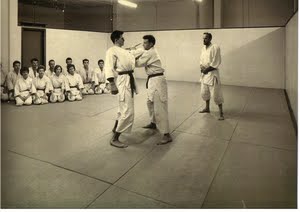
KOJUTSUKAN: The place for the study of martial art skills
Showing posts with label Greg Palmer. Show all posts
Showing posts with label Greg Palmer. Show all posts
Monday, September 23, 2019


Tuesday, May 2, 2017
Blindsight - A Possible Explanation

I was blindfolded and the other two were not. Upon Greg's instruction, the three of use walked randomly around the dojo until he instructed us to stop and stand still. Greg asked me to point to X and when I had pointed he asked me to point to Y.
I'm relatively open-minded and so tried to visualise or feel something that would guide me to their individual locations. Nothing. Out of frustration I pointed to a spot when asked to point to X and likewise for Y. 'This is rubbish,' I thought.
When I took off my blindfold I found I had pointed directly at X when asked to do so and was about five degrees off for Y. X was my regular training partner and Y I only trained with sporadically.
We conducted the exercise again with the same results. The same results including that I felt or perceived nothing but I pointed directly at X each time I was asked to do so and off by five degrees for Y.
During the last session, I turned while we were walking around the dojo (blindfolded). Greg asked why I turned. 'There was a wall in front of me,' I replied. There was.
The final time, Greg asked me to point to X, Y, and the nearest wall. He then asked me how far they were away from me. Spot on with X and the wall and slightly off with Y.
I don't know how I did it. I never tried it again in case I couldn't replicate the results, preferring to have that unblemished memory of something quite extraordinary. Today I read an article on 'blindsight' that may (or may not) explain my experience.
It ranks among the most curious phenomena in cognitive neuroscience. A handful of people in the world have “blindsight”: they are blind, but their non-conscious brain can still sense their surroundings.
"The way Dutton explained it was ‘Don’t think about it too much, just go and do it. Don’t think too much in your mind.’ It was my subconscious mind telling me how to do that task and to avoid hitting the chairs.
“I can walk around the house ok, and tidy things up. But I can’t see them. I know they’re there. My brain is telling me. It’s the same if the family have left things lying in the middle of the living room floor. I say ‘you need to tidy up, so I don’t trip over these things’. If there is something lying there, like a handbag or shoes, I can see it and I miss it, or I go to pick it up.
“But I’ll try to look at you, and I know you’re sitting there, sitting close… but I just can’t see you."
Sunday, January 22, 2017
Throws and Takedowns
I'm finally finalising my book on the science behind fighting techniques.
One chapter in that book is on throws and takedowns. Despite the common meaning of the terms provided by the Oxford Dictionary, it appears the martial arts has managed to confuse the meaning of the terms as applied to marital arts techniques.
I provide a biomechancially based classification for all techniques that are designed to cause a person to fall to the ground. It's based on the biomechanics of balance and stability. A person is stable if their centre of gravity (CoG) is located over their base of support (BoS) and balanced if they possess control of their CoG with respect to their BoS.
It was interesting reviewing the literature on the throws and takedowns of various martial arts. Books dedicated to throws and takedowns of various martial arts did not distinguish between the two, and in fact often only referred to throws.
Judo, according to Kano's classification of Judo techniques, does not teach takedowns.
A throw is a technique were forces are applied to cause both of the opponent's feet to leave the ground. The biomechancial target of the applied forces is the opponent's BoS.
A takedown is a techniques were forces are applied to cause an opponent's CoG to fall outside of their BoS and a balance recovery is prevented. Takedowns can be subclassified as 'one-legged' or 'two-legged' (for want of a better description) takedowns. The biomechancial target for one-legged takedowns is a person's foot in contact with a support surface. For instance, a foot sweep is a one-legged takedown.
The biomechanical target of a two-legged takedown is an opponent's CoG. Forces are applied to cause an opponent's CoG to fall outside of their BoS and a balance recovery is prevented. A hiki-otoshi (elbow drop) is an example of a two-legged takedown.
Irimi-nage and Mukae-daoshi are good examples of the confusion held within the martial arts over this issue. Irimi-nage is 'entering throw' taught by aikido.
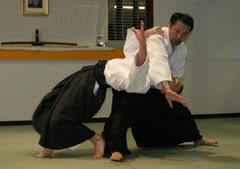
Mukae-daoshi is 'meeting takedown' taught by Yoseikan Budo/Aikido and Jan de Jong.

Using Kano's division of judo techniques (kuzushi, tsukuri, kake), the same kuzushi and tsukuri result in different kake depending on the direction of the applied forces in the kake phase. The same unbalancing and positioning results in a throw or takedown depending on the direction of the applied forces in the execution phase of the technique.
The irimi-nage/entering throw is in fact a takedown while the mukae-daoshi/meeting takdown is in fact a throw. What that also means is that the latter is entirely dependent on the momentum generated during the kuzushi phase of the technique.
It also means that the applied forces for a throw are upward whilst the applied forces for a takedown are downward. A biomechanical understanding of these techniques enables a student to know what to look for in learning and training these techniques as does the instructor. It makes better students of students and better instructors of instructors.
One chapter in that book is on throws and takedowns. Despite the common meaning of the terms provided by the Oxford Dictionary, it appears the martial arts has managed to confuse the meaning of the terms as applied to marital arts techniques.
I provide a biomechancially based classification for all techniques that are designed to cause a person to fall to the ground. It's based on the biomechanics of balance and stability. A person is stable if their centre of gravity (CoG) is located over their base of support (BoS) and balanced if they possess control of their CoG with respect to their BoS.
It was interesting reviewing the literature on the throws and takedowns of various martial arts. Books dedicated to throws and takedowns of various martial arts did not distinguish between the two, and in fact often only referred to throws.
Judo, according to Kano's classification of Judo techniques, does not teach takedowns.
A throw is a technique were forces are applied to cause both of the opponent's feet to leave the ground. The biomechancial target of the applied forces is the opponent's BoS.
A takedown is a techniques were forces are applied to cause an opponent's CoG to fall outside of their BoS and a balance recovery is prevented. Takedowns can be subclassified as 'one-legged' or 'two-legged' (for want of a better description) takedowns. The biomechancial target for one-legged takedowns is a person's foot in contact with a support surface. For instance, a foot sweep is a one-legged takedown.
The biomechanical target of a two-legged takedown is an opponent's CoG. Forces are applied to cause an opponent's CoG to fall outside of their BoS and a balance recovery is prevented. A hiki-otoshi (elbow drop) is an example of a two-legged takedown.
Irimi-nage and Mukae-daoshi are good examples of the confusion held within the martial arts over this issue. Irimi-nage is 'entering throw' taught by aikido.
Mukae-daoshi is 'meeting takedown' taught by Yoseikan Budo/Aikido and Jan de Jong.

Using Kano's division of judo techniques (kuzushi, tsukuri, kake), the same kuzushi and tsukuri result in different kake depending on the direction of the applied forces in the kake phase. The same unbalancing and positioning results in a throw or takedown depending on the direction of the applied forces in the execution phase of the technique.
The irimi-nage/entering throw is in fact a takedown while the mukae-daoshi/meeting takdown is in fact a throw. What that also means is that the latter is entirely dependent on the momentum generated during the kuzushi phase of the technique.
It also means that the applied forces for a throw are upward whilst the applied forces for a takedown are downward. A biomechanical understanding of these techniques enables a student to know what to look for in learning and training these techniques as does the instructor. It makes better students of students and better instructors of instructors.
Thursday, May 24, 2012
Best of Kojutsukan Posts
 Yes folks, it's time for a 'best of' post. What are the top 10 Kojutsukan posts?
Before the top 10, it is an opportune moment to reflect on the Kojutsukan mission. Yes, over the years of research a mission has evolved. That mission is to use theory to inform practice. To use theory to facilitate practice. This concept is relatively unique in the martial art world which is generally a bastion of anti-intellectualism - to its detriment. Many instructors attempt to provide theoretical support for their methods. Those same instructors should often refrain from attempting to explain the whys and stick to the hows. They have not done the work, nor have their instructors, into understanding the whys. My work is about providing the whys. Whys that have practical use; that facilitate the understanding and study of martial arts techniques and those used in violence generally in a practical way.
No. 10 Women Self Defence Courses: Effective or Not? Pt 1.
This blog was posted in December 2011 and the fact it made the top ten reflects the interest in women self defence and violence directed at women. These blogs have attracted the greatest amount of comments both on the blog site and to my personal email. Many from women thanking me for airing issues that they've experienced but did not understand or that they thought others did not understand.
No. 9 Can Martial Arts Falling Techniques Prevent Injuries?
 In this blog I introduced the readers and the martial arts world to the work of Brenda Groen whose PhD thesis was on the use of martial arts falling techniques to prevent injury when landing from a fall. This technique has been included in a broader fall prevention program that has been rolled out in Holland, and which has recorded success according to various studies.
No. 8 Domestic Violence
Given statistics generally suggest that one if four women experience abuse or violence, it comes as no surprise that there is a great deal of interest in this issue.
No. 7 Jan de Jong Pt 3 - The War Years
Jan de Jong and myself would walk the streets of Rotterdam and Amsterdam when we were visiting Europe for his annual seminars. He would point to various buildings or locations and tell me this happened or that happened there during the war years. Standing in the same place he stood 50 years before made it all the more poignant.
No. 6 Women Self Defence Courses: Effective or Not? Pt 2.
 My interest in WSD was increased after becoming involved with a woman who has recently emerged from a long-term abusive relationship. My work over the past few years in researching for my various books and articles provided me with the tools to understand, explain, and help this survivor. I suppose another project to add to my already existing projects is a WSD book and course. This book and course would be different than most others in that it would be based on knowledge of the problem.
No. 5 FOOSH Injuries
My first blog. Fall On OutStretched Hand injuries. I introduced the martial arts world to the concept of FOOSH injuries. Over 85% of all injuries to the upper limb are produced by falling on an outstretched hand. One consequence arising out of this fact is that there is very little information available concerning the physiological explanation of injuries that may be produced when executing kansetsu waza (joint-locking techniques) because the forces are applied in the upper limb in completely different directions in each case.
No. 4 The All or Nothing Law of Strangulation
I recently obtained a copy of another study on shime waza (strangulation techniques) or the more politically correct term neck restraints. There is a bit of controversy over the actual mechanism that causes unconsciousness or death in the case of these techniques or strangles generally. Four mechanisms are often cited, even in the coroners reports I've read which include reports by forensic pathologists or medical personnel. It's often a choice of one of the four mechanisms. I need to do more work on this issue because I am tending towards a combination of two. Stay tuned.
 No. 3 Jan de Jong Pt 19 - What Does a Black Belt Mean?
It is interesting there is so much interest in this blog. This might reflect a general confusion about what the black belt qualification signifies. In some striking based martial arts you can obtain a black belt in 1 1/2 to 2 years. Does that imply a lowering of standards? Not necessarily. If you only have a few blocks, kicks, and punches to learn, and if black belt simply signifies proficiency, then not necessarily. For Jan de Jong, a black belt tended toward the teaching side of things rather than proficiency. For myself, anyone who I grade black will most definitely be a world class instructor. They may not be the world's best exponent, but they will most definitely be a world class instructor.
 No. 2 O Mae Ukemi aka Bridgefall
This was the first blog I included YouTube vision. The YouTube vision came from a demonstration Greg Palmer put on as part of his 2nd dan gradings. I'm fascinated this polled so well.
I recall a seminar in Stockholm where Jan de Jong was teaching a hip turn which is a technique where the partner/opponent is dragged over your hips and made to fall to the ground. In a previous seminar, a participant shattered both radius and ulna when landing on an outstretched hand. I saw in the Stockholm seminar that people did not know how to land safely from this technique. I asked some of the instructors who were hosting the seminar why they were not using o mae ukemi or bridgefall technique to land safely. They didn't know the technique. I suggested to De Jong that we teach this falling technique, to which he agreed reflecting a certain open mindedness. However, he was reluctant to spend too much time on teaching this technique as he thought the participants wouldn't think they had got value for money from the seminar. In the mid-time break I had half a dozen of the senior instructors come up to me and ask for more instruction on this falling technique, not on any of the defences we were instructing.
This is what I found throughout my national and international teaching experience. It is the fundamentals that are lacking; the fundamentals that are of greatest interest to senior students and instructors.
No 1 'Shorter People Have Certain Advantages in Fighting and Warfare'
 Sadly, I suspect the number 1 spot reflects the insecurities shorter people may have rather than an interest in strategy or tactics. I would suggest that shorter people embrace their height challenged status and stand tall, but they can't.
Tuesday, May 8, 2012
Straight Arm Lock/Arm Bar/Ude Kujiki - Take Two
I originally posted this blog using a particular image of what appeared to be the defender stepping toward the attacker when executing the technique. I used this image as it highlighted a particular issue I wanted to explore, however, it was pointed out to me that the technique in question, while looking similar to the straight arm lock under review, was actually different and is the applied forces are intended to produce a different affect. I take that comment on board and apologise unreservedly for taking licence with that image. This blog recasts the previous with a more appropriate image. For those who have already read this blog (and there have been quite a few of you) the amendments are contained in the end part of this blog. This has also given me the opportunity of including a little more information which I neglected to include in the original of this blog.
 I've recently been contacted by a group of fellow martial artists who are interested in the biomechanics of the martial arts. The interaction reminded me of the work I commenced on understanding joint-locking techniques (kansetsu waza).
The photograph to the right is of a straight arm lock, also commonly known as an 'arm bar', and in Japanese as ude kujiki. The photograph is not the greatest, but it was taken at the late Greg Palmer's dojo with two of his former junior students. Greg was a senior instructor of Jan de Jong, was one of my instructors, had a depth of understanding and love of jujutsu possibly second to none at the Jan de Jong Self Defence School, and became a friend and training partner of mine. Out of respect and in memory of Sensei Palmer, I'll use this photograph for illustration purposes.
 The straight arm lock is a technique taught by many, if not most, martial arts. It is one of the few kansetsu waza which is permitted in judo competition, and is often seen in mixed martial arts competitions. It can be applied using the arm, as in the photograph above, or the hip while lying on your back, as in the photo to the right. It can also be applied with the leg, hip while standing, stomach, hand, forearm, shoulder, neck, head, and with weapons.
Jan de Jong included theory gradings in his dan (black belt) grades. These are oral gradings which examine the candidates knowledge of techniques and tactics, the proficiency being taken as given. If a black belt represents a teaching qualification, as it most definitely does in Jan de Jong jujutsu, the candidate's theoretical knowledge should most definitely be examined.
How do you study for this theory grading? Unfortunately biomechanics in biomechanical or martial arts texts will not be of much help. Vieten (2008) provides an overview of the English-language martial arts literature related to biomechanics. He found the percentage of biomechanics papers among the literature in martial arts is very low compared to some popular sports and suggests ‘the biomechanics of the martial arts is still in its infancy’ (562). Too true. My work is about growing that infant. This blog is about growing that infant, and possibly encouraging others more qualified than myself to take up the challenge.
 Welcome to your theory grading, or part thereof. A typical question De Jong would ask, and which Palmer often referred to when explaining the theory examination, was: What are the forces involved in ude gatame ude kujiki (arm set arm breaking; the first techique illustrated above)? This, as it turns out, was a very insightful question. The problem was that De Jong and the candidates only had a layperson's understanding of 'forces'. If they'd have had a mechanical/biomechanical understanding of forces, the answers would have not be so convoluted.
Kreighbaum and Barthels (1996; K&B) explain that 'because forces account for the motion and changes of motion of all things in the environment, including the body and the body segments, it is important for the movement specialist to understand what forces are and how we can picture them as they are applied to or by the body' (80). Firstly, 'a force is something that causes or tends to cause a change in the motion or shape of an object or body' (80). It's not just a change in motion which forces cause; they also cause a change in shape which is referred to as 'deformation' in mechanics. If the deformation of the body's tissues is significant enough, it will lead to injury. Secondly, given the preceding explanation of forces, it is important for martial arts instructors and students to understand what forces are and how they can picture them as they are applied to or by the body. The beauty of it all is that it is so easy - 'easy peesy Japanesey.'
'A force can be thought of as a push or a pull; ... a blow or impact, or gravity' (K&B 1996: 80). Forces have four unique properties: magnitude, direction, point of application, and line of action (K&B 1996). In initially answering our theory question, all we need to do is identify all of the points of application and describe their direction and whether they are a push or a pull. That is it - easy peesy Japanesey. Forces are what makes the technique work. They are the essence of the technique.
See: http://www.kojutsukan.blogspot.com.au/2011/06/using-forces-to-understand-and-explain.html
With the ude gatame ude kujiki, there are three points of application. The right hand is applying a pushing force to the back of uke's (receiver of the technique) flexed hand back towards uke; the left hand is grasping and applying a pulling force on uke's wrist away from uke; and the elbow is applying a downward force to uke's elbow. That is it - easy peesy Japanesey. Next question.
 What is the purpose of ude gatame ude kujiki, or any kansetsu waza for that matter? Kansetsu waza is a seperate class of technique. This can be seen in numerous texts and in numerous systems. For instance, the Kodokan Judo classification of techniques initially classifies all their techniques as nage waza (throwing techniques), atemi waza (striking techniques), and katame waza (grappling techniques). Katame waza is subdivided as osae komi waza (immobilisation techniques), shime waza (strangulation or choking techniques), and kansetsu waza (joint locking techniques).
 The kata gatame ude kujiki (shoulder set arm breaking) illustrated to the right can be turned into a shoulder throw. In jujutsu, throws often involve initially locking up the joint in order to throw an opponent. They are also used to take an opponent to the ground without causing both the opponent's feet to leave the ground. This is my biomechancially-based definition of a takedown technique. Kansetsu waza are often used as immobilisation techniques, as is often seen in aikido. They are also used as kuzushi* (unbalancing) techniques. They are used as pain compliance techniques, and, which is probably the first explanation that would most likely be given, they are used to disable an opponent by injuring their joint. If I was examining a candidate and they gave me the last answer, I'd immediately ask them how often is the ubiquitous wrist twist used to disable an opponent by injuring their wrist. The humble wrist twist is most often used to take an opponent to the ground (takedown technique not a throwing technique as is so often described in aikido and many jujutsu systems)in order to execute another technique, a 'finishing' technique.
Firstly, it can be seen that kansetsu waza is a class of technique which overlaps with many other classes of techniques. It has multiple personalities. Secondly, so what? So what? The technique may look the same, that is to say it has the same points of application of the forces, but the direction and magnitude of the forces will differ depending on the purpose of the technique.
What is the physiological effect of applying forces to the extended elbow when executing ude kujiki? Here there is no authoritative answer. I was astounded, when researching the science behind joint locking techniques, that I could find no detailed explanation of the effects of kansetsu waza when forces are applied and the joint is moved beyond its range of motion. If any reader knows of such information, and only authoritative information is of interest, I'd appreciate it being forwarded to me and I will duly share it with the world via this blog.
Why not refer to medical or forensic texts? I did. However, between 80% and 90% of all injuries that occur to the upper limb are the result of a fall on an outstretched hand (FOOSH injuries; see http://http://www.kojutsukan.blogspot.com.au/search/label/FOOSH). Consequently, the medical and forensic literature focuses on these types of injuries. The forces are applied in a different direction when landing on an outstretched hand compared to when forces are applied at right angles to the posterior aspect of the elbow when executing an ude kujiki.
 The bones of the elbow joint are the humerus, radius, and ulna. The olecranon of the head of the ulna fits into the olecranon fossa of the humerus which limits the hyperextension of the forearm and provides stability to the joint. Dislocation refers to the complete disruption of of a joint so that the articular surfaces are no longer in contact. Dislocation of the elbow results in, among other things, extreme pain and inability to move the elbow. Elbow dislocations are classified with reference to the position of the ulna relative to the humerus following injury. Dislocation of the elbow can be posterior or anterior:
 In layperson terms, with a FOOSH injury more than 90% of the dislocations of the elbow involve the ulna sliding up the back of the humerus because the forces are being transferred from the hand to the forearm and to the elbow. The forces are applied in a different direction when an ude kujiki technique is executed; they are applied to the posterior aspect of the elbow, which means the injury may be different. After all, Whiting and Zernicke (2008) include in their seven factors which combine to determine the nature of an injury, the tissues injured, and the severity of an injury, 'direction (where is the force directed?)'.
Anterior dislocations are often described as occurring when the elbow is flexed and it receives a blow. The olecranon can lever the humerus and slide in front of it, or, it can be fractured. This is often referred to as a 'fracture-dislocation'.
I apologise for not being able to identify the source of the following quote. It is included in my notes without reference, and I need to go back to my notebooks to identify the reference. However for the purposes of this blog I will proceed without the reference.
 What type of dislocation and injury occurs when executing ude kujiki? Given they are permitted and used in judo and mixed martial arts, you might have thought there would be information published on this issue. You might have thought wrong. If I am mistaken, I'd appreciate reader's directing me to the source that would correct my misunderstanding. This blog is, as stated above, a call to arms to encourage others to study these most basic of questions: What injuries are intended to be inflicted when a joint-locking technique is executed? In the case of ude kujiki, in my mind it is the comparatively rare anterior dislocation with a possible fracture of the olecranon
 The technique to the right is described as a 'step in arm lock.' Comment on the technique? This is a question which De Jong would often pose using photographs from books, etc? Firstly, a tactical issue. Stepping toward the opponent while applying this technique exposes the defender to the risks posed by the attacker's free hand. Secondly, stepping forward changes the forces applied by the hand at the wrist. Now it is pushing rather than pulling. This has the effect of 'close packing' the elbow joint increasing rather than decreasing its stability (increasing rather than decreasing its resistance to forces). Thirdly, I would hypothesise that should the combined forces result in a dislocation of the elbow, it would result in a posterior dislocation whereas when forces are applied to stretch the elbow joint and then forces applied to the posterior aspect of the elbow, they might result in an anterior dislocation and/or a disclocation-fracture.
Notes
*Interestingly, Jigoro Kano explains that 'the basis of kuzushi is pushing and pulling' (1986: 42). Kano, the originator of the use of biomechanics to understand and study the tactics and techniques of the martial arts - to a degree and possibly unwittingly.
References
Kano, J. (1986). Kodokan Judo. Tokyo: Kondansha International
Kreighbaum, E. and K.M. Barthels. (1996). Biomechanics: A qualitative approach for studying human movement. 4th edn. Boston, Massachusetts: Allyn and Bacon.
Vieten, M.M. (2008). Application of biomechanics in martial art training. In Handbook of biomechanics and human movement science, edited by Y. Hong and R. Bartlett. Abingdon, Oxon: Routledge.
Whiting, W.C. and R.F. Zernicke. (2008). Biomechanics of musculoskeletal injury.2nd edn. Champaign, Illinois: Human Kinetics.

The photograph to the right is of a straight arm lock, also commonly known as an 'arm bar', and in Japanese as ude kujiki. The photograph is not the greatest, but it was taken at the late Greg Palmer's dojo with two of his former junior students. Greg was a senior instructor of Jan de Jong, was one of my instructors, had a depth of understanding and love of jujutsu possibly second to none at the Jan de Jong Self Defence School, and became a friend and training partner of mine. Out of respect and in memory of Sensei Palmer, I'll use this photograph for illustration purposes.

Jan de Jong included theory gradings in his dan (black belt) grades. These are oral gradings which examine the candidates knowledge of techniques and tactics, the proficiency being taken as given. If a black belt represents a teaching qualification, as it most definitely does in Jan de Jong jujutsu, the candidate's theoretical knowledge should most definitely be examined.
How do you study for this theory grading? Unfortunately biomechanics in biomechanical or martial arts texts will not be of much help. Vieten (2008) provides an overview of the English-language martial arts literature related to biomechanics. He found the percentage of biomechanics papers among the literature in martial arts is very low compared to some popular sports and suggests ‘the biomechanics of the martial arts is still in its infancy’ (562). Too true. My work is about growing that infant. This blog is about growing that infant, and possibly encouraging others more qualified than myself to take up the challenge.

Kreighbaum and Barthels (1996; K&B) explain that 'because forces account for the motion and changes of motion of all things in the environment, including the body and the body segments, it is important for the movement specialist to understand what forces are and how we can picture them as they are applied to or by the body' (80). Firstly, 'a force is something that causes or tends to cause a change in the motion or shape of an object or body' (80). It's not just a change in motion which forces cause; they also cause a change in shape which is referred to as 'deformation' in mechanics. If the deformation of the body's tissues is significant enough, it will lead to injury. Secondly, given the preceding explanation of forces, it is important for martial arts instructors and students to understand what forces are and how they can picture them as they are applied to or by the body. The beauty of it all is that it is so easy - 'easy peesy Japanesey.'
'A force can be thought of as a push or a pull; ... a blow or impact, or gravity' (K&B 1996: 80). Forces have four unique properties: magnitude, direction, point of application, and line of action (K&B 1996). In initially answering our theory question, all we need to do is identify all of the points of application and describe their direction and whether they are a push or a pull. That is it - easy peesy Japanesey. Forces are what makes the technique work. They are the essence of the technique.
See: http://www.kojutsukan.blogspot.com.au/2011/06/using-forces-to-understand-and-explain.html
With the ude gatame ude kujiki, there are three points of application. The right hand is applying a pushing force to the back of uke's (receiver of the technique) flexed hand back towards uke; the left hand is grasping and applying a pulling force on uke's wrist away from uke; and the elbow is applying a downward force to uke's elbow. That is it - easy peesy Japanesey. Next question.


Firstly, it can be seen that kansetsu waza is a class of technique which overlaps with many other classes of techniques. It has multiple personalities. Secondly, so what? So what? The technique may look the same, that is to say it has the same points of application of the forces, but the direction and magnitude of the forces will differ depending on the purpose of the technique.
What is the physiological effect of applying forces to the extended elbow when executing ude kujiki? Here there is no authoritative answer. I was astounded, when researching the science behind joint locking techniques, that I could find no detailed explanation of the effects of kansetsu waza when forces are applied and the joint is moved beyond its range of motion. If any reader knows of such information, and only authoritative information is of interest, I'd appreciate it being forwarded to me and I will duly share it with the world via this blog.
Why not refer to medical or forensic texts? I did. However, between 80% and 90% of all injuries that occur to the upper limb are the result of a fall on an outstretched hand (FOOSH injuries; see http://http://www.kojutsukan.blogspot.com.au/search/label/FOOSH). Consequently, the medical and forensic literature focuses on these types of injuries. The forces are applied in a different direction when landing on an outstretched hand compared to when forces are applied at right angles to the posterior aspect of the elbow when executing an ude kujiki.

- posterior – the forearm bones are displaced posterior to the distal part of the humerusand accounts for the majority of all elbow dislocation injuries.
- anterior - the forearm bones are displaced anterior to the distal part of the humerus and are extremely rare. Consequently the data on these types of injury are likewise rare.

Anterior dislocations are often described as occurring when the elbow is flexed and it receives a blow. The olecranon can lever the humerus and slide in front of it, or, it can be fractured. This is often referred to as a 'fracture-dislocation'.
I apologise for not being able to identify the source of the following quote. It is included in my notes without reference, and I need to go back to my notebooks to identify the reference. However for the purposes of this blog I will proceed without the reference.
Given elbow dislocations are the one joint technique allowable in judo (wrist, shoulder, and knee techniques were forbidden due to the risks of injury associated with the techniques), a sport practiced around the world for a century, and there is no reference I can find in the literature on extreme elbow injuries as in the case of a fracture-dislocation in judo, I might hypothesise that the abovementioned dislocations without fractures are not uncommon when an external force is applied to the posterior aspect of the elbow.

 The technique to the right is described as a 'step in arm lock.' Comment on the technique? This is a question which De Jong would often pose using photographs from books, etc? Firstly, a tactical issue. Stepping toward the opponent while applying this technique exposes the defender to the risks posed by the attacker's free hand. Secondly, stepping forward changes the forces applied by the hand at the wrist. Now it is pushing rather than pulling. This has the effect of 'close packing' the elbow joint increasing rather than decreasing its stability (increasing rather than decreasing its resistance to forces). Thirdly, I would hypothesise that should the combined forces result in a dislocation of the elbow, it would result in a posterior dislocation whereas when forces are applied to stretch the elbow joint and then forces applied to the posterior aspect of the elbow, they might result in an anterior dislocation and/or a disclocation-fracture.
Notes
*Interestingly, Jigoro Kano explains that 'the basis of kuzushi is pushing and pulling' (1986: 42). Kano, the originator of the use of biomechanics to understand and study the tactics and techniques of the martial arts - to a degree and possibly unwittingly.
References
Kano, J. (1986). Kodokan Judo. Tokyo: Kondansha International
Kreighbaum, E. and K.M. Barthels. (1996). Biomechanics: A qualitative approach for studying human movement. 4th edn. Boston, Massachusetts: Allyn and Bacon.
Vieten, M.M. (2008). Application of biomechanics in martial art training. In Handbook of biomechanics and human movement science, edited by Y. Hong and R. Bartlett. Abingdon, Oxon: Routledge.
Whiting, W.C. and R.F. Zernicke. (2008). Biomechanics of musculoskeletal injury.2nd edn. Champaign, Illinois: Human Kinetics.
Monday, July 4, 2011
Jan de Jong Jujutsu/Tsutsumi Hozan Ryu Jujutsu - An Introduction to the Art Pt 3
Here is part three of the demonstration grading presented by Sensei Greg Palmer in satisfaction of his nidan grading requirement.
Even though the grading is suppose to be 20 minutes explaining the style/art and 10 minutes fast action, it would appear that this demonstation is longer so there will be more than three parts. It has to be noted that this demonstration is take two as the actual grading demonstration was unfortunately not captured on film. Jan de Jong asked Greg to put it on again so that it would be captured on film.
Comments. Within this part you'll see me limping after a particular throwing technique. That was the result of a repetitive injury to my shins from being accelerated into the mats on a regular basis over six months.
There is a technique where Marcus performs a winding throw on me. Unfortuantely it wasn't the winding throw we developed. He would sacrifice his balance mid-air while I was mid-air and insert his arm behind my neck and grab hold of my other arm. I'd land in a crucifix. Tough technique on me, but what a wonderful technique.
The technique where you see my sacrifice my balance and insert my leg behind Marcus' neck was developed by me. I ended up getting it to the stage that I'd roll up into a standing neck and arm lock. De Jong would get me to demonstrate it in the instructors class at least once a year and get the instructors to train it. They never became proficient at executing this technique :).
This demonstration also starts to show the weapon work of the system. The jo techniques that Greg Palmer demonstrates formed part of a third dan grading.
Wednesday, June 22, 2011
Jan de Jong/Tsutsumi Hozan Ryu Jujutsu Nidan Demonstration - Introduction to the Art: Pt 2
Here is part two of Sensei Greg Palmer's Nidan demonstration grading.
One thing of note, among many, in this demonstration is the demonstration of O Goshi, major hip throw. Given you have o soto gari, major outer reaping, and ko soto gari, minor outer reaping, it suggest there has to be at the least a minor hip throw. In Kodokan Judo, Kano suggest just such a technique when he compares o goshi to uki goshi. The difference between the techniques is that the former involves lifting the legs and the latter do not. The hip throws demonstrated in this video would probably fall within the latter explanation.
Saturday, June 11, 2011
Jan de Jong/Tsutsumi Hozan Ryu Jujutsu Nidan Demonstration - Introduction to the Art: Pt 1
I have successfully engaged in the technological world :). Yes, I have actually been able to edit a video and post it on YouTube.
The video is Sensei Greg Palmer's demonstration grading for Jan de Jong's second dan jujutsu grading. As you may have gathered from previous posts, I am of the opinion that De Jong's dan grades were developed by De Jong himself. And I hold the view that he held a strong view as to the promotion of the art that he loved. The nidan gradings have an examination whereby the candidate has to produce a demonstration with a minimum of six of his/her students. The demonstration is to be 20 minutes explanation of the Jan de Jong/Tsutsumi Hozan Ryu jujutsu and 10 minutes 'fast action'. The aim of the demonstration is to introduce the entire art to the general public.
Greg's demo was presented in 1985. I'd only been training jujutsu for two years, and all the other participants only a bit longer. Training under Greg was a seminal moment for me. He was the first teacher/mentor for me in my life. During this period, I learnt how to excel.
We trained two or three times a week for six months. And for no other reason than we were training.
This demonstration is take two. The first, the actual grading, was perfect. Even the things that went wrong went right. Unfortunately, the video of the grading did not work out. So, De Jong got us to do it again a couple of weeks later. This video is that demonstration.
De Jong openly acknowledged that Greg's demo was the very best nidan demo grading that was ever produced. I am proud to have been a part of that demonstration. I am more proud to have been a part of the facilitation of something that Greg cherished.
Thursday, March 24, 2011
Jan de Jong Pt 15 - Grades - Attracting or Weeding Out Students

I received the following comment on my blog concerning the Jan de Jong jutsu dan grades:
Interesting, and extensive. I'm most interested in the fact that you needed to develop a deeper understanding, essentially 'on your own'. This truly separates those who just go through the motions and who practice by rote. From your experiences, do you think the extensive grading systems and curriculum attracted students to study long term or did it weed out many, like you said, "by attrition". How many long term students would normally be found training? Interesting stuff.
Firstly, thank you for reading my blogs 'Journeyman'. Secondly, this comment really got me thinking.
The previous blogs demonstrate that the Jan de Jong jujutsu grading system is indeed, extensive. Black and white belt/first kyu is base camp at Everest that is the dan grades. Did the extensiveness of the grading system attract or dissuade students from studying long term? After much thought, I honestly cannot answer that question. Maybe there were those who were put off by the length of the grading system. If there were, I didn't know them. I can only share my experience with you.
I was accused of chasing gradings and chasing belts in my first few years with the Jan de Jong Self Defence School. Why not? From the time I enrolled at the Jan de school, I graded every time gradings were held; that is, every three months. As soon as I'd successfully completed one grading, I'd go to the counter, buy my new belt, and ask for the next grading sheet. As others were leaving the school that day, I'd be sitting on a bench reading my next grading.
But my focus was never on getting a particular grade or belt. My focus was on the grading I was doing. I saw the gradings as a directed form of learning. For whatever reason, when I first enrolled at the Jan de Jong Self Defence School, I attended two lessons a day, six days a week, and then did more training outside the classes. I wanted to learn and I wanted to improve. I was a real Pavlov dog in that I could see myself improving every time I stepped onto the mats, and that was like crack cocaine to me. I vividly recall the time I suddenly realised I was going to get a black belt. It never occurred to me that I would, and it definitely was not my goal. My instructors had black belts, not me.
I have a confession to make. The only reason I completed second and third dan was because Greg Palmer (pictured above), one of my instructors who was also a mentor and eventually a good friend, had a long held dream to complete the grading system. The other instructors progressing through the second and third dan grades did not include him in their journey, so, in what I still consider to be one of the best achievements in my life, I trained with him so he could realise that dream. In the process, I became only the fifth person to complete Jan de Jong's jujutsu grading system.
Numbers can be misleading. Why were there only 21 people graded shodan by De Jong? Was this a deliberate weeding out process? I'd suggest not. Part of the answer lies with the extensiveness of the system. Life and other activities compete for the years that are required to obtain a black belt from De Jong. But another factor may have been, as I have been arguing, that he had to develop his dan grades, and given his relative isolation he didn't have too much to reference to assist him.
Numbers can be misleading. It became a bit of folklore that it takes a minimum of 10 years to get a black belt in De Jong's jujutsu. Rob Hymus did it in seven. But then he was working as an instructor at the school full-time, and, this was when the shodan gradings were first introduced. I was on track to match Hymus' achievement, even though I had to grade three more grades (mon grades) than he did. I wasn't working at the school full-time but my training schedule bordered on the fanatical. Then the Australian right of passage that is backpacking through Europe and my professional career intervened. I graded shodan in just under 10 years. But the length of time others took to achieve their black belt is distorted by the fact there were no black belt gradings at that time. Others simply trained for decades without bothering to do gradings as the training at the school was never focused solely on gradings.
'Weeding out'. It has been suggested, half-joking half-not, that De Jong scheduled the jujutsu instructors class on Friday nights to test the commitment of his instructors. Friday night is socialising/drinks night in Australian working society. Other than that, there was no attempt to weed anyone out. De Jong, I would suggest, did not include gradings to deliberately lengthen the grading process. He did not have some artificially high standard to be attained in order to weed anyone out (even though some of the senior instructors did try and impose them at times; a story for another time). It is my opinion that De Jong developed a grading system that he thought provided his students with knowledge, particularly at the mon and dan levels. The challenge for the instructors now teaching is, I'd suggest, can we modify the grading system so the same knowledge and the same standard is achieved but in less time.
Returning to the original question, I don't know what influence the extensiveness of the grading system had on the long term study by students. I suspect for those who did study long term, it had no influence one way or another. The others, if there were others, I never knew them. What I do know however, is, if you study the gradings rather than merely complete them, there is a great deal of knowledge to be gained.
Sunday, March 13, 2011
Jan de Jong Pt 13 - The Dan Grades
 The photograph to the right was taken circa 2000. From left to right are Peter Clarke, Jan de Jong, Robert Hymus, and Paul Connolly. I may be wrong but I think the photograph was taken around the time of their completion of sandan (third dan), the final technical grading in De Jong's jujutsu grading system. Like my MBA (Master of Business Administration), I'd characterise De Jong's grading system, particularly the dan (black belt) grades, as a 'war of attrition' rather than as being particularly difficult.
Hymus can rightfully be said to be the first shodan De Jong graded in his jujutsu. He was awarded this grade in the very late 1970s. De Jong emigrated to Australia in 1952 and it was more than 20 years before he graded anyone shodan. Why so long? Given the calibre of Tony Chiffings, Warwick Jaggard, Peter Canavan, and other instructors, it could not have been because of the lack of commitment or proficiency.
De Jong visited Europe for the first time since WWII in the late 70s. While there he had the opportunity of visiting various jujutsu schools and comparing the standard of his mudansha (kyu grade holder) instructors with the European yudansha (dan grade holder) instructors. In 1978 he accepted the position of Australian representative for the World Ju Jitsu Federation (WJJF). In 1982 he would return to Europe with a team of his instructors to attend and compete in a WJJF seminar and teach at various other European schools. Is the timing of the awarding of dan grades coincidental? Please don't get me wrong, these instructors are world standard. What I am suggesting is that maybe De Jong wasn't aware they were world standard because he'd been teaching in what has been described as the 'most isolated capital in the world', and without the benefit of the 'information highway'. He had no basis for comparison.
Why weren't the previous instructors graded shodan? I'm of the growing opinion that a major part of the reason may be because he didn't have any dan grades, at least any of significance. A contentious opinion, and one I am prepared to be corrected on. Is it a coincidence that the dan grades, which have more than a 'wiff' of Minoru Mochizuki's teachings, were taught for the first time just after Yoshiaki Unno (see a previous blog) had trained with, and taught for, De Jong for two years? This influence becomes even more evident when he developed and introduced the mon grades (see next blog).
De Jong was justifiably proud of his instructors. He's quoted in a number of articles expressing his pride in connection with the compliments he received domestically, nationally, and internationally about their quality. In the last few years of his life he toyed with the idea of listing the gradings that were required to be completed to be awarded a dan grade to indicate what is required to become a yudansha in his school.
Shodan (1st dan) - 9 parts: revision, practical part 1 and 2, kentai ichi no kata (kata of sword body agreement) and suwari waza no kata (kata kneeling down), shiai (contest), oral theory and terminology, history essay, teaching, and examining.
Nidan (2nd dan) - 9 parts: revision, demonstration, practical, hantachi waza no kata (kata one standing one kneeling) and kentai ichi no kata, defences with short stick and defences against jo (short staff), pressure points, shiai, oral theory, essay on topic approved by De Jong.
Sandan (3rd dan) - 12 parts: revision, demonstration, taisabaki no kata (kata of bodymovements), theory grading with sacrifice throws and takedown techniques, kodachi no kata (kata of short sword), hoju jutsu (art of tying), arresting techniques, searching and handcuffing, jo and tobitanbo (jumping stick), manriki-gusari (weighted chain), shiai, and project assigned by De Jong.
Mochizuki's teachings influence can be seen most evidently in the kentai ichi no kata which is also taught by Mochizuki. However, De Jong would not appear to have simply adopted it wholesale. No. It appears he used it as a template and modified it based on his own experience and purposes. The suwari waza no kata is seen in Kodokan Judo. When I raised this issue with some of the senior instructors (not De Jong), the suggestion was that maybe this was one of the contributions to Jigoro Kano's teachings provided by Tsutsumi Hozan ryu (the jujutsu style De Jong's instructors told him they were teaching). A member of the Tsutsumi family is credited with assisting in the development of Kano's teachings. That is a possible explanation. Another is that De Jong adopted it and included it within his grading system to fulfil a particular requirement of his.
There appears to be some gradings that are repeated. They are not. The revision gradings and certain others are not a simple exercise of demonstrating things previously done. No. The candidate has to demonstrate their understanding of principles, tactics, and techniques, and 'flesh out' the outlined grading. For instance, the taisabaki no kata requires the candidate to demonstrate a specified number of variations of the five basic bodymovements taught within the system. Up until this grading only the five basic bodymovements had been specifically identified within the grading system.
These dan grades definetly have a focus on knowledge and understanding, and not just proficiency. There is a major element in these gradings to produce high quality, world class instructors. Not everyone would become, or wants to become, an instructor. De Jong recognised this, along with the extensive requirements of the grading system, and was toying with the idea of having two different 'types' of black belts. One complete and one a modified version for those who would not teach. He didn't resolve the problems associated with implementing this idea before he died.
These gradings formed the basis for the dan grading system developed for and used by the Australian Ju Jitsu Association (AJJA). I confess I do not know if this system is still being employed by the AJJA, but, the format or content of the dan grades, and not the specific tactics and techniques of De Jong's jujutsu, formed the base for the AJJA dan grading system. I know there are other schools/systems in Australia and Europe that have 'improved' their dan grading systems by referring to De Jong's.
According to Greg Palmer, there are only 21 people who have been graded shodan in De Jong's jujutsu. The first, Hymus, and the last Jamie Francis. Both instructors are now principals of their own schools. It is Francis' (and my) intention that he will be No. 6 to have completed sandan within the De Jong jujutsu grading system.
The more I study De Jong's grading system - study it as opposed to simply grading it - I see the hand of 'intelligent design' by De Jong. Not just modifying his teachers' grading system, but developing it totally, or at least a major portion of it. If so, it is a grand achievement as he didn't have a lot of other grading systems to refer to. I would suggest it is one of De Jong's most outstanding legacies if, and only if, he had the type of hand in developing it as I have suggested.
Saturday, March 5, 2011
Respect
I came across the 1960s classic To Sir, With Love today on television and it reminded me of an article I'd read concerning respect and violence.
The article is titled Shame, Guilt, and Violence, by James Gilligan published in Social Research 70:4 2003. Gilligan is a mental health professional that has worked within the prison and prison mental hospital system for 35 years at the time of writing the article. He introduces his article by sharing his experience concerning the responses he often received when he asked prisoners or mental patients why they assaulted or even killed someone. 'Time after time, they would reply, "because he disrespected me" or "he disrespected my visitor [or wife, mother, sister, girl-friend, daughter, etc]. In fact, they used that phrase so often that they abbreviated it into the slang phrase, "He dis'ed me."' (1149). Heard that phrase before?
Gilligan writes about a running battle between prison officers and a prisoner who would assault them and they would punish him. The more they punished him the more violent he became, and the more violent he became the more they punished him. They placed him in solitary confinement, deprived him of even the last few privileges and possessions a prison inmate has until there was no further punishment to which they could subject him without becoming subject to punishment themselves, and yet he continued to assault them whenever they opened his door. At that point the officers gave up and turned to Gilligan to assist them in understanding the situation that was only harming both parties to the conflict. Gilligan points out the same mutually self-defeating vicious cycle can be observed on a national and international scale and throughout history.
When Gilligan asked the prisoner 'What do you want so badly that you are willing to give up everything else in order to get it?', he astonished him by replying with perfect clarity and a kind of simple eloquence: 'Pride. Dignity. Self-esteem.' He added, 'And I'll kill every motherfucker in that cell block if I have to in order to get it.' He went on to describe how he felt the officers were attempting to strip away his last shred of dignity and self-esteem by 'disrespecting him', and said, 'I still have my pride and I won't let them take that away from me. If you ain't got pride, you got nothin.'.
Respect is a word that is often used today, and in the past. It has taken on a particular significance in the 'gangsta' sub-culture and other similar sub-cultures in our society. These 'gangsta's' appear to hold respect in high regard, however, I'd argue that their regard is in respect (pun acknowledged) of receiving respect and not giving it.
Do you know what respect means? The Oxford Dictionary offers a number of definitions. The first - feeling of deep admiration for someone or something elicited by their abilities, qualities, or achievements - tends to reflect the idea that respect has to be earned. What happens if someone's abilities, qualities, or achievements are not all that admirable? What happens if you don't even know of the person's abilities, qualities, or achievements? What about the case where a person's abilities, qualities, or achievements are the very antithesis of admirable? Are these people undeserving of your respect?
The second meaning of respect by the dictionary is: due regard for the feelings, wishes, or rights of others. This is the respect that Sidney Poitier's character showed to his students. This is the respect that Jan de Jong and Greg Palmer showed me. This is the respect that De Jong and Palmer showed everyone they encountered. Even when the person acted in a 'disrespectful' manner or in a manner that popular convention would suggest unworthy of respect.
Respect should not be, but is often considered to be, reciprocal. In a Common Sense Guide: Working With Teens, the author refers to an answer to a question why teens show respect for some and not others as being, 'because they showed me respect'. The author then asks why should a teen have to earn respect? Why should anyone have to earn respect? The author suggests that respecting them at all times, even when disciplining them, will teach them respect. Not just the meaning of the word, but the true meaning of respect.
Logically, what a 'dumb-arse idea'. If I won't show you respect until you show me respect, and you won't show me respect until I show you respect, ...
De Jong explained that respect was not enforced by his instructors, the Saito brother. Respect was part and parcel of the culture at that time in that culture. Throughout his teaching career, aka his life, he never enforced respect in his classes. In fact, he would decry the fact that some schools/teachers would rigidly enforce 'respect' through their teaching methods. That is not true respect. De Jong showed respect for one and all, and thereby taught respect, whether he intended to or not. I saw Palmer 'disrespected' by some others within the Jan de Jong Self Defence School, and I had the instinctual urge to respond; but his self-esteem and his respect of others was not tied up with their respect of him. I recall a quote from Eleanor Roosevelt that goes: 'No one can make you feel inferior without your consent'. A wiser woman and who could be considered more deserving of your respect than her philandering presidential husband, Theodore. Palmer was a fair approximation for Poitier's character in To Sir, With Love within the Jan de Jong Self Defence School. He tried to teach me, and it would appear that he succeeded to some degree, something about the true nature of respect.
So, there is a lot to learn about respect and its effects on our behaviour. However, when applied to a potentially violent situation we should appreciate the influence of the perception of respect. We are not all as enlightened as us with respect to respect after this blog. By appearing to disrespect an individual we could be fueling a violent act. It may be irrational, we may not understand it, but nonetheless, we have to deal with a person's perceptions and the influence that their instinctive desire for 'respect' can have on their behaviour.
Respect.
Tuesday, March 1, 2011
Jan de Jong Pt 12 - The Kyu Grades
 Recall from recent blogs that Jan de Jong's jujutsu grading system can be broken down into three sub systems - the mon system, kyu system, and dan system. Also recall that the kyu gradings were all that were available until the mid to late 70s. This blog will look at the kyu grades.
The kyu grades consist of six grades commencing at 6th kyu (yellow belt) and ending with 1st kyu (black and white belt). Sixth to 3rd kyu only have one grading whereas 2nd kyu has two parts and 1st kyu has seven parts. The 6th to 3rd kyu gradings use the shinken shobu no kata format as described in earlier blogs, with approximately 30 techniques apiece. Third kyu includes an additional section where five specified throwing and joint-locking techniques are required to be executed against a single handed strangle and double handed strangle separately. Additional pressure is added in that the attacks are continuous and executed by two attackers.
Second kyu is made up of two parts, one of which is shinken shobu no kata consisting of 31 techniques. In addition, it also has a section where 10 techniques have to be executed while blind folded (random attacks), four renko waza (changing techniques) demonstrated, and five joint-locking techniques demonstrated following a shoulder throw and a hand wheel separately conducted in the same format as described in the last section above.
There is evidence of 'intelligent design' when these shinken shobu no kata gradings are analysed. For instance, the tomoe nage (whirl throw or more commonly stomach throw) illustrated in the photograph above is first introduced in 6th kyu against a two handed strangle from the front. There is no follow up technique required and the candidate simple throws the attacker away. That is the first and last time they do not retain control of the attacker after the throw and apply a follow up techique (usually a joint-locking technique). In 4th kyu the defender continues to roll and finishes on top of the thrown attacker, and applies an arm lock. It is then included as one of the techniques required to be executed under pressure against a single handed and double handed strangle in 3rd kyu. In 2nd kyu a 'what-if' arises in that the defender sidesteps the initial technique and a side stomach throw is executed, and another what-if scenario is included in 1st kyu.
This progression can be seen to be common in these gradings. Simple execution of the technique followed by follow up techniques (usually joint-locking techniques) in later gradings and then what-if scenarios.
The second part of 2nd kyu is referred to as kime no kata (kata of agreement). It is a kata only in the sense that it is demonstration. Three different versions of each ukemi waza (breakfalling techniques), three different versions of kuzushi (unbalancing) from hand holds are required to demonstrated. Five of the basic nine joint-locking techniques are to be demonstrated against two attackers who attack at random with any applicable attack. Then Isutsu no Kata (Kata of Five) is required to be demonstrated. This kata is a true kata. The 'five' refers to the five basic taisabaki (bodymovements). Each of the bodymovements are demonstrated with a technique being executed from an 'inside' and 'outside' position relative to the attackers attacking limb.
In this grading we get a hint of Minoru Mochizuki's influence on De Jong. The unbalancing from the four basic hand holds are not seen until this grading. However, they are seen in Mochizuki's teachings. The bodymovements and techniques in Itsutsu no Kata are also seen in Mochizuki's teachings, although Mochizuki only includes one technique for o irimi senkai (major outer rotation) whereas De Jong completes the balance and includes two. These can all be seen in Mochizuki's Nihonden Jujutsu translated as 'Traditional Japanese Jujutsu'. I do not know when this grading was introduced, however, I am going to be given a complete set of the gradings by a senior instructor who was instructing at the school in the 60s and 70s, and I have been invited to discuss this grading and the development of the black and white gradings which he tantalisingly suggested he and his fellows put down on paper.
Second kyu also includes Wakai no Kata (New Kata) which De Jong developed himself. It is a one person kata designed to introduce more punching, blocking, and kicking skills to the student. The influence of pencak silat is evident in some of the moves which evade and set one up for a kick or other technique in such a smart way. I do marvel at pencak silat at times and they way their methods are designed to evade and position for an attack.
First kyu is an instructors grading. Part 1, kime no kata, is a revision grade where over 85 techniques are required to be demonstrated, all of which are taken from the previous grades. Part 2, shinken shobo no kata - >55 techniques, along with blindfold defences, and free fighting against two attackers. Part 3 is a grading designed by Greg Palmer and introduced by De Jong. First to 3rd dan include sword gradings, however, the basics of sword work (drawing, cutting, sheathing, etc) were never examined. As a logical progression, these basics are taught and examined prior to the student engaging in later sword gradings. This logical progression was obvious to Palmer who was a qualified teacher by profession. Part 4 is broken into two parts; the first being an oral history examination and the second an oral terminology examination on the Japanese terminology used in previous gradings. Part 5 is an oral examination of the technical aspects of the techniques taught to 5th kyu. Part 6 is a teaching examination where De Jong assesses the candidates teaching ability in a class of students up to 5th kyu. The final part is obtaining a first aid certificate. It has been suggested that the kime no kata now in 2nd kyu was originally in 1st kyu and was moved to introduce this 'systems approach' at an earlier stage.
When I came to form a view that Mochizuki's teachings significantly influenced De Jong's teachings, and that his mon and dan gradings systems reflected that, I questioned a couple of techniques in 6th kyu that utilised a circular unbalancing from a hand hold. This circular unbalancing is a feature of the unbalancing methods demonstrated in kime no kata in 2nd kyu. De Jong explained he'd replaced two original techniques with new techniques in an effort to introduce this type of, and emphasis on, unbalancing at an earlier stage in his grading system. Remember, this was prior to the mon system being introduced.
Firstly, the two replaced techniques involved disgengagement and not unbalancing. Secondly, these techniques made up a set of three that demonstrated a tactical imperative. The attack is with both hands holding the forearm of a defender, in a manner which would be common when attempting to prevent someone from drawing a sword. The original defences were simple disengagements which repositioned the defender to the right, left, or away from the front of the attacker. The set are beautiful and elegent as it takes into account any tactical situation imposed by a second attacker, surroundings, or different intent. In latter years, De Jong and Palmer were developing this tactical positioning approach to a greater degree.
The kyu gradings, as I hope I've demonstrated, reflect 'intelligent design' with logic and progression (which only becomes obvious when the grading system itself is studied). The 2nd kyu kime no kata introduces the 'systems approach' that comes to form De Jong's school of thought (see a previous blog). The 1st grading attends to both the practical fighting skills as well as starting to shape instructors. As focussed on in previous blogs, a requirement of the grading specifically addresses the duty of care issue that should be one of the highest priorities (but sadly is not in many instances) of all martial arts instructors. With Mochizuki's influence beginning to seep through (if my conclusions are correct), De Jong is seen to not simply be copying someone else to add content, but cherry picking 'things' to develop his instructors and his school of thought.
PS: Most of the above information is contained within Jan de Jong: the man, his school, and his ju jitsu system which may or may not be available through the now renamed Jan de Jong Martial Arts Fitness.
Sunday, February 13, 2011
Jan de Jong Pt 11 - His Grading System Pt 2
 My first blog on the Jan de Jong jujutsu grading system has received a record number of pageviews. It seems his grading system is of interest, so I'll continue on with this series.
The photograph to the right is of the late Greg Palmer executing a mukae daoshi (meeting takedown) on the 'hapless John Coles' (as I was referred to in one published article interviewing Jan de Jong) during his second dan demonstration grading (see below). As an aside, this same technique is referred to as irimi nage (entering throw) within aikido circles and those that follow their terminology. It is performed differently in most cases in these instances. I argue in my book Throwing Techniques and Takedown Techniques of ALL Martial Arts that De Jong's and Mochizuki/Yoseikan's mukae daoshi (meeting takedown) is in fact a throw and the aikido and related parties irimi nage (entering throw) is in fact a takedown. Ironic, isn't it.
The Jan de Jong jujutsu grading system can be divided into three parts. This, as will be seen, also reflects the three stages of the development of his jujutsu grading system. The three parts are the mon grades, kyu grades, and dan grades.
Mon Grades
Grade (Belt)
1st Mon (Yellow and White)
2nd Mon (Blue and White)
3rd Mon (Green and White)
4th Mon (Orange and White)
5th Mon (Purple and White)
9th Kyu (Brown and White)
8th Kyu (Red and White)
7th Kyu (Red)
These are the entry level gradings that De Jong introduced in 1978. Students under 12 years of age commence at 1st mon; 12-15 years of age at 3rd mon; and over 15 years of age at 9th kyu. De Jong obviously differentiated the 'adult' grades from the children's grades by referring to the latter as mon and the former as kyu. Nonetheless, all the grades follow the same format and are designed to introduce the students to the fundamentals of his jujutsu and his systems thinking approach to understanding and studying his jujutsu.
Kyu Grades
Grade (Belt)
6th Kyu (Yellow)
5th Kyu (Blue)
4th Kyu (Green)
3rd Kyu (Orange)
2nd Kyu (Purple)
1st Kyu (Black and White)
As will be explained in further detail in a later blog, this was the original grading system prior to the introduction of the dan grades. 2nd kyu/purple belt consists of two parts - a revision part and a practical part.
At the heart of Jan de Jong jujutsu training methods is shinken shobu no kata. This is a unique method of training (and grading) which is, in my opinion, one of the most significant points of differentiation between Jan de Jong jujutsu and other martial arts. Shinken shobu means sword spirit, or earnest or serious competition. It is not a kata in the traditional sense of the word. It is a blend of randori and kata, free practice and pattern practice. Major Greg Mawkes makes special mention of this training method in connection with his endeavours to develop a close combat system for the Australian Army and SAS. From 6th to 3rd kyu gradings are all shinken shobu no kata format. The practical grading in 2nd kyu likewise adopts this format.
A black and white belt is a little confusing for many. Women used to be awarded a black and white belt instead of a black belt in Kodokan judo. I don't know of anyone else who uses a black and white belt within their grading system. I was warned by Peter Clarke that I would be questioned as to my grade when I wore my black and white belt to the first seminar I attended in Europe. Sure enough, I didn't even make it out of the change rooms without being questioned what grade it represented. It suited me because the seminar organisers didn't know how to classify me so I was free to attend all classes for dan and lower grades.
The 1st kyu/black and white grade is the first serious hill the student encounters. Seven separate gradings: (1) revision; (2) practical (shinken shobu no kata format); (3)demonstration of sword basics and kata; (4) oral examination of history of jujutsu and briefly of other martial arts, as well as Japanese terminology used in 1st mon to 3rd kyu grades and weapons used within the Japanese martial arts; (5) oral examination on technical aspects of any technique in 1st mon to 3rd kyu grades; (6) examination on ability to teach grades from 1st mon to 3rd kyu; and (7) first aid certificate.
My blogs of recent times concerning injury and injury science highlights my view that there should not be an instructor of martial arts, self defence, close combat, or whatever other term you want to use, that does not have at least a first aid certificate. That, in my opinion, is a gross breach of a moral, if not legal, duty of care (which is discussed in my book on injury science and the martial arts).
Dan Grades
1st Dan consists of nine separate grades: (1) revision; (2) and (3) practical (shinken shobu no kata format); (4) suwari waza no kata (kata with partner while both are kneeling) and kentai ichi no kata (kata demonstrating sword techniques and their unarmed applications); (5) shiai (free fight; unarmed vs knife, unarmed vs short stick, then swap roles); (6) oral examination of technical aspects in all grades up to and including 1st kyu, and, oral examination of Japanese terminology used in these gradings and that used for Japanese martial arts weapons; (7) essay on the history of jujutsu and one aspect of jujutsu; (8) examination of ability to teach all grades to 1st kyu; and (9) regulated period of time assisting grading students.
I remember one training partner, Gerald Woods, a warm, friendly, and very funny person. When I discussed the essay requirements with him, it came as a bit of a shock to him that the essay was suppose to be in two parts, one history and the other one aspect of jujutsu. He had written his entire essay, meeting the minimum required length, on the history of jujutsu. He rationalised his approach in that he had written the first half of the essay on the history of jujutsu, as required, and the second half on one aspect of jujutsu which he selected to be the history of jujutsu.
2nd Dan consists of nine separate grades; (1) revision; (2) arrange a demonstration using eight lower grades to demonstrate our jujutsu to the public with 20 minutes explanation type and 10 minutes fast action (see photo above); (3) practical (shinken shobu no kata format); (4) hantachi waza no kata (kata with one kneeling and one standing) and kentai ichi no kata (see 1st dan although different techniques); (5) demonstration of defences with tanbo (short stick) and separately unarmed against jo (short staff); (6) demonstration of knowledge of pressure points; (7) shiai (knife vs knife); (8) oral examination conducted with at least two other candidates discussing technical aspects of any technique selected by De Jong; and (9) essay on a topic approved by De Jong.
My essay in satisfaction of the last requirement of 2nd dan was a plan on how to take advantage of the Chinese-Indonesian entrepreneur's opportunity and franchise Jan de Jong jujutsu world-wide (see the Indonesian trip blog).
3rd dan consists of 12 separate grades: (1) revision; (2) arrange a 10 minute demonstration using only yudansha (black belts) on a topic given by De Jong with only 20 minutes preparation; (3) taisabaki no kata (kata of bodymovements); (4) demonstration of 20 sacrifice throws and 20 takedown techniques and answer any questions raised by De Jong; (5) kodachi no kata (kata with short sword); (6) hojo jutsu (demonstration of use of rope to tie up an opponent); (7) demonstration of arresting techniques when the subject is sitting or standing; (8) demonstration of searching and handcuffing techniques; (9) demonstration of tobitanbo (jumping stick; and the size of a large baton) and jo against various attacks; (10) demonstration of use of manrikigusari (chain with weights on either end); (11) shiai (short stick vs knife, and then change roles); and (12) complete a project assigned by De Jong.
De Jong credited me with the last requirement of the 3rd dan gradings with my writing the booklet: Jan de Jong: The man, his school and his ju jitsu system. Prior to the writing and printing of this booklet, De Jong (or his family) would compile a small folder of information for distribution at his national and international seminars. This printed booklet provided a professional looking document which contained information on his history and grading system, among other things. It proved highly successful, demonstrating the demand for De Jong related information, as it has been sold throughout Western Europe, Australia, and in various Asian countries. I fondly recall that De Jong was so happy with this booklet that he pulled over to the side of the autobahn (or motorway, I can't remember if he was in Europe or the UK) to phone me and thank me, and tell me how happy he was with the finished product.
With regards to the fourth grading in 3rd dan, I wish De Jong was still alive so I could bring my theories and concepts regarding throwing techniques and takedown techniques to the table. Based on my biomechanical classification of these types of techniques, I would challenge at least 25% of the techniques classified as takedown techniques within that grading and reclassify them as throwing techniques. This grading (and another in 1st dan) demonstrates that there is a difference between the two types of techniques, that it is important enough to include in gradings, but that the difference or distinction is not understood. It's telling that the most obvious theoretical question to raise in this grading is, 'what is the difference between a throw and a takedown', and that is the one question that was never asked of the five people who attempted the grading and completed the technical grading system.
All higher gradings are honorary in the Jan de Jong jujutsu grading system, based on age and contribution to the school or jujutsu. Further aspects of the grading system will be discussed in future blogs.
Sunday, February 6, 2011
Jan de Jong Pt 11 - His Grading System Pt 1
 How do you transmit your teachings if you develop a 'school of thought' (see Jan de Jong Pt 1 blog)? A common way within the martial arts is through 'forms' or 'kata'; what Karl Friday refers to as 'pattern practice' in Legacies of the Sword. Jan de Jong's 'school of thought' is transmitted via 'oral tradition' through the teachings of his former instructors, and through his grading system.
De Jong's jujutsu isn't big on kata. Well, not kata as is commonly conceived.
De Jong didn't base his teachings on a theory such as the 'small circle theory'. He didn't base his teachings on a tactical theory such as Brazilian jiu-jitsu which suggests that almost all fights end up on the ground. He didn't espouse a philosophy such as Bruce Lee in what he suggests nobody should refer to as Jeet Kune Do. De Jong's school of thought, and the evolution of his school of thought, can be seen within his grading system.
The De Jong grading system is one of the MOST comprehensive in the world. Following the introduction of the 'mon grades', there are 11 gradings (for an adult) before attempting the 1st kyu grading comprised of seven seperate gradings. Following that is nine separate gradings for shodan, nine separate gradings for nidan, and twelve separate gradings for sandan. All in all there are 49 separate gradings to complete in the technical gradings of De Jong's grading system. Practical, weapons, theory, teaching, history, terminology, first aid, projects - 49!
Only five people have completed the De Jong grading system: Peter Clarke, Robert Hymus, Paul Connelly, Greg Palmer, and myself. I prefer to think of myself as 'slip streaming' behind my instructors.
De Jong understood the extensiveness of his grading system. Towards the end of his life he was talking about including the gradings his instructors/students had to go through for their dan grades on their grading certificates. While I understood his intention, I had to disappoint him in explaining that nobody looks at anyone's certificates within the martial arts. He had to rely on the depth and breadth of knowledge his instructors possessed to express the quality of his grading system.
He was also contemplating having different 'degrees' of shodan in that not all that were at that level were going to become teachers. He was contemplating modifying his grading system to include different 'streams' - teachers and non-teachers. Unfortunately, I again had to disappoint him in explaining that within the martial arts, a black belt is considered a teacher without reference to their actual qualifications. It is unfortunate but it is also true.
A look at De Jong's grading system reveals a great deal about his school of thought, the evolution of that school of thought, and about the quality of his instructors. Consequently, this is part one of looking at his grading system. However, these blogs must be prefaced with the comment that these views may be controversial within the De Jong community.
Wednesday, January 12, 2011
Jan de Jong Pt 9.2 - Internationalisation Pt 2
 Recall from the last blog that Jan de Jong conducted annual teaching tours of Europe from 1982 until ill-health prevented him from doing so in 1999. These tours would be for periods of six to twelve weeks and involved travelling to different cities/towns in different countries.
 The first 'tour' I was a part of was in 1991. De Jong was invited to a three day seminar held in Aarlen, Germany which was put on by Herr Teichmann, a Dutch or German judoka who imported diamonds from South America. The final night had a door prize of a diamond. Many jujutsu masters from around the world were invited. A capoeira team from Brazil was invited and put on a demonstration on the final night. They were 'hard core'. I found out later that one of them was a police officer and participated in the illegal 'blood sports' in his home city.
Soke Fumon Tanaka and his daughter Midori were also honoured guests, along with a member of the Japanese royal family. On the final evening when the invited masters put on demonstrations, Midori demonstrated the use of a naginata and Tanaka demonstrated the use of the katana. The demonstrations went on until the early hours of the morning and Tanaka was one of, if not the last demonstration. He demonstrated cutting a thick bamboo pole representing the thickness of a person's neck. They tried to balance the bamboo pole but the airconditioning kept on blowing it over. Finally, Tanaka simply drew his katana and cut the bamboo pole as it was falling. He cut clean through with the two parts simply separating as they descended uninterrupted towards the floor. Quite something to see.
Our 'team' consisted of Peter and Debbie Clarke, Hans de Jong, Greg Palmer, myself, and of course De Jong. The above photograph is of Peter and Hans training the pencak silat which was part of our demonstration on the final night. We also demonstrated jujutsu and the use of various weapons including the unique use of a short stick or long torch. Peter demonstrated the use of a manrikigusari, a chain with weights on either end. Watching the video of the demonstration brings a smile to my face as the commentator on the night explains that this is a weapon used by the police in Australia (they don't).
One of the gradings in third dan in De Jong's jujutsu grading system is to demonstrate the use of the manrikigusari. Peter was training for third dan and as is his way, he makes the weapon he is training a part of him. I recall seeing him walking down the streets of Munich twirling his manrikigusari. He had it in his pocket as he went to board the plane back to Australia and put it into the tray along with his wallet etc when he went through the metal detector at the airport, then put it back into his pocket and boarded the plane. Different times. I recall arriving at Hamburg airport, or another German airport, and picking up a very large duffle bag loaded with weapons - swords, jos, tanbos, knives, replica guns, etc. I walked through the airport with the bag slung over my shoulder and was not approached once by any official. Different times.
I was the first from De Jong's school to conduct an international seminar independent of De Jong in 1993. I was living in London and was invited to conduct a two day seminar celebrating a milestone anniversary for Wim Mullens' school in Rotterdam. What made this seminar noteworthy was that I was graded first dan (shodan). No shodans conduct seminars in Europe (or anywhere else for that matter). Participants came from throughout Holland, and also Germany and Belgium and more than half were higher graded than me. Such was the reputation of De Jong that they would attend a seminar given by one of his instructors even though he was a lowly shodan.
When I attended the seminar in Aarlen in 1991, I was graded 1st kyu which in our school is represented by a black and white belt (white stripe running the length of the belt in the middle of the belt). Peter Clarke told me that the first thing I'd be asked would be what grade I was because nobody else uses this belt except judo which previously never awarded women a black belt, but a black and white belt. Peter was right. I didn't even make it out of the change rooms the first day I was there and I had to answer that question. It proved quite handy actually as they didn't know how to categorise me so I got to move freely between seminar classes.
Since De Jong's passing in 2003, the tradition of teaching in Europe is continued by his instructors. I believe Maggie de Jong and Paul Connolly taught in Europe one year. Greg Palmer taught in Sweden, Denmark, and Germany before he passed away, fulfilling a dream to teach internationally. He also taught in South Africa if I remember correctly. Peter Clarke and Hans de Jong, independently, conduct annual teaching tours now.
Les Periera wrote an article about the celebrations associated with De Jong's 50th year of teaching professionally titled 'Only doing what I enjoy doing' (http://www.lespereira.com/Documents/Only%20Doing%20What%20I%20enjoy%20Doing.pdf) which was published in Australasian Fighting Arts. He wrote:
With Shihan de Jong's international reputation the Hay St dojo is almost a mecca for Ju-jitsuans around the world, with regular visitors from Switzerland, Denmark,Holland and England, as well as some Pencak Silat practitioners also from Switzerland.Perth, Western Australia, has been described as the most isolated capital in the world, and yet, De Jong's reputation was such that many did indeed make the 'pilgrimage' to train under De Jong and his instructors. Periera missed out a few of the nationalities which have visited here, including, of course, many who've made the trek from the east coast to the west coast of Australia. One of the first groups to visit De Jong's dojo was a group of jujutsuka from Indonesia.
 The photograph to the right accompanied the Periera article. It is a wonderful photo of a younger De Jong executing a painful technique on Ian Lloyd. Lloyd was a senior instructor for De Jong. He owned the Wednesday night classes at the dojo for more than two decades. His was the first class of jujutsu that I attended - April 1983. He has a relaxed style of teaching and would start of each class with a joke, while still in seiza of course. He travelled with De Jong (and others) when De Jong toured Indonesia in the 1980s.
The previous blog referred to the school in Aalborg, Denmark which De Jong taught at annually and the close relationship we have with that school and its instructors. Periera wrote in connection with De Jong's celebration:
Several presentations were made, including a statuette from Sensei Per Brix, of Denmark, for whom Shihan de Jong has held several seminars over the last three years. The presentation was made by Sensei Soeren Markussen, one of the senior Instructors at Sensei Brix's school, who spent three months in Australia training at the school.I'll leave this part of De Jong's story with another quote from Periera's article:
An indication of Shihan de Jong's reputation and standing on the world stage may be gained from the number of telegrams and cards from wellwishers both interstate and overseas - Singapore, Japan, France, Austria, the Netherlands, Germany, Italy, Sweden, Holland....
Subscribe to:
Posts (Atom)