When did teaching/learning martial arts become not enough? Is teaching/learning martial arts relevant anymore?
I am continually seeing fitness appended to martial arts when advertising or promoting one's teachings. My old school, or at least the school that emerged from my old school, rebranded itself from Jan de Jong Self Defence School to Jan de Jong Martial Arts Fitness. The WA Institute of Martial Arts advertises 'Martial Arts Fitness is here.' I just saw another advert/promotion directly coupling martial arts with fitness.
Is a dojo now also a gym? What is the focus of the teaching, martial arts or fitness? Do you ever see cricket, football, basketball etc directly coupled with fitness? 'Football fitness is here.' 'Netball fitness is here.' You don't see other physically activities desperately trying to establish relevance by appending their activity to fitness.
If the focus is on fitness, what impact does that have on martial arts teaching?
Efficiency is a feature of Jigoro Kano's teachings. Efficiency means less effort. The more efficient your tactics and techniques the less effort required to execute them. Does that mean that teachings which teach efficient tactics and techniques are less because they don't focus on fitness which requires more effort?
I understand the marketing impulse to try and extend the brand from martial arts to the fitness industry given the interest in martial arts appears to be waning. But does extending the brand mean that the brand loses meaning? Or that the product is over extended? Is aikido a means to get fit rather than to learn aikido?
When I teach, I am only interested in fitness insofar as it contributes to martial arts effectiveness. I am not interested in teaching fitness for the sake of fitness. If you are unfit and effective, it's all good to me. If you want to get fit, for whatever reason, join a gym. Go for a run. Stop driving your car and walk to work or school.
The two best instructors in the Jan de Jong Self Defence School were Shihan Jan de Jong and Sensei Greg Palmer. Nobody would ever accuse them of being fit, however, they were extremely effective as practitioners and most definitely as teachers. When I wanted to learn martial arts, I'd go to them before any of the other 'fit' instructors.
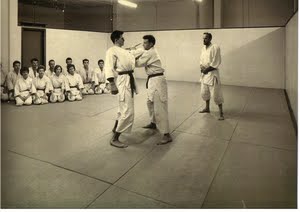
KOJUTSUKAN: The place for the study of martial art skills
Showing posts with label Student Retention. Show all posts
Showing posts with label Student Retention. Show all posts
Monday, September 23, 2019


Thursday, May 5, 2016
Authenic Profits - A guide to runnning a martial arts business (Five Stars)

Reading my biography to the right you will see I have extensive qualifications and experience in business and the martial arts. In addition, I have direct experience of the martial arts industry having assisted in the running of the Jan de Jong Self Defence School which included the development and implementation of a business recovery plan which proved to be highly successful. Thus, I am uniquely positioned to opine on Read's book.
The books is based on theory and experience, however, the theory is only used to inform practice in a practical way. The advice, based on my qualifications and experience, is sound and will assist all in the martial arts industry no matter their motive.
Some of the advice is counter-intuitive and contrary to popular wisdom, however, based on experience it works. Some of the principals espoused by Read were featured in my business recovery strategy that successfully turned the fortunes of the JDJSDS around after nearly two decades of decline in a highly competitive industry.
I cannot endorse the book nor the advice provided in the book more enthusiastically. In particular the focus on relational practices rather than transactional. Transactional is a leaky bucket whereas relational attempts to plug up the holes in the bucket (business) so less water (students) have to keep being poured into the bucket.
The only thing I would add to Read's book, and which supports his advice anyway, is the effect of focusing on relational business can be quantified through a KPI known as 'life-time value.' If you can increase the life-time value of a student then you increase profits and decrease costs. L-TV is calculated as the average time a student spends at the school multiplied by the average membership fee. I focused on this KPI within the recovery strategy for the JDJSDS and it helped in turning a two decade decline in student numbers and income into an upward trajectory.
Read uniquely combines business, psychology, and martial arts. Read is a qualified psychologist and thus provides interesting insights into instructors (or teachers, you'll understand the difference by reading his book), students, marketing, and motives.
The only criticism I would have is that he uses so-called American-English, although, to his credit, he does explain to the reader that his school, Spirit Defence, is spelt 'defence' instead of 'defense' because that is the way English-English speakers spell the word. Okay, he doesn't exactly put it like that but he does inform the reader that others in the English speaking world do not use so-called American-English spelling. Okay, maybe he doesn't exactly put it that way as well, but you get my drift.
Highly Recommended. Five stars *****.
Monday, November 24, 2014
Sexual Harassment and Martial Arts Instruction and Training

Do you have a sexual harassment policy that all instructors and students are familiar with? If not, why not? Do you even know what sexual harassment is? Not think you know but actually know from study and with authority to support your knowledge.
All instructors in the largely amateur activity of the martial arts should be able to answer these questions in the affirmative in order to protect the welfare of both students and instructors. The protection of the welfare of students and instructors takes priority in my view over the legal risks associated with the issue.
The Australian Human Rights Commission defines sexual harassment as: Sexual harassment is unwelcome conduct of a sexual nature which makes a person feel offended, humiliated and/or intimidated where that reaction is reasonable in the circumstances.
When a male instructor or student executes a bear-hug attack from behind or in front of a female student, which involves intimate physical contact of both bodies, and which makes said student feel uncomfortable, is that sexual harassment? Could it be construed by said student as being sexual harassment? Demonstrating a scooping throw (sukui nage) where the defender puts their arm between an opponent's legs when that action makes her feel uncomfortable, is that sexual harassment?
I don't know, but thinking about sexual harassment and how it is dependent upon how the conduct and contact makes the other person feel alerts us to a greater awareness of how we conduct classes.
I became acutely aware of this issue when I was conducting many private lessons with female students. I developed my own way of dealing with the issue because the school I taught for did not have a sexual harassment policy nor instructed instructors on how to deal with this issue.
With all female students, whether in a class or in a private lesson, I'd inform them that they should feel free to inform me if any particular attack or technique made them feel uncomfortable. I'd also inform them of the physical contact ,if the attack or technique involved intimate physical contact, prior to the contact.
I have discuss the above with some male martial artists who dismiss the idea. They suggest that the female student should expect and accept intimate physical contact when training. That is dismissive of the concerns of the student and there are better ways of dealing with the issue.
What remedial action do you take if sexual harassment happens? Without having thought about the issue of sexual harassment prior to teaching, which would include the drafting of a sexual harassment policy, there is no way of knowing what to do in these circumstances.
I was giving private lessons to three female students because they felt 'uncomfortable' with one of the male instructors and the 'attention' he paid them. They decided upon private lessons rather than attending his class. Naively, and ashamedly, I did not take their concerns as seriously as I should have, however, ultimately I did inform the management of the school. The manager's response was to chastise me for saying such things and the claims were never investigated nor the welfare of the women asked after (and please don't confuse manager with principal).
There were failings in this regard in the school I taught at, however, they are common failings because the martial arts industry is essentially amateur in nature and lacks poor governance. The way to rectify this particular failing is to understand the issues associated with sexual harassment and develop a sexual harassment policy that deals with ways to prevent it from happening and how to take remedial action if it does happen, and to ensure that all instructors and students are aware of the policy.
The reference to writing a policy may sound overly officious or ureaucratic to some, however, the discipline of drafting a policy forces one to study and understand the issues involved with sexual harassment. If for no other reason it is a worthy exercise.
A very good start is with the concise information brochure on the subject published by the Australian Human Rights Commission: Effectively Preventing and Responding to Sexual Harassment: A Quick Guide.
A rare example of the martial arts attempting to address this issue is the Australian Ju Jitsu Association's sexual harassment policy. This and other OH&S policies were written by the late Brierley Bailey who was the National Secretary of the AJJA for many years. He was attuned to the need for good governance in order to protect the welfare of students and instructors.
Friday, April 8, 2011
Jan de Jong Pt 18 - Logo
 A big part of the Jan de Jong story is his logo. His logo was based on an ex libris he commissioned during WWII. An Ex libris, or bookplate, is a small graphic label or print that is glued to the inside cover of a book with the purpose of identifying its owner. The Latin phrase 'Ex libris ...', means 'the books of...', and is usually followed by the name of the owner of the book. The designer De Jong commissioned to design his ex libris was Wim Zwiers. In researching this blog, and yes, I do research these blogs, I came across this explanation of why an ex libris is made:
 Ex-libris have been a constant tradition for over five hundred years. They are a challenge to an artist to produce a small graphic art work for a friend, for a customer or for himself with a special purpose: identifying the owner of a book. Pasting a beautiful ex-libris in one's books not only discourages theft and reminds borrowers that a book must be returned, but is also a way of paying tribute to the book, which despite modern communication technology remains a primary vehicle for the transmission of knowledge and a constant source of pleasure and interest. As an object of collection, ex-libris are a wonderful way of acquiring, with time and patience and without being a millionaire, a small-format art museum which reflect the artist's skills and the collector's taste.
 The theme or image of De Jong's ex libris speaks volumes. It is a graphic representation of his original jujutsu instructors, and reflects his love of, and identification with, the art of jujutsu. The image is based on a photo taken of his original instructors, the Saito brothers.
 Zwiers was born in 1922, and would have been in his late teens when De Jong commissioned his ex libris. He went on to become a teacher of fine arts after WWII and is a respected artist utilising many mediums. There are so many stories like this associated with De Jong. Zwiers reconnected with De Jong through an amazing coincidence. They had not had any contact with each other since WWII, but, for whatever reason, in the mid 1990s, Zwiers was visiting Perth, 'the most isolated capital in the world'. He was on a train and saw a van through the window. The van had the ex libris image he'd designed 50 years ago on it, along with a phone number. He phoned the number, and, he and De Jong were reconnected nearly 50 years after their initial meeting, and half a world apart. De Jong would always try and visit Zwiers each year he visited Europe to conduct his seminars. I had the absolute pleasure of meeting Zwiers. He showed me how he created his copper engraved ex libris. He engraves them into a copper plate, backwards, and uses a hand cranked press to print off a limited edition.
The image above of De Jong's ex libris was taken from the ex libris Harry Hartman generously sent me. The fact that the ex libris are printed in a limited edition, by necessity, tells me the esteem with which De Jong held Hartman.
Zwiers is an amazing character. He looks like your traditional grandfather, albeit your traditional Dutch grandfather. But five minutes with him will tell you he is different. He is a true artist in that he has a different view of the world, but, he doesn't have to dress or act different to advertise his different perspective. He lives in this great old house, with a basement that is built into a dyke. The art on the wall of his main living room, a two story affair without the second story, was split 50:50 between his art and those that had been gifted to him by fellow artists when his wife passed away. Those artists had drawn, painted, etc their expressions of grief for a fellow artist. Amazing! And his art ... he told me the story behind many of the pieces he'd chosen to hang on his wall, the art was incredible, but the stories even more so. Obviously, I am a fan ... and I'm proud to say that I have a piece of his work taking pride of place in my home.
 De Jong used his ex libris-based logo for his school from when he first started teaching in the early 1940s until 2002. He used it on his badges, as the badge that Hartman sent me shows.
 He used it on the membership cards as Hartman's membership card shows from the 1950s when De Jong first started teaching in Australia.
  He used it on his badges which signified his gradings rather than belts (see previous blog).
 Hartmen sent me a photo where I think that De Jong is attempting to replicate the original Saito photograph.
Given I'm a business/strategy professional, I find it interesting that the new management of the Jan de Jong Self Defence School rebranded the school with a new name and identifying logo. It is now called Jan de Jong Martial Arts Fitness and thier website explains that this change was introduced in 2002 to reflect a new direction. The new direction is not expanded upon. Possibly, the new direction is reflected in the new name, Martial Arts Fitness. De Jong was only ever interested in the practicality of what he taught; fitness only facilitated the practical. I recall De Jong questioning the idea of going to the gym to become better at what you were doing. His opinion was, do what you do, and you'll become fit doing what you do by doing what you do.
It is most definitely a coincidence that the new logo is very similar to the woolblend logo; which symbolises a blend between 50% wool and synthetics. Having said that, is this an unintentional symbol of the new direction that the new management of De Jong school has taken? A blend between self defence and fitness.
Why would you change your logo when your logo has equity? Would you consider changing the Coca Cola logo? You would, if you were persuing a new direction. Putting some distance between yourself and your origins. While De Jong was present at the 2002 meeting, I would suggest that he supported rather than initiated the new direction and the symbols thereof. I recall the many discussions I had with him concerning succession planing. I'm a business/strategy professional, so of course I talked to him about succession planning. He wasn't interested. The way he saw it, what happened after he passed, happened. He lived for the moment. As I've discussed with Hartman, that's not a perspective that is uncommon for those who have experienced war.
'Don't walk behind me, I may not lead. Don't walk in front of me, I may not follow. Just walk beside me and be my friend.' That to me was De Jong, and it reflects his perspective on succession planning. He wasn't in the game to be followed; to inflate his ego. If you ever had the privilege of talking to De Jong or his former students/instructors, you'll find friendship is the concept that most often comes up. All of the old guys I've had the privilege of speaking to, focus on the relationships, the experiences, and not the quality of the instruction. This reinforces my argument that culture is the key to a successful martial arts school.
It seems appropriate that when De Jong died, the 996 Hay Street dojo was demolished. The name of his school, and his logo/symbol, his ex libris Saito brothers logo/symbol, was replaced. He wanted those who came after him, did so uniquely. He was not in the business of creating clones or librarians; he was in the business of creating teachers of a unique school of thought. But it also seems appropriate that his son, Hans de Jong, went on to use a very similar name and the symbol/logo of his father's school. After all, Hans is probably the longest serving student of his father having commenced training with him in 1955.
Tuesday, August 3, 2010
Culture-Building - Student Retention
This blog is a follow up to my Leaky Bucket - Student Retention blog in July 2010.
For a reason I'll explain in a future blog, I was researching competitive advantage strategies for my chapter dealing with training methods to prepare a person for combat. You'll have to wait to see how it all fits in. Since the business world has long plundered the martial arts world for concepts and theories to guide them in their competitive world, I thought it about time the martial arts world used their concepts and theories to understand and study our world.
Recall from the abovementioned blog that my strategy in rescuing the Jan de Jong Self Defence School from financial ruin was based on building a strong culture. Richard Koch, in The Financial Times Guide to Strategy: How to Create and Deliver a Useful Strategy, had this to say:
Until next time.
John Coles
Become a follower of my blog.
PS: In spite of this and the abovementioned blog, and my business qualifications and experience, my book has nothing to do with the business of managing or running a martial arts school from a management perspective.
For a reason I'll explain in a future blog, I was researching competitive advantage strategies for my chapter dealing with training methods to prepare a person for combat. You'll have to wait to see how it all fits in. Since the business world has long plundered the martial arts world for concepts and theories to guide them in their competitive world, I thought it about time the martial arts world used their concepts and theories to understand and study our world.
Recall from the abovementioned blog that my strategy in rescuing the Jan de Jong Self Defence School from financial ruin was based on building a strong culture. Richard Koch, in The Financial Times Guide to Strategy: How to Create and Deliver a Useful Strategy, had this to say:
Sometimes a corporation's greatness, or its mediocrity, lies not in what it does but in the way that it does it.
The real force driving performance throughout the corporation's different businesses is the culture, the accumulated learning within parts of the firm (its 'competencies'), and the quality of its people and strength of their motivation.
A number of empirical studies have proved that companies with strong and constructive cultures, that stress teamwork and service to customers, and that create an unusual bond between employees and the firm, have been remarkably successful. Paradoxically, companies of this type actually compound shareholder wealth at a faster rate than those firms that stress profit making and shareholder enhancement as their principal business. For example, Robert Waterman, in his book (called What America Does Right in the US and The Frontiers of Excellence elsewhere) quotes two studies demonstrating this paradox, that companies not focusing on shareholder wealth actually outperform on this very dimension.
It is useful to distinguish between four different types of Competency and Culture-Building Corporate Strategy:Koch reinforces the strategy I successfully employed in turning around the flagging fortunes of the Jan de Jong Self Defence School in the 90s. For anyone who is an instructor or a principal of a martial arts school - focus on culture for student rention, and growth.
1. Maintenance, nurturing and fine-tuning of successful culture and competencies.
2. Realising the potential of existing culture and competencies, by focusing the firm's efforts on areas that best exploit these, and retrenching on areas that do not.
3. Maintenance and building of central functions where key competencies reside, and effective dissemination of these competencies to existing and new product business.
4. Radical change in culture and competencies; a transformation strategy.
Until next time.
John Coles
Become a follower of my blog.
PS: In spite of this and the abovementioned blog, and my business qualifications and experience, my book has nothing to do with the business of managing or running a martial arts school from a management perspective.
Monday, July 26, 2010
The Leaky Bucket: Student Retention
This blog was inspired by an article George Kirby wrote entitled 'Student Retention' which is posted on his website (http://www.budoshin.com/). Kirby is a well known American jujutsu master and author of a number of books on the subject. He has kindly been encouraging me in my own work with some sound advice. Kirby's article reminded me of the work I did in arresting the downward spiral of the Jan de Jong Self Defence School (JDJSDS) in the mid-90s.
I was employed by the JDJSDS full-time while I was enrolled full-time in the Master of Business Administration degree (MBA). While there, the principals of the business (Mr and Mrs De Jong) informed me of the dire financial circumstances of the school and that they intended to shut up shop after they returned from teaching in Europe that year. They had been putting in money to the business to keep it afloat for a number of years. The first step in rescuing the school was to gather as much data on the key performance indicators (KPI) that I could lay my hands on.
The KPI's were consistent in that each one of them showed an unwavering downward trend since the early 80s. In the late 70s, early 80s, the membership of the school swelled to over 1,000 members. This population growth was due to the popularity of the television Kung-fu series. Even though the JDJSDS did not teach kung-fu, people were lined up to join the school in queses that extended down the street and around the corner. The business had been living of this 'fat' ever since with each year the membership declining, until in the mid-90s where it was not sustainable.
From my MBA studies, I had been introduced to the concept of 'relationship marketing.' Relationship marketing is based on the premise that it is less expensive to keep the customers you already have than to acquire new ones. The focus of relationship marketing is customer retention and developing long-term relationships. An analogy of a leaky bucket is often used to explain relationship marketing. The bucket is the business and the water are the customers. If water is lost through holes in the bucket, more water continually needs to be poured into the bucket. It's better to attempt to plug the leaks so the water is retained otherwise you have to continually work to pour more water into the leaking bucket.
I equated relationship marketing in the martial art school context with developing a strong culture. And culture is about sitting around camp fires telling stories. Jan de Jong had been travelling annually to Europe since the early 1980s to teach seminars. He loved these tours as did we all when we accompanied him. De Jong would spend three or four months planning the tours, three months touring, and three months telling everyone about it upon his return. I determined the school's culture suffered from De Jong's reduced involvement in, and focus on, the school.
The JDJSDS was made up of the hombu (head school) in the CBD of Perth, Western Australia, and a large number of branches in the suburbs. De Jong never visited the branches. In fact, I found there were students at the branches who did not know Jan de Jong in Jan de Jong Self Defence School was the name of a person. They did not know who De Jong was! Consequently, I encouraged De Jong to visit the branches. These visits were not only directed at the students, but more importantly at the instructors. De Jong took an interest in what they were doing. It showed support. It also gave the instructors an opportunity to introduce De Jong to the students, and to tell stories.
I encouraged De Jong to engage with his instructors more in order to develop two way communication between himself and his instructors. I encouraged him to bring up things which came to mind after his visit to the branches in the weekly Friday night instructors class. The focus on De Jong and his instructors is an example of internal marketing. Internal marketing is about a business marketing to their employees in order to improve their marketing effectiveness. Motivated and engaged instructors then motivate and engage students.
Next, I obtained as much memorabilia as I could lay my hands on from De Jong and hung them on the wall of the members lounge at the hombu. This memorabilia are visual stories of De Jong, the school, and the tradition. Photos of De Jong executing techniques, his instructors, certificates from Minoru Mochizuki, etc. I arranged for an annual get-together at Christmas of all the branches where the instructors put on demonstrations. The students never really got to see the instructors 'do their stuff' and here was a chance for them to see just that and be motivated. It was also an opportunity for all the school to see they belonged to something a lot bigger than the branch or class they attend. This was the only time everyone got to see how large the school actually was. It was also a time where students and instructors could interact on an informal basis, telling stories.
I wrote a book entitled Jan de Jong: the man, his school and his ju jitsu system. It is a coffee-table style book with information on De Jong, his school, the international reputation of the school, tributes to De Jong, the grading system, etc. It gave an overview of the 'tradition' and showed that the student was part of something a lot bigger than, for instance, participating in a sports class at the local community hall.
The De Jong's had the first place in the Yellow Pages for years/decades. It was a large advertisement costing at that time A$10,000+ per annum. I conducted a survey and found only one person said they joined the school based on the advertisement. ONE student! I suggested that if they wanted to spend ten grand on marketing they should do so and market internally not externally. Spend it on strengthening relationships with existing students. Unfortunately, this proposal was too big a leap of faith for the De Jongs.
The idea with relationship marketing is to let the students become the business' sales force. Not in a way which one kung-fu school did which I attended for a very short time. A requirement of membership to that school was to take posters home when you joined and post them around the area the student lived, in shopping centres, laundromats, etc. Another requirement was to wear their distinctive uniform going to and from training so it could be seen on the streets and public transport. They also played some Chinese music in the background when training which I finally understood that the music was background to the continuous repetition of the name of the school.
The KPI I focused on was average length of stay of a student. If I could increase the average length of stay of the students, the relationship marketing would be working and the profits would increase, or in this case the losses reduce.
In the first year I had (often surreptitiously) implemented this marketing approach, the downward trend continued. I decided to stay on after my MBA was completed in order to continue trying to save the school. The second year, for the first time in nearly two decades, the trend plateaued. The third year, for the first time in nearly two decades, the trend started to move upward. Building a strong culture worked. Making the students and instructors feel a part of something worked. Relationship marketing and internal marketing worked. The school continues to operate today.
A postscript to this story is the approach Jamie Francis has adopted with his school in the southwest of Western Australia. When De Jong passed away a number of senior instructors opened their own school. Francis has four branches and he teaches at each one. At the end of each term, he puts on a training session in one location which is free to all members of all his branches. Bringing all the branches together each term. He then puts on a barbecue after the training session where people intermingle and have the opportunity of telling stories. I've had the honour and pleasure of being invited to teach at these end-0f-term training sessions and it's heart warming to see the tradition of building a strong culture continues.
A further postscript is a consistent trend in enrolments which I observed. Consistently for the two decades of data I obtained, enrolments peaked in January/February each year than dropped off until another peak in July/August before dropping off for the rest of the year. I can understand the January/February peak, new year resolutions and all that, but I am still mystified as to the mid-year peak. My business mind looks at the end of the financial year, however I seriously doubt the average person at the end of the financial year thinks now is a good time to learn martial arts.
I was employed by the JDJSDS full-time while I was enrolled full-time in the Master of Business Administration degree (MBA). While there, the principals of the business (Mr and Mrs De Jong) informed me of the dire financial circumstances of the school and that they intended to shut up shop after they returned from teaching in Europe that year. They had been putting in money to the business to keep it afloat for a number of years. The first step in rescuing the school was to gather as much data on the key performance indicators (KPI) that I could lay my hands on.
The KPI's were consistent in that each one of them showed an unwavering downward trend since the early 80s. In the late 70s, early 80s, the membership of the school swelled to over 1,000 members. This population growth was due to the popularity of the television Kung-fu series. Even though the JDJSDS did not teach kung-fu, people were lined up to join the school in queses that extended down the street and around the corner. The business had been living of this 'fat' ever since with each year the membership declining, until in the mid-90s where it was not sustainable.
From my MBA studies, I had been introduced to the concept of 'relationship marketing.' Relationship marketing is based on the premise that it is less expensive to keep the customers you already have than to acquire new ones. The focus of relationship marketing is customer retention and developing long-term relationships. An analogy of a leaky bucket is often used to explain relationship marketing. The bucket is the business and the water are the customers. If water is lost through holes in the bucket, more water continually needs to be poured into the bucket. It's better to attempt to plug the leaks so the water is retained otherwise you have to continually work to pour more water into the leaking bucket.
I equated relationship marketing in the martial art school context with developing a strong culture. And culture is about sitting around camp fires telling stories. Jan de Jong had been travelling annually to Europe since the early 1980s to teach seminars. He loved these tours as did we all when we accompanied him. De Jong would spend three or four months planning the tours, three months touring, and three months telling everyone about it upon his return. I determined the school's culture suffered from De Jong's reduced involvement in, and focus on, the school.
The JDJSDS was made up of the hombu (head school) in the CBD of Perth, Western Australia, and a large number of branches in the suburbs. De Jong never visited the branches. In fact, I found there were students at the branches who did not know Jan de Jong in Jan de Jong Self Defence School was the name of a person. They did not know who De Jong was! Consequently, I encouraged De Jong to visit the branches. These visits were not only directed at the students, but more importantly at the instructors. De Jong took an interest in what they were doing. It showed support. It also gave the instructors an opportunity to introduce De Jong to the students, and to tell stories.
I encouraged De Jong to engage with his instructors more in order to develop two way communication between himself and his instructors. I encouraged him to bring up things which came to mind after his visit to the branches in the weekly Friday night instructors class. The focus on De Jong and his instructors is an example of internal marketing. Internal marketing is about a business marketing to their employees in order to improve their marketing effectiveness. Motivated and engaged instructors then motivate and engage students.
Next, I obtained as much memorabilia as I could lay my hands on from De Jong and hung them on the wall of the members lounge at the hombu. This memorabilia are visual stories of De Jong, the school, and the tradition. Photos of De Jong executing techniques, his instructors, certificates from Minoru Mochizuki, etc. I arranged for an annual get-together at Christmas of all the branches where the instructors put on demonstrations. The students never really got to see the instructors 'do their stuff' and here was a chance for them to see just that and be motivated. It was also an opportunity for all the school to see they belonged to something a lot bigger than the branch or class they attend. This was the only time everyone got to see how large the school actually was. It was also a time where students and instructors could interact on an informal basis, telling stories.
I wrote a book entitled Jan de Jong: the man, his school and his ju jitsu system. It is a coffee-table style book with information on De Jong, his school, the international reputation of the school, tributes to De Jong, the grading system, etc. It gave an overview of the 'tradition' and showed that the student was part of something a lot bigger than, for instance, participating in a sports class at the local community hall.
The De Jong's had the first place in the Yellow Pages for years/decades. It was a large advertisement costing at that time A$10,000+ per annum. I conducted a survey and found only one person said they joined the school based on the advertisement. ONE student! I suggested that if they wanted to spend ten grand on marketing they should do so and market internally not externally. Spend it on strengthening relationships with existing students. Unfortunately, this proposal was too big a leap of faith for the De Jongs.
The idea with relationship marketing is to let the students become the business' sales force. Not in a way which one kung-fu school did which I attended for a very short time. A requirement of membership to that school was to take posters home when you joined and post them around the area the student lived, in shopping centres, laundromats, etc. Another requirement was to wear their distinctive uniform going to and from training so it could be seen on the streets and public transport. They also played some Chinese music in the background when training which I finally understood that the music was background to the continuous repetition of the name of the school.
The KPI I focused on was average length of stay of a student. If I could increase the average length of stay of the students, the relationship marketing would be working and the profits would increase, or in this case the losses reduce.
In the first year I had (often surreptitiously) implemented this marketing approach, the downward trend continued. I decided to stay on after my MBA was completed in order to continue trying to save the school. The second year, for the first time in nearly two decades, the trend plateaued. The third year, for the first time in nearly two decades, the trend started to move upward. Building a strong culture worked. Making the students and instructors feel a part of something worked. Relationship marketing and internal marketing worked. The school continues to operate today.
A postscript to this story is the approach Jamie Francis has adopted with his school in the southwest of Western Australia. When De Jong passed away a number of senior instructors opened their own school. Francis has four branches and he teaches at each one. At the end of each term, he puts on a training session in one location which is free to all members of all his branches. Bringing all the branches together each term. He then puts on a barbecue after the training session where people intermingle and have the opportunity of telling stories. I've had the honour and pleasure of being invited to teach at these end-0f-term training sessions and it's heart warming to see the tradition of building a strong culture continues.
A further postscript is a consistent trend in enrolments which I observed. Consistently for the two decades of data I obtained, enrolments peaked in January/February each year than dropped off until another peak in July/August before dropping off for the rest of the year. I can understand the January/February peak, new year resolutions and all that, but I am still mystified as to the mid-year peak. My business mind looks at the end of the financial year, however I seriously doubt the average person at the end of the financial year thinks now is a good time to learn martial arts.
Subscribe to:
Posts (Atom)