Friday, April 20, 2012

F = ma; ma ≠ F

I am writing an article on the science behind striking and kicking techniques to be published in the Journal of Asian Martial Arts.

In researching the science behind striking and kicking techniques in the martial arts literature, I have come across the frequent use of the mechanical concept of force. Force (F) is calculated as the produce of mass (m) and acceleration (a): F = ma.

It is frequently explained that, based on this formula, an increase in mass and/or acceleration of a strike or kick will increase the force of that strike or kick.

Sprague, in Fighting Science: The Laws of Physics for Martial Artists (2002), suggests that the force will be greater if both mass and acceleration are large. When referring to the force formula, Sprague suggests that we can see why power seems to increase with weight and speed, and why full contact fighting, like boxing and kick boxing, utilise weight classes. Starr, in Martial Mechanics: Maximum Results With Minimum Effort in the Practice of the Martial Arts (2008), suggests that the more you have of mass and acceleration, the more force you will generate. Belonoha, in The Wing Chun Compendium, Volume 2 (2009), likewise suggests that the force formula indicates that more mass and acceleration in a wing chun punch generates more force. Central Ohio Martial Arts (http://www.centralohioma.com/Physics/Force.php) suggest that to 'increase force, either a martial artist has to increase his mass or his acceleration.'

No, no, no! The F = ma formula does not say that if you increase mass or acceleration in a strike or kick you increase the force of that strike or kick. It says that when a force is applied to a body or object it can cause the mass of that body or object to accelerate. It expresses a cause-and-effect relationship. Forces cause acceleration; and acceleration is the effect of forces. A force applied to an arm or leg (mass) causes it to accelerate towards a target. A force applied by a fist/hand or foot in a striking or kicking techniques applies a force to the other body or object causing it's mass to accelerate. It does not say that if you increase the mass or acceleration of that arm or leg that the force will be greater.

F = ma; ma ≠ F.

I state in my article that I'm not interested in the science for the sake of science. I'm only interested in the science behind striking and kicking techniques in so far as it informs practice, and only then if it facilitates the understanding and study of those techniques in a practical way. My review of the martial arts literature in this regards has to date yielded no positive results.

Does F = ma facilitate the understanding and study of striking and kicking techniques? Does the physical fact that a force applied to a body or object causes its mass to accelerate facilitate the understanding and study of striking and kicking techniques in a practical way. I'm going with 'no', until it can be demonstrated otherwise.

However, there are related concepts to force that can be used to facilitate the understanding and study of not only the striking and kicking techniques taught within your own martial art, but also those taught in other martial arts you are unfamiliar with and those used in violence generally. This is the benefit of understanding the science behind the techniques. It enables you to understand not only the techniques taught in your martial art but those taught in unfamiliar martial arts and those used in violence generally.

The purpose of this blog is two fold. First, to put paid to the misconception that increasing mass and/or acceleration in a strike or kick increases the force of that technique based on F = ma. Secondly, to ask 'So what?' whenever science is offered up to explain any techniques in the martial arts or used in violence generally. This the question I raised in virtually all explanations of striking and kicking techniques in scientific terms in the martial arts literature. This question then led me to injury science; a discipline that studies the subject at the very heart of all activities associated with preparing a person to survive a violent encounter. A discipline whose concepts and theories are applied every day in the real world in real ways. These concepts and theories have never, to the best of my knowledge, ever been applied to the tactics and techniques of the activities associated with preparing a person to survive a violent encounter - until now (in my article).

Monday, April 16, 2012

Using The One-Inch Punch to Understand All Punches


I'm currently working on an article tentatively titled: Injury Science: The Science Behind Striking and Kicking Techniques. My previous blog was in relation to a study comparing the reverse punch to the three-inch punch. Last weekend I used the one-inch punch, a sibling of the three-inch punch, to teach the science behind striking and kicking techniques. The science is common to all striking and kicking techniques and can be used to understand all of these techniques taught in any martial art or used in violence generally.

Check out YouTube for demonstrations of the one-inch punch. They usually comprise of a subject holding a thick book on their chest and the puncher executing the punch resulting in the subject staggering backwards and a lot of times falling to the ground or slumping in a chair.

I got my guys to hold a thick financial modelling text (the most interesting use that text has been put to) on their chest and one of them to punch it using a one-inch punch. A one-inch punch refers to the distance between fist and target with no withdrawal permitted.

The result of their first attempts were, to say the least, less than impressive. The conclusion could have been that the technique is ineffective.

How do you analyse the one-inch punch (or any striking and kicking technique for that matter). Firstly, divide the skill into phases. Injury science divides an injury event into three phases: pre-event, event, post-event. An injury derived from an impact can be divided into pre-impact, impact, post-impact. Uniquely, Nakayama (in Dynamic Karate 1966) divided the execution of a karate technique into phases when explaining stances: pre-execution, execution, post-execution.

Let's look at the pre-impact/pre-execution phase of a technique. What are the important things to look for in this phase? When using science to understand striking and kicking techniques, many refer to momentum and/or kinetic energy. Both concepts are quantities of motion. Every striking and kicking possesses momentum and kinetic energy. So what? To cut a long story short, you'll have to read my article to see the confusion and sometimes misdirection that authors present when attempting to use science to explain striking and kicking techniques.

Injury science, the relatively new science that studies injuries, defines injury in terms of exposure to energy in excess of the body's tolerance levels or the absence of such vital elements such as oxygen and heat. Energy = kinetic energy. No need to consider momentum. If anyone refers to momentum to explain striking and/or kicking techniques, ask 'So what?'.

Kinetic energy is a property of a moving body or object. It doesn't cause anything. Forces cause changes. Kinetic energy can be used to understand the pre-impact/pre-execution phase of a technique. Force can be used to understand the impact/execution phase of a technique. This blog will focus on the former phase.

Kinetic energy is the potential to cause injury or to cause a change in the motion of a body or object. Force actually causes the injury or change in motion. Kinetic energy (KE) is calculated as one half of the product of mass (m) and velocity (v) squared: KE = 1/2mv^2. This is all you need to look to in order to understand the potential to cause injury or a change in motion of a body (opponent) or object (breaking board). What is being done in terms of mass and/or velocity in the execution of the technique? There are many different answers provided in the many different striking and kicking methods taught by the martial arts.

How do you increase velocity? The greater the distance between the fist and target, the greater the opportunity to build velocity. The right cross is more powerful than a jab from an orthodox stance in boxing because of, among other possible things, the greater distance between fist and target. Jeet kune do often suggest the changing of the boxer's stance so that the 'strong side' is forward increases the potency of their now leading strong fist because it is faster. It is faster because it is closer the target. That means it takes less time to reach the target, but, the shorter distance means it does not have the same amount of time to build velocity and kinetic energy in its journey. Those attempting to explain the increased power of this punch need to find an alternative explanation other than it's closer to the target. So is the jab, and it is often considered a less powerful technique.

My guys quite correctly pointed out their lack of power was attributable to their inability to 'wind up' on the punch. So, how do you increase velocity when you don't have that opportunity. The use of a kinetic chain is one option. The coordinated sequencing of body parts which transfers motion and kinetic energy from one segment to another culminating in increased velocity of the distal segment, in this case the fist.

Kinetic energy involves both mass and velocity. What about mass? How can you increase mass into the one-inch punch. Lean into it. Check out anyone demonstrating a one-inch punch. They always lean into it thereby increasing the mass of the punch.

Another way is through 'focus'. Focus is 'tightening all the muscles at the moment of impact thereby locking the fist, arm, and upper body into a single unit (high mass)' (Blum 1977: Physics and the art of kicking and punching; American Journal of Physics). Neto, Magini, and Saba (2007) suggest that in addition to contributing more effective mass to the strike, 'the correct bone alignment and muscle contraction timing are responsible to turn the hand, forearm, and arm into a very firm unit,' and that it might also serve to distribute the reaction forces of a strike. The latter is referring to the impact and post-impact phases so we'll skip over that for now.

How can you increase mass? Footwork. Often footwork is described in terms of evading an attack or position to attack, but, it is also used to execute an attack. Jack Dempsey advocates taking a step forward - a falling step - in order to increase the mass behind a punch. You can take a full step forward such as with the karate lunge much. You can also subtly shift your bodyweight from the rear leg to the front leg to increase the mass behind the punch.

KE = 1/2mv^2: what should you focus on in your training? Mass or velocity? I detail in my article the various authors that refer to kinetic energy to explain striking and kicking techniques in the martial arts literature who focus on velocity. Mention kinetic energy and the discussion always focuses on velocity. Many advocate orienting the training of striking and kicking techniques to velocity. It makes sense, if you only refer to the formula for kinetic energy.

Studies overwhelmingly show that increased force in punching techniques is related to increased mass. These studies provide evidence that better trained/more experienced practitioners produce more force because they are better able to contribute more effective mass to the strike or kick. This is what Neto, Magini, and Saba found, which supported a number of other studies in different martial arts, when they studied the role of effective mass and hand speed in the performance of kung fu 'athletes' compared with nonpractitioners. They suggest that this might be one of the reasons why martial arts masters pay more attention to proper striking techniques, bone alignment, coordination, and proper timing of muscle contractions, than to hand speed.

Pre-execution of a striking or kicking technique - what is being done in terms of mass and/or velocity? Moving the body or body segments may or may not be contributing to mass behind the technique, it may be being moved as part of a kinetic chain to increase the velocity of the fist or foot. A distinction needs to be made between moving body segments to increase velocity or moving the same segments to increase the mass. After all, mass and velocity make different contributions to kinetic energy which is the potential to cause injury or the change in motion of an opponent.

I've never attempted a one-inch punch before. Must to my surprise, my first attempt resulted in a Bruce Lee-like result with the recipient staggering backwards before falling to the ground because their upper body had been accelerated faster than their legs could move to create a base of support over which their centre of gravity could located. Yes, I'm deliberately throwing in some basic science that I'm using to understand and study the tactics and techniques on the martial arts and those used in violence generally. I had an understanding of what I wanted to achieve because I was able to analyse what others were doing. I wasn't simply trying to copy them, I understood what they were doing and therefore had a better first-up understanding of what I wanted to do in terms of mass and velocity.

Mass and velocity - that is all you need to look at during the pre-execution phase of a technique.

Monday, April 9, 2012

Three-inch Punch vs Reverse Punch

I'm currently writing an article I'm planning to submit to Journal of Asian Martial Arts (JAMA): 'Injury Science: The Science Behind Striking and Kicking Techniques.'

JAMA is a semi-academic journal which means it provides serious scholarly work instead of just the 'pulp' that most martial arts magazines provide.

The article I'm writing explains the science behind striking and kicking techniques, and commences with examples of explanations that have been provided within the martial arts literature that at the very best is simply science for the sake of science, and at worst actually misdirects readers.

My research involves reading articles buried in academic journals that normally never see the light of day, unfortunately. This is the norm for most real-world activities but more so in the martial arts which is a bastion of anti-intellectualism.

One article I came across yesterday is, 'A comparison of the reverse punch and power punches in oriental martial arts' by J.K. Gulledge and J. Dapena in Journal of Sports Sciences 2008 26(2): 189-196.

The power punch is the infamous three-inch punch popularised by Bruce Lee. We also have the even more infamous one-inch punch. The idea behind these punches is that they only travel three or one inches to the target/opponent and they are 'powerful'.

The aim of the study was to compare the power punch with the reverse punch in regard to potency and to effectiveness in throwing the opponent offbalance.

The study used twelve 'expert' martial artists with six representing Chinese kungfu, three Japanese karate, and three Korean taekwondo.

The results were:
Similar impulses were exerted on the target with both punches, but the maximum amount of force exerted with the reverse punch was almost twice that exerted with the power punch. Therefore, the reverse punch was by far the more potent of the two.
The power/one-inch/three-inch punch is dead. Long live the power/one-inch/three-inch punch. The amount of nonsense that is written and taught about these types of punches is amazing; well it would be if the martial arts was not characterised by ego and gullibility.

An understanding of the science behind striking techniques would immediately suggest the power punch is significantly less powerful than a reverse punch, in fact, any other punch. An understanding that has not been provided in the martial arts literature todate despite the many attempts at using science to understand striking techniques in the martial arts literature.
Disabling the opponent through a potent impact may not be the only goal of a martial arts punch; another possible goal is to throw the opponent off balance. The effectiveness of a punch towards the achievement of this second goal may be measured best through the total impulse exerted on the opponent, and in this regard the power punch performed well. Although the reverse punch exerted a larger maximum force than the power punch, the force decreased more slowly in the power punch, and therefore the impulses exerted on the target were not very different in the two types of punch. In fact, the cumulative impulse exerted on the target during the first 0.20 s of contact was somewhat larger in the power punch than in the reverse punch. This supports the concept of the power punch as a push rather than a punch, ....
Firstly, forces can cause a change in motion or a change in shape. A change in motion can offbalance an opponent. A change in shape can injure an opponent. Secondly, relating the academic study to practice, the power punch applies a force that is more like a push rather than a potentially injurious punch. It applies forces that are more likely to change the motion of an opponent than it is to deform their tissues causing an injury.

The suggestion that striking is used to offbalance an opponent is interesting. Another study buried in another academic journals that studied the biomechanics/physics of karate suggested that 'the primary purpose in striking an opponent is to maximise the deformation damage at the area of contact, and it is only rarely that moving the opponent’s body as a whole is desired.' I'm not suggesting strikes and kicks are not used to offbalance an opponent. The taekwondo pushing kick is specifically designed to do just that. But what form of offbalancing are we referring too? The aforementioned pushing kick, and the power punch referred to in the study, physically offbalance an opponent. However in many jujutsu/aikido systems, striking is often used and referred to as 'mental unbalancing.' They are used to stun or distract in order to facilitate the execution of a finishing technique. They apply forces that are designed to deform the opponent's tissues and not to change their motion, but not deform those tissues sufficiently to cause an injury.

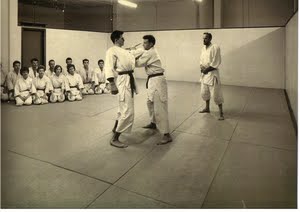
Return to the top of this blog and look at Bruce Lee's demonstration of his one-inch/three-inch punch. Note the punch receiver's stance. It is a parallel stance, which means it is less stable to forces applied from the front or rear - the direction of the 'power punch.' Would the same dramatic effect have resulted if the receiver had stood in a staggered stance, as in a boxer's stance or zenkutsu-dachi, which is more stable to forces applied in those directions? Note Lee's leaning forward when executing the punch. The one-inch or three-inches only refers to the starting distance between the fist and the receiver. The distance actually travelled by the fist is further because he leaned in, putting more bodyweight behind the punch which results in a greater 'pushing' force being applied to the receiver. Lee's demonstrations were contrived and designed for dramatic effect.

Lee's demonstrations always involved pushing and not injuring the receiver of his punch. How anyone can suggest the power punch can cause injury given Lee's demonstrations is beyond me. Next we'll be talking about a 'death touch'; oh wait, we do talk about a death touch in the martial arts.
Given these characteristics, several conclusions can be drawn with regard to the use of the two punches in combat or sport. The power punch will be slightly more effective than the reverse punch when the goal is to throw the opponent offbalance.
That conclusion is a bit sweeping. A reverse punch can also offbalance an opponent rather than injury them, or simply deform their tissues without injuring. However, a power punch does not possess the kinetic energy to injury in the vast majority of cases.
In addition, it may provide the advantage of surprise, since it requires less time for its execution. It is also possible that the power punch might be the most effective for the delivery of a disabling blow when only limited amounts of space and time are available for the delivery of a punch. However, when sufficient space and time are available, it is clear that the reverse punch will be the most potent.
Now they are simply contradicting themselves when suggesting the power punch could ever be a disabling blow under any circumstances. It simply does not possess the kinetic energy to cause damage.

Note I referred to kinetic energy above. Why didn't I refer to momentum like so many others do when attempting to explain the science behind striking and kicking techniques? That is a question I cover in my article.

The study used a force plate to measure the force applied by the punches. So do some other studies regarding punches and kicks. What a brilliant training aid. A training aid that is currently not used in most, if any, martial art. Can you imagine being able to quantitatively measure the force applied by a student's punch or kick. No more 'feel', now we could quantitatively measure the progress (or not) in a student's punch or kick. I'm currently sourcing a force plate and will advise in the near future.

A force plate would also provide a definitive answer to questions raised concerning the efficacy of different striking and kicking techniques, and those of different martial arts. Wing chun tends to make some pretty extravegant claims concerning the power of their punching techniques, even though they travel relatively small distances similar to a power punch. Do they apply as much force as wing chun exponents claim? If so, how, given they do not travel any large distance that is required to build kinetic energy? Considering these questions leads you to understand the essense behind the efficacy of these techniques.

Tuesday, April 3, 2012

Being Called a Cocksucker Isn't Personal

I caught up with a former pupil, now very good friend, last night. I raised a particular issue to which he referred to a scene from Partick Swayze's Roadhouse movie:
We've got entirely too many troubIemakers here. Too many 40-year-old adolescents, feIons, power drinkers and trustees of modern chemistry.
I would like to say welcome to the 21st century, but the movie was made in the 20th century, and unfortunately it is reflective of human nature throughout history and that of the foreseeable future.
It's going to change.

Man, that sure sounds good.

But a lot of the guys who come in here, we can't handle one-on-one. Even two-on-one.

Don't worry about it. All you have to do is follow three simple rules.

One: never underestimate your opponent. Expect the unexpected.

Two: take it outside. Never start anything inside the bar unless it's absoluteIy necessary.

And three: be nice.

Come on.

If somebody gets in your face and calls you a cocksucker, I want you to be nice. OK. Ask him to waIk, be nice. If he won't walk, walk him. But be nice. If you can't walk him, one of the others will heIp you. And you'll both be nice. I want you to remember that it's a job. It's nothing personaI.

Uh-huh. Being called a cocksucker isn't personal?

No. It's two nouns combined to elicit a prescribed response.

What if somebody calls my mama a whore?

Is she?

(laughter)

I want you to be nice ... until it's time to not be nice.
Where this came up was when I was telling my friend that I was watching the football (Australian Rules) when one player deliberately got under the skin of an opposition player who then lost control and punched him. This gave away a free kick resulting in a goal and the offending player lost composure. This is precisely what the niggling player intended.

I didn't understand how professional athletes could lose control when all the other player was doing was mouthing off, aka sledging. I was actually watching the game with another friend, and I said the same thing, to which he replied, 'But you're different to most people.'

Maybe he's right. But this is a lesson that should be numero uno in any activity associated with violence. Martial arts, self defence, security, law enforcement, military - all should be taught not to take other people's words or actions personally. They are just words or actions to elicit a prescribed response. They may be words or actions that are designed to hurt, but they can only hurt if you give them meaning and let them hurt. 'Sticks and stones may break my bones but names will never hurt me' - sound advice we give to children through nursery rhymes but which seems to be lost as we grow up. Sticks and stones may break my bones but names will never hurt me should be a priority in the martial arts, self defence, security, law enforcement, and military training.

These words or actions only become personal when we ascribe meaning to those words or actions and make it personal. Until then, they are just words or actions. An extended middle finger is only an extended middle finger until we ascribe a 'f**k you' meaning to the gesture. Until then, it's just an extended middle finger.

Another football game a couple of years ago. One player tackled another, and as they wrestled on the ground, the tackled player said to the tackling player that he'd f**ked the person who the tackling player had tattooed on his arm. That player went ballistic and had to be forcibly restrained. The tattoo was of his young daughter. So what! They are just words. Words that you know are intended to cause you to lose control. Words that only have meaning if you give them meaning. Until then they are just blah, blah, blah.

Why take these things personally? Only you can make it personal. Until you do, they are just words.

My friend from last night suggested that responding to these words is human nature. If that is true, evolution did us no favours there. Someone calls you whatever, you take it personally, words are exchanged, a fight ensues, pain, injury, death, court cases, victim impact statements saying how they now have a life sentence - they only called you a name. They were just words. Rather than assisting you to survive and reproduce, this 'trait' would appear to be maladaptive. 'It's going to change' - like many self-improvement methodologies, we have to find ways to counter human nature, counter our natural instincts to be idiots. 'Man, that sounds good.'

Provocation is often offered as a defence for why someone assaulted another. They were provoked into assaulting another person because ... they couldn't control your own emotions via the appraisal of the stimuli. The appraisal process elicits the emotion which elicits the behaviour. The defence of provocation is appealing to the lowest denominator of human behaviour. It is encouraging us not to control our emotions via the development of our appraisal process.

On the issue of the provocation defence, raise it at your peril. 'I was provoked'; so was the man that abused his partner, so was the parent that abused their child. We may not agree with the provocation, but it was provoking for those individuals, as it was for those that rely on the provocation defence in more socially acceptable situations.

We have to stand up for ourselves or others we care about. We can't let someone insult us or others we care about. We have pride. They are just words and actions that have no meaning until we give them meaning. If we appraise these words and actions as being benign, they are nothing. There is nothing attacking us or others we care about which we have to defend because we didn't appraise the words or actions as such. There is nothing insulting us or others we care about because we didn't appraise the words or actions as such. Our pride has not been threatened because we didn't appraise the words or actions as such. No feeling nor associated behavioural response was elicited because we appraised these words or actions as benign.

Rule number three - be nice. It's not about pretending to be nice. It's about actually being nice. It's not about teaching how not to respond to provocation. It's about teaching not being provoked; actually not taking things personally. It's about changing mindsets, the appraisal process. It's about changing perception so that provocations are not provocations because they are not made personal by the recipient.

I would like to go into a law enforcement recruit training lecture and say to an indigenous trainee, 'What the fuck do you black c**t think you're doing in this class. It's only for humans not you apes.' Or to a female trainee, 'Piss off b***c. This is men's work and you're too f**king useless to be of any use at all.' This is the sort of abuse they will cop throughout their career. If they let it get to them, it will compromise their effectiveness. I would explain that it's not about putting up with it. It's not about resisting the temptation to retaliate. It is about developing a mindset whereby these words don't elict any temptation to retaliate whatsoever. It is a discipline, but once internalised it no longer means you are an amoeba that simply responds to a stimuli.

Then and only then will you really know when it's time to not be nice.

In the words of Sean Connery from The Untouchables, here endeth the lesson.

Wednesday, March 28, 2012

Women's Self Defence - Fighting With Facts

Based on my blogs concerning Women's Self Defence (WSD), I recieved an email asking my advice on a particular WSD issue. Firstly, thank you considering myself as having something to contribute to your efforts. Secondly, kudos on seeking out more information before attempting to advise women on their own safety. This attitude is relatively rare within the martial arts and those activities associated with preparing a person to survive a violent encounter. Opinions abound; facts are often not considered.

I've chosen a WSD course website at random and do not intend to name it. It is fairly typical of the rhetoric associated with WSD courses.

Unfortunately violence is on the increase in our society. Is it? Is it really? Based on what facts? Some would argue that our reporting of violence has increased; or that the media reporting of violence has increased thereby increasing our appreciation of the level of violence in our society. I once saw a report that Australia was the third highest most violent country in the world, more so than Spain. The reason Australia is the third hightest most violent country in the world is because we report violent crimes. When we report violent crimes, they get reported in the media. Viola, violence is on the increase and we have a violent society.

Has violence increased in our society compared to times gone by when Australian 'aboriginals' or 'native Americans' were systematically hunted down and killed? Was it more or less violent in our society in the 1600s or now, when weapons were the norm in civilian society rather than when they are regulated today? If you are going to suggest violence is on the increase, at least specify a base. Maybe the 1960s when we could leave our doors unlocked when we went out or went to sleep. Some argue that until recent events the 1960's had been our most violent decade of the century.

These courses, and often martial arts, are marketed on fear. We have four times as many negative emotions as positive ones because negative emotions are designed to ensure our survival and positive ones are designed to take advantage of an opportunity. Evolution gave us four times more negative emotions because if we don't survive, we don't reproduce. If we don't take advantage of an opportunity, we still survive and another opportunity will always come along, and we still get to reproduce. So, to protect us, evolution over compensated on the negative emotions, including fear. Fear and ignorance: the fodder of the media; the fodder of politics; and the fodder of self defence courses.

I have a friend who has gone through some pretty rough times. She purchased a pair of Wonder Woman undies which have become a bit of a symbol for her strength and independence. She suggested she was going to develop a women's fitness course and call it Wonder Women Fitness. Wow, I thought. What would I call a WSD course. 'Vulnerable people', 'You're weak but we'll try and fix that', 'Defend yourself cos you are the weakest of the herd' course. I've seen 'Fight Like a Girl' - ~. While that name is intended to be taken a number of different ways, it still originates in weakness. What about Wonder Woman something. Something positive, not based on fear but on strength. Something that says we are building on your inherent strengths, and not trying to fix your inherent weaknesses and vulnerabilities. Of course part of that course would be knowledge. Real knowledge based on supportable facts - knowledge is power.

It is not a martial arts course, it’s an educational program. I can guarantee you that not a lot of 'real' research went into the development of most WSD courses. A lot of opinion has gone into developing them, but very little real, unbaised research. All you have to do is look at the absence of 'intimate assault' strategies.

created the xxx method to specifically address the most common sexual assault scenarios women of all ages are likely to face. If so, this would be the first WSD course that focuses on sexual assault from intimates, people the assaultee knows. Statistically, the biggest threat to females is posed by people they know. The strategies to deal with someone you love and trust who now want to assault you are very different to the strategies aimed at dealing with a stranger assault. We need to cater for both.

Every criminal has two fears. Criminals fear being caught and they fear being hurt. The course provides ample opportunities for the attacker to face both of those fears. What bollocks. If criminals feared being caught then harsher punishments would act as a deterient. It has been shown time and time again that this is not the case. Harsher penalities only make those imposing them feel like their doing something, rather than actually doing something that might deal with the problem. People do not do a cost-benefit analysis when deciding to commit a crime. I recently watched a National Geographic documentary on Casuarina, Western Australia's maximum security prison. A recidivist prisoner explained that he wasn't thinking about any punishment whatsoever whenever he committed any crime.

Did the bikie that threw the young New Zealander out of the first floor window of a Perth pub killing him fear being hurt? Did the serial rapist in New Zealand who when asked by one of his vicitms what she had done to deserve this replied that she had done nothing, that he was just a bastard, fear being hurt?

Does the husband that beats his wife fear being hurt? Does the date that rapes his date fear being hurt? Does the drunken idiot that won't take no for an answer fear being hurt?

What nonsense.

Studies show that half of all attackers will break off their attack if the woman simply indicates she is willing to resist. Finally. An indication that some research might have gone into the development of a course that is supposedly intended to inform and assist a woman to survive a violent encounter.

Studies show that women who resist are not injured any more than women who don’t resist. Yes they do. Kudos for doing some research.

The program teaches women elements of awareness, avoidance and self-defence. Awareness and avoidance - before an attack. Self defence - during an attack. What about after an attack? William Haddon, the father of injury science, analyed injury events using temporal phases. Before, during, and after an injury event. The idea is to prevent an injury, and if you can't to reduce the severity or longevity of the injury. What do WSD courses do to reduce the sequelae of an attack? Is only demonstrating that women who resist an attack reduce their risks of being successfully attacked revictimising those who do not resist, for whatever reason? What is being done to help those people understand and cope with the effects of an attack?

The original email was in regards to the use of keys as a weapon of self defence. It is commonly taught to hold your keys between your fingers to strike or scratch with. Have you tried it? The car key I have with the bulky handle for electronically opening and closing the car door provides a great support for the key to use as a weapon. My stand-alone house key is tough to hold between the fingers when striking with it. Scratching? I tried that. Keys are by design, blunt. It is very tough to scratch a person with a key held between the fingers with no support like the base of the aforementioned key. I've got red marks on my arm, however, no penetration of the skin was achieved.

I'd go back to the non-controversial weapon of a heel-palm or hammerfist strike to the nose. It is tough to teach a person to punch with a fist, let alone kick. Check out Applegate's Kill or Get Killed and Fairburn's Get Tough. They teach the military and law enforcement NOT to punch, but to use a heel-palm strike, hammerfist, or shuto (knife hand). Nancy Wake used the latter to kill a Nazi sentary during WWII as reported in my blog dedicated to the story of Jan de Jong. Using the heel-palm strike does not run the risk of breaking a bone in the hand or wrist. It doesn't run the risk of being ineffective due to a misaligned wrist. It is relatively easy to use and is effective when directed to the nose or the jaw. Why go for the keys between the fingers which is questionable and difficult when you have this weapon at hand (pun intended).

Tuesday, March 13, 2012

You Are Not Defenceless

I'll aim these comments at females, but they are equally applicable to males.

The first thing I would do if conducting a women's self defence course would be to ask the participants, who among them felt they are defenceless. Many may as they have enrolled in a self defence class to gain defensive capabilities. The first thing I would tell the participants is that they are not defenceless. If they were, they would never have been born.

Nature provides humans with a pretty effective defence system. It's pretty effective because we are here. Those that possessed this evolved defence system survived and reproduced passing those traits down to successive generations. Those that did not possess this evolved defence system were defenceless and died, thereby not being afforded the opportunity of passing their defenceless traits down to successive generations.

If you want to see how effective our evolved defensive mechanism is, just read the following newspaper article of a woman's fight for survival. I'll provide certain comments that arise from my work on Beyond Fight or Flight, and it can be seen that the previous blog informs this article.
Perth mother struggled through tears today describing her desperate fight for survival as her estranged husband repeatedly stabbed her and the moment her three-year-old son witnessed the attack.

Lisa Ann Petrelis, 38, is giving evidence at the Supreme Court trial of her husband and father of her two sons, Alexander Nicholas Petrelis, who is fighting an attempted murder charge.

Mr Petrelis, 38, pleaded guilty to causing grievous bodily harm but the prosecution rejected that offer.
Why GBH and not attempted manslaughter? Is there such a thing as attempted manslaughter in WA? I'm always amused at the reduced sentence for attempted homicide. Even though a person had the intention of killing another person, they are rewarded with a lesser sentence because they were incompetent and did not achieve their objective. To my mind, if a person intends to kill another person, and trys to kill that person, it's one and the same if they succeed or fail. You can see the same oddity in many other crimes. Attempted sexual assault - a person gets a lesser sentence because they were rubbish at sexual assault.
Mrs Petrelis said her husband had tapped on her bedroom window at her Karrinyup home at around 11pm on December 5, 2010. She said when she let him in he was talking in a stressed tone, was breathing heavily and told her he had cancer and felt sick.

Mrs Petrelis said her husband eventually asked to be let out and when she walked towards him he suddenly lunged at her, started hitting her and backed her into a corner.

She said she was screaming at him to stop and telling him he would wake their two sons, but it took her a while to realise she was being stabbed as well with her own carving knife that she left on the kitchen sink after making herself a chicken sandwich earlier in the night.

Mrs Petrelis estimated she was hit or stabbed 50 to 60 times during the initial attack.

"I ended up screaming I’m being stabbed, I’m being stabbed ... but being stabbed didn’t hurt, I guess the adrenalin was going through. Somewhere in there I knew I had been stabbed," she told the jury.
Here we see the effects of the evolved physiological response associated with fear - hormones being released which result in increased pain tolerance. This evolved response is designed so that injury does not interfere with our efforts to flee or fight. Serious injuries did not interfere with Mrs Petrelis' fight for survival.
Mrs Petrelis said after slipping on her own blood, she ran to get her mobile phone but her husband chased her into her bedroom where he continued the attack. She said after hitting her in the head while on top of her on the bed, they ended up on the floor where he put her in a headlock and his arm was constricting her windpipe.
As will be seen below, there was considerable amount of blood letting. The evolved physiological response associated with fear is to shunt blood away from the periphery to the muscles that need it to flee. This reported experience has intrigued me to look further into the effects on blood flow when our defensive mechanism has been activated.
"My son (Nicholas) was watching, he turned the light on," she said.

"I couldn’t breathe, I couldn’t scream, I couldn’t do anything. I was about to pass out.

"Nicholas was screaming mummy, mummy, mummy, stop daddy stop. Amongst it all, Alex turned around and told Nicholas go back to your room in the most calmest, monotone voice and then continued to belt me."
Recall the division of aggression into emotional aggression and instrumental aggression. The calm, monotone voice suggests instrumental aggression. This may have legal implications and physiological implications for Mr Petrelis.

This incident reminds me of the advice provided in the women's self defence course developed by Debbie Clarke. The women were advised to instruct their children to not come to mummy's aid if they heard her screaming, but instead to run next door for help. You don't want your defenceless children - and they are defenceless which is the reason they remain with their parents far longer than offspring of any other species - to come running into the middle of a violent situation. Debbie had an ingenious and multi-use method of instilling this behaviour in the children without scaring the bejesus out of them. She advised that fire drills be taught at home (isn't it interesting that we conduct fire drills at work, but not with the ones we are suppose to love) and that the children be taught to get out of the house and go for help. Many children die in household fires attempting to find their parents. A screaming mummy is the same as a fire; don't come to mummy's aid, get out of the house and get help.
Mrs Petrelis said in a desperate final attempt to free herself she put her hand down her husband’s pants and pulled hard on his genitals and bit his finger hard.
An evolved defensive behavioural response. Nature was fighting hard to help Mrs Petrelis survive.
She said after he released her he came at her again and she pulled him over her shoulder as they fell into the bathroom where he hit his head against a wall.

Mrs Petrelis said this was her only chance to escape and she knew her husband wouldn’t hurt her son, so she left him in the house and ran for her life outside screaming out into the street. She said she saw her husband run away in the other direction.
If the husband was engaged in instrumental violence, no emotions would have been activated. No emotions activated, no hormones released which increase pain tolerance. Would the husband have felt the pain associated with the pulling on his genitals and biting of his finger if he was in a rage?

The striking, biting, and genital pulling did not provide Mrs Petrelis with an opportunity to flee, but the husband hitting his head when he fell did. Is this suggestive of an increased focus on takedown techniques being taught as women's self defence techniques?
The jury has been told that Mrs Petrelis was stabbed up to 25 times, including two potentially fatal wounds which punctured a lung and perforated her bowel.

Yesterday at the start of her evidence, Mrs Petrelis told the jury how her five-year marriage had disintegrated to the point where she took out a violence restraining order against her husband in November 2010.

But she said she allowed him to breach the order by making contact with her and visiting the house because she was scared he would become aggressive if she refused.

Mrs Petrelis said her husband had made verbal threats against her in the months before the stabbing attack, including telling her "you better sleep with your eyes open tonight" and "you better not use a pillow because I’ll smother you with it."
Don't judge. Domestic abuse is a complicated issue. Maybe the electronic tagging of VRO recipients being considered (see previous blog) may have given Mrs Petrelis the confidence to refuse the husband's request to visit the house. We have to remember, while we talk about the protection afforded by the law, and enforced by law enforcement, these women more often than not have to deal with these issues alone. The law can apprehend and punish, it struggles with prevention.
Mr Petrelis is arguing he never intended to kill his wife.

His lawyer Tom Percy said his client admitted being responsible for his wife’s life-threatening injuries, but was high on amphetamines at the time.

Mr Percy described his client’s actions as a "savage and frenzied attack" which was "born out of anger, frustration and disappointment".
I won't even go near the diminished capacity defence due to being under the influence of drugs as I'm aware it is a controversial issue. The last statement is interesting in terms of emotive violence vs instrumental violence. Was Mr Petrelis experiencing an emotion (anger) at the time of the attack, or was it emotionless? It may have been 'born' of anger, but was that emotion being experienced during the attack. An emotion fueled act lends itself to manslaughter as the law recognises that our emotions are designed to not be easily overridden by cognition.
Photographs taken inside the Karrinyup home shown to the jury reveal blood splatters on several walls and a big pool of blood on Mrs Petrelis’ bed.

Mrs Petrelis said she was in hospital for nearly two weeks, some of her bruising took close to three months to subside and she wore an arm brace after stab wounds, one of which went straight through her upper arm, severed tendons to three fingers.
You'll notice there is no mention of the word 'victim' to describe Mrs Petrelis. She is no victim; she is a survivor; she is a fighter. Kudos Mrs Petrelis. Kudos Mother Nature.

Do you think Mrs Petrelis' experience acts as a source of support, or even inspiration? We can fight. We can survive. Even against great odds.

Aside from her physical wounds, Mrs Petrelis and her son will need to be aware of the potential for post traumatic stress. Our evolved defensive mechanism kicking in after the danger has pasted. Good luck Mrs Petrelis.

Wednesday, March 7, 2012

Domestic Violence

I read an editorial in the newspaper yesterday. It was either written by the author of Violence In Our Homes: Protecting The Vulnerable or about that paper. The paper is a WA Labor Discussion Paper concerning domestic violence in Western Australia.

http://www.loop.wa.gov.au/Documents/Violence%20in%20Our%20Homes%20-%20Protecting%20the%20Vulnerable.pdf

The paper states that Labor is committed to a raft of things associated with reducing domestic violence. Labor, as is any political party or politician, is committed to being elected. They see this as an issue they can use to get elected. If the community does not actively support the issue via votes, then it'll be dropped without hesitation in favour of the next issue that the political party or politician is 'passionately committed' to. This is an important issue, and it's up to us to inform ourselves on it, and often to deal with ourselves. Even if we are fortunate enough not to experience domestic violence personally, I can guarantee you that some of your friends, relatives, work colleagues, or someone you know will be. It would help if we could help them in a meaningful way, and that can only come about through understanding and education. Thankfully that is one of the recommendations of the paper.

My interest in domestic violence (from an academic perspective) has increased after my involvement with a women who has recently emerged from a long-term abusive relationship. I found the knowledge gained in researching Beyond Fight-or-Flight enabled me to understand, and at times explain, what was going on. I was astounded how well theory fit with experience; how theory informed experience; and how theory could help experience.

I thought I'd just share a few thoughts raised by the paper.
Historically, violence against women was explained and excused as a manifestation of traditional male authority. Consequently, domestic and family violence came to be regarded as a private matter that was unsuitable for outside interference. Although 98% of people today agree that domestic violence is a crime, a culture of silence pervades the issue. Both perpetrators and victims hide domestic and family violence and often the community turns a blind eye. While steps have been taken to increase public awareness through legislative reform, educational campaigns and media advertisements, women may remain reticent to report or pursue prosecutions of violence.
The editorial made a comment that isn't fully explored in the paper. It referred to how we label this experience/crime, 'domestic' violence. It suggested that the very label changed the perception of the violence. It was domestic, in-house, private, a family matter.

Words matter. Labels matter. They shape our perception, and therefore our behaviour. The Canadian military (if memory serves) no longer refer to PTSD as a mental disorder or condition because soldiers did not tend to seek treatment for a mental disorder or condition. To experience a mental disorder or condition is to be weak for a soldier. So, PTSD is now referred to as a 'combat injury', which it is. Soldiers have no problem seeking help for an injury. They understand an injury. There is no stigma attached to an injury.

The first thing I'd advise the authors of the proposed report is to change the name. 'Protecting the Vulnerable' - the self esteem of those who suffer abuse is already at a very low ebb, now they are being labelled as 'vulnerable'. Weak. It's similar to the use of 'victim' to refer to those who have survived sexual assault. They are no longer 'victims' but 'survivors'. Both terms may be accurate descriptions, but we as human beings invest emotional meaning into terms. A victim implies being helpless, a survivor implies strength. My friend is not a victim of abuse, she survived abuse.

Children who are exposed to domestic and family violence learn abuse from a young age and are more likely to continue patterns of violence.

Here we have our first contentious issue - the heated debate over physically punishing our children. Physical punishment is violence. The violent behaviour has a different motivation (hopefully), but the behaviour is still violence. Violence being used to punish and to change behaviour for the better. This violence is sanctioned by law as long as it is confined to family members. It's not too much of a leap to then extend the idea from your children to female partners.

I recall playing pool in a pub in the 1990s. A challenge was accepted from a male and female couple. I got talking to the women, who explained that her boyfriend hit her on the odd occasion, but that it was OK because she deserved it. I did not agree; possibly a little too loudly, and possibly a little too sarcastically. I might have referred to her boyfriend as Maynard G. Krebs, the hippie character from the TV series, The Many Loves of Dobbie Gillis (who incidentally was fashioned on the hippie character, Shaggy, from Scooby Doo). The boyfriend had a little beard on his chin like Krebs. Long story short, Maynard, and his four friends, took exception to my conversation, characterisation, and comments - so a pool cue was introduced to my face, and then the four friends introduced themselves to me. Suffice it to say, I now know the 'eagle-claw' technique to the throat is really very effective.

My point is that the right to physically punishment in a relationship is a cultural issue as much as it is a legal issue. Violence is violence, and violence can be violence. If it's sanctioned in certain situations, then why not in those that are only slightly different.

According to the Australian Bureau of Statistics, one in three Australian women have experienced physical violence since the age of 15, and almost one in five have experienced sexual violence. ... In 2006-2007, 53% of female homicide victims in Australia had an intimate relationship with the offender.

Truly horrendous statistics. I have three adopted nieces, and these statistics are a call to action for me. Not only in discussing these issues with them to better prepare them, but also in my views on violence generally in society. For instance, in the case of the abovementioned Krebs incident, why were not the police involved. It was an assault, and we shouldn't tolerate assaults. We should not accept violence as a normal way of dealing with situations in our society.

Those who teach womens self defence courses; do you also teach your female students to actively teach their sons respect for women. Every male abuser is the son of some women. It's long been understood that mother's can have a significant influence on their sons. Surely we can extend the concept of womens self defence courses to much more than simply looking after ourselves. Maybe this might have the effect of further empowering the women undertaking the course.

The paper identifies 'vulnerable groups': indigenous women and girls, women living in remote communities, women from culturally and linguistically diverse backgrounds, women 45 years and older, women with a physical or intellectual disability, and gay, lesbian, bisexual, transgender, and intersex communities. Bollocks!

Any women can find themselves in an abusive relationship. My friend has told me of a lot of women who have approached her after she publicly admitted she was in an abusive relationship and that she got out of it. The women who have approached her are in an abusive relationship - none of them fit into the aforementioned vulnerable groups. And its scary how many there are.

There was an article in The Age about a 'successful professional businesswomen,' Pamela, who now shares her experiences of being in an abusive relationship.

http://www.theage.com.au/victoria/embarrassed-victim-kept-silent-for-13-years-20120303-1ua2t.html

Not being considered 'vulnerable' can in itself create additional pressures.
'I couldn't tell anyone, I was so ashamed and embarrassed that I was this smart, sophisticated professional woman who was putting up with this bullshit at home,'' she says.
This was the exact same comment I heard from my friend. One of the frustrating things I've found is that the abusive experiences and effects are so common place and written about over and over again, they become cliches. But for those who prefer to become informed rather than rely on their own biased, often self serving albeit well intentioned, opinion, there is a lot of information available that can truly help.

The paper refers to women not reporting domestic violence or seeking help as a result of fear. It is a FAR more complex issue than just fear. Domestic violence involves a person with whom the abused has an intimate relationship with. He is the father of their children. They promised to love each other through the good times and the bad - this is just one of the bad times.
Danny Blay, head of No To Violence, an agency that co-ordinates programs for men who are violent to their families, says Pamela's experience is familiar. 'I wish we had a buck for every time a woman called our service and said, 'I don't want the relationship to end, I just want the violence to stop,''' he says.
There are a million reasons not to leave an abusive relationship - and all need to be treated as valid. To question them simply revictimises the abused.

'Why didn't you leave?' The most insidious of questions. One of the recommendations in the paper is:
Enhance current training programmes and develop new comprehensive training programmes for Western Australian police, prosecutors, judges and health care providers to develop sensitised understandings of domestic and family violence.
Agreed. Lesson number one - do NOT ask the abused why they did not leave. It was interesting, and frightening, that this was exactly the question my friend was asked by the police when she first reported her abuse to the police. In 2012, with all the information available and all the training that is done, and still one of the first questions asked reinforces in the abused that they are useless.

There are a number of objective reasons proposed for a woman not leaving an abusive relationship. The kids, financial dependence, isolation, etc. One that is only now starting to be considered, and which I've touched on before in previous blogs is the natural behavioural response of 'learned helplessness.' A person cannot see there is anything they can do to change their position; even though we on the outside see 'obvious' solutions, and don't mind telling the abused so.

'I didn't even know I was in an abusive relationship' my friend told me, 'How stupid am I'. Most abusive relationships don't start out with full-on violent assaults. Abuse is an insidious process, creeping up on you. I used the boiling frog analogy (to great effect). A frog put in a pot of boiling water will immediately jump out. Put a frog in a pot of cool water and then slowly increase the heat, and the frog will remain and boil to death.
Within six months he had moved into the home she was paying off. Their first few months were happy, and while he appeared to have 'slight anger problems, I didn't think anything of it'. Within a year the violence had started.
The paper includes are recommendations school education and awareness through various campaigns. Are you going to rely on the government to deal with this issue that may, and the chances are high, affect your daughters, granddaughters, nieces, sisters, female friends, etc? This issue needs to brought out into the light. It needs to be discussed, objectively, and with informed opinion. We have to develop a culture where those who have experienced abuse do not feel embarrassed or ashamed. We also have to develop a culture where those men who are, or have the potential, of abusing their partner, or children, recognise it as abuse and have the opportunity of seeking help to remedy the problem. Demonising them does nothing except make us feel superior and prevent them from seeking help.