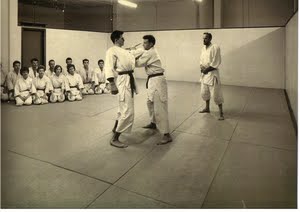

What is an 'air punch'? The Urban Dictionary (apologies for the less then credible source) defines an air punch as: the act of throwing a punch in the air intended for someone or something, but without the physical contact.
Karate, kung fu, wing chun, taekwondo, etc., etc. all have their students standing in lines practicing their punches via air punches.
A recent blog on Japanese Jiu Jitsu: A Journey (http://japanesejiujitsu.blogspot.com.au/) raised the issue of keeping what is useful and discarding what is not, and the issue of how we decide between the two. The martial arts were developed by trail-and-error. Supposedly, those who discard the traditional techniques are doing so based on trial-and-error, although sometimes you have to question their 'trial'. That blog provided further support for my work. One way to evaluate methods we are unfamiliar with is by understanding the science behind the methods. The science is common to all methods; it is the essence of the methods and what makes them work, or not. What does science have to tell us about air punching; one of the most common ways to teach striking and kicking techniques in the martial arts.
A force is something that causes something to start, stop, speed up, slow down, or change direction. From a stationary position, a force is applied to an arm to start its journey and speed it up when punching. When the arm is extended and the punch is terminated, a force must have been applied to the arm to cause that arm to decelerate and stop. When we are talking about air punches we are talking about internal forces as no contact is made with another body or object which applies a force to that arm/fist. Internal forces start the punch and internal forces stop the punch.
All moving things possess kinetic energy. Energy can be neither created nor destroyed - it has to go somewhere. A moving air punch possesses kinetic energy. When a punch or kick stops moving it no longer possesses kinetic energy. Where did the kinetic energy go? It was absorbed by the puncher's body.
So, what are we training when we train air punches? We are training to apply a force to our arm to accelerate it in a particular direction and then to apply another force to decelerate and stop the arm, thereby doing 'work' on the arm and absorbing the kinetic energy in our own bodies.
Injury is defined by injury science as the exposure to energy in excess of the tissue's tolerance levels. Kinetic energy is transferred from one body or object to another via mechanical work. Mechanical work refers to force. A force is applied to another body or object which transfers the kinetic energy of the punch to the impacted body or object with an injury or damage resulting if the transferred kinetic energy is in excess of the impacted body or object's tolerance levels. The force applied to an impacted body is a different force to that applied to stop a punch without impacting another body.
A force is simply defined as a push or a pull. Pushing and pulling involves different muscles, as explained in Arthur Chapman's Biomechanical Analysis of Fundamental Human Movements. A force applied to stop an air punch has to be a pulling force, whereas a force applied to another body or object has to be a pushing force. By definition, the different actions have to involve different muscles.
A punch is designed to apply a force to another body or object, and to transfer the kinetic energy of the punch to the target. An air punch does not train the application of a force to another body or object. Rather, it trains the application of an internal force to decelerate and stop a punch, and thereby the absorption of the kinetic energy of the punch in the puncher's own body.
In addition, Newton's third law of motion states that for every action there is an equal and opposite reaction. Newton was referring to forces when he referred to actions and reactions. When we punch a body or object, the body or object 'punches' us back. The reaction force has to be absorbed in our own body otherwise it will cause a change in our motion or shape (the latter meaning deformation, or injury or damage). Air punching provides no experience of the reaction force exerted on us when punching.
The potentially deleterious effect of training air punching was brought home to me when I explored Bruce Lee's three-inch punch with two very experienced jujutsuka/aikidoka. One, who had trained for over 20 years, was literally rocked backwards when punching a thick text book held on his partner's chest. He had not trained, and had no appreciation of, the reaction force that accompanies a punch when impacting with another body or object.
An understanding of the science behind punching tells us that air punching is not punching.
I could leave the issue with the rather dramatic statement above. That would be the common approach. I would not abandon air punching simply based on the above argument, even as compelling as it is. Rather, I would look to air punching and ask, what is it actually training? After all, based on the traditional trial-and-error method, it appears to have some benefits. The trick is in understanding precisely what those benefits are. What the above analysis does demonstrate however, is that we have to train striking and kicking techniques by actually striking and kicking something. Otherwise, we are not training striking and kicking techniques.
Karate, kung fu, wing chun, taekwondo, etc., etc. all have their students standing in lines practicing their punches via air punches.
A recent blog on Japanese Jiu Jitsu: A Journey (http://japanesejiujitsu.blogspot.com.au/) raised the issue of keeping what is useful and discarding what is not, and the issue of how we decide between the two. The martial arts were developed by trail-and-error. Supposedly, those who discard the traditional techniques are doing so based on trial-and-error, although sometimes you have to question their 'trial'. That blog provided further support for my work. One way to evaluate methods we are unfamiliar with is by understanding the science behind the methods. The science is common to all methods; it is the essence of the methods and what makes them work, or not. What does science have to tell us about air punching; one of the most common ways to teach striking and kicking techniques in the martial arts.
A force is something that causes something to start, stop, speed up, slow down, or change direction. From a stationary position, a force is applied to an arm to start its journey and speed it up when punching. When the arm is extended and the punch is terminated, a force must have been applied to the arm to cause that arm to decelerate and stop. When we are talking about air punches we are talking about internal forces as no contact is made with another body or object which applies a force to that arm/fist. Internal forces start the punch and internal forces stop the punch.
All moving things possess kinetic energy. Energy can be neither created nor destroyed - it has to go somewhere. A moving air punch possesses kinetic energy. When a punch or kick stops moving it no longer possesses kinetic energy. Where did the kinetic energy go? It was absorbed by the puncher's body.
So, what are we training when we train air punches? We are training to apply a force to our arm to accelerate it in a particular direction and then to apply another force to decelerate and stop the arm, thereby doing 'work' on the arm and absorbing the kinetic energy in our own bodies.
Injury is defined by injury science as the exposure to energy in excess of the tissue's tolerance levels. Kinetic energy is transferred from one body or object to another via mechanical work. Mechanical work refers to force. A force is applied to another body or object which transfers the kinetic energy of the punch to the impacted body or object with an injury or damage resulting if the transferred kinetic energy is in excess of the impacted body or object's tolerance levels. The force applied to an impacted body is a different force to that applied to stop a punch without impacting another body.
A force is simply defined as a push or a pull. Pushing and pulling involves different muscles, as explained in Arthur Chapman's Biomechanical Analysis of Fundamental Human Movements. A force applied to stop an air punch has to be a pulling force, whereas a force applied to another body or object has to be a pushing force. By definition, the different actions have to involve different muscles.
A punch is designed to apply a force to another body or object, and to transfer the kinetic energy of the punch to the target. An air punch does not train the application of a force to another body or object. Rather, it trains the application of an internal force to decelerate and stop a punch, and thereby the absorption of the kinetic energy of the punch in the puncher's own body.
In addition, Newton's third law of motion states that for every action there is an equal and opposite reaction. Newton was referring to forces when he referred to actions and reactions. When we punch a body or object, the body or object 'punches' us back. The reaction force has to be absorbed in our own body otherwise it will cause a change in our motion or shape (the latter meaning deformation, or injury or damage). Air punching provides no experience of the reaction force exerted on us when punching.
The potentially deleterious effect of training air punching was brought home to me when I explored Bruce Lee's three-inch punch with two very experienced jujutsuka/aikidoka. One, who had trained for over 20 years, was literally rocked backwards when punching a thick text book held on his partner's chest. He had not trained, and had no appreciation of, the reaction force that accompanies a punch when impacting with another body or object.
An understanding of the science behind punching tells us that air punching is not punching.
I could leave the issue with the rather dramatic statement above. That would be the common approach. I would not abandon air punching simply based on the above argument, even as compelling as it is. Rather, I would look to air punching and ask, what is it actually training? After all, based on the traditional trial-and-error method, it appears to have some benefits. The trick is in understanding precisely what those benefits are. What the above analysis does demonstrate however, is that we have to train striking and kicking techniques by actually striking and kicking something. Otherwise, we are not training striking and kicking techniques.


