This post is inspired by my contemplation of emails that have been exchanged with friends regarding their disappointment with my isolation tendencies associated with burnout. I've thought about their frustrations which led me to a deeper understanding of this and other anxiety related conditions such as anxiety, depression and PTSD. It also has wider implications.
'I think now, looking back, we did not fight the enemy; we fought ourselves.' This is one of the final scenes from the Vietnam war movie, Platoon.
The martial arts often philosophically (and self righteously) suggest that the martial arts is designed to improve oneself by engaging in a battle with oneself. Not unlike many religions and philosophies.
Sun Tzu in The Art of War suggests that the odds of success in battle diminish depending on your knowledge of yourself and your enemy. Who is the enemy when you are battling yourself?
America prosecuted the war in Vietnam based on strategy developed during WWII in continental Europe. They did not know their enemy in Vietnam, hence, as Sun Tzu forecasted, they lost the war.
Who is your enemy when you are battling yourself? The understanding of your enemy is understood when the 'survival process model' I developed for my book is understood. Emotions are evolutionarily designed to override cognition. In fact, emotions evolved before cognition. Emotions are designed to promote survival. They are designed to do so without time consuming cognitive processes.
Emotions are designed to be an amoeba stimulus-response chain. No thought, just feel and act. Cognition is often involved in justifying the amoeba stimulus-response chain emotion, but that is just an attempt at justifying and amoeba stimulus-response reaction. There was no thought, there was just doing.
It is a battle between your recently evolved neocortex and your ancient amygdala. However, your ancient amygdala has an evolutionary advantage over your newly evolved neocortex. It is evolutionarily designed to override thought. This is the strategic assessment that needs to be understood in order to pursue success in this battle.
One of the aforementioned friends was quite disparaging of the benefits that 'book learning' provided. The suggestion was to 'just do.' This is not an uncommon attitude, particularly among the action oriented martial arts.
This attitude, unbeknown to these advisers, goes directly against Sun Tzu's advice. A constant theme throughout Tzu's work is to study. Know thy self, know thy enemy, know thy terrain, etc. To just do is a sign of immature strategy. America 'just did' in Vietnam. On the other hand, Ho Chi Minh studied the strategy and tactics of the Algerians who succeeded in ejecting the French colonial power from Algeria.
Experience is limited. It is limited by your experience. I do not bow exclusively to the altar of academia. However, I'm prepared to leverage my experience with the experience of others and 'see further by standing on the shoulders of giants.'
The war analogy is so useful in the martial arts and emotional disorder situations. The quote offered was that 'life is a war we cannot win.' How do you prosecute a war you cannot win? America is once again experiencing the same dilemma in Afghanistan and Iraq as it did in Vietnam in that they are wars they cannot win. Reference was made to the 'quality' of the fight. The Americans did not lose a battle in Vietnam, they just lost the war. Is Vietnam considered anything other than a failure?
I'm not criticising the advice offered by well meaning friends. I'm simply exploring the analogies because they are more telling then they could ever have imagined. The message here is that when we talk about fighting ourselves, we are often talking about our neocortex (cognition) fighting our amygdala (emotion). We have to appreciate the latter has an evolutionary advantage and develop our strategies accordingly. The Art of War has a lot to tell us in our battles with ourselves, but only when we correctly identify and understand our enemy.
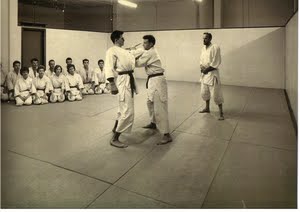
KOJUTSUKAN: The place for the study of martial art skills
Saturday, February 16, 2013


Tuesday, February 12, 2013
Sensei
This is a mediation on instructing and teaching. It was brought about when considering the objective of my book: to teach both teachers and students.
What does Sensei mean? Apparently it is translated as 'one who is born before.' This may be used in a literal or metaphorical sense. The person standing in front of the class was 'born' in that martial art before the students in front of them.
Sensei is also used to refer to a teacher and to show respect to someone who has achieved a certain level of mastery in an art form or some other skill. Teaching and mastery are very different qualities. A distinction that is lost on so many, including many sensei.
Those who know, do. Those that understand, teach.
Who do you want to be taught by? Those who can do or those who understand? The two are not necessarily related.
Morehei Ueshiba, founder of Aikido, was a brilliant practitioner. Reading some of the interviews or biographies of instructors that came after him commonly refers to confusion surrounding his teaching. On the other hand Jigoro Kano, founder of Kodokan Judo, is often considered a mediocre practitioner but without exception a great teacher.
Jan de Jong knew, and he did. He understood, and he taught. But was he a good teacher? A professional teacher who was also a senior instructor of De Jong's would explain to me that, technically, De Jong was not a good teacher.
'The mediocre teacher tells. The good teacher explains. The superior teacher demonstrates. The great teacher inspires.'
Using the above criteria, it cannot be questioned that De Jong was a great teacher. He inspired, not like modern coaches with pep talks and rousing speeches, nor 'tough love,' but through his sheer enthusiasm, interest and joy of what he taught and wanted to share with others.
Technically, I am a better teacher than De Jong. Inspiration wise, I'll never come close.
I know some experienced and knowledgeable martial artists and they worship practical ability while dismissing theory. There is a reason why many elite athletes do not go on to become coaches. They can do but they don't understand. Would you seek out Roger Federer to coach you in tennis or the coaches that produced Roger Federer?
'The best teachers are those who show you where to look, but don't tell you what to see.'
I may not be the inspirational teacher that De Jong was, but my work (including my book) most definitely is targeted at showing the teacher and student where to look. Most instructors only know how to do a particular move, they don't know the 'why' and therefore, if the student cannot replicate the instructor's actions the instructor is lost.
'Before I started (college), that's the advice my dad gave me. He said to pick classes based on the teacher whenever you can, not the subject...his point was that good teachers are priceless.'
Choose your instructor wisely. Be discerning. The teacher's ability is separate from their practical ability.
A practitioner has a 'use-by date,' a teacher with understanding does not.
What does Sensei mean? Apparently it is translated as 'one who is born before.' This may be used in a literal or metaphorical sense. The person standing in front of the class was 'born' in that martial art before the students in front of them.
Sensei is also used to refer to a teacher and to show respect to someone who has achieved a certain level of mastery in an art form or some other skill. Teaching and mastery are very different qualities. A distinction that is lost on so many, including many sensei.
Those who know, do. Those that understand, teach.
Who do you want to be taught by? Those who can do or those who understand? The two are not necessarily related.
Morehei Ueshiba, founder of Aikido, was a brilliant practitioner. Reading some of the interviews or biographies of instructors that came after him commonly refers to confusion surrounding his teaching. On the other hand Jigoro Kano, founder of Kodokan Judo, is often considered a mediocre practitioner but without exception a great teacher.
Jan de Jong knew, and he did. He understood, and he taught. But was he a good teacher? A professional teacher who was also a senior instructor of De Jong's would explain to me that, technically, De Jong was not a good teacher.
'The mediocre teacher tells. The good teacher explains. The superior teacher demonstrates. The great teacher inspires.'
Using the above criteria, it cannot be questioned that De Jong was a great teacher. He inspired, not like modern coaches with pep talks and rousing speeches, nor 'tough love,' but through his sheer enthusiasm, interest and joy of what he taught and wanted to share with others.
Technically, I am a better teacher than De Jong. Inspiration wise, I'll never come close.
I know some experienced and knowledgeable martial artists and they worship practical ability while dismissing theory. There is a reason why many elite athletes do not go on to become coaches. They can do but they don't understand. Would you seek out Roger Federer to coach you in tennis or the coaches that produced Roger Federer?
'The best teachers are those who show you where to look, but don't tell you what to see.'
I may not be the inspirational teacher that De Jong was, but my work (including my book) most definitely is targeted at showing the teacher and student where to look. Most instructors only know how to do a particular move, they don't know the 'why' and therefore, if the student cannot replicate the instructor's actions the instructor is lost.
'Before I started (college), that's the advice my dad gave me. He said to pick classes based on the teacher whenever you can, not the subject...his point was that good teachers are priceless.'
Choose your instructor wisely. Be discerning. The teacher's ability is separate from their practical ability.
A practitioner has a 'use-by date,' a teacher with understanding does not.
Friday, February 1, 2013
Mokuso

However, I've had cause to consider mokuso. Mokuso means meditation. It is often announced/instructed at the beginning of many Japanese martial arts classes, and mokuso yama (cease meditation) if often announced/instructed at the end of those classes.
Mokuso is a life lesson that has far more usefulness than the martial arts instruction.
Mokuso is designed to prepare us to live in the moment in order to attend to what we need to attend to. We leave your troubles at the door.
I have a natural mokuso moment when I go surfing. All my troubles, and believe me I have many, are left behind the sand dunes. When I go surfing it is only me and the beach and the surf. Everything else melts away. When I return behind the sand dunes, the troubles are still waiting, but they are somehow easier to deal with. They have been put into perspective.
Mokuso can enahnce that experience. Mokuso is about consciously choosing to live in the moment. We can all think and do things that theory explains, but theory helps us do it consciously rather than haphazardly. Now when I go surfing, I close my eyes and perform mokuso so that I deliberately leave my troubles behind me.
Try it at your work desk when your personal life intrudes. Try it at your home life when your work intrudes. Try it when your entire life intrudes on your entire life.
Mokuso.
Saturday, January 12, 2013
Professional Combat Sports Amendment Act 2011
The Professional Combat Sports Amendment Bill 2009 was passed by Parliament in October 2011. This new legislation establishes broader regulatory coverage of combat sports in WA and ensures that all combat sports contestants enjoy the same level of health and safety controls that have been enjoyed by professional contestants under the Professional Combat Sports Act 1987.
The new legislation was to come into effect on 1 July 2012 however some delays have been encountered with the finalisation of the regulations and the approval of rules. At this time the current unamended version of the Professional Combat Sports Act 1987 is still in effect with the new legislation coming into force in the coming months.
It should be noted that this new legislation only applies to actual combat sport contests as defined by the legislation. The legislation does not apply to training sessions, in gym sparring, martial arts classes or fitness classes with a combat sport feel.
The Department of Sport and Recreation and the Professional Combat Sports Commission (PCSC) will work with the industry to ensure that all parties are educated, informed and supported through the transitional phase leading up to the roll out of the new legislation.
Should you have any queries regarding the legislation please contact Greg McGuire at the Department of Sport and Recreation on 9492 9746 or via email at combatsport@dsr.wa.gov.au
I have a question for Mr McGuire. Does the Commission actually know what they are doing?
Don't get me wrong. I am no anti government, big brother, conspiracy theory type. I simply object to ignorance and stupidity.
The Commission's 2012 annual report states that 'the structure of the Commission is a vital enabling element of the broader governance system. The structure refers to the size and composition of the Commission, including independence, the presence of commissioners and has regard for the balance of gender, cultural diversity, skills and experience.' Apparently actually knowing anything about the safety of combat sport participants is secondary to the Government mandate for political correctness and equality.
The 2012 annual report lists the Commission representatives. What is the one position that is vacant?: Nominee of the medical of the Australian Medical Association. There is not one member on the Commission that has any detailed knowledge of possible injuries.
The Chair is a lawyer. He specialises in criminal law. The previous Chair was a lawyer who likewise specialised in criminal law. I met him and he is simply an ambitious lawyer using the Commission for ambitious purposes. How is it that lawyers insinuate themselves into the nooks and crannies of everyday life? They are like rats. At the very heart of their profession is disingenousness. They do not argue a position because they believe in it, they argue it for the sake of arguing it.
We then have a representative from the WA Police Force. Why? Surely the legal aspect of governance is covered by the lawyer.
Next we have the Nominee of the Director General of the Department of Sport and Recreation. Fair enough. You have to have a department representative, even if they know nothing about the actual thing that is attempting to be governed.
Next we have industry representatives. Seriously?!? The martial arts and combat sports are bereft of understanding of the 'why' of what they do. They are very good at the how, but the physiological or anatomical effects of their techniques, they haven't a clue. All you have to do is reference the literature associated with these activities to see the desert that is the knowledge associated with these activities. Even scratch the surface of the literature that has attempted to explain the physiological or anatomical effects of these methods and you will see that they are uninformed.
Of the many, many questions the Commission should be considering is the use of neck holds/shime waza. If forensic pathology and law enforcement authorities around the world consider these techniques to be lethal force, how can they be sanctioned in competition. It is illegal to use lethal force in competition. And please reader, do not simply refer to the ignorant public who influence policy. If you read the research and literature on this subject you'll understand their stance is not influenced by public opinion.
Do not get me wrong, I am not arguing for or against the use of these techniques. What I am arguing is that this is an obvious quandary that any proper Commission should be considering, but because of the uninformed nature of this Commission, they don't even recognise it is an issue.
Good luck combat sports, for you are now governed by an uninformed Commission.
Friday, January 11, 2013
Shime Waza and Neck Restraints - Update of the Update
I previously posted a post on shime waza/neck restraints and then posted an update on that post. This post is an update on that update.
In the update, I referred to a study - Mechanism of loss of consciousness during vascular neck restraint - published in the Journal of Applied Physiology. A Force Science News article expressed views that this study was the definitive study on shime waza/neck restraints that target the lateral aspects of the neck. In my post, I suggested that the authors did not address the issue of jugular vein occlusion which the Pi panel had suggested was more important than carotid artery occlusion in the loss of consciousness. They did not.
I contacted one of the authors of the study concerning this issue. They generously replied to my correspondence and informed me why. As it turns out, the study is a definitive study, they just don't do a very good job of establishing the definitive nature. You have to work to appreciate that definitive nature.
The Pi panel base their argument on three legs. Firstly, on a study by Reay and Matthews which involved five FBI Special Agents. Not surprising given that Pi, in addition to being an MD is also an FBI Special Agent. This study is in no way conclusive, however, this in itself does not invalidate the Pi conclusions. Secondly, they rely quite heavily on the fact that it takes more pressure to occlude the carotid arteries than the jugular veins. They suggest that venous occlusion halts the cerebral circulation with the net effect being similar to the occlusion of the forward blood flow of the carotid arterial system. What happens when the arterial and venous blood flow are restricted? They are silent on that issue. Thirdly, their argument relies heavily on the presence of petechiae. Ely and Hirsh clearly demonstrate that conjunctival and facial petechiae are the product of purely mechanical vascular phenomena, unrelated to asphyxia or hypoxia. The loss of consciousness appears to be related to carotid artery occlusion while petechiae appears to be related to venous occlusion after a relatively prolonged period of time. The Pi panel fail to provide any reference for the clinically ‘observed’ petechiae with carotid restraint techniques.
The Mitchell et al study is definitive. They, and the Force Science article, simply do a poor job of promoting the definitive nature of the study.
As an aside, I love this world. This world where you study, research, think, apply, develop ideas. Where you talk to like-minded individuals who are so generous with their time and are happy to share their work with you. You have to do the requisite work beforehand, however, having done that they are, in the majority, happy to share their knowledge with you. I will miss this world when I am forced to return to the mundane real world.
In the update, I referred to a study - Mechanism of loss of consciousness during vascular neck restraint - published in the Journal of Applied Physiology. A Force Science News article expressed views that this study was the definitive study on shime waza/neck restraints that target the lateral aspects of the neck. In my post, I suggested that the authors did not address the issue of jugular vein occlusion which the Pi panel had suggested was more important than carotid artery occlusion in the loss of consciousness. They did not.
I contacted one of the authors of the study concerning this issue. They generously replied to my correspondence and informed me why. As it turns out, the study is a definitive study, they just don't do a very good job of establishing the definitive nature. You have to work to appreciate that definitive nature.
The Pi panel base their argument on three legs. Firstly, on a study by Reay and Matthews which involved five FBI Special Agents. Not surprising given that Pi, in addition to being an MD is also an FBI Special Agent. This study is in no way conclusive, however, this in itself does not invalidate the Pi conclusions. Secondly, they rely quite heavily on the fact that it takes more pressure to occlude the carotid arteries than the jugular veins. They suggest that venous occlusion halts the cerebral circulation with the net effect being similar to the occlusion of the forward blood flow of the carotid arterial system. What happens when the arterial and venous blood flow are restricted? They are silent on that issue. Thirdly, their argument relies heavily on the presence of petechiae. Ely and Hirsh clearly demonstrate that conjunctival and facial petechiae are the product of purely mechanical vascular phenomena, unrelated to asphyxia or hypoxia. The loss of consciousness appears to be related to carotid artery occlusion while petechiae appears to be related to venous occlusion after a relatively prolonged period of time. The Pi panel fail to provide any reference for the clinically ‘observed’ petechiae with carotid restraint techniques.
The Mitchell et al study is definitive. They, and the Force Science article, simply do a poor job of promoting the definitive nature of the study.
As an aside, I love this world. This world where you study, research, think, apply, develop ideas. Where you talk to like-minded individuals who are so generous with their time and are happy to share their work with you. You have to do the requisite work beforehand, however, having done that they are, in the majority, happy to share their knowledge with you. I will miss this world when I am forced to return to the mundane real world.
Sunday, January 6, 2013
Shime Waza, Neck Holds and Neck Restraints - Update

A comment was gratefully received in response to the previous post directing me to an article discussing a recent study published in the Journal of Applied Physiology: 'Mechanism of loss of consciousness during vascular neck restraint.'
The Canadian Police Research Centre Neck Restraint Literature Review listed advantages and disadvantages of using neck restraints. One of the listed disadvantages was: 'During litigation, it is difficult to precisely explain to a jury the physiological effects of neck hold procedures due to an inadequate base of medical evidence.' This is very true. Even though the author of the abovementioned article and comment refer to the study in glowing terms, the study failed to consider the effects, if any, of the occlusion of the jugular veins.
Riviello suggests that because only 4.4 lbs of pressure is needed to compress the jugular veins compared to 11 lbs to cut off blood supply from the carotids, almost all cases of carotid compression include jugular compression. In these cases, the blood supply continues from the vertebral arteries, but no drainage can occur. Riviello explains that the faces of these victims often appear blue as a result of vascular constriction and that because of the raised venous pressure in the face and neck, these victims usually have petechiae on their face, eyelids and conjunctiva.
Dr John Pi (who is also an FBI Special Agent) organised and led a panel of medical personnel to research the carotid restraint and, among other things, create a better understanding of the medical explanation for its effectiveness. The panel suggest that a common misconception is that carotid artery occlusion is the primary and only mechanism responsible for the rapid loss of consciousness. The Pi panel suggest that rather than carotid artery occlusion, jugular vein occlusion and stimulation of the carotid sinus are the principle causes of a rapid loss of consciousness when this technique is applied.
Carotid sinus stimulation is a lot more controversial than the artery vs vein debate.
The Pi panel suggests venous occlusion effect is similar to the occlusion of the forward blood flow of the carotid arterial system. They suggest that the venous occlusion mechanism correlates with the clinical effects of facial flushing, distended veins above the point of occlusion and conjunctival petechiae observed with carotid restraint techniques in the past. They suggest that occlusion of the carotid arteries leads to pale discolouration.
Which is it? Red face, blue face or pale face? The latter two are easily understandable albeit associated with different mechanisms. But why would the face flush when either or both the carotid arteries and jugular veins are occluded? With respect to the jugular vein being occluded, it would be expected that the face would turn blue due to deoxygenated blood not being able to flow from the face.
Despite the enthusiasm of the authors of the original mentioned article and comment, there are still questions which the study does not answer.
Wednesday, January 2, 2013
Fist or Open Hand?

One of the things studied in that study was the difference between striking with a fist or an open hand.
The force and force impulse of both forward and overhead strikes were not different when the subjects struck with a fist or an open palm.
Although the forcefulness of a strike can be important to the outcome of a fight (e.g. accelerating the body, knocking an opponent off their feet; or accelerating the head, causing unconsciousness or a concussion), local tissue damage, such as bone fracture and contusion, is produced not by force but by stress (force per area)
The striking surface area of a fist is less than one-third the area of the whole hand and ~60% of the area of the palm. This means that if the total force applied in a strike is the same, then the stress in the targeted tissue will be 1.7 to 3.0 times greater in a fist strike than in a palm strike. Thus, although striking with a fist appears not to result in more forceful strikes, fists increase the peak stresses that are imposed on the target and, therefore, the potential for injury.
One thing that is not lacking in the martial arts is opinions. One thing that is lacking is authoritative facts. Studies like this, and hopefully my work, goes towards increasing the martial arts body of knowledge with facts rather than more opinions.
Subscribe to:
Posts (Atom)