The linked article was published today in The Age concerning a road rage incident experienced by a lawyer. It is a wonderful example by which the survival process concept I've developed by integrating the theories of fight-or-flight, stress and emotion theory can be used to gain greater insights and understanding.
When physically confronted, the lawyer explains that 'the savage instinct of fight/flight battered against the calmer, resolution-seeking side of my mind.' Lets dissect this statement with reference to the survival process concept.
'Instinct of fight/flight' refers to our evolved survival mechanism. A stimulus is unconsciously appraised. Based on that appraisal, a feeling response is elicited which motivates an impulse to act in a particular way. At the same time, an automatic physiological response is experienced which prepares the body for the behaviour that the feeling response motivates. The behaviour is designed to deal with the stimulus. This is our evolved survival mechanism.
The lawyer, even given their training to be exact with the use of their terminology, incorrectly refers to fight/flight. Many people who refer to the fight-or-flight concept do not understand that Walter Cannon, the developer of this concept, associated fight with anger and flight with fear. So, what was the lawyer's instinctive reaction - anger or fear? The different emotions are elicited based on different appraisals and produce different action tendencies which are supported by different physiological responses designed to prepare the body for different behaviours.
The lawyer was correct in referring to it as an instinct. Emotions were developed in our evolutionary past to deal with survival problems in the environment without the time consuming cognitive process. Is the instinct 'savage'?
We are all still 'cave people in suits.' We have changed our environment, but we have not evolved to adapt to that environment. The aggressor was prepared to physically engage the lawyer because of action tendency elicited by his appraisal of the lawyer beeping his car horn at him which in turn elicited the emotion of anger. Emotions were designed by nature to deal with threats to our well-being. Honking a car horn at someone is not a threat to our well-being, but some of us have not evolved to distinguish between the two.
Why did the lawyer describe this evolved instinct, albeit misdescribed, as 'savage.' He is placing a judgement on his instincts. Technically, savage is defined by violence and aggression. Flight is not violence or aggression. Savage is also defined as being uncivilised. 'Civilised' refers to a judgement about a stage of development that is considered to be more advanced. Now this refers to (a) interventions in the appraisal process in order to elicit certain emotions in response to certain stimuli, and/or (b) the ability to manage emotions once they are elicited.
The latter is what the lawyer was referring to when he wrote about the calmer, resolution-seeking side of his mind. There is a disconnect in humans between the impulse to act and the actual behaviour. This disconnect has been described as providing the opportunity of considered other behaviours other than the feeling-motivated impulse to act. Rather than fleeing or fighting the road rager, the lawyer was provided the opportunity to consider alternative behaviours because of this disconnect.
Some people obviously have a limited disconnection between impulse to act and actual behaviour. It is said that the difference between animals and humans is the disconnect between impulse and behaviour. Animals experience the emotion process in terms of a stimulus-response chain. I suppose technically you could say that those people who react in terms of a stimulus-response chain are closer to animals than humans.
'The only sensible outcome was to talk my way out of this. Be calm, swallow my pride, engage him so as to placate him.' Be calm - all of the components of the survival process are interrelated. A stimulus is appraised as a threat which elicits a feeling of fear which motivates an impulse to flee. At the same time, a physiological response is experienced which increases both heart rate and breathing rate to increase the amount of oxygenated blood that is provided to the muscles that will aid in flight. By intervening in the physiological response by voluntarily controlling his breathing, the lawyer was able to manage his feeling of fear and its associated impulse to act, along with the other physiological reactions and even the appraisal of the stimulus.
'Swallow my pride' - now that is an interesting comment. Pride is an emotion, hence, pride is based on an appraisal and elicits a feeling which motivates an impulse to act which a physiological reaction prepares the body to enact. What does 'swallow your pride' actually mean? I'd suggest it means to deal with the emotion of humiliation which is elicited based on the appraisal of the stimulus. The question then to consider is why are you feeling humiliated?
I recently watch the classic movie with Ben Kingsley playing Gandhi. In that movie, it shows line after line of Gandhi followers moving towards the military armed with large clubs who then clubbed the passive protesters. Did they swallow their pride when they were beaten and dragged away blooded and injured. No. In fact, they were probably proud of their non-violent action. Funnily enough, armed with an understanding of pain (which is another chapter in my book), they probably experienced the 'pain' associated with the beating far differently than you or I would under different circumstances.
Listen to what people say. It often says more about them than it does about what they are talking about. 'Swallow my pride' tells me the lawyer feels bad to a certain degree about not standing up to his aggressor/attacker. There is a judgement associated with his appraisal of the situation. Take an objective view of the experience or change the way you appraise the situation, and their is no more swallowing of pride.
'Engage him so as to placate him' - emotions are evolutionarily designed to be short lived. If you can stall someone from enacting their emotionally motivated action for a short period of time, the intensity of the emotion or the emotion itself would have subsided. This then provides the opportunity for cognition to be engaged. Remember, emotion is evolutionarily designed to override cognition; the latter being a later development in human evolutionary history.
The more we understand of the survival process, the less we will judge ourselves and others, and the more we will be able to manage our emotions in emotionally excitable circumstances.
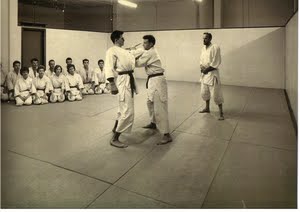
KOJUTSUKAN: The place for the study of martial art skills
Wednesday, March 20, 2013


Monday, March 18, 2013
Kansetsu Waza Assistance Request
I only need a small piece of information to complete my book which facilitates the understanding and study of all fighting/self defence methods. I'm using this blog to request any reader's assistance in this regard.
I'm writing a chapter on joint-locking techniques (kansetsu waza), focusing on techniques applied to the upper limb because of their popular and tactical use. Incredible as it may seem given the popularity of these techniques, to the best of my knowledge there is no anatomical description of these techniques in the martial arts and related literature.
The medical literature is of no help because the vast majority of injuries that occur in the upper limb are as a result of a fall on an outstretched hand (FOOSH injuries). The forces experienced when falling on an outstretched hand are different to those applied with a joint locking technique. For instance, a fall on an outstretched hand involves an extended hand whereas most joint-locking techniques involve a flexed hand.
I've described the anatomical effect of techniques that target the shoulder based on the movement of the humerus in the shoulder joint. This produced a classification that can be used to understand and study familiar and unfamiliar techniques that target the shoulder joint.
I've described the possible dislocations (3) that techniques targeting the elbow might produce.
 There is a technique that targets the forearm taught in aikido and some jujutsu systems. This technique is called kote hineri (forearm twist; see right) in Jan de Jong jujutsu and involves applying forces to the hand to rotate the forearm towards the body. I thought obtaining an anatomical description of the effects of this technique would prove the most difficult to obtain, but it turned out to be the easiest. A researcher was interested in the effects of hyper-pronation of the forearm and published the results of a study in 1949. He used 18 cadavers and stripped the forearm of the tissues andheld the shaft of the humerus firmly in a vice and the forearm was gripped in a wooden clamp just above the wrist and slowly pronated.
 I'm interested in three basic wrist locks. The first is the popular wrist crush (see right), also known as 'goose-neck' wrist lock, and gokyo (fifth teaching) in aikido. A study was conducted on this technique and published in an academic journal so I have some information on the possible anatomical effects of this technique. However, it has to be said the study was a little light on.
 The second wrist lock is what De Jong referred to as yoko tekubi hishigi (side wrist lock; see right and down), which aikido refers to as nikyo (second teaching). A study on the possible anatomical effects of this technique was published in an academic journal by the above author of the study on gokyo and another by another author. Again, these studies are not as comprehensive as they might be.
The third wrist lock is the ubiquitous wrist twist (see below right). I have no information on the anatomical effects of this technique other than a general possible explanation provided by a physiotherapist. While I would appreciate information on the above two wrist locks, it is a description of the anatomical effects of the wrist twist that I am missing. If any reader could assist with a description from an authoritative source (anatomist, biomechanist, etc), I would be very appreciative. You would be contributing to the general body of knowledge because no such description appears to exist today.
 Thank you.
I'm writing a chapter on joint-locking techniques (kansetsu waza), focusing on techniques applied to the upper limb because of their popular and tactical use. Incredible as it may seem given the popularity of these techniques, to the best of my knowledge there is no anatomical description of these techniques in the martial arts and related literature.
The medical literature is of no help because the vast majority of injuries that occur in the upper limb are as a result of a fall on an outstretched hand (FOOSH injuries). The forces experienced when falling on an outstretched hand are different to those applied with a joint locking technique. For instance, a fall on an outstretched hand involves an extended hand whereas most joint-locking techniques involve a flexed hand.
I've described the anatomical effect of techniques that target the shoulder based on the movement of the humerus in the shoulder joint. This produced a classification that can be used to understand and study familiar and unfamiliar techniques that target the shoulder joint.
I've described the possible dislocations (3) that techniques targeting the elbow might produce.
 There is a technique that targets the forearm taught in aikido and some jujutsu systems. This technique is called kote hineri (forearm twist; see right) in Jan de Jong jujutsu and involves applying forces to the hand to rotate the forearm towards the body. I thought obtaining an anatomical description of the effects of this technique would prove the most difficult to obtain, but it turned out to be the easiest. A researcher was interested in the effects of hyper-pronation of the forearm and published the results of a study in 1949. He used 18 cadavers and stripped the forearm of the tissues andheld the shaft of the humerus firmly in a vice and the forearm was gripped in a wooden clamp just above the wrist and slowly pronated.
  I'm interested in three basic wrist locks. The first is the popular wrist crush (see right), also known as 'goose-neck' wrist lock, and gokyo (fifth teaching) in aikido. A study was conducted on this technique and published in an academic journal so I have some information on the possible anatomical effects of this technique. However, it has to be said the study was a little light on.
 The second wrist lock is what De Jong referred to as yoko tekubi hishigi (side wrist lock; see right and down), which aikido refers to as nikyo (second teaching). A study on the possible anatomical effects of this technique was published in an academic journal by the above author of the study on gokyo and another by another author. Again, these studies are not as comprehensive as they might be.
The third wrist lock is the ubiquitous wrist twist (see below right). I have no information on the anatomical effects of this technique other than a general possible explanation provided by a physiotherapist. While I would appreciate information on the above two wrist locks, it is a description of the anatomical effects of the wrist twist that I am missing. If any reader could assist with a description from an authoritative source (anatomist, biomechanist, etc), I would be very appreciative. You would be contributing to the general body of knowledge because no such description appears to exist today.
Friday, March 15, 2013
The Effect of Sexual Assault Statistics
 Most women's self defence courses (WSD) begin by informing the participants of the horrendous statistics associated with sexual assault. It could be argued this is problem solving 101: identify the problem and then provide a solution. It could also be argued that this is a marketing or motivational ploy in motivating the participants to enrol and actively learn and participate. But is this approach the best approach?
Jocelyn Hollander from the University of Oregan , based on her experience in teaching about violence against women, explains how she adopted the traditional approach of making a strong case about the pervasive and devastating nature of such violence. However, she found that 90% of her mostly female students felt disempowered by such information. The students felt vulnerable and that violence was inevitable. Emphasising women's victimisation reinforced the cultural fusion of femininity as vulnerability, weakness, and fragility.
Another source of discomfort for Hollander with her original approach was her increasingly firm belief that emphasizing women’s victimisation at the hands of men was, at best, telling only a partial story. According to a literature she had initially overlooked, women's victimisation is pervasive but not inevitable. For example, women successfully resist at least 75% of all attempted sexual assaults; in other words, they escape, they stop the violence, and they protect themselves as much as possible.
Hollander modified her original approach:
Together, these strategies help balance students' feelings of vulnerability and futility when learning about violence and provide a more complex picture of the realities of violence in women's lives. Information on women's resistance to violence included in class readings and lectures helps counter the myth that women can never defend themselves from men's violence and helps expand the students' understandings of resistance to include emotional, psychological, and verbal strategies. ... Information on those changes that have occurred challenges the sense of futility and powerlessness that often produces frozen inaction.An approach I'm adopting is based on the evolved survival process concept I have developed. I've been thinking how I'd start a seminar or WSD course by asking the participants to raise their hand if they thought they were defenceless against a male attacker. I'd then explain that if they were truly defenceless, there would be no human race.
Nature provided a very sophisticated, comprehensive and effective defence mechanism for human beings. It involves an appraisal process that, if a stimulus is defined as a threat, elicits a feeling response which motivates an instinctive defensive behaviour that an automatic physiological reaction prepares the body to enact. There are numerous behaviours - flight, fight, tonic immobility, faint, help-seeking, submission, etc - that are evolved, instinctive defensive behaviours. These behaviours are supported by a different physiological response that supports the behaviour and promotes the survival of an individual.
The appraisal process is all important. It is made up of three parts: primary appraisal, secondary appraisal, and reappraisal. Primary appraisal results in a stimulus being appraised as irrelevant, benign-positive or stressful. Stressful appraisals are appraised as being harmful, threatening or challenging, and are subject to a secondary appraisal. Secondary appraisal determines the abilities and resources to deal with the harm, threat or challenge.
Constantly reinforcing a person's vulnerability changes their unconscious appraisal of their resources and abilities to deal with a threat. This shapes the feeling, physiological and behavioural responses to a threat in terms of its nature and intensity. If you don't believe you can defend yourself you won't be able to. You won't be able to take advantage of nature's defence mechanism to promote your own survival because your 'learned' appraisal tells you that you cannot defend yourself.
My approach is based on explaining to participants that nature provided them with a very effective defence mechanism. Society tends to undervalue and undermine this defence mechanism by the constant reporting of successful attacks on women in the news media as well as entertainment (movies, TV, books, etc). If our evolved survival responses are undermined, it reduces the possibility that those behaviours which are evolutionarily designed to promote survival and have done so successfully for thousands of years, will not be enacted when they are needed the most.
My approach goes on to say that the education and training I provide in my women's self protection program is designed to improve on nature. Nature's efforts is already effective, but it's usefulness is under-reported by the sensationalist and fear-provoking (which motivates sales) news media. I deliberately use the term 'protection' instead of 'defence' because my approach is holistic. It is based on injury science theory in which an injury event is divided into three phases: pre-event, event, and post event. It's also based on all the factors involved in an injury event: host (person at risk), vector or vehicle (person or object that can cause injury), and environment (physical and cultural).
Do not discount nor dismiss what nature gave you. Instead, learn more about what nature gave you and build on that.
Friday, March 8, 2013
Killer Commando
 There is a fascinating article published on various news websites concerning a former Australian commando's (Paul Cale) developing a leading edge military close combat system based on martial arts. This could be read in conjunction with an interview with the same person in the Australian martial arts magazine, Blitz.
The original story is fascinating to me, not because of its 'warrior' story but because of the sheer nuts and bolts of it all which my work either informs or raises questions.
Cale tells of an incident in Afghanistan that became a hand-to-hand battle in which he strangled a Taliban fighter. Technically, despite the posted comments to the article, at no time does the article say that the strangulation killed the fighter. However, assuming it did, I'd be fascinated to know the details, not out of some morbid curiosity but from a purely technical point of view.
The forensic pathology literature time line proposed for neck holds/strangulation techniques/shime waza is approximately 10 seconds to unconsciousness, 2 minutes and will resuscitate unaided, 2-4 minutes and manual resuscitation will be required, 3-4+ minutes death.
Was the strangulation held on for 3-4 minutes to cause death? That's a long time to hold a technique in the middle of a combat scenario with multiple combatants. Or was the technique held on for long enough (approx. 10 secs) to induce unconsciousness and then released before the enemy was dispatched by another means? That is to say the strangulation facilitated a decisive technique and was not the decisive technique in and of itself.
This then raises the question concerning how this technique is taught to be tactically employed in a close combat system.
If the time line proposed by the forensic pathology discipline is mistaken, given they've no personal experience in using the technique to cause a fatal injury, Cale's experience would be a unique contribution to the body of knowledge.
Cale talks about breaking an enemy fighter's shoulder. Again, I'd love to know how as I've developed a simply anatomical classification that explains the mechanics of how a shoulder is dislocated by any technique that targets the shoulder taught by any martial art, combat sport, or activity associated with preparing a person to survive a violent encounter. This understanding then, through experience, facilitates the understanding, study, and use of the technique as you know precisely what your application of force(s) is designed to achieve (more than beyond 'break elbow').
Cale talks about the military kit not being suited for being engaged in hand-to-hand combat and that he developed a method which caters for this limitation. It is disturbing when you see any military close combat, law enforcement empty hand control training, and martial arts being used in those two environments, when the techniques taught to be used in an operational environment are trained wearing outfits that are not worn in operational environments (e.g. uniform with no kit or sports attire). I would dearly love to see Cale's modifications to his martial arts methods to cater for the wearing of the cumbersome military kit.
Cale makes the very important point that the combat sport is only used to train a combat ethos. It is a part of his overall training methodology. It is important to understand what the training produces. Combat sports does not teach combat methods. To be sure, there are overlaps, but there is also significant differences, as Cale points out. Many in the martial arts worship 'action,' 'doing things,' and disregard an intellectual study of what they are doing. Because you struggle and train with resistance, sweat, feel pain, get injured, injure and inflict pain, bleed and cause bleeding, does not mean that your training is preparing you for an operational environment. It most definitely trains a mind set, or a warrior ethos as Cale refers to it as, but the tactics and techniques may not 'fit' the operational environment.
Injury science's division of the factors of an injury event - host (person at risk of being injured), vector (person attempting to cause an injury), and the environment - forces you consider all of these factors. The martial arts tends to ignore the latter two factors, which then affects the development of the tactics and techniques of that martial art.
Taking Cale's methodology a step further based on injury science's methodology. You train your close combat methods in your military kit. Should your training partner do likewise? The Taliban fighter is not going to be similarly attired. If you develop tactics and techniques based on an enemy being similarly attired (and similarly trained), they may be flawed. A similar argument is applicable for the environment factor (dojo/training hall vs closed confines of a room in a house in Afghanistan).
The father-of-two said his program also helped returned soldiers suffering with Post Traumatic Stress Disorder. "It's very calming and we find a lot of guys are coming to classes just to unwind and release the pressure valve," he said. "I'm broken, injured and a little bit older than most. For me it's all about technique and being calm and centred. Our psychologists are looking into the calming effect and apparently there's been a body of work done on this issue and US veterans."In the Blitz article, Cale refers to 'stress relief.' Stress is a limited concept. It looks at a survival mechanism that was selected for in nature to promote an individual's survival. Stress only looks at part of that mechanism, and from a biased viewpoint. Even those involved in the stress discipline describe stress and an ambiguous concept.
The survival process model I've developed provides a holistic approach to study the calming effects produced by combat sports training Cale refers to. Stress training, and some PTSD recovery programs, use an academic understanding of stress and stress effects/symptoms to help manage them. The survival process model, due to its comprehensive/holistic nature, improves on the stress approach.
Thursday, February 28, 2013
Autogenic/Combat/Tactical Breathing

A physiological control technique that is taught by Survival Activities is breath control. Grossman refers to this technique as 'tactical breathing' and suggests that extensive feedback confirms that tactical breathing has saved many lives. He explains that it is an easy-to-do technique that can be used in stressful situations to 'slow your thumping heart beat, reduce the tremble in your hands, ... and to bathe yourself with a powerful sense of calm and control.' Siddle refers to this technique as 'combat breathing' and suggests that numerous studies indicate that voluntary changes in breathing pattern can modify an individual's ability to cope with fear-provoking situations and reduce anxiety under stressful conditions. He argues that combat breathing should be a mandatory component of survival and combat training. Christensen suggests that the technical term for this technique is 'autogenic breathing' and explains that SWAT officers report using it before making high-risk forced entries, and soldiers use it to bring calm to their minds and bodies before they go into battle and after the battle to 'come down' from the adrenalin rush.The above is an excerpt from my book. How does autogenic/combat/tactical breathing work to produce these calming effects? How it works can be understood by referring to the survival process.
The survival process is a model I've developed based on the integration of fight-or-flight, stress and emotion theory. It involves an appraisal process that elicits a feeling, physiological, impulse to act and behavioural response that this designed to influence the initiating stimulus. All the components in the survival process are highly interconnected. Influence one component and you can influence another or all of the other components.
How controlling breathing produces calming effects can be understood by the interconnectedness of the components of the survival process. A stimulus is perceived as a threat eliciting a feeling of fear with an accompanying physiological reaction. Among the physiological reactions is an increase in heart and breathing rates which are designed to increase the amount of oxygen being supplied to the muscles required to flee the threat. Controlling the breathing rate intervenes in the physiological response. This intervention influences the feeling response as well as the other physiological responses as well as the appraisal of the initiating stimulus.Autogenic breathing needs to be taught and practiced/trained (Crucial Elements of Firearms Training by B.R. Johnson).
I would teach my students that when they felt under pressure in any form of reality based training that if they start to feel overwhelmed to take a step back and suck in a breathe or two. Everything calms down with those breathes because controlling the physiological response affects the feeling response and the appraisal of the stimulus.
Friday, February 22, 2013
80% of killers known to their victims
I came across a newspaper article titled '80 percent of killers know their victims':
http://www.theage.com.au/victoria/80-per-cent-of-killers-known-to-their-victims-20130221-2eudm.html
Injury science is a relatively new science that studies the causes of injury (including fatal injuries). Injury is studied in terms of all the factors that contribute to an injury: the host, agent (vector or vehicle), and environment.
The host is the person at risk of being injured. While not technically correct for the sake of this post, the agent is defined as the vector or vehicle. The vector is the person who is injuring the host and the vehicle is the object that injures the host. The environment consists of the physical as well as the social, etc.
The World Health Organisation presents a relevant explanation of these factors in causing an injury. This is an extract from my book:
For the most part, the vector is largely ignored which means by default it becomes someone trained in the same martial art. Judo teaches defences against judo attacks, karate teaches defences against karate attacks, wing chun teaches defences against wing chun attacks. How self defence oriented is this approach?
Sun Tzu in The Art of War suggests that our odds of success in battle decrease as our knowledge of ourself or our enemy decreases. Most martial arts are very knowledgeable about themselves. Who is the enemy? This is an important question because the strategies, tactics and techniques developed, taught and trained reflects the knowledge of the enemy, explicitly or implicitly.
Who is our enemy? According to the above article, the enemy is an acquaintance or domestic (e.g. partner) and the method of violence is 39% knife attacks or 25% beaten. Does your martial art cater for that scenario? Does your self defence course cater for that scenario? Does your 'real fighting' training cater for that scenario?
My point is that if the focus is on self defence, it behoves us to get to know our enemy. To question the underlying assumptions of the activities that purports to teach us self defence.
http://www.theage.com.au/victoria/80-per-cent-of-killers-known-to-their-victims-20130221-2eudm.html
Injury science is a relatively new science that studies the causes of injury (including fatal injuries). Injury is studied in terms of all the factors that contribute to an injury: the host, agent (vector or vehicle), and environment.
The host is the person at risk of being injured. While not technically correct for the sake of this post, the agent is defined as the vector or vehicle. The vector is the person who is injuring the host and the vehicle is the object that injures the host. The environment consists of the physical as well as the social, etc.
The World Health Organisation presents a relevant explanation of these factors in causing an injury. This is an extract from my book:
The WHO suggest that the epidemiological model can be used to analyse an act of interpersonal violence where a person slaps another person. In this case the host is the person slapped, the agent is the kinetic energy (slap), the vector is the person who does the slapping, and the environment includes the domestic situation and the societal norms or values that make such behaviour acceptable. These factors interact to cause an injury. Using a model of this type can help to identify all the factors involved in an injury from interpersonal violence.In the martial arts, the host is the martial artist. Who is the vector? This is an important question because the strategies, tactics and techniques developed and taught by the martial art are determined by the definition of the vector.
For the most part, the vector is largely ignored which means by default it becomes someone trained in the same martial art. Judo teaches defences against judo attacks, karate teaches defences against karate attacks, wing chun teaches defences against wing chun attacks. How self defence oriented is this approach?
Sun Tzu in The Art of War suggests that our odds of success in battle decrease as our knowledge of ourself or our enemy decreases. Most martial arts are very knowledgeable about themselves. Who is the enemy? This is an important question because the strategies, tactics and techniques developed, taught and trained reflects the knowledge of the enemy, explicitly or implicitly.
Who is our enemy? According to the above article, the enemy is an acquaintance or domestic (e.g. partner) and the method of violence is 39% knife attacks or 25% beaten. Does your martial art cater for that scenario? Does your self defence course cater for that scenario? Does your 'real fighting' training cater for that scenario?
My point is that if the focus is on self defence, it behoves us to get to know our enemy. To question the underlying assumptions of the activities that purports to teach us self defence.
Tuesday, February 19, 2013
How to Help Survivors of Sexual Assault
I read the following article first on a news website and then followed the link to the original source:
http://goodmenproject.com/guy-talk/how-i-stopped-being-an-angry-feminist-and-started-loving-men/#A1JfjkdciMjESLkV.99
What I found interesting is what the author describes as helping her during what she describes as her 'recovery journey.' These are interesting and informative extracts:
My brother steadfastly believed what happened to me and validated how much I was impacted by being molested. The simple act of witnessing me in my pain helped me heal. And so did the mac and cheese he made me when I was sad, and the hours of Nintendo-playing we did when I was too down to do anything else.
My best male friend from college was by my side through the darkest days of my healing journey. After every therapy session, he helped me process what I was learning about myself. He saw me through the powerful emotions that went along with those lessons. He told me he loved me 10 times a day. He stood by my side when I told my story for the first time in public at a Take Back the Night event on our campus. He learned that while he couldn’t “fix” me, he could love me, and that his love would help me become whole again.
Simple acts of friendship and love are powerful tools that help survivors of sexual violence trust and heal.
They want to help, but feel powerless – and afraid to say or do the wrong thing.
The author's best male friend had to learn he couldn't 'fix' her. We tend to offer advice that is intended to help fix the problem but it appears from this experience that even though we may feel powerless, it's enough just to be there.
http://goodmenproject.com/guy-talk/how-i-stopped-being-an-angry-feminist-and-started-loving-men/#A1JfjkdciMjESLkV.99
What I found interesting is what the author describes as helping her during what she describes as her 'recovery journey.' These are interesting and informative extracts:
My brother steadfastly believed what happened to me and validated how much I was impacted by being molested. The simple act of witnessing me in my pain helped me heal. And so did the mac and cheese he made me when I was sad, and the hours of Nintendo-playing we did when I was too down to do anything else.
My best male friend from college was by my side through the darkest days of my healing journey. After every therapy session, he helped me process what I was learning about myself. He saw me through the powerful emotions that went along with those lessons. He told me he loved me 10 times a day. He stood by my side when I told my story for the first time in public at a Take Back the Night event on our campus. He learned that while he couldn’t “fix” me, he could love me, and that his love would help me become whole again.
Simple acts of friendship and love are powerful tools that help survivors of sexual violence trust and heal.
They want to help, but feel powerless – and afraid to say or do the wrong thing.
The author's best male friend had to learn he couldn't 'fix' her. We tend to offer advice that is intended to help fix the problem but it appears from this experience that even though we may feel powerless, it's enough just to be there.
Subscribe to:
Posts (Atom)