Do you teach this in your martial arts or self defence class?
http://www.viraldoza.com/man-got-mugged-train-station-next-genius/#
How do you teach this attitude?
I'm no expert, but the first thing I'd suggest is the Buddhist non-judgemental approach. Don't judge. Judgements are so destructive and debilitating.
Secondly, adopt Plato's quotation: Be kind, for everyone is fighting a hard battle.
The man in the story is more of a 'man' than any physical fighter.
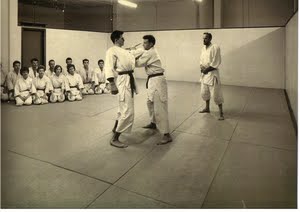
KOJUTSUKAN: The place for the study of martial art skills
Friday, February 28, 2014


Thursday, February 13, 2014
1% of rapes are committed by strangers
I tried to insert an image but for what ever reason I could not. The image was of advertisements for women's self defence (WSD) courses that advertised:
Scenario Based Training Approach: The Situation Determines The Solution.
There was a picture accompanying the advertisement of an attacker with a knife attacking a woman in a car. Another one was titled:
Reality Based Training: Sexual Assault; Rape; Street Robbery; Armed, Multiple Assailants; We Have The Solutions.
'Scenario based training.' 'The situation determines the solution.' 'Reality based training.' 'We have the solutions.'
The NSW Rape Crisis Centre executive officer, Karen Willis, is quoted as saying that 1% of rapes are committed by strangers.
So the scenario, the reality, the solution for WSD courses should be predicated on an attack from a familiar - partner, date, friend, colleague, family member, etc - rather than a stranger. Are WSD courses predicated on this fact? No.
Sun Tzu in The Art of War said that if you know yourself and know your enemy then you will not be imperilled in 100 battles. The odds decrease as your knowledge of yourself and your enemy decrease. Who is the enemy in the case of WSD courses?
WSD courses; WSD strategies should include assaults by familiars and well as strangers. The responses to deal with the situation should be different. The relationships, the fall-out, the relative power is different, so, the solutions should be different.
I'm developing a WSD course that is based on fact not myth. It is a tried and tested marketing strategy to scare the bejesus out of potential WSD participants by quoting the horrifying statistics of sexual assault against women. Unfortunately, that is with no study of those statistics. The approach I'm developing is based on fact not fiction. It's an evidenced based approach. It's not good marketing because I explain how nature has provided each and every one of us with an effective defence mechanism. The evidence to that fact is that the human race exists today. The first lesson is designed to inform the participant that they are already capable of surviving an attack. Not necessarily defending it off but surviving it. After all, nature does not judge and is only interested in our survival. People judge, and consequently people suffer. My WSD course will then try and improve on nature.
Scenario Based Training Approach: The Situation Determines The Solution.
There was a picture accompanying the advertisement of an attacker with a knife attacking a woman in a car. Another one was titled:
Reality Based Training: Sexual Assault; Rape; Street Robbery; Armed, Multiple Assailants; We Have The Solutions.
'Scenario based training.' 'The situation determines the solution.' 'Reality based training.' 'We have the solutions.'
The NSW Rape Crisis Centre executive officer, Karen Willis, is quoted as saying that 1% of rapes are committed by strangers.
So the scenario, the reality, the solution for WSD courses should be predicated on an attack from a familiar - partner, date, friend, colleague, family member, etc - rather than a stranger. Are WSD courses predicated on this fact? No.
Sun Tzu in The Art of War said that if you know yourself and know your enemy then you will not be imperilled in 100 battles. The odds decrease as your knowledge of yourself and your enemy decrease. Who is the enemy in the case of WSD courses?
WSD courses; WSD strategies should include assaults by familiars and well as strangers. The responses to deal with the situation should be different. The relationships, the fall-out, the relative power is different, so, the solutions should be different.
I'm developing a WSD course that is based on fact not myth. It is a tried and tested marketing strategy to scare the bejesus out of potential WSD participants by quoting the horrifying statistics of sexual assault against women. Unfortunately, that is with no study of those statistics. The approach I'm developing is based on fact not fiction. It's an evidenced based approach. It's not good marketing because I explain how nature has provided each and every one of us with an effective defence mechanism. The evidence to that fact is that the human race exists today. The first lesson is designed to inform the participant that they are already capable of surviving an attack. Not necessarily defending it off but surviving it. After all, nature does not judge and is only interested in our survival. People judge, and consequently people suffer. My WSD course will then try and improve on nature.
Wednesday, February 12, 2014
Update
I'm back.
My computer was 'hijacked' by hijackware and the remedy including industrial strength security prevented me from entering blogger to post posts. All has been remedied and I'm back.
In the mean time, I've had four articles posted in Blitz, Australia's premier martial arts magazine. Two articles are biomechanically based and two are based on fight-or-flight and fear. The latest is a two part article on the ways that have been developed to overcome fear by activities associated with violence. It involves the strategic use of emotion.
I'm working on an article that provides an evolutionary explanation of passive responses to rape. It was always in the back of my mind to write this article but a recent episode of Law & Order: UK prompted me to (a) write the article, and (b) to contact the writer of the episode. It turns out, the writer wrote the episode based on being group raped age 14.
More to come.
My computer was 'hijacked' by hijackware and the remedy including industrial strength security prevented me from entering blogger to post posts. All has been remedied and I'm back.
In the mean time, I've had four articles posted in Blitz, Australia's premier martial arts magazine. Two articles are biomechanically based and two are based on fight-or-flight and fear. The latest is a two part article on the ways that have been developed to overcome fear by activities associated with violence. It involves the strategic use of emotion.
I'm working on an article that provides an evolutionary explanation of passive responses to rape. It was always in the back of my mind to write this article but a recent episode of Law & Order: UK prompted me to (a) write the article, and (b) to contact the writer of the episode. It turns out, the writer wrote the episode based on being group raped age 14.
More to come.
Saturday, September 7, 2013
Zhuge and Fight-or-Flight

Those who are skilled in combat do not become angered, those who are skilled at winning do not become afraid. Thus the wise win before they fight, while the ignorant fight to win.Most martial arts would subscribed to this view, however, there is more to this than initially meets the eye.
Anger and fear and their accompanying physiological response were selected for in nature because they conferred a survival advantage on an individual. It's better known as the fight-or-flight response (which is the subject of my article in Blitz this month). Back in the first century, Zhuge is suggesting that these emotions have become maladaptive and now confer a survival disadvantage on an individual.
Before Zhuge was Sun Tzu. He advises that 'in order to kill the enemy, our men must be roused to anger.'
The berserker warrior tradition is a 3,000 year old, cross-cultural phenomenon whereby warriors deliberately enflame their emotions to rage to fight.
Many women's self defence courses teach to turn fear into anger.
Major Greg Mawkes OAM wrote that the SAS are taught to have controlled aggression. Aggression, according to Plutchik, is a combination of anger and anticipation. Anger is a negative emotion and anticipation is a positive emotion.
In Osama Bin Laden: Shoot to Kill, an ex-Navy SEAL explains that the SEALs would have experienced an adrenalin surge, but never fear. The adrenalin surge suggests and emotion is being experienced. Which one? Possibly aggression.
Aggression and violence are often divided into emotional and instrumental. Instrumental violence involves no emotional arousal. It is a well establish phenomenon in the natural world.
No emotion means no physiological response which prepares the body to fight or flee (among other behaviours). The SNS activation and hormonal cascade increases speed, strength, endurance, blood clotting abilities, and pain tolerance. Zhuge's approach, instrumental violence, does not obtain the survival advantages of these physiological responses that accompany emotional arousal.
The above are examples of fighting traditions that are not entirely prepared to forgo the survival benefits that nature bestowed upon us.
Nature's survival mechanism involves emotion, physiological reaction and instinctive behavioural responses. Fighting traditions teach tactics and techniques that are learned behaviours, but they have to be supported by an appropriate emotion and physiological reaction. What emotion do you train for, and why?
Monday, September 2, 2013
Updating Fight-or-Flight - Magazine Article
The July edition of Blitz, Australia's #1 martial arts magazine, published my article on force and how it helps understand all techniques in the martial arts.
The August edition of Blitz will contain an article of mine titled Updating Fight-or-Flight.
Many martial arts, self defence, security, law enforcement and military instructors refer to fight-or-flight. Most have a limited and flawed understanding of the concept. In fact, the fight-or-flight concept itself is limited and flawed. My article remedies those deficiencies.
'Those who are skilled in combat do not become angered, those who are skilled at winning do not become afraid' - Zhuge Liang, Chinese military strategist, 181-234.
While many martial arts, etc., will concur with Zhuge, there are some and some warrior traditions that do not. A more complete understanding of the fight-or-flight concept enables us to better understand Zhuge's comment and the teachings of the martial arts and other activities associated with preparing a person to survive a violent encounter.
The August edition of Blitz will contain an article of mine titled Updating Fight-or-Flight.
Many martial arts, self defence, security, law enforcement and military instructors refer to fight-or-flight. Most have a limited and flawed understanding of the concept. In fact, the fight-or-flight concept itself is limited and flawed. My article remedies those deficiencies.
'Those who are skilled in combat do not become angered, those who are skilled at winning do not become afraid' - Zhuge Liang, Chinese military strategist, 181-234.
While many martial arts, etc., will concur with Zhuge, there are some and some warrior traditions that do not. A more complete understanding of the fight-or-flight concept enables us to better understand Zhuge's comment and the teachings of the martial arts and other activities associated with preparing a person to survive a violent encounter.
Monday, August 26, 2013
Friday, July 12, 2013
What Are You Training When You Train?

Repetition is the bedrock of martial arts training. Many in the martial arts and other sports refer to 'muscle memory.' MUSCLES DO NOT HAVE MEMORY. The reference to muscle memory is a way for people who don't know the 'why' of techniques or training to explain the why of techniques or training. It is a constant source of amusement when my work on understanding the why of techniques is derided and yet those same deriders then attempt to explain the why of the tactics and techniques they are teaching. The why explanation that is anecdotal at best.
The brain is 'plastic.' Neuroplasticity refers to the ability of the brain to create new neuroconnections throughout its life. Habits are well established neuroconnections. If you want to create new habits, you need to create new neuroconnections. You then need to reinforce them with repetition.
The brain changes physically (anatomy) and functionally (physiologically). It's not just about 'the way we think.' Training is about changing the physical and functional characteristics of the brain.
Your training is developing new neuroconnections and reinforcing those neuroconnections. That is why visualisation works to improve your physical performance. The brain changes itself. You visualise your physical activity and that is establishing and reinforcing those new neuralconnections. There have been studies done were people how have never played an instrument have learnt to play that instrument without physically playing it.
There is training that trains the body - pushups, etc - however, the skill training, while you may think it is physical training, is actually mind training.
Subscribe to:
Posts (Atom)