Book #2 is tentatively titled: Fear and Fight: Understanding Our Natural and Learned Responses to a Threat. It integrates the theories of fight-or-flight, stress, emotion, and cognition in order to develop a survival process model that can be used to explore and explain our natural and learned responses to a threat. Our learned responses are in fact interventions in the survival process.
At the same time as I was researching and writing this book, I was diagnosed with anxiety and panic disorder. The mechanism responsible for these disorders is the same one responsible for our natural responses to a threat, therefore, I have a unique perspective as I have the opportunity of studying it from the inside and out.
Grossman explains how soldiers often fall asleep after battle not through exhaustion but due to a 'parasympathetic backlash.' In the heat of battle the sympathetic nervous system (fight-or-flight) is activated due to the emotions of fear, anger, or excitement being experienced. Immediately the action is passed the parasympathetic nervous system (rest-and-digest) is activated to counter the SNS symptoms and a return to homeostasis.
Emotion is all about homeostasis.
The other night, I experienced my own parasympathetic backlash. We moved house, a stressful event for most people but an absolute nightmare for someone suffering anxiety. Heightened anxiety, panic attacks, nausea, vomiting, trembling, narrowed cognitive and reasoning abilities, the works. That was extended because our property managers are attempting a 'cash grab' by using our security bond money to landscape the property garden.
I obsessively commenced a campaign against the property managers, and I do mean obsessive. However, when we received the final property condition report and security bond disposal documentation which revealed a lot less than I thought was going to be retained my anxiety dissipated. It is then that I can see how much the anxiety takes over my body and mind. That night I virtually passed out in front of the television at 7.30. Unheard of. It was a parasympathetic backlash experienced after my battle was over and the threat removed.
The final chapter in my book applies the information used to understand our natural and learned responses to a threat to anxiety with the aid of my own experience. My parasympathetic backlash experience will make its way into that chapter.
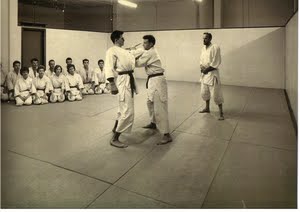
KOJUTSUKAN: The place for the study of martial art skills
Friday, May 4, 2018


Thursday, April 19, 2018
Turn Fear Into Anger, Spite, Hate in Order to Turn Flight Into Fight
After submitting my manuscript, The Science Behind Fighting Techniques, to a publisher, I have been working on book #2, Fear and Fight: Understanding Our Natural and Learned Responses to a Threat. For the past few days I've been working on the chapter looking at an article about the strategic use of emotion to counter fear in war.
The five strategies in the paper are:
Changing terror back to fear through rational discourse.
The creation of anger.
The creation of spite.
Threat of shame.
Inculcation of hope.
The first strategy is not strictly a strategic use of emotion to counter fear in war. It is a distraction strategy to take your mind of the threat stimuli.
The other four strategies are about turning fear into another emotion that promotes fight behaviour rather than fight behaviour.
Emotion is not just a feeling state. It is a process whereby an appraisal elicits a subjective feeling that motivates an instinctive behaviour that an automatic physiological reaction prepares the body to enact. The output of the process is the effect on the stimulus in order to return to an equilibrium state.
Each of the four strategic uses of emotion to counter fear in war target the appraisal component of the emotion (survival) process. They are interventions in the appraisal component of the emotion (survival) process.
Turning fear into anger is taken straight from nature's playbook. Many people who refer to the fight-or-flight concept, including the authors of the paper under review, associate both fight and flight with fear. Why would you need to counter fear in war if fight is an instinctive behaviour associated with fear? The founder of the fight-or-flight concept associated flight with fear but fight with anger. It has been found that the first impulse when threatened is to flee and fight is only engaged in when flight has been obstructed. That is, in fact, what Sun Tzu and a general from the 30 year war suggested to do in order to get your soldiers to fight. Cut off all means of retreat. Burn bridges, boats, etc.
Lazarus and Lazarus refer to spite as being part of the 'anger family.' It is similar to anger in motivating fight behaviour but it is different in that is a different type of fight behaviour. Solomon warns against using spite as a strategic use of emotion to counter fear in war and to turn flight into fight because it is a 'malicious envy with a wicked twist.'
Plutchik's psychoevolutionary theory of emotion contains eight primary emotions and by combining them they produce different emotions. Fear and Anger are among the eight primary emotions.
Spite (contempt) = disgust + anger
Envy = sadness + anger
Outrage = surprise + anger
Aggression = anticipation + anger
Pride = joy + anger
Dominance = trust + anger
Welcome to the anger family. They all have a common parent, anger, and its action tendency of fight. What makes them different, and what makes the fight behaviour different with different goals is anger's 'mate.'
There is more to this, however, this is the insight I gained last night. By writing about it on this blog I am also delving deeper into the theory I am creating.
The five strategies in the paper are:
Changing terror back to fear through rational discourse.
The creation of anger.
The creation of spite.
Threat of shame.
Inculcation of hope.
The first strategy is not strictly a strategic use of emotion to counter fear in war. It is a distraction strategy to take your mind of the threat stimuli.
The other four strategies are about turning fear into another emotion that promotes fight behaviour rather than fight behaviour.
Emotion is not just a feeling state. It is a process whereby an appraisal elicits a subjective feeling that motivates an instinctive behaviour that an automatic physiological reaction prepares the body to enact. The output of the process is the effect on the stimulus in order to return to an equilibrium state.
Each of the four strategic uses of emotion to counter fear in war target the appraisal component of the emotion (survival) process. They are interventions in the appraisal component of the emotion (survival) process.
Turning fear into anger is taken straight from nature's playbook. Many people who refer to the fight-or-flight concept, including the authors of the paper under review, associate both fight and flight with fear. Why would you need to counter fear in war if fight is an instinctive behaviour associated with fear? The founder of the fight-or-flight concept associated flight with fear but fight with anger. It has been found that the first impulse when threatened is to flee and fight is only engaged in when flight has been obstructed. That is, in fact, what Sun Tzu and a general from the 30 year war suggested to do in order to get your soldiers to fight. Cut off all means of retreat. Burn bridges, boats, etc.
Lazarus and Lazarus refer to spite as being part of the 'anger family.' It is similar to anger in motivating fight behaviour but it is different in that is a different type of fight behaviour. Solomon warns against using spite as a strategic use of emotion to counter fear in war and to turn flight into fight because it is a 'malicious envy with a wicked twist.'
Plutchik's psychoevolutionary theory of emotion contains eight primary emotions and by combining them they produce different emotions. Fear and Anger are among the eight primary emotions.
Spite (contempt) = disgust + anger
Envy = sadness + anger
Outrage = surprise + anger
Aggression = anticipation + anger
Pride = joy + anger
Dominance = trust + anger
Welcome to the anger family. They all have a common parent, anger, and its action tendency of fight. What makes them different, and what makes the fight behaviour different with different goals is anger's 'mate.'
There is more to this, however, this is the insight I gained last night. By writing about it on this blog I am also delving deeper into the theory I am creating.
Wednesday, April 4, 2018
Anxiety and Courage
I'm working on book #2 which is about understanding our natural and learned responses to a threat.
Our natural response to a threat is fear. Fear was selected for in nature because it conferred a survival advantage on an individual. It is adaptive. However, with an anxiety disorder, fear becomes maladaptive.
The action tendency of fear is flight (or withdrawal). The military want fight. The go-to response for the military to overcome fear in war is courage.
Courage is most often defined in terms of acting in spite of fear.
I have a diagnosed anxiety disorder. Not pleasant to say the least, however, I use it to study the mechanism responsible for fear from the inside as well as outside.
I have the perfect storm going on. I am moving house and I have an anxiety condition. Anyone who tells you that anxiety is nervousness does not know what they are talking about. Anxiety can be debilitating, not allowing you to function. You can't breathe, you are petrified. Of what? Amygdala has identified a threat in the environment but does not necessarily tell neocortex what that threat is.
Back to courage. If courage is acting in spite of fear, and anxiety is fear of something that is not actually a threat, is acting in spite of something that is not actually a threat courage?
One of the chapters in my book looks at a paper on the strategic use of emotion to overcome fear in war. The first strategy is not actually a strategic use of emotion to overcome fear. It's the use of 'rational discourse,' but actually refers to distraction.
I put that strategy into action on Monday when I was having a panic attack. I watched the football game. It took a half of football before I could focus on the game, but it finally worked.
Another strategic use of emotion to overcome fear is the 'inculcation of hope.' I have studied hope and discuss it in my book. There is a calculus to hope. Hope = willpower to change something + waypower.
I operate on willpower and do not experience hope. Intellectually I know I can do something that I fear but that does not reach amygdala and so the emotion of hope is not elicited.
Our natural response to a threat is fear. Fear was selected for in nature because it conferred a survival advantage on an individual. It is adaptive. However, with an anxiety disorder, fear becomes maladaptive.
The action tendency of fear is flight (or withdrawal). The military want fight. The go-to response for the military to overcome fear in war is courage.
Courage is most often defined in terms of acting in spite of fear.
I have a diagnosed anxiety disorder. Not pleasant to say the least, however, I use it to study the mechanism responsible for fear from the inside as well as outside.
I have the perfect storm going on. I am moving house and I have an anxiety condition. Anyone who tells you that anxiety is nervousness does not know what they are talking about. Anxiety can be debilitating, not allowing you to function. You can't breathe, you are petrified. Of what? Amygdala has identified a threat in the environment but does not necessarily tell neocortex what that threat is.
Back to courage. If courage is acting in spite of fear, and anxiety is fear of something that is not actually a threat, is acting in spite of something that is not actually a threat courage?
One of the chapters in my book looks at a paper on the strategic use of emotion to overcome fear in war. The first strategy is not actually a strategic use of emotion to overcome fear. It's the use of 'rational discourse,' but actually refers to distraction.
I put that strategy into action on Monday when I was having a panic attack. I watched the football game. It took a half of football before I could focus on the game, but it finally worked.
Another strategic use of emotion to overcome fear is the 'inculcation of hope.' I have studied hope and discuss it in my book. There is a calculus to hope. Hope = willpower to change something + waypower.
I operate on willpower and do not experience hope. Intellectually I know I can do something that I fear but that does not reach amygdala and so the emotion of hope is not elicited.
Saturday, March 31, 2018
Moral and Physical Courage
The recent Australian cricket ball tampering scandal (sandpaper-gate) works as a case study for the 'enigma of courage' as General Sir Peter de la Billiere puts it in the forward to 2007 edition of Lord Moran's classic The Anatomy of Courage:
There is no doubt that the three cricketers involved in this cheating scandal possessed physical courage, but did they possess moral courage? The courage to stand up against the crowd, which in this case was the 'leaders' of the team.
I agree with de la Billiere. Moral courage is rarer than physical courage. As Mark Twain says, 'It is curious that physical courage should be so common in the world and moral courage so rare.'
Unfortunately the lack of moral courage is so common place that there is no lack of examples. Take for instance Senator Michaella Cash's weaselly 'apology' when she attacked the reputation of the women working for Bill Shorten. Unfortunately the lack of moral courage has become a feature of modern politics.
The martial arts teach physical courage, but does it teach moral courage. Many would sanctimoniously suggest that it does, but does it really? We teach physical courage. We develop ways and means of developing physical courage. But do we do the same with moral courage? And if so, how?
My experience with Jan de Jong's Self Defence School is that we were adept at teaching physical courage, however, some of the instructors demonstrated a lack of moral courage. How do we go about teaching moral courage?
PS: This post arises out of my work on the tentatively titled Fear and Fight: Understanding Our Natural and Learned Responses to a Threat.
Moral courage is higher and rarer in quality than physical courage. It embraces all courage, and physical courage flows from it. We are all faced with decisions requiring moral courage in our daily lives, even at home – disciplining and teaching our children for example. It is applicable in business, in law, within institutions such as schools and hospitals. It takes moral courage to stand up against the crowd, to assist a victim of bullying or to reveal negligence where others would prefer it to remain hidden. Moral courage implies the belief that what you are doing or saying is right, and are willing to follow through your conviction regardless of personal popularity or favour. So easy to expound, so demanding to achieve. In my experience a person of high moral courage will seldom fail to demonstrate an equally distinguished level of physical courage.
There is no doubt that the three cricketers involved in this cheating scandal possessed physical courage, but did they possess moral courage? The courage to stand up against the crowd, which in this case was the 'leaders' of the team.
I agree with de la Billiere. Moral courage is rarer than physical courage. As Mark Twain says, 'It is curious that physical courage should be so common in the world and moral courage so rare.'
Unfortunately the lack of moral courage is so common place that there is no lack of examples. Take for instance Senator Michaella Cash's weaselly 'apology' when she attacked the reputation of the women working for Bill Shorten. Unfortunately the lack of moral courage has become a feature of modern politics.
The martial arts teach physical courage, but does it teach moral courage. Many would sanctimoniously suggest that it does, but does it really? We teach physical courage. We develop ways and means of developing physical courage. But do we do the same with moral courage? And if so, how?
My experience with Jan de Jong's Self Defence School is that we were adept at teaching physical courage, however, some of the instructors demonstrated a lack of moral courage. How do we go about teaching moral courage?
PS: This post arises out of my work on the tentatively titled Fear and Fight: Understanding Our Natural and Learned Responses to a Threat.
Wednesday, March 28, 2018
Martial Arts Normalise Violence
There was an article published that said 'Australian doctors' want martial arts/combat sports banned because they normalise violence.
Many viewers of the Kojutsukan blog will be martial artists and will immediately object to that assertion and may even be insulted by it, however, I counsel you to objectively assess all assertions. Something that is not generally encouraged in the martial arts.
Is there anything inherently wrong with normalising violence?
The general idea behind the Australian doctors argument is that by normalising violence you encourage violence from those that have been normalised.
Women's self-defence. Based on that argument, women who participate in WSD courses are normalised to violence and are therefore more likely to be violent.
Based on that argument our prisons should be filled with ADF personnel.
Never reject a proposition out of hand. Consider it objectively. It often helps to consider the proposition in another setting.
Many viewers of the Kojutsukan blog will be martial artists and will immediately object to that assertion and may even be insulted by it, however, I counsel you to objectively assess all assertions. Something that is not generally encouraged in the martial arts.
Is there anything inherently wrong with normalising violence?
The general idea behind the Australian doctors argument is that by normalising violence you encourage violence from those that have been normalised.
Women's self-defence. Based on that argument, women who participate in WSD courses are normalised to violence and are therefore more likely to be violent.
Based on that argument our prisons should be filled with ADF personnel.
Never reject a proposition out of hand. Consider it objectively. It often helps to consider the proposition in another setting.
Monday, March 26, 2018
Mindset and Done!!!!!!
I am done! I have completed The Science Behind Fighting Techniques and am in the process of preparing the submission to a publisher. I am resisting the temptation to yet once again review this work. I am done.
In my last post, The Science Behind Kiai, I promised to share with the mindset necessary when attempting to use science to explain practice in the martial arts. Here is the extract from my conclusion in The Science Behind Fighting Techniques:
In my last post, The Science Behind Kiai, I promised to share with the mindset necessary when attempting to use science to explain practice in the martial arts. Here is the extract from my conclusion in The Science Behind Fighting Techniques:
What mindset or attitude should we adopt when attempting to use science to explain techniques? You may be horrified to know that I am about to refer to the Australian Auditing Standards (ASA) to answer that question. ASA 200 requires an auditor to adopt an attitude of ‘professional scepticism.’ Professional scepticism is defined in the Auditing Standards as ‘an attitude that includes a questioning mind, being alert to conditions which may indicate possible misstatement due to error or fraud, and a critical assessment of audit evidence.’ Professional scepticism is fundamentally a mindset. A sceptical mindset drives auditor behaviour to adopt a questioning approach when considering information and in forming conclusions.Scepticism and questioning are not generally encouraged in the martial arts, however, we must adopt that mindset and approach when attempting to use science to explain practice. This is no better explempified then my ‘so what’ questions of the science currently used in martial arts and biomechanical texts to explain punching and kicking techniques (see chapter 10). That questioning led me to injury science which provides the foundation for understanding all punching and kicking techniques taught by all activities associated with preparing a person to engage in a violent encounter (see chapter one) and those used in violence generally. This questioning approach also led me to question the injury science transfer of energy explanation of injury causation (see chapter nine) which in turn led me back to mechanical force (see chapters four and nine). This then enabled me to better understand the science behind breakfalling techniques (see chapter 12). However, there is a risk that adopting a sceptical mindset and questioning approach when considering the science behind fighting techniques and forming conclusions thereon might lead to the heretical adoption of the same mindset and approach to the how-to instruction. Although that scepticism and questioning would be based on a growing body of knowledge associated with why a martial arts technique works, which this book is designed to contribute to.
Any feedback gratefully received.
Sunday, March 18, 2018
The Science Behind Kiai
 Kiai is a Japanese term that is used to refer to a short yell or shout uttered when performing an attacking move. Why kiai?
The following is a draft of a passage included in the conclusion to my The Science Behind Fighting Techniques which is in the process of being submitted to a publisher. The conclusion calls on others to build on my work in building a body of knowledge about why a technique works in addition to how to perform the technique.
As I was in the process of concluding this book, Australian Ashleigh Barty played Belorussian Aryna Sabalenka in the 2018 Australian Open (tennis). The Belorussian’s powerful hitting and loud ‘grunting’ was cause for numerous articles on the issue to be published, one of which was by Damian Farrow (2018), professor of sports science at Victoria University: ‘All the racquet: What science tells us about the pros and cons of grunting in tennis.’ He reports that a number of studies have shown that ball velocity increases with hits accompanied by grunting. Can the findings in those studies be extended to kiai, a short yell or shout uttered in Japanese martial arts when performing an attacking move? Increased ball velocity means increased force is being applied when hitting the ball accompanied by a grunt. Can those findings be extended to prove that punches accompanied by a kiai apply increased force on impact? If so, how does a grunt/kiai generate more force on impact with a punch? This is an example of the current lack of biomechanical information associated with martial arts methods and how we may need to be inventive in developing that knowledge base in the absence of direct research.
There are those, many, who will have opinions on this martial arts question, however, they are only opinions. Uninformed opinions at that. My book is designed to turn the many uninformed opinions into informed opinions, which in the process will debunk many opinions.
The studies associated with tennis grunting confirm the increased
velocity of the tennis ball accompanied by grunting. They do not explain
where the additional force that was applied to the tennis ball was
generated from.
The answer to the increased force on impact lies within the concept of kinetic energy. KE is the energy of motion which is transferred on impact. KE is calculated as one half of the product of mass and velocity squared. So which one of the variables of KE does grunting/kiai impact on in order to increase the KE of the arm/racket thereby increasing the force on impact?
The tennis studies limited explanation is highly technical/incomprehensible, however, it would appear to point to grunting tightening the body core which increases the mass behind the tennis strike thereby increasing the force on impact resulting in the increased velocity of the tennis ball. In like manner, a kiai when punching might tighten the body core thereby increasing the mass behind a punch and the force on impact.
This would fit in with other studies on punching techniques in the martial arts that confirm that the difference in the velocities of punches by experienced and inexperienced practitioners is insignificant but the difference in the force applied on impact is significantly different. This difference is down to the experienced practitioners knowing how to contribute more mass behind their punches.
1. The findings in the studies above goes against everything that has been advised in martial arts and biomechanical texts in relation to punching techniques when referring to the biomechanical concept of KE.
2. There is a study published on the effects of kiap, the Korean equivalent of kiai, on gripping strength. A martial arts 'authority' refers to this study to confirm that kiap increases punching force on impact. It does not, as even the authors of the study acknowledge. It simply confirms that kiap increases gripping strength, so kiap away when grabbing someone. The tennis studies have more to suggest that kiai increases the force on impact than does the kiap study.
3. All of the above is an example of the mindset that is required when attempting to use science to explain martial arts practice. A mindset that is sadly lacking in current martial arts literature. That mindset will be the subject of the next post.
Subscribe to:
Posts (Atom)