I am currently working on the conclusion to Fear and Fight: Understanding Our Natural and Learned Responses to a Threat. An interesting question has arisen.
Colonel John M. House explains that soldiers must overcome their fear of death and injury in order to act and survive on the battlefield (Why War? Why an Army?). The way I describe it in my book (this week) is that fear impinges upon a person's readiness and ability to engage in and succeed in a fight. The same is true of all violent encounters.
I explain in the book that ironically, I had my first panic attack and was diagnosed with generalised anxiety disorder and panic disorder while researching and writing that book on the mechanism responsible for those disorders. While distressing and debilitating, this condition has enabled me to study our inherited survival mechanism from the inside out, which in turn enabled me to study our learned responses to a threat because they are often designed to thwart nature's survival efforts.
I have recently been prescribed sertraline. Sertraline is used to treat depression, panic attacks, OCD, PTSD, and anxiety disorders. It may decrease fear, anxiety, unwanted thoughts, and the number of panic attacks. In 2016, it was the most prescribed psychiatric medication in the United States with over 37 million prescriptions.
Soldiers must overcome their fear (and anxiety) of death and injury in order to act and survive on the battlefield. Fear and anxiety impinges upon a person's readiness and ability to engage in and succeed in a fight. If sertraline reduces or eliminates anxiety, fear, and panic, and is safe, why aren't soldiers and others such as front-line police officers given sertraline in order to counter fear and anxiety? Its legal, it just needs a prescription which I am sure is not an issue for the government. It'd be far easier and a lot cheaper than training such as stress exposure training that is designed to less negative reactions (anxiety and fear) under high stress conditions (combat) that impinge upon performance (fighting).
Women enroll in women's self-defence classes in order to reduce their anxiety and fear of being attacked. A big part of their training is overcoming fear in order to fight. Why not provide sertraline to manage that issue? No need to be threatened in training in order to learn to deal with fear.
Martial arts are supposed to teach ways to overcome or counter fear in order to fight. Sertraline would appear to take care of that problem.
A book on the short history of emotion suggests that these magic pills gets rid of Stoic and Buddhist teachings and discipline in terms of managing emotions, and of course you have to question the usefulness of psychotherapy given this magic pill deals with these issues. :)
It is an intriguing question. :) ... more so for me because if soldiers are not provided with sertraline given their line of work, why am I being prescribed sertraline to deal with my anxiety and panic disorders?
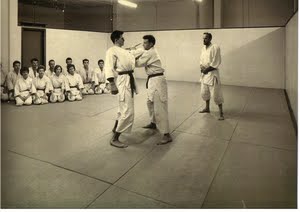
KOJUTSUKAN: The place for the study of martial art skills
Wednesday, March 4, 2020


Tuesday, November 12, 2019
The best advice EVER for managing fear, panic, and anxiety
I'm working on the conclusion to Fear and Fight: Understanding Our Natural and Learned Responses to a Threat. Our principal natural response to a threat is fear. Fear and anxiety are similar but different emotions, as I explain in my book. Panic is an extreme version of both fear and anxiety.
While researching a way of concluding the abovementioned book, I came across Schwartz and Vecchio's 'The basics of survival' in Schwartz, McManus, and Swenton's Tactical Emergency Medicine.
They explain that the first and most important element of survival is getting control of your thought processes. When perceived threats escalate,
Simple, effective. No jargon. No new world metaphysical concepts. Thousands of dollars in psychotherapy boiled down to a cup of tea by the British SAS. It is simply brilliant.
While researching a way of concluding the abovementioned book, I came across Schwartz and Vecchio's 'The basics of survival' in Schwartz, McManus, and Swenton's Tactical Emergency Medicine.
They explain that the first and most important element of survival is getting control of your thought processes. When perceived threats escalate,
How does one control these feelings of fear and panic? The British SAS recommends sitting down and making a cup of tea. This is a great response. Sitting down will stop one's haste ... Making tea forces one to break the chain of thought, which will continue to escalate toward panic. Once this chain of thought is broken and one's mind can be redirected, the person can later return to the original situation with a controlled and rational thought process.
Simple, effective. No jargon. No new world metaphysical concepts. Thousands of dollars in psychotherapy boiled down to a cup of tea by the British SAS. It is simply brilliant.
Friday, November 1, 2019
Holistic Martial Arts
I'm working on a chapter on stress training which is being increasingly used by the military and law enforcement to better prepare their personnel for operational deployment.
The first phase of stress exposure training and stress inoculation training is information provision which includes indoctrination where the usefulness of stress training is demonstrated to the trainee.
This can be achieved by explaining the relationship between stress training and learning to fight.
McCaughey explains that learning to fight involves the coordination of thinking, feeling, and acting. She also explain how most self-defence empahsise the physical but not the emotional and thinking. Various papers on stress training for the military say the same thing of traditional military training.
Stress training distinguishes between training and stress training. The way I explain the difference is that training is learning to fire a gun at a target whereas stress training is learning to fire a gun at a target that is firing at you.
Training = physical. Stress training = mental + emotional. Training + stress training = physical + mental + emotional.
This is an attempt at adopting a holistic approach to preparing a person to engage in a violent encounter.
The fighting trilogy also explains our natural response to a threat. The objective of our natural response to a threat is survival. The objective of 'Fight Activities' is to fight. To fight for a variety of reasons, including survival, but to fight nonetheless. They have to develop ways and means to counter our natural response to a threat. The target there is primarily the mental and emotional elements in the fight trilogy.
LeDoux refers to that as the conflict between evolutionary and cultural agendas. The evolutionary agenda is survival. The cultural agenda of Fight Activities is fight. They develop ways and means to resolve this conflict in agendas in their favour.
All Fight Activities training, including martial arts training, is at its heart a fight between our natural and learned responses to a threat.
The first phase of stress exposure training and stress inoculation training is information provision which includes indoctrination where the usefulness of stress training is demonstrated to the trainee.
This can be achieved by explaining the relationship between stress training and learning to fight.
McCaughey explains that learning to fight involves the coordination of thinking, feeling, and acting. She also explain how most self-defence empahsise the physical but not the emotional and thinking. Various papers on stress training for the military say the same thing of traditional military training.
Stress training distinguishes between training and stress training. The way I explain the difference is that training is learning to fire a gun at a target whereas stress training is learning to fire a gun at a target that is firing at you.
Training = physical. Stress training = mental + emotional. Training + stress training = physical + mental + emotional.
This is an attempt at adopting a holistic approach to preparing a person to engage in a violent encounter.
The fighting trilogy also explains our natural response to a threat. The objective of our natural response to a threat is survival. The objective of 'Fight Activities' is to fight. To fight for a variety of reasons, including survival, but to fight nonetheless. They have to develop ways and means to counter our natural response to a threat. The target there is primarily the mental and emotional elements in the fight trilogy.
LeDoux refers to that as the conflict between evolutionary and cultural agendas. The evolutionary agenda is survival. The cultural agenda of Fight Activities is fight. They develop ways and means to resolve this conflict in agendas in their favour.
All Fight Activities training, including martial arts training, is at its heart a fight between our natural and learned responses to a threat.
Tuesday, September 24, 2019
In response to a comment on post questioning when teaching martial arts became not enough
My previous post was regarding the focus, marketing driven, on fitness when teaching martial arts: 'When did teaching martial arts become not enough?' That focus is exemplified for me with the rebranding of my old school by its new principals from Jan de Jong Self Defence School to Jan de Jong Martial Arts Fitness.

The second chapter of Kodokan Judo is titled: 'Principles and Aims of Kodokan Judo.' The first section is titled: 'Judo as Physical Education.'
What has to be understood is that Kano was on a rescue mission when he developed Kodokan Judo. He studied traditional forms of jujutsu and despaired at the decreasing number of students studying jujutsu. Jujutsu was a Japanese cultural institution that was in danger of being lost to the Japanese people so Kano developed Kodokan Judo to appeal to the Japanese people in order to be a vehicle for them to then become interested in studying the traditional jujutsu.
One of the main marketing strategies that Kano adopted was to turn the traditional fighting art of jujutsu into a sport, and, a form of physical education. These were marketing strategies to generate interest by the current generation of Japanese so that they would then go on to study traditional jujutsu, the traditional cultural icon of the Japanese.
Those martial arts schools today who rebadge, rebrand, or focus on physical education, physical fitness, do not have such noble motives. It is purely a cynical marketing exercise to attract new students who are not necessarily interested in studying martial arts per se.
I will leave you with a comment that I received from a grand child of de Jong regarding this matter: 'I recall someone speaking of a conversation they had with my grand father who had come from another martial arts school and asked “why don’t you condition your fighters” and his response was something to the effect of “why would I condition my students when the intention is for the fight to go for the shortest time possible.”' De Jong to a T.
Monday, September 23, 2019
When did teaching martial arts become not enough?
When did teaching/learning martial arts become not enough? Is teaching/learning martial arts relevant anymore?
I am continually seeing fitness appended to martial arts when advertising or promoting one's teachings. My old school, or at least the school that emerged from my old school, rebranded itself from Jan de Jong Self Defence School to Jan de Jong Martial Arts Fitness. The WA Institute of Martial Arts advertises 'Martial Arts Fitness is here.' I just saw another advert/promotion directly coupling martial arts with fitness.
Is a dojo now also a gym? What is the focus of the teaching, martial arts or fitness? Do you ever see cricket, football, basketball etc directly coupled with fitness? 'Football fitness is here.' 'Netball fitness is here.' You don't see other physically activities desperately trying to establish relevance by appending their activity to fitness.
If the focus is on fitness, what impact does that have on martial arts teaching?
Efficiency is a feature of Jigoro Kano's teachings. Efficiency means less effort. The more efficient your tactics and techniques the less effort required to execute them. Does that mean that teachings which teach efficient tactics and techniques are less because they don't focus on fitness which requires more effort?
I understand the marketing impulse to try and extend the brand from martial arts to the fitness industry given the interest in martial arts appears to be waning. But does extending the brand mean that the brand loses meaning? Or that the product is over extended? Is aikido a means to get fit rather than to learn aikido?
When I teach, I am only interested in fitness insofar as it contributes to martial arts effectiveness. I am not interested in teaching fitness for the sake of fitness. If you are unfit and effective, it's all good to me. If you want to get fit, for whatever reason, join a gym. Go for a run. Stop driving your car and walk to work or school.
The two best instructors in the Jan de Jong Self Defence School were Shihan Jan de Jong and Sensei Greg Palmer. Nobody would ever accuse them of being fit, however, they were extremely effective as practitioners and most definitely as teachers. When I wanted to learn martial arts, I'd go to them before any of the other 'fit' instructors.
I am continually seeing fitness appended to martial arts when advertising or promoting one's teachings. My old school, or at least the school that emerged from my old school, rebranded itself from Jan de Jong Self Defence School to Jan de Jong Martial Arts Fitness. The WA Institute of Martial Arts advertises 'Martial Arts Fitness is here.' I just saw another advert/promotion directly coupling martial arts with fitness.
Is a dojo now also a gym? What is the focus of the teaching, martial arts or fitness? Do you ever see cricket, football, basketball etc directly coupled with fitness? 'Football fitness is here.' 'Netball fitness is here.' You don't see other physically activities desperately trying to establish relevance by appending their activity to fitness.
If the focus is on fitness, what impact does that have on martial arts teaching?
Efficiency is a feature of Jigoro Kano's teachings. Efficiency means less effort. The more efficient your tactics and techniques the less effort required to execute them. Does that mean that teachings which teach efficient tactics and techniques are less because they don't focus on fitness which requires more effort?
I understand the marketing impulse to try and extend the brand from martial arts to the fitness industry given the interest in martial arts appears to be waning. But does extending the brand mean that the brand loses meaning? Or that the product is over extended? Is aikido a means to get fit rather than to learn aikido?
When I teach, I am only interested in fitness insofar as it contributes to martial arts effectiveness. I am not interested in teaching fitness for the sake of fitness. If you are unfit and effective, it's all good to me. If you want to get fit, for whatever reason, join a gym. Go for a run. Stop driving your car and walk to work or school.
The two best instructors in the Jan de Jong Self Defence School were Shihan Jan de Jong and Sensei Greg Palmer. Nobody would ever accuse them of being fit, however, they were extremely effective as practitioners and most definitely as teachers. When I wanted to learn martial arts, I'd go to them before any of the other 'fit' instructors.
Saturday, July 27, 2019
Systemic Approach to Defensive and Offensive Aggression

A system is a set of related components that work together in a particular environment to perform whatever functions are required to achieve the system’s objective. There are four basic elements to a system: input, throughput (process), output, and feedback.
Our natural response to a threat is a system whose objective is survival - the 'survival system.' The survival system is comprised of cognition (appraisal), feeling, physiological arousal, impulses to action, and over behaviour components that are interconnected via feedback loops and which work together to achieve the objective of the system - survival.
McCaughey (Real Knockouts, 1997) explains that learning to fight involves the coordination of thinking, feeling, and acting. McCaughey is describing a 'fight system.' The fight system contains the same components as the survival system, however, the objective is to fight. To fight for a variety of reasons but to fight nonetheless. At the very least, the components of the fight system cannot work against the behaviour component (fight) if the objective of the fight system is to be realised.
An Australian female university student who is a taekwondo black belt with many years experience was sexually assaulted on campus. She explains that she was capable of defending herself because of her extensive martial arts training, however, at the time of the assault she was ‘paralysed with fear.’ An American female judoka who had studied judo for self-defence two hours a day, five days a week, for 2 1/2 years was sexually assaulted, however, ‘she found herself dangerously unprepared for what happened during the actual attack.’ She explains how she had plenty of opportunities to strike back but she did not even scream. ‘Instead, she froze.’ These female martial artists were let down by a systemic failing in their training.
McCaughey refers to an instructor who remarked that the biggest problem with self-defence courses is an overemphasis on the physical without the mental and emotional:
‘There are people who don’t quite understand what they are doing when they teach … and I think part of it is that instructors don’t offer what I call a balance – mental and emotional aspect of human beings combined with physical skills …’ (1997, 110)
The same may be said of most martial arts.
The first step in remedying this deficiency in martial arts training and that of any activity associated with preparing a person to engage in a violent encounter is in understanding our natural response to a threat.
Many people use the fight-or-flight concept to explain our natural response to a threat. Unfortunately, most of those that do have a limited and flawed understanding of the concept and the concept itself is limited and flawed.
Many people also use the stress concept to explain our natural response to a threat. They often follow Bruce Siddle's efforts in Sharpening the Warrior's Sword, whether they know it or not. The stress concept was derived from the fight-or-flight concept and therefore all of the limitations and flaws associated with the fight-or-flight concept in explaining our natural response to a threat are inherent in the stress concept when used for the same purpose. Those limitations and flaws are compounded as stress research focused on the deleterious effects of 'stress' on health, thus further limiting and skewing their interest in our inherited survival mechanism.
A complete and comprehensive explanation of our natural response to a threat is provided in Fear and Fight. It also enables us to better understand our learned responses to a threat because they are all interventions in the survival system.
Thursday, May 16, 2019
Police: Head, Heart, & 'Graduation Day'
Legendary Australian singer-songwriter John Schumann has penned a new anthem, this time dedicated to our nation’s police.
Schumann is most famous for his song written for Vietnam veterans, I Was Only 19.
He released a new track, Graduation Day, a look into the lives of the men and women who hold ‘the thin blue line’.
Graduation Day comes off the back of a landmark Beyond Blue report that showed extremely disturbing levels of mental illness among emergency services personnel.
Proceeds from the song are being directed to the National Police Foundation to assist police officers and their families who are in need.
It is a brilliant song, however, a part of the chorus struck a cord with me given my research and writing of a book about understanding our natural and learned responses to a threat. A chapter in that book looks at the separation between passion and reason, emotion and cognition, feeling and thinking, heart and head.
Chorus #1: 'Head says run, heart says stay.'
Chorus #2: 'Heart says go, head says stay.'
Chorus #3: 'Head says run, heart says stay.'
The essence of courage is commonly described as being the use of willpower to overcome fear.
Fear is the principal emotion that is evoked in response to a perceived threat and its action tendency is flight.
'Heart says go' = perceived threat > fear (heart) > flight (go). 'Head says stay' = reason/intellect/cognition (head) > stay = courage.
I can understand the heart-head explanation of the second chorus, but what of the first and third where the head and heart are telling the officer to do the opposite? Did Schumann make a mistake in these choruses, or is he trying to say something more?
When I discussed this with my partner, she rounded on me asking why I had to over analyse/over think things and ruin a brilliant song.
I raised the issue with my 15yo stepdaughter the next morning as I drove her to school. She didn't round on me and actually gave me the answer. It is true that children often see to the heart of things and are not influenced by preconceptions.
She used an example of an injured child to explain the first chorus ... which is exactly the scenario being sung about before the first chorus. I will take some credit because I often share my work with her as I drive her too and from her various activities.
The officer cradles the body of a young boy who died in a car crash (injuries are not accidents; injury science mantra; chapter in book #1, The Science Behind All Fighting Techniques). It is a horrible, confronting, traumatic scene and his head is telling him to leave but his compassion tells him to stay. It's a similar scenario for the third chorus. The second chorus is singing about the courage shown by officers in response to life-threat.
It is a brilliant piece of song writing. An understanding of this nuance illustrates the brilliance, AND, it illustrates the emotional minefield (mindfield) that police officers have to traverse. Heart often being stimulated and head being used to control the urges of the heart.
Listen to the song with a great appreciation of both the song writing and the work our police officers engage in which often have a toll on both mind and body.
Schumann is most famous for his song written for Vietnam veterans, I Was Only 19.
He released a new track, Graduation Day, a look into the lives of the men and women who hold ‘the thin blue line’.
Graduation Day comes off the back of a landmark Beyond Blue report that showed extremely disturbing levels of mental illness among emergency services personnel.
Proceeds from the song are being directed to the National Police Foundation to assist police officers and their families who are in need.
It is a brilliant song, however, a part of the chorus struck a cord with me given my research and writing of a book about understanding our natural and learned responses to a threat. A chapter in that book looks at the separation between passion and reason, emotion and cognition, feeling and thinking, heart and head.
Chorus #1: 'Head says run, heart says stay.'
Chorus #2: 'Heart says go, head says stay.'
Chorus #3: 'Head says run, heart says stay.'
The essence of courage is commonly described as being the use of willpower to overcome fear.
Fear is the principal emotion that is evoked in response to a perceived threat and its action tendency is flight.
'Heart says go' = perceived threat > fear (heart) > flight (go). 'Head says stay' = reason/intellect/cognition (head) > stay = courage.
I can understand the heart-head explanation of the second chorus, but what of the first and third where the head and heart are telling the officer to do the opposite? Did Schumann make a mistake in these choruses, or is he trying to say something more?
When I discussed this with my partner, she rounded on me asking why I had to over analyse/over think things and ruin a brilliant song.
I raised the issue with my 15yo stepdaughter the next morning as I drove her to school. She didn't round on me and actually gave me the answer. It is true that children often see to the heart of things and are not influenced by preconceptions.
She used an example of an injured child to explain the first chorus ... which is exactly the scenario being sung about before the first chorus. I will take some credit because I often share my work with her as I drive her too and from her various activities.
The officer cradles the body of a young boy who died in a car crash (injuries are not accidents; injury science mantra; chapter in book #1, The Science Behind All Fighting Techniques). It is a horrible, confronting, traumatic scene and his head is telling him to leave but his compassion tells him to stay. It's a similar scenario for the third chorus. The second chorus is singing about the courage shown by officers in response to life-threat.
It is a brilliant piece of song writing. An understanding of this nuance illustrates the brilliance, AND, it illustrates the emotional minefield (mindfield) that police officers have to traverse. Heart often being stimulated and head being used to control the urges of the heart.
Listen to the song with a great appreciation of both the song writing and the work our police officers engage in which often have a toll on both mind and body.
Subscribe to:
Posts (Atom)