Thursday, November 4, 2010

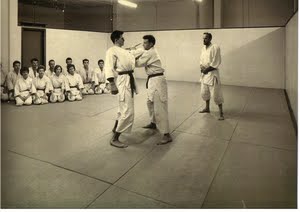
Jan de Jong Pt 1 - The School of Jan de Jong

I've received numerous requests to write about Jan de Jong to which I am now acquiescing. I will basically serialise the chapter I drafted for my originally conceived book on the tactics and techniques of Jan de Jong jujutsu with certain modifications.

What is the ‘school of Jan de Jong’?

'School,' when used in this sense, refers to a school of thought or a continuing tradition, like the 'school of Rembrandt' for instance. When used in this context, The Macquarie Concise Dictionary defines 'school' as, 'a body of scholars, artists, writers, etc. who have been taught by the same master, or who are united by a similarity of method, style [and/or] principle.' Hence, the 'school of Jan de Jong' refers to the school of thought concerning martial arts which can be attributed to Jan de Jong and those who follow his teachings.

With regards to the Japanese martial arts schools, I will defer to the work of Karl Friday. Friday is associate professor of Japanese history at the University of Georgia and he holds the menkyo kaiden license and is a certified shihan in Kashima-Shinryu. His book Legacies of the Sword is one of the most authoritative English-language books on the Japanese martial arts ever written. This book should be required reading for anyone attempting to understand the Japanese martial arts. He has this to say with regards to martial art ryuha (school):
Martial art ryuha ... have historically tended to practice total transmission, in which students certified as having mastered the school's kabala are given 'possession' of it. ... such former students normally left their masters to open their own schools, teaching on their own authority; masters retained no residual control over former students or students of students. Each new graduate was free to modify his master's teachings as he saw fit, adding personal insights and/or techniques and ideas gleaned from other teachers. It was common practice for such graduates to change even the names of their styles, in effect founding new ryuha and independent branches of ryuha in each generation.
Friday presents a case study by analysing the history, philosophy, and pedagogical dynamics of Kashima Shinryu to lay the foundation for a broader understanding of what the classical bugei (martial arts) are, what they were, and what they mean to those who practice them. His explanation of the historical pattern of the development of martial arts schools definitely explains the evolution of the school of Jan de Jong following his death in 2003.

According to De Jong, he started teaching in Perth, Western Australia in 1952, the year he emigrated to Australia from Indonesia. In 1955 he named his school Ju Jutsu Kan which was changed to Jan de Jong's Self Defence School (JDJSDS) in 1973.

The style of jujutsu which De Jong taught is often referred to as Tsutsumi Hozan Ryu jujutsu. However the JDJSDS grading certificates only refer to Tsutsumi Ryu and discussions with previous generations of instructors only refer to Tsutsumi Ryu. It appears to be quite late in the piece that De Jong started to refer to Tsutsumi Hozan Ryu.

The Jan de Jong jujutsu grading system includes technical grades up to and including third dan. Higher grades are honorary and awarded at the discretion of De Jong. There are only five people who have completed all the technical grades under De Jong. Peter Clarke was the first in 1998 and was immediately awarded fourth dan. The grading certificate referred to Jan de Jong Jujutsu for the first time. It would appear that De Jong was acquiescing to the lobby to change the name of the style of jujutsu he taught to reflect his contributions. However, he only did so on certain higher grade certificates.

Clarke was followed by Rob Hymus, Paul Connolly, Greg Palmer, and myself. These four instructors were my instructors and I am the only 'student' who has completed the technical grades under De Jong.

Greg Palmer is pictured above receiving his third dan grading certificate. Just prior to De Jong's death he was awarded fourth dan. He went on to establish his own school which he named Keikai, apparently the Japanese equivalent of his name. He also changed the name of the jujutsu he taught to Keikai jujutsu. Unfortunately Greg passed away in 2008.

Debbie Clarke, wife of Peter, established Southern Cross Bujutsu a few years before De Jong's death. Peter joined his wife after De Jong's death and became the technical director of the school. He refers to his jujutsu as Tsutsumi Jugo Ryu jujutsu. Peter, along with Hymus and Connolly, was awarded sixth dan by De Jong just prior to his death. Peter is a very proficient and thoughtful practitioner and I am led to believe, based on discussions with him, that he has made some significant changes to the jujutsu he is now teaching.

De Jong's school was taken over by his daughter, Maggie de Jong (first dan), following his death. Connolly, her partner, assumed technical control. They changed the name of the school to Jan de Jong Martial Arts Fitness and they advertise they teach Tsustumi Hozan Ryu jujutsu. Hymus established Indian Ocean Dojo which he advertises as teaching Tsutusmi Hozan Ryu jujutsu. Hans de Jong, De Jong's son, established Hans de Jong Self Defence School and likewise teaches jujutsu he refers to as Tsutsumi Hozan Ryu jujutsu. All of these schools are based in Perth, Western Australia.

One of De Jong's students/instructors, Jamie Francis, established South West Self Defence School teaching Tsutsumi Hozan Ryu jujutsu in the south west of Western Australia. He has built up quite a respectable following with over 80 students. He graded up to second dan with De Jong and half way through third dan with Palmer. I've agreed to continue his journey and teach and grade him the remainder of third dan. When completed, he will be only the sixth person to have completed the Jan de Jong jujutsu grading system.

I have succumed to the requests to teach and am teaching a small number of higher graded students/instructors. Given my obsessive nature, I do not want to commence teaching until my book(s) have been completed. I've also received requests to teach in Europe and the United States. Again, these requests have been put on hold until I complete my book(s). I consistently refer to the jujutsu I learnt and teach as Jan de Jong jujutsu reflecting what I believe to be the school of Jan de Jong.

Monday, November 1, 2010

Mental Unbalancing - State of Mind


This is the second in a series of blogs I plan to post on the nebulous concept of 'mental unbalancing'.

Recall from my previous blog that, based on the Oxford dictionary definition of unbalance, mental unbalancing could be described as upsetting or disturbing the equilibrium of a person's state of mind. Colonel Rex Applegate, the father of Modern Army combatives, in Kill or Get Killed specifically referred to mental balance as a 'state of mind'.

What does 'state of mind' mean? Recall from my previous blog that I could not find a dictionary which defined this phrase, even though it is a phrase which is commonly used. If any reader can point me in the right direction for an authoritative definition of the phrase I'd be very grateful. Having said that, and based on the common usage of the term, let's look at what state of mind means to some people.

A person can have a calm or agitated, peaceful or aggressive, healthy or unhealthy, positive or negative, robust or fragile, rational or irrational state of mind. Applegate explains that mental balance is a state of mind. Pain is often described as a state of mind. So is fear. Courage is a state of mind according to Major Darryl Tong of the New Zealand Army. Success and failure, happiness and sadness, freedom and slavery, and democracy and communism have all been described as states of mind.

Defeat is a state of mind according to Bruce Lee. Texas is a state of mind according to John Steinbeck. Youth is a state of mind for Robert F. Kennedy. The Dali Lama refers to disciplined and undisciplined states of mind as causes for wholesome and unwholesome actions respectively. People’s subjective states of mind are often referred to although an auditor is suppose to have an objective state of mind.

Recklessness and negligence have been referred to as states of mind in law. So has motive. A cool state of mind has been described by a trial court as meaning that a killing was committed with a fixed design to kill, regardless of whether the person was angry or gripped with passion at the time of the act. A guilty state of mind has been described by other trial courts as meaning an act was committed deliberately or recklessly and without care about the result of the action. The English Court of Appeal argued that, for the purposes of law, consent is a state of mind when deciding whether sex was consensual or not. But what does ‘state of mind’ actually mean? In each case this question is never specifically addressed.

While I could not find a definition for state of mind, a synonym of the phrase, frame of mind, proved more successful. Based on this definition, state of mind can be thought of as the way a person thinks and feels about something at a particular time. This definition certainly applies to the conceptions of state of mind referred to above.

Therefore, mental unbalancing could be defined as upsetting or disturbing the way a person thinks and feels about something at a particular time.

When discussing the 'most basic fundamental principle in hand-to-hand combat', balance, and looking at mental balance in particular, Applegate explains that
in exciting circumstances, such as vital combat, the mental balance of the opponent can often be upset by the surprise of the attack. The use of yells, feints or deception; throwing dirt or other objects in the opponent's face; or the use of any strategy that he does not expect forces him to take time to condition his mind to a new set of circumstances.
Does Applegate's mental unbalancing tactics sound like upsetting or disturbing the way a person thinks and feels about something at a particular time? The way a person thinks or feels about something, not what they are thinking about (a leading question if ever there was one).

Loren Christensen in Far Beyond Defensive Tactics lists the following tactics as mental kuzushi (unbalancing): pointing away from you, screaming, shining your flashlight in their eyes, deliberately knocking something over, saying something to an imaginary partner behind the suspect, warning a suspect about a passing car, and handing a suspect’s ID back and then dropping it to the floor just before he takes it. Shinzo Takagaki and Harold E. Sharp, in The Techniques of Judo, suggest that it is important to try to unbalance an opponent's mind in addition to unbalancing their body. They refer to the following 'tricks' as examples of ways to unbalance an opponent’s mind: shouting, slapping some part of your body, creating a sharp sound, or a jerk. Would you suggest that these tactics are designed to upset or disturb the way an opponent thinks and feels about something at a particular time?

Are not these tactics more accurately described as distraction. Distraction means to divert a person's attention away from something. Isn't this what Applegate's, Christensen's, and Takagaki and Sharp's mental unbalancing/kuzushi tactics are designed to do? Isn't distraction a more accurate and nuanced explanation of what these tactics are designed to do?

Why bother? This is a question I'm often asked when discussing my work with others (the few that I do, other than readers of my blog of course). I agree that, at least initially, many appear not to be interested in the finer detail. But then why do these same people attempt to offer explanations on why certain things are done, and done a particular way? Why don't they simply stick with explaining how to do something instead of also trying to explain why something is done? The why adds credibility to the how. The why enhances understanding of the how. The why facilitates the understanding and study of the tactics and techniques of the martial arts (the how). Most people are already referring to these concepts - the problem is they have not been studied. Those that are referring to them are often at odds to explain what is actually meant by the concept, and when they can based on their own understanding of the concept, are often at odds to explain the inconsistencies of the concept when applied to practice.

Many instructors and authors discuss unbalancing and refer to both physical unbalancing and mental unbalancing. They then go on to provide detail of the physical unbalancing and often relegate mental unbalancing to 'then of course there is also mental unbalancing' (as one unnamed author did) with no further detail. Others provide examples of mental unbalancing as referred to above, without clarifying what is actually meant by mental unbalancing. Why? Because they cannot offer an authoritative explanation of what is meant by mental unbalancing.

There is one author, George Kirby, that describes both physical and psychological off-balancing in conceptual terms and then gives examples. He does this in Advanced Jujitsu: The Science Behind the Gentle Art. Kudos to Kirby I say. At least he attempts to articulate what others simply refer to in superficial terms, with no real understanding of what they are describing. However, as will be seen in next weeks blog, Kirby's conceptualisation of psychological off-balancing shows how nebulous the concept is and how all manner of 'sin' is included under its umbrella.

It may often appear I'm taking aim at the work of other authors and the teachings of other martial arts. This is only because reference to these works provides the basis to which others can readily refer when discussing certain concepts and issues. The school I was involved in is not immune to these issues. Mental unbalancing was often referred to within the teachings of Jan de Jong jujutsu (aka Tsutsumi Hozan Ryu jujutsu). As will be seen in later blogs, the use of the phrase and concept within Jan de Jong jujutsu is just as flawed as it is in many other teachings.

I would be appreciative of any reference to any detailed discussion on mental unbalancing any reader may direct me to. Or any discussion where blocking and striking techniques are explained in terms of these techniques being mental unbalancing.

Until next time.

Wednesday, October 27, 2010

Unbalancing - Physical and Mental(?)


In Kill or Get Killed, Rex Applegate suggests 'there are a number of fundamental principles in hand-to-hand combat ... [and that] the most basic fundamental of all is that of balance.' He applies this insight strategically when he advises:

Balance must be retained by the attacker and destroyed in the opponent.

Applegate, like so many, refers to physical balance/unbalance and mental balance/unbalance.

Socrates said the beginning of wisdom is a definition of terms. Let's take the first step on the path to wisdom regarding this most basic fundamental principle of hand-to-hand combat with an understanding of what these terms mean.

Unbalance is defined by Oxford Dictionaries as: (1) Make (someone or something) unsteady so that they tip or fall; (2) upset or disturb the equilibrium of (a situation or person's state of mind). The equivalent definitions provided by Cambridge Dictionaries are: (1) Cause someone or something to not be firm but likely to fall or change position suddenly; (2) to make someone mentally ill.

Physical unbalancing can then be described as causing a person to tip, change position suddenly, or fall. This is a pretty straight forward concept and can be explained in biomechanical terms as I do in my tentatively titled Throwing Techniques and Takedown Techniques of ALL Martial Arts.

Presumably we can safely ignore Cambridge Dictionaries' definition in the context of hand-to-hand combat tactics. Therefore, based on Oxford Dictionaries' definition, mental unbalancing can be described as upsetting or disturbing the equilibrium of a person's state of mind. But what does that actually mean?

Equilibrium means 'calm state of mind' (Oxford Dictionaries) or 'a state of mental calmness' (Cambridge Dictionaries). So we’re back to state of mind. Finding a precise meaning for 'state of mind' has proven quite elusive. 'Frame of mind' is often listed as a synonym for 'state of mind' and has proved a little more accommodating in terms of finding a meaning for the phrase. Oxford Dictionaries defines 'frame of mind' as 'a particular mood that influences one's attitude or behaviour' while Cambridge Dictionaries defines it as 'the way someone thinks or feels about something at a particular time.' Thus, mental unbalancing can be described as upsetting or disturbing the way a person is thinking or feeling about something at a particular time.

Does this accord with your conception of mental unbalancing?

Physical unbalancing is a concrete concept which can be explained in objective terms. Mental unbalancing, as we will see in future blogs, is a far more nebulous concept. A nebulous concept that appears to be a 'catch-all' phrase which is used to refer to everything that is considered unbalancing but is not physical unbalancing. Including tactics which have a dubious claim to being unbalancing of any description at all in certain cases.

This catch-all phrase is used to describe strategies and tactics which can be described in far more accurate, precise, terms. We can do so much better in explaining and conceiving the strategies, tactics, and techniques of the martial arts. One, diplomatically un-named author, suggests unbalancing cannot be understood but has to be experienced. Whenever these type of comments are made, and they are made often in regards to numerous subjects in the martial arts, I suggest the author of those comments simply does not have the wherewithall to explain the concept. We can do better.

I would be grateful for any references which provide authoritative, supportable, explanations of 'state of mind' or mental unbalancing.

The next couple of blogs will continue to explore the concept of mental unbalancing with reference to various explanations of the concept which have been provided. This exploration will be conducted with reference to the above definition of mental unbalancing and/or any alternative conceptualisation of the concept which is provided which has some authority.

Friday, October 22, 2010

Martial Arts Techniques to Reduce Fall Serverity

I've added a new book to the 'books of interest' on my blog. It is a printed copy of Brenda Groen's PhD thesis entitled 'Martial arts techniques to reduce fall severity.'

I came across Brenda's work while researching the science being martial arts breakfalling techniques. Quite surprisingly, given the relativly large impact of falls without our society, virtually nobody has looked to the martial arts even simply to investigate the possibility that the techniques taught within the martial arts might have something to offer the wider community at large. This, to me, is symbolic of the relative lack of credibility the martial arts holds within our society. Tennis, golf, any game involving chasing a ball of any size or shape appears to have more credibility than the martial arts in our society. Part of what I hope to achieve is to lead the initial wave in amending this credibility deficit.

Brenda is, not relativly, absolutely unique in looking to the marital arts to look for solutions to problems experienced in the wider community.

I contacted Brenda after researching all the studies I could lay my hands on with respect to 'landing strategies'. The martial arts refers to 'breakfalls', as in breaking a fall, but some misguided individuals refer to these as falling techniques. As the saying goes, it's not fall that kills you, but the sudden stop at the end. The marital arts techniques are pragmatic enough to be concerned with the sudden stop at the end, as is Brenda.

I'm referring to Brenda by her christian name as we've developed a (platonic) relationship based on our correspondence. She is very kind and generous to share her time and work with me. She sent me a copy of her competed and printed thesis before it has been accepted by the powers that be. It includes the results of six diffent studies that she and her colleagues conducted in Holland concerning various aspects of martial arts fall techniques - OK. Sorry Brenda - she also refers to the inappropriately named 'fall' techniques.

I ensured Brenda would not be wasting her time as I did extensive research and contemplation before I deinged to contact her. I always advise anyone to do the work before contacting any academic or 'professional'. I've found many to be very generous and very supportive, but, I'd always done the work before hand. I must have done something right as she informed me the questioned I'd raised over certain other studies were the same ones she herself had raised. This confirmed to me that I was heading in the right direction and at a level I was aiming at.

Brenda's work will be referenced in my proposed Throwing Techniques and Takedown Techniques of ALL Martial Arts book. I'll be maintaining contact with Brenda and will hopefully visit her laboratory, which she has gaciously invited me to do so, next year. I'd love to see if there is anything else the martial arts can contribute to the wider community in addition to dealing with personal violence.

Good luck Brenda and thank you very much.

What use is pain?

In my originally conceived how-to book on the tactics and techniques of Jan de Jong jujutsu (aka Tsutsumi Hozan Ryu jujutsu) I intended to include a 'little science' to support said instruction. When writing about joint-locking techniques (kansetsu waza)I wanted a paragraph or two explaining why pain is experienced as the joint is moved towards, but not necessarily beyond, the range of movement of the joint. The research into pain to provide this paragraph or two resulted into a separate chapter in and of itself. This chapter is now intended to be included in my books tentatively entitled and dedicated to 'Injury Science' and 'Beyond Fight-or-Flight' and is (today) receiving a fleeting mention in 'Throwing Techniques and Takedown Techniques of ALL Martial Arts' - book #1.

The research into pain turned out to be fascinating, revealing a hitherto unknown treasure trove of information. Apparently we've learnt more about pain in the past 10 years than we have in the past 1,000. Information which broadens and deepens our understanding of pain and can be applied to similar effect within the disciplines studying the tactics and techniques associated with interpersonal violence.

'What use is pain?' is the title of an article presented in the British Journal of Anaesthesia (2005) by T.P. Nash, Department of Pain Medicine, Walton Centre for Neurology and Neurosurgery, Liverpool, UK. 'Ask any medical student, trainee anaesthetist, or patient 'what use is pain?' an they will tell you it is protective, or it is a warning.' Nash can add martial artist and particularly martial arts/self defence/close combat instructors to his list of people who provide this answer to this question.

He starts out by referring to the International Association for the Study of Pain (www.iasp-pain.org) and explains that 'in no way [do they] suggest that pain has a use or is protective.' Myth number one exalted on high already challenged within the first paragraph of Nash's article.

Nash explains that Galen (2nd century AD) was the first to suggest that pain had a use: '"The third aim of nature in the distribution of nerves is the perception of that which can cause harm" (De Usus Partium).' He also refers to Sydenham in the 17th century who reckoned that pain caused reflex movement for retraction and flight. He also refers to Leriche in 1939 who considered pain to be no use at all. He quotes Leriche as saying:
'Defence reaction?' Fortunate warming? But as a matter of fact, the majority of diseases, even the most serious, attack without warning. When pain develops ... It is too late. ... The pain has only made more distressing and more sad a situation already lost.'
To cut a long story short (something my blogs appear to be incapable of doing) Nash concludes:
If pain had any important use, then surely we should experience it with every injury. But pain is not always felt immediately after injury. Beecher found 65% of severely wounded soldiers and 20% of civilians undergoing major surgery had little or no pain for hours or days after the injury. Indeed, 37% of injured patients attending an emergency clinic felt no pain for many minutes or even hours after the injury. Clearly, it is not a reliable informant. ... Pain is not even an essential part of the withdrawal reflex, which happens even before pain is felt [(Hervey, GR. The functions of pain. In Holden AV, Winlow W, eds. The Neurobiology of Pain. 1984).
Beechers article is fascinating and will be referred to within my book(s) and maybe the subject of another blog. Nash goes on to say:
Pain normally produces strong aversive responses. However, dogs can be trained to seek painful electric shocks that normally produce strong aversive behaviour, when they receive a reward of food after each shock. It is clear that pain is involved in learning and memory, normally producing aversion but if the reward is good enough, it may lead to the animal seeking the pain source to obtain the reward.
This is the argument that Greg Downey was making in reference to the animals/competitors of the Ultimate Fighting Championship tournaments in his 'Producing Pain: Techniques and Technologies in No-Holds-Barred Fighting' (Social Studies of Science 37/2 April 2007) which was discussed in a previous blog of mine.
If our evidence that pain has a use, and is protective and a warning, is based on knowledge about congenital or hereditary insensitivity to pain, then we must accept that the evidence does not support this view, or is severely flawed.
If our view of the use of pain is severely flawed, what does this say about the tactics and techniques which are developed within the marital arts and other close combat disciplines based on our 'understanding' of the use of pain in the human species?

We use 'pain compliance' techniques. Pain is used as a form of mental unbalancing (which I'm currently writing about and which inspired my looking at this issue). Paraphrasing Col. Rex Applegate in Kill Or Get Killed, pain is to be avoided in the attacker and inflicted upon the opponent. Law enforcement officers are taught to use, among other things, pain to subdue violent offenders. The same law enforcement officers are held accountable for their actions for excessive force when these supposed pain techniques failed to subdue the violent offenders. These strategies, tactics, and techniques (and their representation in courts of law) are all based on 'conventional wisdom' - which we can now significantly improve upon.

SueC writes a blog (kickasssuec.blogspot.com) entitled 'My Journey to Black Belt' and follows my blog, as I do her's. She recently wrote a blog on training methods and their focus on combat effectiveness with reference to her own experience. Without confirmation todate, I'm prepared to accept responsibility for inspiring her thoughts on this subject and subsequent blog based on my series of blogs on the same subject :). Having (somewhat egotistically) said that, Sue refers to the reluctance of women to participate in martial arts or self defence training because of a fear of being hurt, which includes a fear of pain. Do you know one of the methods that is being used to increase pain tolerance? An understanding of the pain process.

David S. Butler and G. Lorimer Moseley in Explain Pain suggest
there are many myths, misunderstandings and unnecessary fears about pain. Most people, including many health professionals, do not have a modern understanding of pain. This is disappointing because we know that understanding pain helps you to deal with it effectively. Here are two important things we know about explaining pain: the physiology of pain can be easily understood by men and women in the street, and undertanding pain physiology changes the way people think about pain, reduces the threat vale and improves their management of it.
I'll be writing more about this issue in later blogs, and obviously in my books, but for now I'll leave you with this tidbit: pain is not felt, pain is experienced. This understanding opens the door to a vast array of possibilities and implications for the marital arts and any disciplines associated with interpersonal violence.

Until next time.

Friday, October 15, 2010

Post Traumatic Stress

Towards the end of last year, my best friend from high school (oh so many years ago) contacted me and informed me that his 15 year old son (Cam) had been attacked on the way to school. Cam is a fit, strong and muscular (unlike his father and me at the same age ... or ever), and confident young man who is a talented Aussie Rules football player. Unlike his talented father, Cam also plays the game quite aggressively, not being too shy about playing the game on a physical level.

On the way to school one day, Cam was jumped by two young men who initially king-hit him and laid into him while he was on the ground. The 'reward' for their efforts was five or ten dollars. According to the police, it is a common practice for some young lads to travel from the poorer northern suburbs to the middle-class southern suburbs, buy a burger (breakfast of 'champions'), and mug some unfortunate before jumping on a train to return home. A day out if you will.

What made this experience even more devastating was that as Cam attempted to stand up, one of the assailants took out a stanley trimmer and slashed at Cam's face. Fortunately Cam put his hand in front of his face in a defensive reflex, receiving lacerations to the palm of his hand rather than to his face and/or eyes which had been targeted. This is a young man's first experience of violence other than on the football field, movies, television, or computer games - none of which prepares one for violence with the ugly face of an intention to do serious harm. There is a significant difference between an opponent who wants to 'win' and one who wants to hurt you.

Cam's father asked if I'd show Cam some defensive tactics and techniques (obviously not using those technical terms). Of course I immediately agreed. However, due to my research in writing my book(s), I was in a far better position to assist Cam and his family than I have ever been.

While researching/writing my originally proposed book on the tactics and techniques of Jan de Jong jujutsu, I intended to provide a couple of paragraphs on why pain is experienced when a joint is moved towards, but not necessarily beyond, its range of movement. This led me to a body of knowledge on pain which I hitherto had been sorely ignorant, and which came to form a chapter dedicated to pain in the aforementioned book. A part of that chapter was devoted to 'stress induced analgesia' which refers to increased pain tolerance due to hormones released in times of stress.

I recalled a particular incident when a 'customer' of the Jan de Jong Self Defence School and Martial Arts Supplies pulled a knife on me and placed it on my throat. What was my physiological response? Nothing, nada, zip. There was no 'hormonal cascade', no adrenalin dump, and consequently no increased pain tolerance. Why not? This led me to investigate stress from which I uncovered the most amazing concepts and theories which facilitate the understanding and study and possible development of the tactics and techniques of the martial arts.

My research uncovered the stress process and a stress process model. The input (stimuli) elicits a physiological, feeling, and behavioural response which is the process which produces an output. This is the nature of a process - input, process, output. But the stress discipline did not tend to study the feeling and behavioural response and tended to define the output in terms of health issues or effects of stress on performance. This did not help explain why I didn't gain the benefits of our evolved responses to deal with threats.

I'm an accountant (among other things) and so reconciliation is something I gravitate towards. I couldn't reconcile the theories and concepts of the stress discipline with the stress process model and my experience. More research (the story of my life for the past few years). I cannot remember how I did it, but I stumbled upon the emotion discipline which studies the exact same process. The stress discipline and emotion discipline study the exact same process but do not refer to each others concepts and theories - unbelievably so. Surely the very definition of inefficiencies. The emotion discipline tends to focus on the feeling response and behavioural response, have a more detailed process model, and define the output in terms of the intended effect on the initial input/stimuli. A threat elicits a physiological, feeling, urge to act (unique to the emotion discipline and humans), and behavioural response which is designed to interact with the initial stimuli and reduce the threat. Brilliant! A model which explains all interpersonal violence to a large degree. A model which can be used to study and understand all interpersonal violence. A model which can be used to study and understand all martial arts. A model which offers the promise of developing new and improved methods of dealing with interpersonal violence, both pre, during, and post the actual event.

The responses are evolved responses designed to assist humans in dealing with harm, threats, and challenges. Unfortunately, these very useful adaptive features have not been fine tuned to only be turned on when an actual threat is present. There is an appraisal element to the process. The reason, I have postulated, why I didn't experience the hormonal cascade designed to assist me in dealing with the threat of a knife on my throat, the reason why I didn't feel fear, anger, apprehension, well anything other than slight annoyance, was that I did not appraise this situation as being threatening. Post traumatic stress (PTS) is associated with this process being activated when there is no immediate and present threat, when the threat is imagined or remembered. There does not have to be an immediate or present threat for this evolved response to be elicited, but the body, mind, and feelings act the same as if there was one.

I was in a position to inform Cam's father of this possibility. To keep an eye out for the symptoms and provide an understanding of why they might be occurring. I was also in a position to inform him that PTS, the eliciting of these responses, was not only possible within the survivor (who we no longer refer to as 'victims')of an assault but also within others close to the survivor. Cam's father then could understand why his daughter, Cam's sister, had been acting differently since Cam's attack.

A couple of days ago I received an email from Cam. Even though we don't see a lot of each other (that would appear not to be my makeup) Cam considers me to be a close friend and supporter of his family. He is not wrong in that assumption. His suggestion that I am wise I put down to him not knowing me well enough or to the ignorance of youth. In his email he asked me my advice on boxing and certain training regimes. More tellingly, he confided in me he had been experiencing moments of anger he couldn't understand. He asked my advice concerning these anger issues.

Firstly, I am in awe of a teenager who identifies an emotional issue within themselves which they do not wish to be part of who they are. Secondly, I am in awe of a teenager who asks for help concerning these issues. Particularly when they are a young man living in a testosterone, ego, macho fueled sporting environment/society.

One of the ways being used to initially treat PTS is in understanding the process. Understanding what is going on within oneself so that it may be possible for that person to process the responses on an informational level rather than an emotional level. This provides the opportunity of reducing the intensity of the responses and managing the process. Here I was in a position to provide that information to Cam and his father. This information provides the opportunity for Cam and his father to understand and manage the PTS effects of the initial attack.

This understanding the process and processing the experience on an informational level rather than an emotional level can also be seen in chronic pain management. In fact, when you receive a needle and the nurse explains what you are about to experience, this is an example of providing information about the process in order that you might process the experience on an informational level and not an emotional level and thereby reducing the intensity of the negative experience.

Another of the benefits associated with understanding this process from an evolutionary perspective is that the responses are not judgement laden. You are not a coward because you felt scared. You are not 'bad' because you get angry. You are not weak because you didn't fight back. Judgemental attitudes have a lot to answer for in terms of human pain and misery and if society could embrace the Buddhist non-judgemental approach it would, in my opinion, be far more healthy.

So Cam and his father are more likely to seek professional help if the symptoms of PTS continue. Cam, to his credit and my humility, already raised the issue of seeking professional help when he asked for my advice. I've advised him before to look upon himself in the third person. We are often so more helpful and supportive of others than we are ourselves. I was a far better teacher to others than I was to myself. We look objectively on another in this situation and keep an open mind on professional help whereas so many would close their mind to this 'sign of weakness' if considered within oneself.

Cam's situation forced me to recall a private lesson I once had at the Jan de Jong Self Defence School (JDJSDS). This young man had been out with some young women who 'mouthed off' to other young men in a car park outside a pub. These young men took exception to the 'attitude' of the young women and confronted them. The young women responded by locking themselves in their car and leaving their lone male companion outside to deal with these irate young men. Long story short, the lone male companion got the s&*t kicked out of him and was rendered unconscious. He came to the JDJSDS seeking help. I can see the look of emasculation and doubt that was on his face. How he doubted himself, and judged himself. He was a nice young man, not physically inclined, not macho oriented, and this experience had caused him to question who he was and doubt himself.

We as instructors are often on the front line in these situations. People come to us seeking help after they've been involved in these experiences. If we want to truly help them we need to do better. We need to know more and provide more than just tactics and techniques. It behoves us to understand the nature of violence. This is one of the driving forces behind my now intended third book. It may be dedicated to the young man who came seeking help from the JDJSDS and with the assistance of the information contained within that book, I could have done a far better job. A far better job that I am fortunate enough to be able to provide to young Cam.

Tuesday, October 12, 2010

Neck Holds - Lethal Weapons

Donald T. Reay, M.D., and John W. Eisele, M.D., published an article entitled 'Death from law enforcement neck holds' in The American Journal of Forensic Medicine and Pathology in September 1982 (3:3). In their conclusion they state:
Because of the structures involved, neck holds must be considered potentially lethal under any circumstance and used only when there is no other alternative. Use of neck holds must be viewed in the same way as firearms; the potential for a fatal outcome is present each time a neck hold is applied and each time a firearm is drawn from its holster. The neck hold differs in that its fatal consequence can be totally unpredictable. ... its use should be restricted to those situations where the officer or another person's life is in immediate danger. ... It must be viewed as a potentially fatal tactic and reserved to situations which merit its risk.(emphasis added)
The neck holds to which Reay and Eisele (R&E) refer are taught as shime-waza, strangulation techniques, or choking techniques within the martial arts. R&E's conclusions have some interesting/serious implications for the use and instruction of these techniques.

R&E suggest neck holds are lethal weapons and should only be used when a person's life is in immediate danger. In this way they should be viewed in the same way as firearms. There is a flip side to this argument. Based on this argument, you should be entitled to consider the application of a neck hold on yourself by another person as the use of lethal force against yourself. In most jurisdictions you're legally entitled to use lethal force to defend yourself against lethal force, so, you'd be entitled to use lethal force when someone applies a neck hold to yourself.

R&E suggest the potential for a fatal outcome is present each time a neck hold is applied. This is what makes neck holds a lethal weapon. Over the past few years 'one-punch deaths' have received a good deal of publicity in Australia and have been the source of legislation concerning these deaths. One-punch deaths refer to deaths following one punch. To be sure, the death is most often associated with the head impacting a hard surface from falling after the punch. Using the same logic as with neck holds, you could argue that punches are lethal weapons as the potential for a fatal outcome is present each time a punch is used. If this is the case then, using the flip side logic, you would be entitled to consider a punch lethal force and apply lethal force in defence.

Particularly with a punch, this is not legally the case. It is medically the case that you run the risk of dying after being struck with one punch as the number of fatalities attest. What do you instruct your students? Do you inform them of the potentially fatal risks associated with someone punching them? Doesn't this then set the scene for the student to increase their use of force when confronted with a punch? A use of force which is possibly not sanctioned by law. On the flip side it does encourage the student to consider their use of force and the potential outcomes associated with it. Does this have the potential of inhibiting their defensive response?

Vincent J. M. DiMaio and Dominick J. DiMaio, in Forensic Pathology wrote when discussing neck holds: 'In weighing how much force is acceptable in a situation, one must realise that any action involving force always has the potential of producing severe injury and death' (emphasis added). I couldn't agree more, however, the flip side poses certain problems. If any action involving force always has the potential of producing severe injury and death, doesn't this influence my response to force applied to me? Doesn't this influence how much force I might consider acceptable in a situation given the risk of severe injury and death? Do I inform my students that any action involving force always has the potential of producing severe injury and death which then may influence their use of force which may not be in agreement with the law? Might this information have the effect of making the student hyper-vigilant (for want of a better term).

In August 2005, the Crime and Misconduct Commission (Queensland) (CMC) published their findings concerning the injuries sustained by Samuel Hogan during his arrest. The police officers used a neck hold during the arrest and the commission considered the contribution, if any, the use of this technique had on the brain damage sustained by Hogan. The coroner's report appended to the CMC report had this to say on the classification of neck holds:
It is intriguing and possibly worrying that neck restraints are completely undifferentiated from use of firearms. Both are lumped together as lethal of force options. Although there is a possibility of a fatal outcome from neck restrains, the number of investigations such as this one is testament to the relative infrequency of fatal outcomes. The same cannot be said of delivering a large calibre hollow point projectile into any body cavity at short range. From the medical probability of an undesirable outcome there is merit in differentiating neck restraints from use of firearms. ... It seems to me there is scope for a further category that separates 'high probability' lethal force from 'slight possibility' lethal force.
How does this reclassification or introduction of a new level of force assist in determining, and instructing, the appropriate level of force to be applied in response to force being applied to oneself. Does the slight possibility of death when a neck hold is applied to you preclude you from using a knife or gun, both of which might be classified as high probability lethal force, to defend yourself?

To the best of my knowledge, there has been no study to determine the relative frequencies of fatal outcomes using various force options. Is the relative infrequency of fatalities from neck holds to which the CMC coroner's report refers due to the fact of the relative infrequency of the use of neck holds? What would the outcome be if a percentage basis was used to determine the risks of fatal outcomes when applying these techniques? There are significantly more deaths associated with one-punches, so, based on the coroner's logic does this mean that punches should be classified as high possibility rather than slight possibility?

This blog is a philosophical musing only and should in no way be considered advice of any sort. It is also a call to arms that more work needs to be done, more information provided, on the actual effects of the techniques taught within the martial arts. The martial arts teach a range of techniques which have varying degrees of risks of fatality. The advice concerning the use of these techniques is often relegated to 'use it only to defend yourself.' If legal considerations are taken into account, the less than ethical advice has been provided that 'it's better be judged by 12 than carried by 6.' We need to do better than what we are doing. We need to know more, definitively, about the effects of the techniques we teach and the risks associated with them. ... And society needs to have a greater appreciation and understanding of the nature of violence and its effects on the human body. Law is shaped and people are judged based on, among other things, people's understanding of the nature of violence. An understanding which I would suggest is often woefully uninformed.