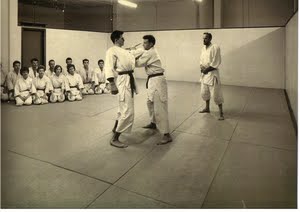
What is a blocking technique? The Overlook Martial Arts Dictionary defines blocking techniques as 'any technique that hinders, checks, neutralises or nullifies an opponent's attack, using any part of the body'
That definition, it has to be said, is a very broad and vague definition of blocking techniques. It is broad and vague by necessity given certain ambiguity surrounding blocking techniques. An ambiguity that only comes to light when the various conceptualisations of blocking techniques that are espoused by different martial arts are studied.
Moclair, in Jujutsu: A Comprehensive Guide, defines blocking techniques in terms of the use of an arm or arms to stop an attacker from striking a person with a blow from their hands, fists, knees or other parts of their body. Moclair’s definition explicitly, and with clarity, refers to the common and traditional conception of blocking techniques as being techniques that are used to stop an attacker from hitting or kicking a person.
In The Textbook of Modern Karate, Okazaki and Stricevic provide the following definition of blocking techniques: 'A block is a karate technique directed at a certain target – the opponent's hand, foot, leg or arm – for the purpose of arresting or deflecting his attack.' Okazaki and Stricevic’s definition informs us that blocking techniques are directed at the opponent's body part that is attempting to hit or kick the blocker. It also provides a description of how blocking techniques stop the opponent from hitting or kicking the blocker: by arresting or deflecting the attacking body part.
It should be noted that some martial arts or martial artists distinguish between blocking techniques and deflection or parrying. In this case, blocking techniques are isolated to those techniques that arrest an attack to avoid being hit or kicked. Deflection or parrying serve the same purpose but by a different means.
Blocking and Evasion
In Mastering Jiu-Jitsu, Gracie and Danaher distinguish between evasion and blocking to avoid being hit or kicked. Evasion does not involve contact with the opponent's attacking body part. Evasion can be basically subdivided into two types: those that involve moving the feet and those that involve moving just the upper body or head. Japanese martial arts refer to the former as taisabaki (body movement). Boxing teaches both methods with the former referred to as footwork and the latter bobbing and weaving.
If a body movement of any description is used in conjunction with a blocking (or deflection) technique, there are two questions that should always be asked. Firstly, was the body movement not sufficient to qualify as an evasion. Secondly, if the answer to the first question is affirmative, what was the purpose of the blocking technique. After all, the evasion took care of the problem of getting hit or kicked.
Blocking Possibilities
Nakayama, in the karate classic Dynamic Karate, suggests that, while blocking, you must attempt to seize the initiate and turn the opponent's attack to your advantage. He provides six methods that he suggests illustrates the various possibilities in blocking:
1. Block the opponent's arm or leg with sufficient force to discourage further attack. In a sense, this kind of block can be called an attack.
Nakayama does not define block. If we assume it involves a technique that is designed to avoid being hit or kicked, then this type of block serves two purposes. Firstly, to avoid being hit or kicked, and secondly, to apply sufficient force to cause pain and/or injury. If the block is used in conjunction with an evasive movement then it only serves the latter purpose. This is a possible answer to the question posed above.
2. Block the opponent's attack with only enough force to parry or deflect it. This
would be termed a light block in #1.
A deflection or parry changes the direction of the attack. If an evasive movement is used to avoid being hit or kicked there is no need to change the direction of the attack. If the attack is deflected in these circumstances, the question has to be asked and answered, why?
A 'brushing block' refers to a technique where the attack is brushed past the defender with no change in direction of the attack. This implies an evasive movement was used to avoid being hit or kicked. The question has to be asked as to the purpose of the brushing block.
3. Block and attack. Block the opponent's attack and immediately counter-attack. It is also possible to block and counterattack at the same instant.
Nakayama's solitary example of blocking and counterattacking at the same instant is unconvincing. The pencak silat I studied contained wonderful examples of the use of this strategy. However, it also contained wonderful examples of the use of brushing blocks in conjunction with evasive movements. Each brushing block now bears investigation as to purpose.
4. Unbalance the opponent with your block.
Jan de Jong jujutsu makes extensive use of taisabaki to avoid being hit or kicked, as well as to reposition to attack. It also makes use of blocking techniques which is explained by their use to unbalance the opponent.
The unbalancing is physical and 'mental.' The physical unbalancing involves applying forces to cause the opponent's centre of gravity to be located outside of their base of support. The 'mental unbalancing' involves applying forces that do not physically unbalance an opponent but stuns, causes sudden loss of motion, or pain. In this way, they are similar to Nakayama's blocking possibility #1.
5. Block the opponent's attack as it is about to begin. To do this you must anticipate his attack.
6. Block and then retreat to a safe position until a chance to counter presents itself.
Blocking possibility #5 is the very definition of seizing the initiative, whereas blocking possibility #6 is not so much.
Direct and Indirect Blocks
In two books dedicated to the mechanics of martial arts, Starr distinguishes between direct and indirect blocks. Direct blocks are described as being applied directly against the force of the opponent's attack. Starr suggests that this form of blocking often requires the blocker to be physically stronger than the opponent, and the risk of injury to the blocking body part is high if the opponent's attack is very powerful. Indirect blocks are described as being sometimes referred to as deflections. Starr suggests that because indirect blocks do not directly oppose the opponent’s attacking force, they require very little strength to apply and the risk of injury is minimised. Starr is correct, in so far as it goes.
Starr's examples of indirect blocks includes the standard karate, high, middle and low blocks. These blocks do not involve applying force directly against the force of the opponent's attack. They do not involve applying force in the opposite direction to the force of the opponent's attack. You will find that the vast majority of karate's blocking techniques are designed to apply force to the opponent's attacking limb at an angle to the force of the opponent's attack. They apply a force to an attacking body part at an angle which results in a deflection rather than the attack being arrested.
This is a common misconception, that and traditional blocks are designed to oppose force directly, espoused by many who attempt to extol the virtues of their soft blocking methods over hard blocking methods.
Given that deflections generally require less force than techniques designed to arrest an attack, why then do karate practice applying a great deal of force in their blocking methods. The answer's may lay in Nakayama's blocking possibilities #1 and #4.
Absorption Blocks
Gracie and Danaher refer to blocks absorbing the forces of the attacker's attacking body part. This is typical boxing style blocks, and can be seen in shin blocks etc. In this case, the blocking techniques are not so much designed to avoid getting hit or kicked as they are to manage what body parts are hit or kicked.
Karate style blocking techniques do not tend to absorb the force of the attacker's attacking body part as they are designed to apply forces to an opponent's attacking body part.
Forces
Forces cause all bodies and objects to change direction or shape. Forces applied in different ways result in different outcomes. Even when the points of contact between two bodies (defender and attacker) are similar, the direction and magnitude of the force can produce a different outcome. It is important for the martial artists to understand specifically what they are trying to achieve, and why they are trying to achieve that, in order to better understand how the forces are to be applied to achieve that outcome.
*************
PS: Dear Reader
Okazaki and Stricevic make the following statement when discussing the forces involved in blocking techniques: 'The amount of force necessary to deflect an object is generally less than the force needed to initiate its motion.'
I am having some difficulty in supporting or correcting that statement in mechanical/physics terms. If any reader has mechanical or physics background and can help out in this regard, I'd be very grateful.
Thank you.
Showing posts with label Pencak Silat. Show all posts
Monday, October 8, 2012
Saturday, March 19, 2011
Jan de Jong Pt 14 - The Mon Grades

Jan de Jong introduced the mon system at the front end of his grading system in 1978. I am of the opinion that this is the pinnacle of the Jan de Jong school of thought.
In an article written by Mike Clarke for Australasian Fighting Arts in 1991, De Jong provides the following answer to Clarke's question, 'Do you think that was a good idea, to change the system to suit the students?':
Yes. I know what you're saying, but you know you can learn all the time. And if the results are better one way than the other, why carry on in a way that gives poorer results? I'll give you an example. In 1978 a Major Greg Mawkes MBE asked me if I would go and teach the army self-defence. I said okay and soon afterwards found myself teaching members of the SAS and the Commandos. Shortly after I had started to to do this the Major and I had a discussion about things. He told me that he thought the method of fighting was really good and he was pleased with that. But he said the men were having some difficulty understanding it all. I said this was the usual way of things and that my students were the same. He then explained the army did not have unlimited time to spend on this and that what he needed was quick results.This answer speaks volumes for De Jong on so many levels.
So it was at this point I had to think things through and see what I could come up with. I looked at the usual way the army taught things and decided I would alter the way I was teaching and come more in line with the army way of doing things. Well, do you know, the people started to pick things up much faster then before, and they could do the techniques much better than before! So I had a talk with my instructors and said I thought that we should change things so that we were teaching everyone like this. And at that time we changed the way we taught the students. The techniques were the same, it was only the method of teaching them that was different. And since then things have been much better.
Prior to the introduction of the mon grades, the first gradings were the kyu grades (see a previous blog). The kyu grades are specified defences against specified attacks, albeit graded in shinken shobu no kata format (see previous blogs). The mon gradings consist of eight grades. Students 12 years and under start at first mon, 13-15 years start at 3rd mon, and over 15 years at 9th kyu. The reference to kyu in the mon system reflects De Jong's conceptualisation that mons are for children and kyus are for adults, however, the ninth to seventh kyu grades are part of the mon system and adopt the mon format. Lets look at the final grading of the mon system, seventh kyu, as an example of this format.
Breakfalls (Ukemi Waza) - demonstrate specified breakfalls.
Wakai no Kata - demonstrate a kata De Jong designed to introduce punching, kicking, and blocking at this level.
Throwing techniques (Nage Waza) - demonstrate specified throwing techniques from specified attacks.
Bodymovements (Taisabaki) - demonstrate specified bodymovements.
Unbalancing (Kuzushi) - demonstrate specified unbalancing techniques from specified attacks.
Locking techniques (Kansetsu Waza) - demonstrate specified joint-locking or joint techniques from unspecified attacks.
Basic blocks and attacks (Uke and Atemi) - demonstrate specified blocks and punches from specified attacks.
Reflex (Shinken Shobu no Kata) - see previous blogs.
I'll speak from a jujutsu perspective, although, many of the observations are applicable to most other martial arts. A review of the jujutsu literature will quickly reveal that the art is taught as defences against attacks. As tricks, which is in fact how H. Irving Hancock and Katsukuma Higashi describe each of their defences in The Complete Kano Jiu-Jitsu.
Gerry Carr, in Biomechanics for Coaches, advises breaking down sport skills into phases. This reduces the possibility (probability) of the student being overwhelmed by the complexity and speed of the skill they are trying to learn, and makes it much easier to look for errors in their performance. He suggests that many skills can be broken down into the following four phases: (1) Preparatory movement (set up) and mental set, (2) windup, (3) force-producing movements, and (4) follow-through (or recovery).
Masatoshi Nakayama, in the classic Dynamic Karate, is a rare example of a martial artist dividing his skills into phases. When discussing the height of stances, he explains that 'the form of a particular stance is different in the ready position from its form at the time a technique is applied. The form of the stance immediately after the technique has been applied again differs from the preceding two. There is a delicate change at each stage, although the form looks almost the same.' Interestingly, for me at least, this reflects the injury science division of the injury production process by William Haddon into pre-event/pre-injury, event/injury, and post-event/post-injury phases. This is included in my book on the application of injury science and pain to the martial arts tactics and techniques.
Jigoro Kano, of course, is very well known for his division of judo throwing skills into kuzushi-tsukuri-kake, unbalancing-fitting in-execution. Tadao Otaki and Donn F. Draeger, in Judo: Formal Techniques, suggest this division is not only used for throwing techniques but also for techniques used in 'grappling situations'. However, I've never seen it used outside of throwing techniques.
What is De Jong's division of his jujutsu's skills? Based on the mon grades it is taisabaki-kuzushi-waza, bodymovement-unbalancing-technique. He had difficulty in separating the three, particularly when I discussed this division with him when writing Jan de Jong: the man, his school, and his ju jitsu system for him. But they can be divided into these three tactical components for analytical purposes (I refer to them as tactics as the technique is the end part of the tactic). Even De Jong did not fully appreciate the insights he'd achieved and the power of those insights.
We were teaching in Sweden one year and De Jong asked me what he should teach. I said bodymovments. He was very much opposed to the idea based on the grounds that the seminar participants would be bored with this 'mundane' exercise. I argued my case, and as a reflection of De Jong, he did teach bodymovements (albeit at the speed of light). At the end of the seminar we ended up with approximately ten instructors/black belt students requesting private lessons. Not in any of the techniques we'd taught, but in the bodymovements. They could see the uniqueness of this approach and the power of the division of tactics.
Another example of the utility of this approach. When living in London I attended Richard De Bordes pencak silat classes. Their pencak silat was very, very different (and highly recommended) to what I'd seen at De Jong's school. They didn't break their skills into phases of any description, however, I did. Even though they don't use the same bodymovements, nor unbalancing to any great extent, I could still apply this analytical approach to understand and study tactics taught in a relatively foreign martial art. I may not have been immediately proficient, but I knew what I was trying to do. I could practice the component parts of the tactic.
As a full-time instructor working at the Jan de Jong Self Defence School, I was engaged to teach more private lessons than any other instructor in the school. My approach in analysing and teaching techniques/tactics was taisabaki-kuzushi-waza. As Carr suggests, 'errors occurring during an early phase of a skill are bound to affect all the phases that follow. So when something goes wrong at the end of a skill, examine not only the last phase but also earlier phases to see if the root of the problem lies there.' I found that the vast majority of the corrections of a private lesson student's technique lie in the bodymovement. Fix the bodymovement and the unbalancing and technique took care of themselves. I suppose the students paid for my understanding of this methodology as much as they did in my expertise in executing these techniques.
Based on my study of the martial arts tactics and techniques, among other 'scientific' concepts and theories, for my book, I now divide the tactics of any martial art into kamae-taisabaki-kuzushi-waza, ready position-bodymovement-unbalancing-technique. This is a method of analysing the tactics, even when the tactic may not incorporate an element.
But breaking down a skill into phases is just analytical thinking. De Jong uniquely went beyond analytical thinking. Systems thinking has been described as the art of seeing the forest and the trees. According to Russell Ackoff, one of the founding fathers of the systems thinking movement, the difference between analytical and systems thinking is not that one analyses and the other doesn’t, but rather that systems thinking combines analysis with synthesis: analysis, taking things apart, and synthesis, putting things together and understanding how they work together. The fundamental assumption on which the systemic thinking concept is based is that everything is systemic. Everything interacts with (affects and is affected by) the things around it. This is not unlike the worldview adopted by many eastern philosophies.
De Jong broke his tactics down into their analytical elements in the mon grades. He would then teach exercises where the different elements were mixed. Different bodymovements were used with an unbalancing method to execute a technique. Different unbalancing methods were used with a bodymovement to execute a technique. Different techniques were executed using a bodymovement and unbalancing method. De Jong's 'thinking' evolved into systems thinking that was reflected in his mon grades.
One (nameless) instructor who now has is own school has dispensed with the mon grades. Don't throw out the baby with the bathwater. The mon grades have a degree of circularity that was influenced by Minoru Mochizuki's teachings. The kyu grades are more linear and direct, possibly reflecting the Saito brother's original approach. I would argue in favour of not going back to teaching 'tricks' but rather to embrace the systems thinking approach that De Jong adopted, even though he was unaware of it. It has to be said, the De Jong grading system is not seamless. The mon grades prepare the student for the dan grades more than they do the kyu grades. Having said that, they provide the student with the analytical and systems mindset to understand and study the 'tricks' in the kyu grades.
I've found a lot can be learnt from studing De Jong's grading system than simply studying the gradings. Even before I discovered the concept of systems thinking, I knew there was a more holistic approach being taught by De Jong. He wasn't just teaching a martial art, he was teaching a martial arts system. As Ackoff said: 'System is more than just a concept. It is an intellectual way of life, a worldview, a concept of the nature of reality and how to investigate it – a weltanschauung.'
Wednesday, January 26, 2011
Jan De Jong Pt 10 - Indonesia 1995 Pt 3
The 1995 Indonesian tour continues.The photograph to the right was taken when we visited a pencak silat school/instructor in Bandung. It would appear that pencak silat has far greater respect in Indonesia than most martial arts in other countries as the tourist maps of the city included a number of silat schools to visit. We visited one such school which taught Mande Muda style of pencak silat.
The instructor's young son was playing with toy cars on the ground when we introduced ourselves. Jan de Jong paid some attention to the young lad who, when invited by his father, put on the most amazing impromptu display of pencak silat. The instructor showed some of his tactics and techniques using, you guessed it, yours truly as the receiver of the techniques. He then asked if we wanted to see how they condition their arms for combat, to which De Jong expressed his interest.
I was instructed to sit on the ground with a specific leg configuration (see photograph). The instructor then proceeded to beat my forearm from wrist to elbow along the ulna with a short stick. He only stopped when there was an unbroken, raised welt the full length of the ulna. He then proceeded to massage a truly revolting smelling liquid into the bruised flesh (see photograph). Then the bashing continued, followed by more massaging of the bruised flesh. I'm not sure what hurt more, the bashing or the massaging of the bruised, tenderised flesh that was my forearm. Not wishing to embarrass De Jong, I didn't object to this assault and tried not to register any expression of discomfort or pain. After repeated cycles of this process I must confess to having thoughts about what other uses the short stick could be put to. I ended up with a perfect, unbroken, raised, deep purple bruise running the full length of my ulna. Apparently they go through this process twice a week before moving onto harder materials to condition their forearms.
We ran into one of De Jong's pencak silat students in the back blocks of Java. The tourist 'attraction' where we ran into this student was a place with bubbling, grey, sulfur-smelling mud. Sulfur-smelling meaning it smells of rotten eggs. Why sulfur-smelling mud is a tourist attraction is beyond me, but, that is where we ran into De Jong's student. De Jong of course remembered who he was. He had an amazing memory in this regard. At one of the seminars in Holland in the mid 1990s, a grandfather of one of the young seminar participants approached De Jong and asked him if he remembered him. De Jong looked at him for a moment or two then said he did and that he was one of his students during WWII, nearly 50 years previous. The grandfather confirmed De Jong's identification and then tearfully and proudly showed him his membership card he'd kept all those years.
We visited many places of significance to De Jong. The house where he grew up, various places he practiced as a physiotherapist after WWII, and of course the place where the Saito's dojo used to be. De Jong pointed out the school he used to attend in Semarang and told of the time when his father visited the school to check on his son's progress. His father was somewhat surprised to learn that his young son had not attended the school in the past six months. De Jong had been attending his jujutsu classes instead of his school classes. De Jong explained, with a rye smile, that his father was not pleased.
We also visited Surabaya, Indonesia's second largest city. Shortly after writing the blog concerning De Jong's return to Indonesia after WWII, a newspaper article was published which told of an Australian 'who had a front row seat as history unfolded' (http://www.smh.com.au/world/artist-had-a-front-row-seat-as-history-unfolded-20101119-1810k.html). British Brigadier General A.W.S. Mallaby was killed by Indonesian independence fighters in 1945 to which the British responded 'with a terrifying and vengeful sweep of Surabaya aided by a huge air and sea bombardment.'
'That was the cruelest thing I had seen,' says Rafty. 'They didn't care who they bombed. They killed many women and children. There was no justification for what they did to the city of Surabaya and its people.' It was a bloodbath, which Rafty vividly recorded in a series of sketches. Some 10,000 Indonesians died and many more fled the city as the British gradually asserted control after three weeks of ferocious fighting. The day the bombardment in Surabaya was launched, November 10, is National Heroes day in Indonesia, its equivalent of Anzac Day. And, like Anzac Day, it honours a terrible defeat.This was in addition to the deal Lord Mountbatten made with the Japanese to disarm the Indonesian's before they surrendered to the British in order to pave the way for the Dutch to reclaim their colony. Interestingly, it was Ian Fleming, author of the James Bond novels, who advised the British of Mallaby's assassination which sparked this post WWII bombardment.
Don't you find it interesting (or hypocritical) that a basic tenet of our legal system is that only proportionate force is legally allowable to an attack in cases of self defence. However, our governments, in our name, have often used force against others which is out of all proportion, e.g. the bombing of Vietnam and the British bombing of Surabaya.
Wednesday, January 12, 2011
Jan de Jong Pt 9.2 - Internationalisation Pt 2
Recall from the last blog that Jan de Jong conducted annual teaching tours of Europe from 1982 until ill-health prevented him from doing so in 1999. These tours would be for periods of six to twelve weeks and involved travelling to different cities/towns in different countries. The first 'tour' I was a part of was in 1991. De Jong was invited to a three day seminar held in Aarlen, Germany which was put on by Herr Teichmann, a Dutch or German judoka who imported diamonds from South America. The final night had a door prize of a diamond. Many jujutsu masters from around the world were invited. A capoeira team from Brazil was invited and put on a demonstration on the final night. They were 'hard core'. I found out later that one of them was a police officer and participated in the illegal 'blood sports' in his home city.
Soke Fumon Tanaka and his daughter Midori were also honoured guests, along with a member of the Japanese royal family. On the final evening when the invited masters put on demonstrations, Midori demonstrated the use of a naginata and Tanaka demonstrated the use of the katana. The demonstrations went on until the early hours of the morning and Tanaka was one of, if not the last demonstration. He demonstrated cutting a thick bamboo pole representing the thickness of a person's neck. They tried to balance the bamboo pole but the airconditioning kept on blowing it over. Finally, Tanaka simply drew his katana and cut the bamboo pole as it was falling. He cut clean through with the two parts simply separating as they descended uninterrupted towards the floor. Quite something to see.
Our 'team' consisted of Peter and Debbie Clarke, Hans de Jong, Greg Palmer, myself, and of course De Jong. The above photograph is of Peter and Hans training the pencak silat which was part of our demonstration on the final night. We also demonstrated jujutsu and the use of various weapons including the unique use of a short stick or long torch. Peter demonstrated the use of a manrikigusari, a chain with weights on either end. Watching the video of the demonstration brings a smile to my face as the commentator on the night explains that this is a weapon used by the police in Australia (they don't).
One of the gradings in third dan in De Jong's jujutsu grading system is to demonstrate the use of the manrikigusari. Peter was training for third dan and as is his way, he makes the weapon he is training a part of him. I recall seeing him walking down the streets of Munich twirling his manrikigusari. He had it in his pocket as he went to board the plane back to Australia and put it into the tray along with his wallet etc when he went through the metal detector at the airport, then put it back into his pocket and boarded the plane. Different times. I recall arriving at Hamburg airport, or another German airport, and picking up a very large duffle bag loaded with weapons - swords, jos, tanbos, knives, replica guns, etc. I walked through the airport with the bag slung over my shoulder and was not approached once by any official. Different times.
I was the first from De Jong's school to conduct an international seminar independent of De Jong in 1993. I was living in London and was invited to conduct a two day seminar celebrating a milestone anniversary for Wim Mullens' school in Rotterdam. What made this seminar noteworthy was that I was graded first dan (shodan). No shodans conduct seminars in Europe (or anywhere else for that matter). Participants came from throughout Holland, and also Germany and Belgium and more than half were higher graded than me. Such was the reputation of De Jong that they would attend a seminar given by one of his instructors even though he was a lowly shodan.
When I attended the seminar in Aarlen in 1991, I was graded 1st kyu which in our school is represented by a black and white belt (white stripe running the length of the belt in the middle of the belt). Peter Clarke told me that the first thing I'd be asked would be what grade I was because nobody else uses this belt except judo which previously never awarded women a black belt, but a black and white belt. Peter was right. I didn't even make it out of the change rooms the first day I was there and I had to answer that question. It proved quite handy actually as they didn't know how to categorise me so I got to move freely between seminar classes.
Since De Jong's passing in 2003, the tradition of teaching in Europe is continued by his instructors. I believe Maggie de Jong and Paul Connolly taught in Europe one year. Greg Palmer taught in Sweden, Denmark, and Germany before he passed away, fulfilling a dream to teach internationally. He also taught in South Africa if I remember correctly. Peter Clarke and Hans de Jong, independently, conduct annual teaching tours now.
Les Periera wrote an article about the celebrations associated with De Jong's 50th year of teaching professionally titled 'Only doing what I enjoy doing' (http://www.lespereira.com/Documents/Only%20Doing%20What%20I%20enjoy%20Doing.pdf) which was published in Australasian Fighting Arts. He wrote:
With Shihan de Jong's international reputation the Hay St dojo is almost a mecca for Ju-jitsuans around the world, with regular visitors from Switzerland, Denmark,Holland and England, as well as some Pencak Silat practitioners also from Switzerland.Perth, Western Australia, has been described as the most isolated capital in the world, and yet, De Jong's reputation was such that many did indeed make the 'pilgrimage' to train under De Jong and his instructors. Periera missed out a few of the nationalities which have visited here, including, of course, many who've made the trek from the east coast to the west coast of Australia. One of the first groups to visit De Jong's dojo was a group of jujutsuka from Indonesia.
The photograph to the right accompanied the Periera article. It is a wonderful photo of a younger De Jong executing a painful technique on Ian Lloyd. Lloyd was a senior instructor for De Jong. He owned the Wednesday night classes at the dojo for more than two decades. His was the first class of jujutsu that I attended - April 1983. He has a relaxed style of teaching and would start of each class with a joke, while still in seiza of course. He travelled with De Jong (and others) when De Jong toured Indonesia in the 1980s.The previous blog referred to the school in Aalborg, Denmark which De Jong taught at annually and the close relationship we have with that school and its instructors. Periera wrote in connection with De Jong's celebration:
Several presentations were made, including a statuette from Sensei Per Brix, of Denmark, for whom Shihan de Jong has held several seminars over the last three years. The presentation was made by Sensei Soeren Markussen, one of the senior Instructors at Sensei Brix's school, who spent three months in Australia training at the school.I'll leave this part of De Jong's story with another quote from Periera's article:
An indication of Shihan de Jong's reputation and standing on the world stage may be gained from the number of telegrams and cards from wellwishers both interstate and overseas - Singapore, Japan, France, Austria, the Netherlands, Germany, Italy, Sweden, Holland....
Sunday, January 2, 2011
Jan de Jong Pt 9.1 - Internationalisation
In Jan de Jong: the man, his school and his ju jitsu system (1997), I refer to the internationalisation of Jan de Jong. I should have referred to the internationalisation of the school of Jan de Jong (see first blog in these series for further details) given how his teachings have influenced so many he taught throughout the world .
Following the first very successful tour in 1982, the 'European tours' became an annual event until ill-health forced De Jong to refrain from travelling in 1999. He would spend between six and twelve weeks travelling throughout Europe each year, teaching for different schools, instructors, and organisations. The seminars ranged from a few hours to week long camps. He would be accompanied by some of his instructors and later by instructors from other schools in Australia or Europe. Maggie De Jong (De Jong's daughter) assisted him on many of these tours, and I suspect I am the instructor with the second highest number of tours.
De Jong tried to accommodate as many invitations as possible, however, that was not always logistically possible. There were scheduling challenges involving seminars at different dates in different towns and cities in different countries for different people and organisations. De Jong would spend months organising these tours himself. The transportation around Europe involved hiring a car or van and partaking of a 'road trip'. Everyone who accompanied De Jong have their own stories concerning these road trips.
The photo to right was taken on one of the European tours circa 1995. De Jong is demonstrating the use of the kusurigama against a katana. I'm pretty sure the photograph was taken by Renate Sluiter who was/is an instructor of Hans Roos (Bara ryu jiu jitsu) in Holland. In the abovementioned book, they, along with Wim Pieck provided the following tribute (extract only):
I also recall demonstrating the same weapons with De Jong at a seminar in Norway. One morning we were practicing and I kept on leaning my head to one side as De Jong ensnared my sword blade with the rope and attacked my neck with the kusurigama blade. He told me not to do that as it didn't look good for the demonstration. Following my respected teacher's instructions, I resisted my evolved self preservation impulse and did not lean my head to the side. As the blood started to trickle down my neck I said, 'that is why I lean my head to the side'; to which he replied, 'I thought you were going to do it again'.
It's been said that weapons were not taught within most jujutsu systems in Europe prior to De Jong's demonstration of them in his team's 1982 demonstration at the World Ju Jitsu Federation conference, and his subsequent teaching of them since. Over the years he's demonstrated the use of the katana (sword), wakizashi (short sword), jo (short staff), tanbo (short stick - based on the Indonesian pencak silat use of the stick and adapted to jujutsu by De Jong), kusurigama (sickle with weighted chain/rope), manrikigusari (weighted chain) and hojo-jutsu (rope tying art).

The photograph to the right is De Jong demonstrating the use of the jo on, what one reporter described in her article as, 'the hapless John Coles'. Unfortunately, this is how many people might remember me, always the uke (receiver) never the tori (giver). Many times I'd be the only or senior student/instructor of De Jong's on these tours and would consequently be used to attack when demonstrating techniques. One especially memorable occassion was at the end of a week long summer camp in Norway where I was going to be given the opportunity of showing what I could do. The teachers at the seminar had to put on a demonstration and the De Jong team consisted of himself, Maggie, myself, and Soren Stiller Markussen.
The relationship with Soren is a very special one arising from De Jong's European tours. He was an instructor at the Aalborg Selvforsvar & Ju-jitsu Klub in Denmark (by the way guys, I need a new t-shirt as my other one has been worn so much it literally fell apart). De Jong had a strong relationship with the Aalborg and associated instructors and enjoyed visiting and teaching there nearly every year. There was one particular milestone event for one of the instructors and De Jong was asked if he would demonstrate handcuffing techniques on said instructor, ... and not release him so that the other instructors could take him outside and pound him with cinnamon (I think/hope). Some strange Danish/Aalborg custom I suppose. This appealed to De Jong's sense of fun and he gladly joined in.
Soren has visited Perth on numerous occassions spending up to three months at a time where he trained six days a week (that is not to say that there was not a lot of socialising and beach going to be had). Soren is an adopted member of the Jan de Jong jujutsu school in every sense of the word(s). He was (and I'm sure still is) a very fit, athletic, proficient, and dynamic practitioner. I was going to be given the opportunity of showing what I could do in full flight with the aid of Soren attacking. The commentator announced our demonstration: 'Jan de Jong demonstrating x with John Coles attacking'; 'Maggie de Jong demonstrating y with John Coles attacking'; 'Soren Markussen demonstrating z with John Coles attacking' ... and so on. Yes, I attacked for every single group, but, I was going to be given the opportunity of demonstrating what I could do ... or at least that was the plan. De Jong later explained that he forgot about my two groups. To add injury to insult, Maggie put me on my head on the floor boards with a magnificent jo technique that completely upended me, and De Jong injured one of the ribbed structures in my throat with a walking stick technique. For six months there was a clicking sound in my throat each time I swallowed.
This is the first of the blogs concerning De Jong's international experiences. I'll leave you with one further tribute from the first mentioned book, this time by Mike Wall, a long-time supporter of De Jong and his European tours:
I still teach almost every day. I have to travel around a lot too. Each year I am asked to go to different places like New Zealand, Europe, Scandinavia and places like that. Also, each year I go all around Australia, Adelaide, Sydney, the Gold Coast, Brisbane and Darwin. I sometimes go to Alice Springs and to Groote Eylandt Island off the north coast where a mining company has a big jujutsu club. So I am kept very busy at all times of the year. (Interview with De Jong by Mike Clarke published in Australasian Fighting Arts, Aug/Sept 1991)De Jong first accepted invitations to teach overseas in 1982. Since then, he has conducted seminars in Austria, Belgium, England, France, Germany, Holland, Indonesia, Italy, Malaysia, New Zealand, Norway, Poland, Spain, Sweden, and the USA (in addition to teaching throughout Australia).
Following the first very successful tour in 1982, the 'European tours' became an annual event until ill-health forced De Jong to refrain from travelling in 1999. He would spend between six and twelve weeks travelling throughout Europe each year, teaching for different schools, instructors, and organisations. The seminars ranged from a few hours to week long camps. He would be accompanied by some of his instructors and later by instructors from other schools in Australia or Europe. Maggie De Jong (De Jong's daughter) assisted him on many of these tours, and I suspect I am the instructor with the second highest number of tours.
De Jong tried to accommodate as many invitations as possible, however, that was not always logistically possible. There were scheduling challenges involving seminars at different dates in different towns and cities in different countries for different people and organisations. De Jong would spend months organising these tours himself. The transportation around Europe involved hiring a car or van and partaking of a 'road trip'. Everyone who accompanied De Jong have their own stories concerning these road trips.
The trip has had quite an impact on my life. ... The trip has helped me to see that the road to mastery of jujutsu is long and unending. ... Between training/teaching sessions in various places, there were the funny occurrences that come part and parcelled with any fun trip. The first of these memorable experiences was that of being a passenger in the car driven by Shihan de Jong. I won't go into too much detail, but suffice to say that, he didn't get his nickname 'Leadfoot Shihan' by mistake! Our first demonstration was held in Helsingborg, Sweden. I must say it was an awesome sight to see approximately 600 jujutsuans under one roof. (Interview with Sam Gervasi, principal of his own school in Victoria, in Ju-Jitsu Australasia 1990)
The photo to right was taken on one of the European tours circa 1995. De Jong is demonstrating the use of the kusurigama against a katana. I'm pretty sure the photograph was taken by Renate Sluiter who was/is an instructor of Hans Roos (Bara ryu jiu jitsu) in Holland. In the abovementioned book, they, along with Wim Pieck provided the following tribute (extract only):With this letter I want to thank you again for teaching in the Netherlands. Once again you have proved to be a great master of jujutsu. I am proud to have hosted your seminars for the past five years. Since the first seminar, my students and I have admired you for your great skills and knowledge of jujutsu. I hope you teach us for many years to come. ... You teach us the correct use of the principles and how to apply them to techniques. Your tactical and technical lessons are of enormous value to us. I am sure that every time you teach us the quality of my, and my students jujutsu increases enormously.I never knew De Jong when he was at his physical peak so he may very well have been different in younger days, however, this photograph for me epitomises how De Jong approached combat. Not flashy, not flamboyant, but totally controlled and focused. He would continually stalk his opponent by creeping forward with complete concentration. His indomitable spirit was almost a physical presence. I recall seeing Robert Hymus, one of De Jong's senior instructors, being forced backwards when demonstrating the use of the same weapons, even though Hymus had the katana and was fitter and younger and had a pretty 'aggressive' (for want of a better word) attitude of his own.
I also recall demonstrating the same weapons with De Jong at a seminar in Norway. One morning we were practicing and I kept on leaning my head to one side as De Jong ensnared my sword blade with the rope and attacked my neck with the kusurigama blade. He told me not to do that as it didn't look good for the demonstration. Following my respected teacher's instructions, I resisted my evolved self preservation impulse and did not lean my head to the side. As the blood started to trickle down my neck I said, 'that is why I lean my head to the side'; to which he replied, 'I thought you were going to do it again'.
It's been said that weapons were not taught within most jujutsu systems in Europe prior to De Jong's demonstration of them in his team's 1982 demonstration at the World Ju Jitsu Federation conference, and his subsequent teaching of them since. Over the years he's demonstrated the use of the katana (sword), wakizashi (short sword), jo (short staff), tanbo (short stick - based on the Indonesian pencak silat use of the stick and adapted to jujutsu by De Jong), kusurigama (sickle with weighted chain/rope), manrikigusari (weighted chain) and hojo-jutsu (rope tying art).

The photograph to the right is De Jong demonstrating the use of the jo on, what one reporter described in her article as, 'the hapless John Coles'. Unfortunately, this is how many people might remember me, always the uke (receiver) never the tori (giver). Many times I'd be the only or senior student/instructor of De Jong's on these tours and would consequently be used to attack when demonstrating techniques. One especially memorable occassion was at the end of a week long summer camp in Norway where I was going to be given the opportunity of showing what I could do. The teachers at the seminar had to put on a demonstration and the De Jong team consisted of himself, Maggie, myself, and Soren Stiller Markussen.
The relationship with Soren is a very special one arising from De Jong's European tours. He was an instructor at the Aalborg Selvforsvar & Ju-jitsu Klub in Denmark (by the way guys, I need a new t-shirt as my other one has been worn so much it literally fell apart). De Jong had a strong relationship with the Aalborg and associated instructors and enjoyed visiting and teaching there nearly every year. There was one particular milestone event for one of the instructors and De Jong was asked if he would demonstrate handcuffing techniques on said instructor, ... and not release him so that the other instructors could take him outside and pound him with cinnamon (I think/hope). Some strange Danish/Aalborg custom I suppose. This appealed to De Jong's sense of fun and he gladly joined in.
Soren has visited Perth on numerous occassions spending up to three months at a time where he trained six days a week (that is not to say that there was not a lot of socialising and beach going to be had). Soren is an adopted member of the Jan de Jong jujutsu school in every sense of the word(s). He was (and I'm sure still is) a very fit, athletic, proficient, and dynamic practitioner. I was going to be given the opportunity of showing what I could do in full flight with the aid of Soren attacking. The commentator announced our demonstration: 'Jan de Jong demonstrating x with John Coles attacking'; 'Maggie de Jong demonstrating y with John Coles attacking'; 'Soren Markussen demonstrating z with John Coles attacking' ... and so on. Yes, I attacked for every single group, but, I was going to be given the opportunity of demonstrating what I could do ... or at least that was the plan. De Jong later explained that he forgot about my two groups. To add injury to insult, Maggie put me on my head on the floor boards with a magnificent jo technique that completely upended me, and De Jong injured one of the ribbed structures in my throat with a walking stick technique. For six months there was a clicking sound in my throat each time I swallowed.
This is the first of the blogs concerning De Jong's international experiences. I'll leave you with one further tribute from the first mentioned book, this time by Mike Wall, a long-time supporter of De Jong and his European tours:
He is a living legend ... Jan de Jong is one of the friendliest and most humble people I know in the world of martial arts. He always has time for a smile and a good joke ... few are the masters who have the experience and knowledge that he does. ... He can express details and philosophies which few other masters are able to and his visits are always one of the highlights of the year. ... If you have never met Jan de Jong you have missed one of the highlights of the year.
Wednesday, December 22, 2010
Jan de Jong Pt 8 - The Political Years
Jan de Jong returned to Europe with his family for a holiday in 1978. While he was there he took the opportunity to make contact with various jujutsu instructors. The European jujutsu community were quick to embrace and court him. He was appointed the Australian representative for the World Ju Jitsu Federation (WJJF)the same year. He would go on to be appointed Vice President of the WJJF in 1991. Alan Campbell, National Coach for WJJF, has this to say on the WJJF Australia website:In February 2002, Alan visited Jan de Jong Self Defence School in Perth who was regarded as a highly respected member of the World Ju-jitsu Federation. Regrettably, Jan de Jong has since passed away but his Self Defence School will continue to be considered an honorary member of the World Ju-Jitsu Federation. Jan de Jong's efforts will always be recognised by the World Ju-Jitsu Federation, in particular his efforts in promoting martial arts within Australia.In 1985, through General Eddie Nalapraya of the Indonesian Army, the man responsible for the promotion of pencak silat on behalf of the Indonesian Government, De Jong was appointed the Australian representative for the International Pencak Silat Federation. Nalapraya was one of the founding members of this organisation which goes by the acronym PERSILAT reflecting the Indonesian spelling of the organisation's name. He was appointed President of PERSILAT. In Violence and the State in Suharto's Indonesia (Benedict R. O'G. Anderson ed.), Nalapraya is described as being one of the first commanders of President Suharto's private security detail, holding high staff positions in the Jakarta District Military Command during the 1970s, and serving as Vice-Governor of Jakarta in the 1980s. He is also described as a 'long-time martial arts enthusiast'. In 2010, Nalapraya was one of ten people awarded the prestigious Mahaputra medals of honor for their services for the nation, presented by President Susilo Bambang Yudho-yono. He was awarded the Mahaputra Pratama for his services associated with PERSILAT.
The Australian Ju Jitsu Association (AJJA) was formed in 1985. One of the founding members was De Jong whose office was Director of Coaching. The logo of the AJJA is reproduced at the top of this blog. It is based on a photograph of Mike Boland executing a wrist twist on Hans De Jong and a side kick to Greg Palmer, all of whom were instructors for De Jong at the time. Jan de Jong: The man, his school, and his ju jitsu system, written under the direction of De Jong reports him being appointed President and National Coach for the AJJA in 1987. I'm in the process of confirming this along with the dates.
Brierley Bailey OAM, National Secretary of the AJJA, credits the presence of De Jong within the AJJA as having brought jujutsu together around Australia and moving it forward in world circles.
Whilst associated with the AJJA, De Jong developed a competition format to satisfy the growing desire for competition by some members of the organisation. He was not a fan of competition to any large degree so the competition was based on a kata-type format which he thought would also promote better technique. De Jong, with the assistance of Peter Clarke, developed a Dan grading system for the AJJA. When I say 'assistance', Clarke was probably mostly responsible for these gradings. The aim of this grading system was to facilitate continued learning opportunities and advancement for those wishing to do so, through a credible grading system. The grading system was very clever as it did not impose De Jong's 'style of jujutsu' onto the AJJA schools. What it did do was test their tactics and techniques using particular formats as well as introduce a systemic way of thinking about their jujutsu. A systems thinking approach is a defining feature of De Jong's jujutsu (for those who think about it rather than just 'do' it). This grading approach which De Jong and Clarke developed and which was adopted by the AJJA formed the basis for my business plan to franchise the Jan de Jong Self Defence School in response to a request by an Indonesian-Chinese entrepreneur which will be discussed in a future blog.
De Jong had been awarded 3rd dan by his original instructors (the Saito brothers) in 1939 aged 18. This was the final technical grading and all higher gradings were based on, among other things, age. De Jong had a long way to go before he would have been eligible for any honary grades. Subsequently, he was awarded the equivalent of 6th degree black belt in pencak silat when studying the art in Indonesia (see previous blogs). He was awarded 1st dan in Yoseikan aikido and Shotokan karate while he was studying under Minoru Mochizuki (see previous blogs).
De Jong celebrated 50 years of teaching in Australia in 2002. In an article written by Rob Hymus (a senior instructor of De Jong's) in relation to this milestone ('Shihan Jan de Jong: Fifty years of teaching in Austrlaia: 1952-2002', Australasian Blitz), De Jong had this to say concerning his gradings:
I came here as a 3rd dan and much, much later on people thought 3rd dan was not high enough. In the early 1980s I went to England and people asked why I was a 3rd dan? I said I had been a 3rd dan for 40 years! [(Hymas informs the reader of the age restrictions discussed above)] ... There was nobody else that was a high dan grade, but now everybody is a high dan grade. One fellow in England even said that his pupils had made him a high grade because he was teaching all the time, so they just made him a 6th dan! When I returned to England my instructors and I gave a demonstration at the WJJF conference in London in 1982. There were a lot of different jujutsu styles present and we came second in a demonstration competition. After that the WJJF awarded me a 6th dan. So I never worried about it, you just know what you know. That's all you do, you do not worry about dan grades very much.He goes on to say that 'dan grades are not important - it is what you can give the people, that is what is important.'
De Jong was awarded 4th dan and 6th dan by the WJJF in 1980 and 1982 respectively. I'm led to believe the same gradings were awarded to De Jong by the AJJA at the same time though I'm in the process of confirming that. In writing the abovementioned book for De Jong, he advised me he was awarded 8th dan and 9th dan in 1989 and 1996 respectively. Reflecting De Jong's attitude to honorary gradings, it never occurred to me to ask who awarded him these gradings. I'm in the process of trying to obtain these details now that I'm writing this unofficial biography.
In 1990, De Jong was awarded the Order of Australia Medal (OAM) by the Governor-General of the Commonwealth of Australia for services to the martial arts.
(PS: See Jan de Jong Pt 8.1 for updated information contained in this blog)
Tuesday, December 14, 2010
Jan de Jong Pt 7 - Yoshiaki Unno
Yoshiaki Unno is a fascinating off-shoot from the Jan de Jong story. The photograph to the right is a rare photograph of a young Unno presenting Branco Bratich with his 1st dan certificate in Yoseikan karate in March 1976 (more on Bratich below).After De Jong returned from Japan in 1969-70, he asked Minoru Mochizuki to send an instructor to Perth. Mochizuki sent Unno who was a personal student of his, and a seriously credentialed martial artist. He's been credited with 6th or 7th dan Yoseikan aikido, 6th dan Yoseikan karate, 6th dan jujutsu, 5th dan kobodo, 5th dan iaido, 4th dan Nihon den kempo (Takushoku University), 4th dan Shotokan karate, and 2nd dan judo.
Unno was born in February 1950 and arrived in Perth in 1974. He is known for teaching aikido and karate for De Jong, however, some students of those classes have said he taught an eclectic mix of martial arts in the Yoseikan Budo tradition.
Bratich provides further information on the Unno story in an article published in Bujutsu International (Jan/Feb 2006) and which is available on his website (http://www.yoseikan-ryu.net/downloads/bujutsu_branco.pdf).
Sensei Unno taught six days a week for Jan de Jong. Wherever Sensei Unno taught, Branco was there to assist and learn. It was under Unno Sensei that Branco first studied kobudo and aikido and dabbled in judo.The Yoseikan Budo way teaching eclectically. Unno was to teach for De Jong for two years. During that time, De Jong and his son, Hans, trained with him six days a week from 7am to 9am. Hans refers to Unno as his aikido teacher on his website: http://www.hansdejong.biz/aikido4.htm.
Bratich (8th dan) has built Yoseikan-ryu Karate Australia into an Australia wide organisation. He opened his first club in 1978. His introduction to karate started in 1973 at Jujutsu Kan, Perth (De Jong's school). The article states that his initial interest was in karate closely followed by jujutsu. It also states that in later years he realised that the jujutsu training made it easier for him to understand and appreciate the 'bunkai' of kata.
After two years training, Jan de Jong, founder of Jujutsu Kan, approached Branco about teaching karate and Branco accepted becoming increasingly aware of his great enjoyment of teaching karate even though he felt his knowledge was limited.What karate? I asked Bratich was it Shotokan karate or was it pencak silat. He said it was pencak silat although De Jong called it karate. You can see on the old signage of the 996 Hay Street School photograph in my blog 'The Perth Years' advertising teaching jujutsu, karate, aikido, and self defence.
Bratich also informed me that a visiting Indonesian instructor said what De Jong was teaching was not pencak silat. I'd heard that said before myself. He was teaching pencak silat, it's just that it 'looked' different. In Budo Masters: Paths to a Far Mountain by Michael Clarke, De Jong is quoted as saying with regards to teaching pencak silat: 'I found I that I had to modify things a little for Australian students ... so I changed the way I taught to suit them, and by doing so I got them to understand what I was trying to teach' (2000: 135-136) De Jong told me this same thing. Rather than Westernising pencak silat, I think of it as Japanising it which, paradoxically, made it more acceptable to the Western audience. I did most of my formative pencak silat training outside of De Jong's school, particularly with Richard de Bordes in London (some of the toughest training I have ever done). Their pencak silat was trained in the 'Indonesian way'. In the latter part of the 1990s, De Jong started to reintoduce this style into his pencak silat. Even though I was lowly graded in his pencak silat I was invited into the instructors class because, among other things, I was more familiar with this method than anyone in the school. I refer anyone interested in pencak silat to the Dutch book, Pencak Silat: De Indonesische Vechtsport by Joep Caverle & Franc Van Heel.
It was in the latter part of 1976 that Sensei Unno opened his own Yoseikan Budo dojo in William St Perth. It was a small dojo. The training was still rigorous. It was surprising that any student would let them self be subjected to the brutal kumite training that was done in those days.Unno also taught aikido at the University of Western Australia as John Langley (7th dan)(http://www.ioaikido.com.au/resource/aboutSensei.html) explains:
Sensei Yoshiaki Unno taught Yoseikan Budo. He held the Grades of 7th dan aikido, 7th dan karate, 6th dan kobudo (weapons), 4th dan bojutsu and 2nd dan judo. He also taught kenjutsu. His Sensei was Kancho Minoru Mochizuki (10th dan) as Yoseikan Budo Hombu Dojo, Shizuoka City, Japan. After several years, Sensei Yoshiaki Unno left UWA.Many aikido instructors in Perth reference training under Unno in their biographies. Both De Jong and Unno have had a significant influence on the martial arts scene in Perth.
I didn't know much about Unno until I undertook research for my originally conceived book. I only had the opportunity of meeting him once, and that was sheer coincidence. A friend of a friend, totally unrelated to the martial arts, invited me to a Christmas breakfast a couple of years ago. Lo and behold I was introduced to Unno who was a guest at the same breakfast. Unfortunately I did not get to have the depth of conversation I'd have liked. He passed away in June 2006.
[Appreciation is extended to Branco Bratich for his permission to reproduce his photograph and for his information on his time with Jan de Jong]
Saturday, November 27, 2010
Jan de Jong Pt 5 - The Perth Years
In the last blog we left Jan de Jong and his young family emigrating to Perth, Western Australia in 1952. There are various subjects of interest during this period until his death in 2003 which will be discussed in detail in future blogs.
De Jong arrived in a very provincial Perth in 1952. When discussing this subject he would use as an example that Perth had only one Chinese restaurant at that time. His physiotherapist qualifications weren't recognised in Australia so he initially worked as a labourer. It wasn't long before his work colleagues started to ask him to teach them martial arts. He initially taught them during his lunchtime break for no charge on what has now become the site of the West Australian parliament. This then laid the seed of an ambition to teach martial arts as a full-time profession. In the forward to my Jan de Jong: The man, his school, and his ju jitsu system, De Jong explains:
In 1955, De Jong's school was relocated to Swan River Rowing Club located on the city's foreshore. Attending the first class were ten students. After demonstrating a bridgefall and putting both his feet through the floorboards into the river, only three students returned for the next lesson. It was suggested that the use of mats may encourage more people to take up jujutsu, so, as mats were not available in those days, they made some mats by hand. Rodney Miller, a student in the 1960s and later an instructor, recollects training on these home-made mats: 'Can you imagine training on canvas mats? Well, that's what we had in the early days. They were especially good for mat burns and broken toes.'

In 1960, the school was relocated to 870 Hay Street, Perth, which is located in the Perth central business district. The photograph to the right is of training at the 870 Hay Street dojo. You might note how thin the room is. One can only imagine the difficulties this imposed on training. Also look closely and you'll see the home-made mats that Miller was so fond of. De Jong is kneeling centre.

In 1963 the school was moved to 996 Hay Street where it remained until De Jong's death in 2003. The building was full of character ... which is another way of saying it was a dodgy old building. It was a large building with four (five in the earlier years) separate large matted areas.

It was around this time that De Jong imported a large number of tatami from Japan. Towards the end they were moved around and tapped up due to the wear and tear they sustained over the decades. The photograph to the right was taken around 1963 according to Warwick Jaggard (aka Zak), a colourful character who went on to become an instructor for De Jong. He joined the school in that year and said that he 'always always loved the smell of the tatami as you walked in off the street.'
The building only had a ceiling in the upper area. Down stairs in the main training areas there was no ceiling, only a tin roof. On hot summer days when it was 30 degrees plus outside, it was another 5 or 10 degrees hotter inside. On some Saturdays you could not stand still in one place on the mats because of the heat radiating off the mats onto your bare feet.
Classes were held at the 996 Hay Street dojo six days a week. The dojo was open from morning until late at night so there was always somewhere to train. For whatever reason, when I commenced training in 1983 I attended two lessons a day, six days a week and took the opportunity of also doing training at the dojo in addition to the classes.
In 1965 the first branch was opened and over the years there would be many more branches opened throughout the Perth metropolitan area. In 1975 the name of the school was changed to 'Jan de Jong’s Self Defence School'. The school grew to, at its peak, having 800 to 1,000 students, without sensationalisation nor inflated promotion. Standards were never lowered as De Jong had a qualitative rather than an economic imperative when it came to his teachings.
From 1955, attendance at De Jong's pencak silat classes was by invitation only. In 1968 he offered classes in pencak silat to the public for the first time. Given the informal nature of pencak silat, De Jong would have to develop an entire grading system which he did. He placed an age restriction on admittance to the class as he considered jujitsu, and later aikido, provided a more appropriate ethical foundation for young people as they emphasised acceptance and control rather than initially teaching a child to punch or kick another person.
In 1968, De Jong was introduced to aikido by Phillipe Boiron. Boiron was a student of Minoru Mochizuki and taught his Yoesikan style of aikido. De Jong said that he was very impressed with Boiron's technique and Boiron began teaching for him in that year. After training with Boiron, De Jong developed an ambition to visit Japan to train. Professional development if you will. In 1969, age 48, he realised that ambition. While he was in Japan he visited a number of schools before finally becoming a live-in student with Mochizuki. More will be said of the 'Mochizuki influence' on the 'school of Jan de Jong' in a future blog.
Two more children were born in Australia before De Jong was divorced. Only Hans, born in Indonesia as explained in the previous blog, would go on to make teaching martial arts his full-time profession. De Jong remarried a few years later. Margaret, his wife, would go on to become his partner in establishing a thriving business teaching martial arts and selling martial arts supplies in Perth. Their first born, Maggie, would go on to make teaching martial arts her full-time profession and become principal of his school when he passed away. Maggie would accompany De Jong on most of his European teaching tours in the 1990s. Maggie would be followed by a brother who trained martial arts but never took it up to the same extent as his sister.
Jan de Jong began teaching aikido when he returned to Australia. In 1974, he sponsored Yoshiaki Unno from Mochizuki’s Yoseikan to become an Australian resident and to teach aikido and karate at his school. More will be said of Unno in a future blog.
Accompanied by his family, De Jong returned to Europe for a holiday in 1978. He took this opportunity to make contact with various jujutsu instructors throughout Europe and to peruse the jujutsu scene. The European jujutsu community was impressed with him, his knowledge and his expertise, and were quick to embrace and court him. When he returned home he was lobbied to become the Australian representative for the World Ju Jitsu Federation (WJJF) which he eventually accepted.
This began, what appeared to be, the political life of De Jong. In 1985, through General Eddy Nalapraya of the Indonesian Army, the man responsible for the promotion of pencak silat on behalf of the Indonesian Government, De Jong was appointed the Australian representative for the International Pencak Silat Federation. This was followed by his appointment as President and National Coach for the Australian Ju Jitsu Association (AJJA) in 1987, and Vice President of the WJJF in 1989. Whilst these were political offices, De Jong was anything but political. His focus was always on improving techniques and 'on strengthening both jujutsu itself and the image it holds'. Briely Baily OAM, National Secretary of the AJJA, credits the presence of De Jong within the AJJA as having brought jujutsu together around Australia and moved it forward in world circles. His achievements were officially recognised by the Australian Government when he was awarded the Order of Australia Medal in 1990.
De Jong had been graded third dan in jujutsu since 1939. After his initial visit and subsequent involvement with the hierarchy of the WJJF, he was awarded fourth dan in 1980. Following his first teaching tour of Europe in 1982, the WJJF awarded him sixth dan and then eighth dan in 1989. I've been advised that the AJJA also awarded De Jong eighth day in the same year though I am yet to verify this fact.
Actually, De Jong was 'awarded' numerous higher gradings from various individuals and organisation including a number of tenth dans. I was present when he and Margaret were both awarded tenth dans by a German instructor (who was not invited to the seminar but proceeded to take it over anyway). Margaret should have been chuffed because she never graded first dan under De Jong or anyone else for that matter. These certificates were put in the draw along with so many others.
De Jong wasn't concerned about higher grades for himself and lamented the increasing frequency with which higher grades were being awarded. In an interview published in 2002, De Jong said:
Another watershed in De Jong’s professional life was his appointment as the Chief Instructor and Adviser to the Australian Special Air Service Regiment ('SAS') in 1979. Major Greg Mawkes MBE had been tasked with updating the Australian Army’s capability for unarmed combat training and after considerable research had identified De Jong as the man that could help him fulfil his mission.
PS: I have since been advised the photograph included above which was identified as being the 870 Hay Street school was not in fact that school. To date the location is unidentified and it would be greatfully appreciated if anyone can identify the location. This is one of purposes of this blog, albeit not originally intended, for the Jan de Jong story to be 'filled in' with other people's information which I have not contacted as yet.
De Jong arrived in a very provincial Perth in 1952. When discussing this subject he would use as an example that Perth had only one Chinese restaurant at that time. His physiotherapist qualifications weren't recognised in Australia so he initially worked as a labourer. It wasn't long before his work colleagues started to ask him to teach them martial arts. He initially taught them during his lunchtime break for no charge on what has now become the site of the West Australian parliament. This then laid the seed of an ambition to teach martial arts as a full-time profession. In the forward to my Jan de Jong: The man, his school, and his ju jitsu system, De Jong explains:
Looking back at my own early years in Australia (1952-1963), self defence was often considered a rather peculiar and odd thing to do. The term 'judo' was known by some, but most people had not even heard of 'karate' or 'kung fu,' let alone 'jujutsu'. My expressed intention to make the teaching of this art into my living was almost always met with doubt, if not ridicule. The idea that anyone could teach an oriental self defence professionally was not considered possible. However, I had the confidence that I could and would do this. When I did make it my full-time occupation in 1963, to the best of my knowledge I was the only full-time martial arts instructor in Australia.Later that year he took his first steps in realising that ambition by offering classes in a premises located in North Perth. That same year he relocated his school to Victoria Park and then finally to his residence in Scarborough. Hans de Jong, his son, who would go on to make teaching jujutsu his full-time profession as well, recalls students being inadvertently thrown over balconies and through walls during lessons held at the Scarborough residence.
In 1955, De Jong's school was relocated to Swan River Rowing Club located on the city's foreshore. Attending the first class were ten students. After demonstrating a bridgefall and putting both his feet through the floorboards into the river, only three students returned for the next lesson. It was suggested that the use of mats may encourage more people to take up jujutsu, so, as mats were not available in those days, they made some mats by hand. Rodney Miller, a student in the 1960s and later an instructor, recollects training on these home-made mats: 'Can you imagine training on canvas mats? Well, that's what we had in the early days. They were especially good for mat burns and broken toes.'
In 1960, the school was relocated to 870 Hay Street, Perth, which is located in the Perth central business district. The photograph to the right is of training at the 870 Hay Street dojo. You might note how thin the room is. One can only imagine the difficulties this imposed on training. Also look closely and you'll see the home-made mats that Miller was so fond of. De Jong is kneeling centre.

In 1963 the school was moved to 996 Hay Street where it remained until De Jong's death in 2003. The building was full of character ... which is another way of saying it was a dodgy old building. It was a large building with four (five in the earlier years) separate large matted areas.
It was around this time that De Jong imported a large number of tatami from Japan. Towards the end they were moved around and tapped up due to the wear and tear they sustained over the decades. The photograph to the right was taken around 1963 according to Warwick Jaggard (aka Zak), a colourful character who went on to become an instructor for De Jong. He joined the school in that year and said that he 'always always loved the smell of the tatami as you walked in off the street.'
The building only had a ceiling in the upper area. Down stairs in the main training areas there was no ceiling, only a tin roof. On hot summer days when it was 30 degrees plus outside, it was another 5 or 10 degrees hotter inside. On some Saturdays you could not stand still in one place on the mats because of the heat radiating off the mats onto your bare feet.
Classes were held at the 996 Hay Street dojo six days a week. The dojo was open from morning until late at night so there was always somewhere to train. For whatever reason, when I commenced training in 1983 I attended two lessons a day, six days a week and took the opportunity of also doing training at the dojo in addition to the classes.
In 1965 the first branch was opened and over the years there would be many more branches opened throughout the Perth metropolitan area. In 1975 the name of the school was changed to 'Jan de Jong’s Self Defence School'. The school grew to, at its peak, having 800 to 1,000 students, without sensationalisation nor inflated promotion. Standards were never lowered as De Jong had a qualitative rather than an economic imperative when it came to his teachings.
From 1955, attendance at De Jong's pencak silat classes was by invitation only. In 1968 he offered classes in pencak silat to the public for the first time. Given the informal nature of pencak silat, De Jong would have to develop an entire grading system which he did. He placed an age restriction on admittance to the class as he considered jujitsu, and later aikido, provided a more appropriate ethical foundation for young people as they emphasised acceptance and control rather than initially teaching a child to punch or kick another person.
In 1968, De Jong was introduced to aikido by Phillipe Boiron. Boiron was a student of Minoru Mochizuki and taught his Yoesikan style of aikido. De Jong said that he was very impressed with Boiron's technique and Boiron began teaching for him in that year. After training with Boiron, De Jong developed an ambition to visit Japan to train. Professional development if you will. In 1969, age 48, he realised that ambition. While he was in Japan he visited a number of schools before finally becoming a live-in student with Mochizuki. More will be said of the 'Mochizuki influence' on the 'school of Jan de Jong' in a future blog.
Two more children were born in Australia before De Jong was divorced. Only Hans, born in Indonesia as explained in the previous blog, would go on to make teaching martial arts his full-time profession. De Jong remarried a few years later. Margaret, his wife, would go on to become his partner in establishing a thriving business teaching martial arts and selling martial arts supplies in Perth. Their first born, Maggie, would go on to make teaching martial arts her full-time profession and become principal of his school when he passed away. Maggie would accompany De Jong on most of his European teaching tours in the 1990s. Maggie would be followed by a brother who trained martial arts but never took it up to the same extent as his sister.
Jan de Jong began teaching aikido when he returned to Australia. In 1974, he sponsored Yoshiaki Unno from Mochizuki’s Yoseikan to become an Australian resident and to teach aikido and karate at his school. More will be said of Unno in a future blog.
Accompanied by his family, De Jong returned to Europe for a holiday in 1978. He took this opportunity to make contact with various jujutsu instructors throughout Europe and to peruse the jujutsu scene. The European jujutsu community was impressed with him, his knowledge and his expertise, and were quick to embrace and court him. When he returned home he was lobbied to become the Australian representative for the World Ju Jitsu Federation (WJJF) which he eventually accepted.
This began, what appeared to be, the political life of De Jong. In 1985, through General Eddy Nalapraya of the Indonesian Army, the man responsible for the promotion of pencak silat on behalf of the Indonesian Government, De Jong was appointed the Australian representative for the International Pencak Silat Federation. This was followed by his appointment as President and National Coach for the Australian Ju Jitsu Association (AJJA) in 1987, and Vice President of the WJJF in 1989. Whilst these were political offices, De Jong was anything but political. His focus was always on improving techniques and 'on strengthening both jujutsu itself and the image it holds'. Briely Baily OAM, National Secretary of the AJJA, credits the presence of De Jong within the AJJA as having brought jujutsu together around Australia and moved it forward in world circles. His achievements were officially recognised by the Australian Government when he was awarded the Order of Australia Medal in 1990.
De Jong had been graded third dan in jujutsu since 1939. After his initial visit and subsequent involvement with the hierarchy of the WJJF, he was awarded fourth dan in 1980. Following his first teaching tour of Europe in 1982, the WJJF awarded him sixth dan and then eighth dan in 1989. I've been advised that the AJJA also awarded De Jong eighth day in the same year though I am yet to verify this fact.
Actually, De Jong was 'awarded' numerous higher gradings from various individuals and organisation including a number of tenth dans. I was present when he and Margaret were both awarded tenth dans by a German instructor (who was not invited to the seminar but proceeded to take it over anyway). Margaret should have been chuffed because she never graded first dan under De Jong or anyone else for that matter. These certificates were put in the draw along with so many others.
De Jong wasn't concerned about higher grades for himself and lamented the increasing frequency with which higher grades were being awarded. In an interview published in 2002, De Jong said:
I never worried about [accepting the higher grade], you just know what you know. That's all you do, you do not worry about Dan grades very much. Dan grades don’t say very much anymore. In my time it said something. … I'm still learning too. Dan grades are not important – it is what you can give the people, that is what is important.Following his initial visit, De Jong received many invitations to conduct seminars throughout Europe. In 1982, he returned with a team of his instructors for what became an annual tour. Over the next two decades, he would conduct seminars in Austria, Belgium, Denmark, England, France, Germany, Holland, Indonesia, Italy, Malaysia, New Zealand, Norway, Poland, Spain, Sweden, the United States of America, as well as throughout Australia. As a consequence of his increasing international reputation, students/instructors from around Australia and Europe would travel to Perth in order to train with De Jong and his instructors. More will be said of these tours in a later blog.
Another watershed in De Jong’s professional life was his appointment as the Chief Instructor and Adviser to the Australian Special Air Service Regiment ('SAS') in 1979. Major Greg Mawkes MBE had been tasked with updating the Australian Army’s capability for unarmed combat training and after considerable research had identified De Jong as the man that could help him fulfil his mission.
I had very firm ideas of what was required. I needed a man with a vast knowledge of and skill in several martial arts. Someone who knew that unarmed combat has both offensive and defensive applications. A man who understood that aggression has to be developed but controlled. A man who could appreciate what works in the dojo may not be effective on the battlefield. And if possible, a man who had experienced combat. I approached several martial arts schools in Perth, but although they were willing to help, none could offer the total solution I was seeking. Without exception though, they felt that Jan de Jong was my man. In de Jong Sensei I found a man who was not only genuinely interested in helping me solve the problem, but a man with exceptional skill and knowledge. Before I even set foot on a tatami mat we spent many hours discussing the likely situations that SAS men could face in hostile environment. When training actually commenced I found him to be flexible in both mind and approach to the task, but above all patient.The 1999 tour of Europe was the last tour for De Jong. He suffered heart problems during that tour and was hospitalised. From that time he was plagued with ill health until he passed away on 5 April 2003, coincidently, a couple of months before Mochizuki passed away.
PS: I have since been advised the photograph included above which was identified as being the 870 Hay Street school was not in fact that school. To date the location is unidentified and it would be greatfully appreciated if anyone can identify the location. This is one of purposes of this blog, albeit not originally intended, for the Jan de Jong story to be 'filled in' with other people's information which I have not contacted as yet.
Friday, November 19, 2010
Jan de Jong Pt 4 - The Post WWII Indonesian Years
Indonesia had been occupied by the Japanese during World War II. Two days after the Japanese surrender to the Allies, the Indonesians seized the opportunity of the Netherlands situation to declare independence. British forces landed to disarm the Japanese and 'to maintain law and order until the time that the lawful government of the Netherlands East Indies is once again functioning.' Prior to the arrival of the British forces, the Dutch Lieutenant-Governor of the Indies met Lord Mountbatten in Ceylon and asked that Japanese troops still in Indonesia be ordered by the British to suppress the Republican government. Mountbatten agreed but the Japanese delayed. Prior to their repatriation, the Japanese forces did, indeed, fight Republican forces and hand over the territory won to the British forces.
The British forces found themselves in conflict with the fledgling Republic who, when confronted with all out combat from the sea, air and land from the British (assisted at times by the Japanese), decided to withdraw from urban battles and adopt a guerrilla campaign. The Dutch, under the pretext of representing the Allied forces, sent in troops to regain control of their former colony in what was to be their largest military effort in their history. After more than four years of bloody conflict where human rights abuses abounded on both sides, the Dutch formally transferred sovereignty to Republik Indonesia Serikat (Republic of United States of Indonesia) on 27 December 1949. The Royal Netherlands Indies Army (KNIL) were officially disbanded six months later.
No sooner had Independence been won then the new Republic had to face numerous armed challenges. The Darul Islam terrorised the countryside of West Java in their move to establish an Islamic State. The former Dutch army captain Turco Westerling band claimed the lives of thousands of innocent lives. Outside Java, demobilised ex-colonial armed men who remained loyal to the Dutch crown staged a revolt and proclaimed 'the Republic of South Malaka'. There were also various separatist movements and the Indonesian Communist Party all pushing their separate agendas through violent means.
This was the Indonesia De Jong returned to in 1946 and lived in for the next seven years. He was initially posted to Jakarta but was soon reassigned to his hometown of Semerang. He was mostly unsuccessful in locating people from his past but was fortunately reunited with his parents and brother who had survived the Japanese camps. His father told him that one of the Saito brothers (his former Japanese jujutsu instructors) had helped him when he was interned but no news was ever heard of his former instructors again.
De Jong commenced teaching jujutsu in Jakarta and Semerang, though it was never in any sustained way. The previously mentioned student of De Jong, Kees van Deijk, had ceased training in 1947. He joined the KNIL as a sergeant-major and was posted to Jakarta, Indonesia. Van Deijk wrote to me and described their improbable meeting in Indonesia after WWII:
One day when I was in my office I heard a well-known voice. Who was sitting about five metres next to me? Jan. We looked at each other, astonished, meeting in Indonesia, how was it possible. To make a long story short: after talking with each other for hours, Jan and I decided to give a jujutsu demonstration in the Army hospital at Jakarta. We did it together with my fencing teacher, Dick Trouvatt, and these demonstrations were so successful that we did it twice. Thereafter I lost connection with Jan until 1994.He went on to say in his correspondence to me: 'Now that I am writing I see Jan before me (often with his smile), who gave me jujutsu lessons, which formed a part of my character in my life. I'll never forget him!'
De Jong turned his attention to learning the indigenous martial art of Indonesia, pencak silat ('silat'). He had been introduced to silat during his school days but had not trained it in any depth.
Just as with his jujutsu instruction, it wasn't simply a matter of locating a school and enrolling for lessons. He asked his barber if he knew of a good teacher, a Guru, who might teach him. The barber told him he knew a man who knew a lot about silat and a little while after that brought him to his house. This man, Soehadi, visited De Jong on a number of occasions where they would talk about various matters. On one occasion he asked, 'why do you want to do silat? You’re a white boy, you should be doing tennis or something like that.' De Jong replied, 'because it's in my heart to do so.'
On some of the visits to De Jong’s house, Soehadi would be accompanied by other men. Unbeknown to him, they were leaders of the Suci Hati aliran (Suci Hati is Indonesian for ‘pure heart,’ and aliran refers to the same concept as ryuha). It was usually the custom for the applicant to be brought to the elders, but due to the War of Independence being waged and De Jong being a Dutchman attached to the KILN, Soehadi thought it judicious to go against custom and bring the elders to him. After a number of months, Soehadi informed him that the elders considered him of good character and acceptable to them for inclusion into their aliran and that he was to be his Guru. As it turned out, Soehadi was the chief guru for all of middle Java, but he had never mentioned that he even trained silat, let alone was a guru of some note.
Training was conducted three times a week in a garage and was initially on a private basis due to the conditions of the times. About a year after he'd started training, Soehadi told De Jong that permission had been granted for him to meet 'the brothers'. The two men journeyed up Mount Ungaran, about 15 miles from Semarang and arrived at a house which had a picture of Sukarno (leader of the Indonesian's struggle for independence) on the wall and 'the brothers' all sporting long hair. He realised he was deep in rebel held territory and the long-haired Indonesians were persuda (Indonesian for youth), young freedom fighters operating in fierce gangs and who had vowed not to cut their hair until all the Dutch had been driven out of Indonesia. The bond between members of an aliran is exceedingly strong and appears to transcend nationalistic concerns.
Given the Indonesian culture and temperament, training was a lot more relaxed than under the Saito brothers. De Jong was very fit and very experienced in combative arts so he was able to pick up the skills of silat very fast. Gradings consisted of various senior members of the aliran observing the training and deciding that a higher grade would be awarded. De Jong said he was awarded the equivalent of sixth degree black belt in 1951.
During these years, De Jong was practising as a physiotherapist at the hospital in Semerang. His third child and second son, Hans de Jong, was born at the same hospital (1950 I think). In later years I would have occasion to visit that hospital and the room where De Jong practiced his physiotherapy, but that is a story for another blog.
After living with the risks and stresses associated with living in a theatre of war for twelve years, and now with the added responsibility of a young family, who had themselves been threatened by armed bandits during a home invasion, De Jong decided to emigrate. Through his aversion to cold climates born of the Hunger Winter, he narrowed his choices to South Africa, South America and Australia. Perth won out due to its political stability, language, and of course, warm climate.
Subscribe to:
Posts (Atom)


