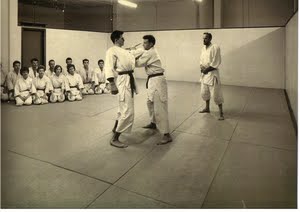
Showing posts with label Randori. Show all posts

Friday, March 8, 2013

Killer Commando

There is a fascinating article published on various news websites concerning a former Australian commando's (Paul Cale) developing a leading edge military close combat system based on martial arts. This could be read in conjunction with an interview with the same person in the Australian martial arts magazine, Blitz.

The original story is fascinating to me, not because of its 'warrior' story but because of the sheer nuts and bolts of it all which my work either informs or raises questions.

Cale tells of an incident in Afghanistan that became a hand-to-hand battle in which he strangled a Taliban fighter. Technically, despite the posted comments to the article, at no time does the article say that the strangulation killed the fighter. However, assuming it did, I'd be fascinated to know the details, not out of some morbid curiosity but from a purely technical point of view.

The forensic pathology literature time line proposed for neck holds/strangulation techniques/shime waza is approximately 10 seconds to unconsciousness, 2 minutes and will resuscitate unaided, 2-4 minutes and manual resuscitation will be required, 3-4+ minutes death.

Was the strangulation held on for 3-4 minutes to cause death? That's a long time to hold a technique in the middle of a combat scenario with multiple combatants. Or was the technique held on for long enough (approx. 10 secs) to induce unconsciousness and then released before the enemy was dispatched by another means? That is to say the strangulation facilitated a decisive technique and was not the decisive technique in and of itself.

This then raises the question concerning how this technique is taught to be tactically employed in a close combat system.

If the time line proposed by the forensic pathology discipline is mistaken, given they've no personal experience in using the technique to cause a fatal injury, Cale's experience would be a unique contribution to the body of knowledge.

Cale talks about breaking an enemy fighter's shoulder. Again, I'd love to know how as I've developed a simply anatomical classification that explains the mechanics of how a shoulder is dislocated by any technique that targets the shoulder taught by any martial art, combat sport, or activity associated with preparing a person to survive a violent encounter. This understanding then, through experience, facilitates the understanding, study, and use of the technique as you know precisely what your application of force(s) is designed to achieve (more than beyond 'break elbow').

Cale talks about the military kit not being suited for being engaged in hand-to-hand combat and that he developed a method which caters for this limitation. It is disturbing when you see any military close combat, law enforcement empty hand control training, and martial arts being used in those two environments, when the techniques taught to be used in an operational environment are trained wearing outfits that are not worn in operational environments (e.g. uniform with no kit or sports attire). I would dearly love to see Cale's modifications to his martial arts methods to cater for the wearing of the cumbersome military kit.

Cale makes the very important point that the combat sport is only used to train a combat ethos. It is a part of his overall training methodology. It is important to understand what the training produces. Combat sports does not teach combat methods. To be sure, there are overlaps, but there is also significant differences, as Cale points out. Many in the martial arts worship 'action,' 'doing things,' and disregard an intellectual study of what they are doing. Because you struggle and train with resistance, sweat, feel pain, get injured, injure and inflict pain, bleed and cause bleeding, does not mean that your training is preparing you for an operational environment. It most definitely trains a mind set, or a warrior ethos as Cale refers to it as, but the tactics and techniques may not 'fit' the operational environment.

Injury science's division of the factors of an injury event - host (person at risk of being injured), vector (person attempting to cause an injury), and the environment - forces you consider all of these factors. The martial arts tends to ignore the latter two factors, which then affects the development of the tactics and techniques of that martial art.

Taking Cale's methodology a step further based on injury science's methodology. You train your close combat methods in your military kit. Should your training partner do likewise? The Taliban fighter is not going to be similarly attired. If you develop tactics and techniques based on an enemy being similarly attired (and similarly trained), they may be flawed. A similar argument is applicable for the environment factor (dojo/training hall vs closed confines of a room in a house in Afghanistan).

The father-of-two said his program also helped returned soldiers suffering with Post Traumatic Stress Disorder. "It's very calming and we find a lot of guys are coming to classes just to unwind and release the pressure valve," he said. "I'm broken, injured and a little bit older than most. For me it's all about technique and being calm and centred. Our psychologists are looking into the calming effect and apparently there's been a body of work done on this issue and US veterans."
In the Blitz article, Cale refers to 'stress relief.' Stress is a limited concept. It looks at a survival mechanism that was selected for in nature to promote an individual's survival. Stress only looks at part of that mechanism, and from a biased viewpoint. Even those involved in the stress discipline describe stress and an ambiguous concept.

The survival process model I've developed provides a holistic approach to study the calming effects produced by combat sports training Cale refers to. Stress training, and some PTSD recovery programs, use an academic understanding of stress and stress effects/symptoms to help manage them. The survival process model, due to its comprehensive/holistic nature, improves on the stress approach.


Thursday, October 7, 2010

Insidious Effects of Training Methods and Combat Effectiveness Pt 3

This is the last blog in my series dealing with training methods and combat effectiveness.

The blogs associated with the 'insidious effects' of training methods has tended to focus on sparring as a method of preparing a person for combat. This focus should not be taken to suggest I favour kata over sparring as a superior method of preparing a person for combat. Not at all. The reason for this particular focus, and the resultant apparent unbalanced view, is that the potential weaknesses of kata and the strengths of sparring are well known and well documented. What would appear to be relatively less well known and definitely not well reported are the potential weaknesses of sparring.

Peter Falk submitted a comment to my last blog which articulately represented the strengths of sparring as a training method for preparing a person for combat. Peter is a thoughtful and intelligent martial artist from Sweden and I do not disagree with anything he had to say in this regard. The reason for my musings in these blogs was to explore the potential weaknesses of this training method which are often overlooked, if appreciated at all.

Protective Equipment

Recall in the last blog the prohibition on groin attacks in the Ultimate Fighting Championship (UFC) competitions and how some critics suggested it diminished the 'realism' of the fights. The tournament organisers then lifted the ban, to which the competitors responded by wearing groin guards. This resulted, as Greg Downey explained, in the tactic of attacking the groin not being decisive. Why would you attempt to kick someone in the groin if you knew they were wearing a groin guard? You wouldn't. Not only would it be ineffective but you could also injure your foot in the process. So, the tactics are modified by natural selection to not include groin attacks, meaning the competitors don't train to use groin attacks nor do they train to defend against them. Tactics to use groin attacks or defend against them are also not developed. After all, why learn to defend against attacks which are not going to be used.

Some authors have looked to the methods used to train swordsmen of ancient Japan when considering methods used to prepare a person for combat. Obviously sparring with a live blade has certain inherent risks and limitations. Donn Draeger, in Comprehensive Asian Fighting Arts, explains that 'kenjutsu [(sword art)] may, and frequently does, require practice with a naked blade, though usually in training a hardwood weapon of dangerous capabilities is used in its place. Thus the nature of the weapon means that training methods must be confined to kata.' Draeger is quite disparaging of the weapon used in place of the naked blade or hardwood weapon of dangerous capabilities: 'Kendo has built-in safeguards such as the "weapon," which is a flexible bamboo object called a shinai.' Because of the protective equipment adopted in this form of sparring training, as well as the limitation placed on the target areas, Draeger suggests it resulted in 'combat nonsensicals, which have all but flushed the fighting value down the drain.'

Hunter B. Armstrong, in 'The koryu bujutsu experience' in Diane Skoss' Koryu Bujutsu: Classical Warrior Traditions of Japan, had this to say on the subject:
In weapons/fighting systems designed for mortal combat … the inherent dangers in training with lethal weapons aimed at potentially fatal targets precludes the use of a free-sparring type action. In some cases this danger has been avoided through the development of protective armour. However, training armour itself is a limiting factor and imposes changes upon the patterns of movements (angles and targeting), and more importantly, the psychological components of combat – the feeling of safety while training cannot prepare the individual for the psychological stress from the danger/threat inherent in mortal combat. Preparation to withstand such stress can only be readily approached in training through the use of actual weapons (or potentially dangerous simulated or rebated weapons), utilising prearranged patterns of movement in which the potential for danger arises from any errors made in timing or movement.

Again I reiterate, this and the previous blogs are only exploring the potential weaknesses of sparring as a training method. The potential weaknesses which are often overlooked, if they are understood at all. It is not my intention within these blogs to advocate one training method over another.

Armstrong makes one statement which echoes my 'insidious effects' warning: 'training armour itself is a limiting factor and imposes changes in patterns of movements.' Protective equipment and prohibition on target areas are limiting factors and impose changes in the tactics and techniques of martial arts utilising this training method.

This is not an issue relegated to historical interest only. The use of protective equipment is increasingly being used to train in as 'realistic' a manner as possible due to technological advances in body armour. The question is, 'is this training armour imposing changes on the tactics and techniques being developed and trained?'

Developing Tactics and Techniques

Say you're using sparring as a training method as you consider it more realistically approximates the real combat experience. You're sparring against an opponent with the aim of defeating them. You develop new tactics and techniques in order to defeat the opponent. In turn, your opponent develops new tactics and techniques in order to defeat you. You both develop tactics and techniques to counter the tactics and techniques developed and employed by each other. Who are the tactics and techniques that are being developed and trained aimed at defeating? Someone who uses those same tactics and techniques. Someone who is trained in your fighting methods. Tactics and techniques are used by judo and Brazilian jiu-jitsu practitioners to spar and defeat judo and Brazilian jiu-jitsu practitioners respectively. Karateka and taekwondo practitioners train and develop tactics and techniques to defeat their fellow practitioners when sparring is used as a training method.

Techniques that are effective against a particular attack are disregarded because they become relatively ineffective in sparring as counters have been developed for them. After all, why learn and train techniques which are not effective when training for combat?

Resisting Opponent in Sparring

I've often heard the phrase 'resisting opponent' or variations on this theme when the benefits of sparring as a training method for preparing a person for combat are espoused. If the opponent is resisting, they are not attacking. So, you are training to fight an opponent who resists your tactics and techniques and not an opponent who is attacking you. Surely the way you don't lose when encountering a resisting opponent is not to attack!

The idea of a resistance to frustrate the attempts of an opponent in sparring is a common feature, and criticism, of sparring and competition. A criticism of modern judo competitors is their initial stances which are not aimed at positioning them for a throw but rather to resist the efforts of an opponent in throwing them. The same issue is seen in the UFC where Downey explains that the rules were changed to work against the tactic of resisting an opponent to go the distance of the round.

Using Your Training Partner's Tactics and Techniques Against Them

In the Jan de Jong jujutsu (aka Tsutsumi Hozan ryu jujutsu)grading system, there are three sparring gradings in the dan grades. Shodan (1st dan) involves unarmed against a knife and unarmed against a stick, and the positions are reversed. Nidan (2nd dan) involves knife vs knife, and sandan (3rd dan) is knife vs stick with the positions being reversed. I learnt to 'play the game' by nidan. I knew everything my opponents knew. I knew their tactics and techniques. So, I used this knowledge; I used my opponent's tactics and techniques against them. I also 'cheated' in training in that I didn't reveal this strategy which I intended to employ in the grading in training. A strategy based on using the tactics and techniques they'd learnt and which they teach against them.

There were half a dozen of us grading the nidan grading. All were obviously the same grade but most had been training for a longer period of time than I had. At the end of the grading De Jong confided in me that I'd done the best out of all the candidates participating in the grading. I was very good at sparring against a knife wielding opponent ... who was trained in a particular way with which I was intimately familiar with. I 'played the game' better than they did. I didn't know what to take away from this grading or the compliment afforded me by De Jong.

Conclusion

While the strenghts of sparring are often focused on, we should be just as aware of the limitations of sparring as a training method for preparing a person for combat. The limitations should be understood and considered or the insidious effects may materialise. There have been different ways of addressing these limitations. Kano included the techniques too dangerous for his randori in his kata. Gracie and Gracie (Brazilian Jiu-Jitsu) recommend their students 'adapt' if these techniques are used against them in combat. It would appear they have adopted the approach that the tactics and techniques which are used in their sparring gives their students the best chance of success in combat and accept the risks imposed by not using nor training against prohibited techniques. These are two different approaches and I offer no comment as to the effectiveness of either, however, I do have an issue with tactics and techniques being developed without consideration as to the potential risks associated with their use in combat. One such technique(s) is any strangulation technique applied to an opponent from the front when the opponent's arms are not restricted in some manner, as discussed in part 1 of these blogs associated with the insidious effects of training methods.

Monday, September 13, 2010

Training Methods and Combat Effecitveness Pt 2

In the previous Training Methods and Combat Effectiveness Pt 1 blog, I referred to Karl Friday's reference to the '300-year old debate' concerning the best training method of preparing a person for combat.

Firstly a comment on Friday's Legacies of the Sword. I originally picked up a copy in a book store in Rotterdam when travelling with Jan de Jong one year teaching seminars throughout Western Europe. It was mostly text and seemed academic so I wasn't initially interested in purchasing it. De Jong's daughter convinced me to buy it as we hadn't seen it available in Australia, and she was used to her father buying martial arts books when ever possible. It wasn't until many years later I read it, and I was amazed. The theories I'd developed concerning the development of jujutsu - here was a professional academic providing support for my theories. Here was a professional academic who is also versed in the martial arts writing seriously about the martial arts. The analysis of various aspects of Kashima-Shinryu which is used as a case study to understand and study the Japanese martial arts can also be used to study and understand all martial arts. It is truly an amazing book and one which should be part of the foundation of any serious martial artists library.

Friday summarises the arguments associated with both sides of the 300-year old debate:

Proponents of sparring and competitions that developed concomitantly argued that pattern practice [(kata)] alone cannot develop the seriousness of purpose, the courage, decisiveness, aggressiveness, and forbearance vital to true mastery of combat. Such skills, they said, can be fostered only by contesting with an equally serious opponent, not by dancing through kata. Pattern practice, moreover, forces students to pull their blows and slow them down, so they neverdevelop their speed and striking power. Competition, it was argued, is also needed to teach students how to read and respond to an opponent who is actually trying to strike them.

Kata purists, on the other hand, retorted that competitive sparring does not produce the same state of mind as real combat and is not, therefore, any more realistic a method of training than pattern practice. Sparring also inevitably requires rules and modifications of equipment that move trainees even further away from the conditions of duels and/or the battlefield. Moreover, sparring distracts students from the mastery of kata and encourages them to develop their own moves and techniques before they have fully absorbed those of the ryuha [(marital arts discipline or school)].

This is a pretty good summary of the respective arguments and I cannot disagree with either side. One point though, Friday's comment regarding the pulling of blows is equally applicable to competition as the detractors of the non-contact or semi-contact karate and taekwondo competitions often raise.

Hunter B. Armstrong, Director of the International Hoplology Society, argues strongly in favour of kata as the better means of preparing a person for combat in 'The Koryu Bujutsu Experience' in Koryu Bujutsu: Classical Warrior Traditions of Japan (edited by Diane Skoss). He makes a couple of additional points which can be added to Friday's arguments. Firstly, while arguing in favour of kata he also argues against the solo katas of modern budo:
The aim of classical training was and is not simply the learning of movement techniques, but the development of combative behaviours that prepare one for implementing simple-but-learned-movement techniques in the face of the overwhelmingly traumatic stress of combat. No amount of solo training or single movement training will do that.
He also raises the issue of the effect of protective gear in training:

Training armour itself is a limiting factor and imposes changes upon the patterns of movement (angles and targeting), and more importantly, the psychological components of combat - the feeling of safety while training cannot prepare the individual for the psychological stress from the danger/threat inherent in mortal combat.

Again, all valid points . The comment regarding armour is particularly relevant today with improved technology resulting in increased usage of protective armour in training. Many train with full body armour today in order to engage in 'full power' training.

Gracie and Gracie's arguments in favour of sparring discussed in the previous blog is a 21st century extension of the 300-year old argument which Friday suggests has no resolution in sight for the foreseeable future. Gracie and Gracie's arguments concerning the reduction in combat effectiveness of Kano's judo due to the prohibition of 'too many' techniques in his randori is an argument from the kata advocates. My pointing out the Gracie and Gracie's argument concerning the combat effectiveness of Kano's judo is equally applicable to their Brazilian jiu-jitsu as they also prohibit certain 'dangerous' techniques in their randori is using the arguments of the kata side.

Even though it may have appeared I was advocating one method over another in the previous blog, or maybe even in this one, that is not the case. My issue is the explicit understanding and recognition of both the strengths and weaknesses of the training methods adopted. By understanding the issues of both sides of the arguments, the appropriate questions can be asked. There are different answers but the important thing is that the questions are asked. If only the strengths are focused on and the weaknesses ignored, Armstrong's reference to changes upon the patterns of movement, that is upon the tactics and techniques of a martial art, are at high risk of materialising. A couple of common instances of this will be presented in the next blog.

Cheers

Monday, September 6, 2010

Training Methods & Combat Effectiveness Pt 1

Renzo Gracie and Royler Gracie (G&G), in Brazilian Jiu-Jitsu: Theory and Technique, make the following insightful observation:
Kano was not a great innovator in technique; most of what he knew in terms of technique was taken from old jujutsu schools. His great innovation lay in the way he taught and trained his students in those techniques. (8)
Competitive advantage is a phrase used in business to refer to a situation where one business has some advantage over and outperforms its competitors. Different martial arts, different styles of the same martial art, and different schools of the same martial art are often established because their founders believe they have some competitive/combative advantage over their 'competitors.' According to G&G, and rightly so, Kano's competitive/combative advantage was largely attributable to the use of randori (free exercise or sparring) as the preferred training method in preparing a person for combat:
The idea was for the students to train 'live' with each other, each trying as hard as he could to apply technique on the other. By this means students could become familiar with the feeling of applying technique on a live, resisting human being. This, as you can imagine, is far more difficult than applying technique on a cooperating training partner in some choreographed kata. Such live training develops far greater physical and mental agility and speed in the student and prepares them well for the tiring and unpredictable movements of real combat. In order for randori to be possible, Kano saw that the dangerous elements of jujutsu would have to be removed. One cannot engage in daily sparring sessions with full power strikes, hair pulling, and eye gouging! To prevent unacceptable attrition through injury, Kano removed strikes and 'foul' tactics from randori. (8)
G&G refer to the 'paradox of randori' in that a martial art can be made more combat effective by the removal of 'dangerous' techniques. They suggest that

what Kano realised is that the effectiveness of a martial art is not determined solely by its repertoire of techniques, but also by the training method by which it instills those techniques into the students. ... Kano saw that a fighter who constantly trained at full power on a resisting opponent in live combat with 'safe' techniques would be more combat effective than a fighter who always trained with 'deadly' techniques on a cooperating partner with no power. (9)

The Gracie/Brazilian jiu-jitsu's (BJJ) competitive/combative advantage lies in, according to G&G, their extension and modification of the techniques, training methodology, and strategy of Japanese jujutsu and judo. They suggest 'Kano took out too much of the dangerous elements of fighting and grappling training' (11). These dangerous techniques which were prohibited by Kano in randori, they explain, are
very effective combat techniques. By removing them students lose a good deal of combat effectiveness. Also if they encounter someone who does use them, their lack of familiarity with the techniques will make them very vulnerable. By adding these techniques to randori training the Gracies made their art much more combat effective. Live sparring had much more combative feel to it with the removal of these restrictions on technique. (11)
Firstly, the arguments put forward by G&G reflect what Karl Friday (Legacies of the Sword) refers to as the 300 year old debate over the better training method for preparing a person for combat - kata or sparring and competition. A debate which he suggests, despite G&G and likeminded individuals' arguments, has no prospect of resolution in the near future. Secondly, Kano's reasons for restricting dangerous techniques in randori - reducing the risk of unacceptable attrition through injury - is a valid concern. You can't very well train a person for combat if they are injured all the time. G&G suggest the Gracie's added the dangerous techniques back to randori. So how do they manage the risk of unacceptable attrition through injury? When discussing the BJJ training methods, G&G explain that
a very large percentage of training time in Brazilian jiu-jitsu is taken up with live sparring. ... Because the more extreme elements of a real fight (such as biting, eye gouging, hair pulling, and striking) are removed from training, you can partake in such live sparring on a daily basis without fear of constant injury and damage. (20)
So, they also prohibit certain dangerous techniques. They have to. And for the very same reasons Kano had to. Doesn't G&G's argument concerning the reduction of combat effectiveness when dangerous techniques are prohibited hold for their BJJ as well. Yes! It has to! You cannot fault the logic of G&G. If certain techniques are prohibited in training then the student does not get to train to use nor to defend against these techniques. The argument becomes one of degree. BJJ is more combat effective than judo because less techniques are prohibited in randori. However, certain techniques are still prohibited in BJJ which has the potential of having a negative effect on the combat effectiveness of their students.

What did Kano do about training the dangerous but very effective combat techniques? He trained them in kata where there are no restrictions on the types of techniques which can by trained. What does G&G/BJJ do about the training the dangerous but very effective combat techniques? It would appear they do not train them at all and they advise their students to simply 'adapt':
The resulting familiarity with applying your techniques full power against a person doing everything in his power to defeat you is a great advantage in a real fight. Of course you have to adapt to the obvious differences that will emerge in a real fight. The opponent will probably be trying to punch, kick, scratch, gouge, and bite you. However, the familiarity with active resistance will make the transition relatively easy. (26)
It has to be understood that any and all training methods have their limitations. There are always tradeoffs. Where problems emerge in terms of combat effectiveness is when these limitations and tradeoffs are not understood and/or appreciated. When the focus is purely on the strengths of a particular training method with no mind given to its inherent weaknesses. When the combat imperative is not the sole focus. The danger then becomes that tactics and techniques may be developed and shaped to meet other demands which may not be effective or may pose unacceptable risks in real combat.

The next couple of blogs will focus on martial arts training methods. Next weeks will provide some examples of tactics and techniques which have been developed based on training methods which potentially pose unacceptable risks in real combat. Tactics and techniques which are taught by many martial arts who refer to their focus on combat effectiveness as their point of differentiation and the source of their competitive/combative advantage.