Showing posts with label Teaching. Show all posts

Thursday, July 2, 2020

Warfighting - Required Reading for all Self-Defence Activities

Warfighting is the U.S. Marines basic philosophical manual that provides the authoritative basis of how they fight and how they prepare to fight. The first chapter in Warfighting concerns the nature of war and the human dimension. The material in that chapter is applicable to all violent encounters and all who prepare themselves or others to engage in a violent encounter by fighting. It should be mandatory reading for all of those people.
Since war is a violent enterprise, danger is ever present. Since war is a human phenomenon, fear, the human reaction to danger, has a significant impact on the conduct of war.
The same is true of all violent encounters. 'Fight Activities,' such as the military, law enforcement, martial arts, self-defence, and combat sports, teach fight. As I explain in Fear and Fight: Understanding Our Natural and Learned Responses to a Threat, fear impinges upon a person's readiness and ability to engage in and succeed in a fight. This is why the Warfighting manual instructs, 
Leaders must study fear, understand it, and be prepared to cope with it.
It's not just Marine leaders that must study fear, understand it, and be prepared to cope with it. It is anyone who is involved in preparing themselves or others to engage in a violent encounter. If you do not study fear, understand it, and be prepared to cope with it, you are not teaching effective fight behaviour. You are not teaching effective self-defence.

Wednesday, June 10, 2020

How Did George Floyd Die and Who is Directly Responsible?

We are very aware of who George Floyd is and the circumstances surrounding his tragic death given the near non-stop media coverage in since the video emerged of the incident.

It is a terrible look with the officer kneeling on Floyd's neck and his passing after eight minutes and x seconds. I hadn't given much thought to the specifics of the incident until a comment on Facebook yesterday which set my mind in curiosity mode.

How did George Floyd die and who is directly responsible?

You will recall that I have researched and written a book tentatively titled, The Science Behind All Fighting Techniques. A chapter in that book is dedicated to Shime Waza (strangulation techniques). The police call these techniques neck restraints or neck holds for obvious reasons.

There are two types of these techniques that target the neck. The either target the carotid artery(s) or the front of the neck. Applying pressure to the side of the neck occludes the carotid artery(s) reducing blood supply to the brain resulting in loss of consciousness in 10-12 seconds. Applying pressure to the front of the neck forces the tongue backward blocking the windpipe passage and depriving the body of oxygen.

Floyd remained conscious therefore it is unlikely that the knee of the officer on the neck occluded the carotid artery(s). Floyd continued to speak saying that he could not breathe, therefore, I could not see how the knee was producing pressure on the front of the neck forcing his tongue backward to block the windpipe passage and deprive the body of oxygen. In that case he should not have been able to speak. In any event, when I studied the photograph, and I won't reproduce it because there is no need to share this horrible image of his last moments more than it has been, the officer had his knee on the side of the neck and not the back or front.

I hypothesised that the officers sitting on his back prevented his lungs from expanding thereby rending it impossible for Floyd to breath. The knee on the neck was to prevent Floyd from squirming, which it did thus preventing him from relieving the pressure on his back. I hypothesised that it was the officers on Floyd's back that are directly responsible for Floyd's death and not the officer kneeling on his neck.

Turns out that the independent coroner concurs with my hypothesis. There were two autopsies conducted. The following is extracted from a New York Times article about the subject:

The criminal complaint supporting a murder charge for the officer, which referred to the Hennepin County medical examiner’s preliminary findings, said the autopsy had discounted traumatic asphyxia or strangulation as the cause of Mr. Floyd’s death.

The private autopsy by doctors hired by Mr. Floyd’s family determined that he died not just because of the knee on his neck — held there by the officer, Derek Chauvin — but also because of two other officers who helped pin him down by applying pressure on his back. All three officers were fired last week, as was a fourth officer at the scene.

There is more in the article supporting the second narrative.

The inability to breathe was not complete because apparently we have around 6mins worth of oxygen in our bloodstream without it being replaced.

And then there is EDS, 'excited delirium syndrome.' From my as yet unpublished book,
 
It has been suggested that sudden deaths that have occurred when a neck restraint has been applied by law enforcement officers may be explained through ‘excited delirium syndrome’ (EDS). 

The actual cause of death associated with EDS is not known, however, it is often linked to the level of catecholamines in the body.


DiMaio and DiMaio (2006) suggest that EDS deaths result from a fatal cardiac arrhythmia (irregularity in rhythm) caused by, in addition to the release of catecholamines due to the struggle to restrain the individual experiencing the excited delirium episode, the excited delirium itself triggering a release of catecholamines. DiMaio and DiMaio suggest that the highest levels of catecholamines occur approximately three minutes after cessation of the activity, therefore, EDS fatalities often occur after the struggle has taken place and the subject has been subdued. 

What are the ramifications associated with this narrative. I am no lawyer so this is in no way definitive. The kneeling officer is charged with 2nd degree murder. If he was not directly responsible for the death of Floyd he may be found not guilty. The two officers sitting on his back are charged with being accomplices. If they are directly responsible for Floyd's death they are not accomplices.

The State Attorney laid the charges and he is a politician before being a prosecutor. It would be politically difficult for him to amend the charges particularly that the optics convict the kneeling officer in the public's mind. If these officers are not convicted, riots will most definitely ensue. If they are convicted of these charges, innocent men of THESE charges may be being sent to prison (the emphasis for the benefit of those who will argue send them to prison nonetheless).

One of the outcomes of this situation is relevant for martial arts and combat sports. Police and politicians are responding to calls for change by banning the use of neck holds/restraints by police (even though they were not used in this case). France has come out and banned their use by police after the Black Lives Matter protests. These techniques are described as being dangerous whenever used. In my chapter I refer to a coroner who called for their ban in the 90s and referred to them as a 'lethal weapon' because they are capable of causing death whenever used.

If they are potential lethal weapons and can cause death whenever used, why are they not banned from being taught by martial arts and used in combat sports? In light of this argument/discussion, ANYONE teaching these types of techniques in martial arts or combat sports should morally and ethically, if not legally, consider their continued teaching and use of these techniques. That consideration would include being fully informed about the subject and these techniques. To the best of my knowledge my chapter is the most comprehensive study of the subject.

As luck would have it, as soon as I published this post I read this news article about a subject dying from EDS while being restrained by police officers:

“Mr McGlothen had underlying heart disease and clearly was suffering from excited delirium. The combination of these factors caused his death.”

Friday, March 13, 2020

Chemical Soldiers and Mushin no Shin

I was talking to a friend who served in Afghanistan about my work concerning fear, how it impinges upon a person's readiness and ability to engage in and succeed in a fight, and the military's efforts in overcoming or counter fear in order to fight and fight effectively.

Colonel John M. House wrote in his Why War? Why an Army? that soldiers need to overcome the fear of death and injury in order to act and survive on the battlefield. How do our troops do that in Afghanistan? How do their adversary, the Taliban, do the same?

When I discussed my work and those questions with the abovementioned friend, he said that the Taliban fought under the influence of drugs.

This set of a 'What's going on here?' reaction in me which research psychologist Gary Klein explains in Seeing What Others Don't: The Remarkable Ways We Gain Insights is the curiosity pathway to gaining insight.

There were many questions posed by this reaction, however, at around the same time I was prescribed sertraline for my generalised anxiety disorder. Sertraline is one of the most highly prescribed medications to reduce anxiety, fear, and panic.

Fear (anxiety and panic) impinge upon a person's readiness and ability to engage in and succeed in a fight. Sertraline is reqularly prescribed to reduce anxiety, fear, and panic. Why aren't the Army providing sertraline or similar medication to their troops to enhance their fighting performance? If the Army are not prescribing sertraline for their troops who can live and die based on their level of anxiety, fear, and panic, why are we being prescribed this medication?

Briefly looking at this issue, I came across the work of Dr. Richard Gabriel (Colonel, U.S. Army Ret.): https://www.perfectkiller.com/gabriel-afterword.shtml

Gabriel explains that the next frontier in warfare is not technological but biochemical:

But what modern armies have in mind far surpasses anything tried in the past. Biology and chemistry have combined in the modern age to produce the science of biochemistry. Armed with this new knowledge, the military research establishments of the United States, Russia, and Israel have set for themselves the task of abolishing fear in the soldier to make him a more efficient killing machine. The next revolution in military power will occur not in weapons technology, but in biochemistry that will make it possible for soldiers to better endure the conditions of modern war. If the search is successful, and it almost inevitably will be, the fear of killing and death will be banished and with it will go man's humanity and his soul. The chemical soldier will become a terrifying reality.

It's a thought provoking read. The holy grail of military research is biochemicals that eliminate fear, anxiety, and panic, producing 'chemical soldiers' as Gabriel describes them. Without anxiety and fear war will become wars of attrition. We need anxiety and fear to retain our humanity.

What does Gabriel's work then say about the samurai's mushin no shin, mind of no mind, where warriors are trained to fight without fear or anger? The war of attrition based on mushin no shin, no fear, is dramatically portrayed in the final battle scene of The Last Samurai. Are the Japanese atrocities during WWII attributable to the successful training of mushin no shin?

Gabriel makes another interesting point in the context of my book in that the 'brave pill' will render military concepts such as bravery and courage obsolete when bravery and courage are conceived of as acting in spite of fear.

Needless to say, this has added another chapter to my book, Fear and Fight: Understanding Our Natural and Learned Responses to a Threat.


Monday, September 23, 2019

When did teaching martial arts become not enough?

When did teaching/learning martial arts become not enough? Is teaching/learning martial arts relevant anymore?

I am continually seeing fitness appended to martial arts when advertising or promoting one's teachings. My old school, or at least the school that emerged from my old school, rebranded itself from Jan de Jong Self Defence School to Jan de Jong Martial Arts Fitness. The WA Institute of Martial Arts advertises 'Martial Arts Fitness is here.' I just saw another advert/promotion directly coupling martial arts with fitness.

Is a dojo now also a gym? What is the focus of the teaching, martial arts or fitness? Do you ever see cricket, football, basketball etc directly coupled with fitness? 'Football fitness is here.' 'Netball fitness is here.' You don't see other physically activities desperately trying to establish relevance by appending their activity to fitness.

If the focus is on fitness, what impact does that have on martial arts teaching?

Efficiency is a feature of Jigoro Kano's teachings. Efficiency means less effort. The more efficient your tactics and techniques the less effort required to execute them. Does that mean that teachings which teach efficient tactics and techniques are less because they don't focus on fitness which requires more effort?

I understand the marketing impulse to try and extend the brand from martial arts to the fitness industry given the interest in martial arts appears to be waning. But does extending the brand mean that the brand loses meaning? Or that the product is over extended? Is aikido a means to get fit rather than to learn aikido?

When I teach, I am only interested in fitness insofar as it contributes to martial arts effectiveness. I am not interested in teaching fitness for the sake of fitness. If you are unfit and effective, it's all good to me. If you want to get fit, for whatever reason, join a gym. Go for a run. Stop driving your car and walk to work or school.

The two best instructors in the Jan de Jong Self Defence School were Shihan Jan de Jong and Sensei Greg Palmer. Nobody would ever accuse them of being fit, however, they were extremely effective as practitioners and most definitely as teachers. When I wanted to learn martial arts, I'd go to them before any of the other 'fit' instructors.

Monday, March 25, 2019

Ken Tai Ichi no Kata and The Core of All Learning

The following is a link to a post on my Shihan Jan de Jong OAM 9th Dan blog where I use Yoseikan's ken tai ichi no kata to discuss the core of all learning which is the second chapter in my The Science Behind All Fighting Techniques.

Thursday, February 28, 2019

Happoken no Kata

I published a post on my The School of Jan de Jong blog which uses the theory presented in my The Science Behind All Fighting Techniques to analyse the Happoken no Kata taught by Jan de Jong jujutsu, Yoseikan Budo, and Yoseikan Aikido.

The post is an example of the use of theory to gain understanding and insights into practice. It is also an example of the necessity to always question your teacher's instruction, but only when you understand the theory and the instruction does not stack up to the theory.

Sunday, January 22, 2017

Throws and Takedowns

I'm finally finalising my book on the science behind fighting techniques.

One chapter in that book is on throws and takedowns. Despite the common meaning of the terms provided by the Oxford Dictionary, it appears the martial arts has managed to confuse the meaning of the terms as applied to marital arts techniques.

I provide a biomechancially based classification for all techniques that are designed to cause a person to fall to the ground. It's based on the biomechanics of balance and stability. A person is stable if their centre of gravity (CoG) is located over their base of support (BoS) and balanced if they possess control of their CoG with respect to their BoS.

It was interesting reviewing the literature on the throws and takedowns of various martial arts. Books dedicated to throws and takedowns of various martial arts did not distinguish between the two, and in fact often only referred to throws.

Judo, according to Kano's classification of Judo techniques, does not teach takedowns.

A throw is a technique were forces are applied to cause both of the opponent's feet to leave the ground. The biomechancial target of the applied forces is the opponent's BoS.

A takedown is a techniques were forces are applied to cause an opponent's CoG to fall outside of their BoS and a balance recovery is prevented. Takedowns can be subclassified as 'one-legged' or 'two-legged' (for want of a better description) takedowns. The biomechancial target for one-legged takedowns is a person's foot in contact with a support surface. For instance, a foot sweep is a one-legged takedown.

The biomechanical target of a two-legged takedown is an opponent's CoG. Forces are applied to cause an opponent's CoG to fall outside of their BoS and a balance recovery is prevented. A hiki-otoshi (elbow drop) is an example of a two-legged takedown.

Irimi-nage and Mukae-daoshi are good examples of the confusion held within the martial arts over this issue. Irimi-nage is 'entering throw' taught by aikido.


Image result for irimi nage

Mukae-daoshi is 'meeting takedown' taught by Yoseikan Budo/Aikido and Jan de Jong.


Using Kano's division of judo techniques (kuzushi, tsukuri, kake), the same kuzushi and tsukuri result in different kake depending on the direction of the applied forces in the kake phase. The same unbalancing and positioning results in a throw or takedown depending on the direction of the applied forces in the execution phase of the technique.

The irimi-nage/entering throw is in fact a takedown while the mukae-daoshi/meeting takdown is in fact a throw. What that also means is that the latter is entirely dependent on the momentum generated during the kuzushi phase of the technique.

It also means that the applied forces for a throw are upward whilst the applied forces for a takedown are downward. A biomechanical understanding of these techniques enables a student to know what to look for in learning and training these techniques as does the instructor. It makes better students of students and better instructors of instructors.


Tuesday, May 24, 2016

Book #1 Progress

My first book, the book that inspired this block, is nearing completion. It is about the science behind the techniques taught by activities associated with preparing a person to survive a violent encounter and the teaching thereof.

1. I need a 'snappy title' to process ':The science behind the techniques taught by activities associated with preparing a person to survive a violent encounter and the teaching thereof.

2. I need to shorten the explanation after ':'.

3. I need a phrase that includes martial arts, self-defence, combat sports, law enforcement methods, and military close combat. I initially was using 'Survival Activities', however, the primary teachings of those activities is sometimes not survival.

Would appreciate your help on these matters.

I have a professional photographer on board, complete with lights, cameras, consent forms, and copyright issues.

I have two 'models' complete with contrasting gi.

I have a dedicated location.

Within the body of the book, there is only one small part missing. An anatomical description of wrist twists and wrist locks. I have, for the first time in this literature, an anatomical description of all shoulder locks, elbow locks, forearm locks, and side wrist locks.

As I explain in the book, the medical literature is of no assistance as >85% of all injuries to the upper limb occur as a result of a fall on an outstretched hand (FOOSH injuries) and the forces experienced then are very different to those experienced when a joint-lock (kansetsu waza) is applied.

The Australian Institute of Sport has a Combat Centre that focuses on combat sports. I am trying to get in contact with anyone associated with the AIS CC to discuss this matter. If anyone can help, most appreciated.

Friday, October 9, 2015

What Are You Teaching And Why?

I haven't posted anything for a while because of various reasons, however, I'm back.

I'm writing a book concerning the 'survival process'. The survival process involves a stimulus, our evolved survival mechanism, and an output that is designed to affect the initiating stimulus. It order to develop this theory I have had to integrate the theories of fight-or-flight, stress, and emotion, which, due to our fractured sciences, all look at the same thing but in limited ways and for different purposes which distorts their understanding of the original survival process. Integrating these theories and developing new theory then brings us back to it's core function - survival.

An understanding of our survival process is useful because it allows us to understand (a) our natural responses to a threat or challenge, and (b) all of the methods taught by the martial arts, self-defence, military close combat, and law enforcement methods because they are ALL interventions in the survival process.

What are you teaching and why?

Lets look Donn Draeger's martial arts dichotomy of self protection and self perfection.

The 'practical' approach to martial arts is to teach a person to protect themselves. Nature did not leave us unprotected and defenceless. I can prove that. I can prove it because we are here. If we were unprotected and defenceless, we would not be here. Nature provided us with an extraordinarily sophisticated defence system. What the martial arts are trying to do is to 'improve' on nature by teaching us learned defensive behaviours that are designed to improve on instinctive defensive behaviours.

Teaching tactics and techniques is an analytical approach to the defensive problem. A systems approach, a holistic approach, recognises that there is more to the survival process than behaviour. The behaviour has to be supported or not impeded by the emotion and physiological responses to a threat or challenge that an appraisal produces. What are the martial arts doing concerning the emotion and appraisal responses to a threat or challenge?

The martial arts moved beyond the mundane task of defending ourself to one of perfection ourselves. In this case, the defensive effectiveness of the tactics and techniques is of very little importance. But what does it mean to perfect ourselves through the study and training of the martial arts?

Many often speak of the battle, defeat, conquering, etc of the ego. It all sounds very grand, but what does it mean?

Nature originally provided most organisms with emotion, which in humans arises from the amygdala. Later, nature provided humans with intellect, which arises from the neocortex. Intellect/neocortex enabled humans to climb to the top of the food chain ... but at a price.

Neocortex ('Neo') and amygdala ('Amy') don't always get along. In fact, Neo often wants to control and subjugate Amy. 'Defeat one's own ego'- what that means is defeat one's emotions/defeat Amy. This is the very basis for religious doctrine. Don't give into your base desires, which is driven by Amy.

Don't flee when afraid. Don't strike out in anger.

How do you not give into your base desires? This is where Neo comes in. Neo is used to manage or control the older but more selfish Amy.

Self protection based martial arts need to manage or control emotions, mostly fear and anger. Fear does not support the fight behaviour that martial arts teach and anger may lead to uncontrolled fight behaviour. So, what is your martial art doing to manage or control Amy in order to ensure the tactics and techniques you learn are effective in a life-threatening situation?

Self perfection - control Amy. Defeat Amy. How is your marital arts training designed to defeat Amy?

There is so much to this subject. So much that I'm currently exploring in order to develop theory that will enable us to better understand what we are doing and just as importantly to improve what we are doing.

Buckle up. It's going to be an interesting journey.

Wednesday, August 5, 2015

Poo Don't Pee

I have written extensively about the core of all learning in my Kojutsukan blog and my The School of Jan de Jong blog, both explaining the core of all learning and applying the core of all learning to understand various things. I have had an article on the subject published by Blitz, the premier martial arts magazine in Australia, and chapters are devoted to the subject in two of the three books I've drafted.

The core of all learning is the identification of similarities and differences. Research has identified four forms of identifying similarities and differences that have proven highly effective. They are: comparison, classification, creating metaphors, and creating analogies.

I'm only going to refer to the effectiveness of creating metaphors in this post.

The martial arts classic movie, The Karate Kid, demonstrates the effectiveness of using metaphor to teach martial arts skills. Wax on, wax off; paint the fence; sand the floor; paint the house were all metaphors used by Mr Miyagi to teach Daniel-san karate skills.

I will share with you a personal experience where the use of metaphor had immediate positive effects on my execution of a sporting skill.

On my first skiing trip, I was taking snowboarding lessons in a group environment. While the lessons were getting me down the hill, it wasn't always in an upright position and not without risk of serious injury on the way down through multiple crashes. One particular cartwheeling crash had the other skiers being towed up the hill clapping.

I decided to take a private lesson. It was either that or stop skiing or risk serious injury. My instructor was this mature female 'ski rat' who followed the snow from country to country teaching skiing. After this and that technical instruction, she turned to me and said ... 'poo, don't pee.'

'Poo, don't pee' immediately changed my posture on the snowboard resulting in radically improved performances. I could actually make it down the hill without crashing while executing turns on the way down.

'Poo, don't pee' - teach and learn by the creation of metaphors.

Thursday, May 28, 2015

What's The Difference Between Throws and Takedowns? Part 1

What is the difference between a throw and a takedown in the martial arts? This is the question that was asked on the Martial Arts Planet internet forum in 2007. The following is a summary of the responses received:

  • There is no official distinction.
  • A hard and fast definition is difficult because there is so much overlap between the two.
  • A throw ends a fight and a takedown takes the fight to the ground.
  • Both of the opponent's feet have to leave the ground with a throw and not a takedown.
  • A throw gets one or both feet off the ground and a takedown gets one or no feet off the ground.
  • It is martial art dependent. The same technique may be a throw in one martial art and a takedown in another.
  • In addition to throws and takedowns, there are slams, sweeps, reaps, and trips.
  • You go with the opponent to the ground with a takedown and not with a throw.
  • A distinction between the two techniques cannot be based solely on mechanics.
Despite the quality of the source of the information, the responses are a pretty good depiction of the different conceptions that are held within the martial arts community of the distinction between throws and takedowns. They also reflect the confusion that surrounds the issue.

'There is no offical distinction'
The book I initially proposed to write was a how-to book on the jujutsu taught by Shihan Jan de Jong OAM 9th Dan. It was intended to contain difference chapters for each class of technique taught by Tsutsumi Hozan Ryu jujutsu/Jan de Jong jujutsu (and most other jujutsu systems) which included separate chapters for throws and takedowns. I wanted an authoritative definition(s) that distinguished between throwing techniques and takedown techniques for those chapters so I undertook a comprehensive review of the English-language martial arts and related fields literature. The results of that review was that, as respondent #1 above suggested, there is no official distinction between these two types of techniques within the martial arts literature.

Authoritative Distinction
The how-to book was shelved in favour of a book on the science behind martial arts/fighting techniques and the teaching thereof and a chapter was devoted to my failed search for an authoritative distinction between these two types of techniques. Within that chapter I also present, for the first time in the English-language martail arts and related literature, an authoritative distinction between these two types of techniques. This distinction then forms the basis for classifying all techniques that are designed to cause a person to fall to the ground.

I'm drafting an article about this issue for the Blitz martial arts magazine. Due to the limitations on the size of magazine articles, which I frequently exceed, I cannot detail this most interesting of journey's within the martial arts literature to find an authoritative distinction between these two types of techniques, so I thought I might share some of the journey with the readers of this blog.

Classification
The authoritative distinction between these two types of techniques I developed formed the basis of classifying all techniques that cause an opponent to the ground. When I discussed this classification with some senior martial artists I was generally met with bemusement. 'Why classify these or any other techniques?', they would ask. Rather than just assume I'm rightand my work is of importance, I went in search of an explanation of why classification is important. In researching this answer I came across 'the core of all learning.'

The Core of All Learning
The core of all learning is said to be the identification of similarities and differences. There seems to be consent as to the similarities between throws and takedowns - they are both types of techniques that cause a person to fall to the ground - but there is no consensus as to what separates them apart ... not until now.

Research has identified four forms of identifying similarities and differences that are highly effective: comparing, classifying, creating metaphors, and creating analogies. Each of those forms of identifying similarities and differences are seen by cognitive theorists as being more than simply linguistic or literary devices, rather, they are seen as being fundamental ways of thinking.

Rather than asking 'Why classify?', we should instead be asking why we don't classify. In the case of throws and takedowns it is probably because while the similarities between these two types of technique are understood, the differences are not.

Previewing
We will see that classification can be used, as it is intended to be used, to preview the technique to be taught or learnt. For instance, what do you know if you were told you were going to be taught a throw? You'd know that you are about to be taught a technique were forces are applied to an opponent to cause them to fall to the ground. What would you know if you were told you were about to be
taught a te waza (hand technique) as per Jigoro Kano's classification of judo techniques? You'd know that you are about to learn a technique that is:
  1. a nage waza where forces are applied to an opponent to cause them to fall to the ground;
  2. a tachi waza where the thrower will be standing during and at the completion of the execution of the technique;
  3. a te waza where the thrower’s hand is the main body part that plays a central role in the execution of the technique; and
  4. similar to other te waza and different from all non-te waza techniques.
You'd know all this before you even knew the name of the technique let alone before you'd seen it demonstrated, just because the technique was classified as a te waza. This classification is already suggesting to you what the key elements in the technique are, the important elements to look for. You can call upon your background knowledge of similar techniques to understand and learn the new technique.

Judo and Takedowns
What would you know if you were told you were about to learn a takedown (taoshi waza) with reference to Kano's classification of judo techniques? You'd know you were not learning judo.

The judo classification does not include a class that refers to takedowns (taoshi waza). That means that either judo does not teach takedown techniques or that judo does teach takedown techniques but they are included in another class of technique. The latter explanation means that the similarities between takedown techniques and the other techniques in the class, e.g. nage waza, have been identified but either the differences are considered not material enough to warrant their own class or, as is the case, they are not understood.

Does judo teach takedown techniques? Geoff Thompson's The Throws and Take-Downs of Judo would suggest they do - but then why does Thompson not provide definitions that distinguish between these two similar types of techniques and refers to all the techniques in his book as throws?

 The journey continues in part 2.


Thursday, April 11, 2013

Do We Need Explicit Knowledge of Techniques?

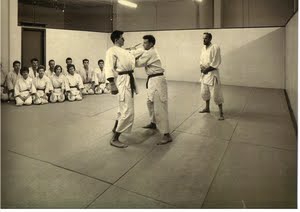
One of the shodan gradings in Jan de Jong's jujutsu grading system is a theory grading. The theory grading is an oral examination of the candidate's technical knowledge. A common question De Jong posed was: 'What are the forces involved in a tai gatame ude kujuki (body set are breaking)?' The candidate was required to answer the question verbally with no physical demonstration.

This is an example of explicit learning or explicit knowledge. The Australian Institute of Sport provide the following explanation of explicit learning which is contrasted with implicit learning:
Explicit learning can be related to traditional coaching approaches where verbal instruction is used to coach a learner about how to perform a skill. This process typically results in the learner being able to verbalise how to perform the skill, although it does not guarantee the learner can physically execute the skill. In contrast, implicit learning methods typically contain no formal instruction about how to perform the skill yet result in a learner being able to perform the skill despite being unable to verbally describe how they do it.
Do we need explicit knowledge of techniques? De Jong obviously thought so given he included an explicit knowledge grading within his shodan grades. The 'traditional' teaching method of Asian martial arts involves implicit learning where techniques are demonstrated and the student attempts to imitate them. Does the student need to be able to verbally describe techniques in addition to being able to perform them? Does the instructor?

De Jong saw his dan grades as producing instructors in addition to practitioners. He expected his instructors to possess an explicit understanding of techniques. Many others in the martial arts do not expect either their students or instructors to possess an explicit understanding of their techniques. One possible explanation for the traditional Asian martial arts teaching model being based on implicit learning may be because the instructors did/do not possess an explicit understanding of the techniques. If you come up under an implicit learning model, where do you gain the explicit knowledge?

Why would an instructor need to have an explicit understanding of techniques if they use implicit learning methods when teaching? One reason is that it provides a through understanding of the mechanics of the technique. It enables the instructor to analyse techniques and provide instruction to correct errors and improve performances. The problem is that an explicit explanation of techniques is hard to come by in the martial arts.

Let's return to De Jong's question; 'what are the forces involved ...?' De Jong intuitively knew that forces are important in understanding how a technique works. Unfortunately, neither he nor the candidates knew much about forces. My work remedies that shortcoming.

Forces are what causes every technique taught by every martial art work. The good thing is that forces is a simple concept for the layperson to understand and apply. First you identify all points of contact between the 'defender' and the 'attacker.' Next you determine if the force applied at each point of contact is a push or a pull. Then you describe the direction and relative magnitude of each of the forces. Finally you determine the intended effect of the applied net forces. This approach provides an explicit understanding of every technique taught by every martial arts.

A very good and rare example of this approach at work is with Jigoro Kano's Kodokan Judo. When you understand the concept of forces and adopt the approach described above, you'll see that Kano consistently describes all his methods in these terms. In this way, Kano focuses on the important elements in the techniques to provide an explicit understanding of judo techniques for the reader.


Tuesday, April 2, 2013

Implicit Learning vs Explicit Learning

The previous post looked at Being Taught vs Learning. This post looks a little more at learning, which an understanding of is important for both teacher and student of the martial arts.

Learning comes in two guises: explicit and implicit learning.

Explicit learning can be related to traditional coaching approaches where verbal instruction is used to coach a learner about how to perform a skill. This process typically results in the learner being able to verbalise how to perform the skill, although it does not guarantee the learner can physically execute the skill. In contrast, implicit learning methods typically contain no formal instruction about how to perform the skill yet result in a learner being able to perform the skill despite being unable to verbally describe how they do it.

Hurst, in Armed Martial Arts of Japan, suggests that in Japanese medieval times when fighting skills were still practical, the head of any martial arts school instructed his disciples in a manner analogous to that of many religious teachers. That is to say that transmission of the teachings occurred largely by example and not through verbalisation. Hurst is describing implicit learning as being the traditional model for martial arts transmission.

It has been found that athletes who are given instructions (explicit learning) were found to more likely preoccupy themselves with thoughts about how they were executing the skill, which in most sports is detrimental to performance. Under pressure, the players were found trying to consciously control normally automatic, implicit or subconscious processes, commonly termed ‘paralysis by analysis’. In other words, they were more susceptible to choking. Alternatively, players who did not have any instructions to refer to (implicit learning) were less likely to think about how to execute the skill because they did not consciously know what they actually did. That is not to say their bodies did not know what to do, they simply left the brain out of it.

The explicit-implicit distinction is not as defined in most modern day martial arts training. Instruction is provided, but that instruction focuses on the how-to with very little, if any, instruction provided as to the why-to. That is to say that instruction is provided as to how to do the technique with none provided as to why the technique works.

As with everything, there are costs and benefits. A benefit of implicit training is increased resilience to detriments in performance under pressure. A benefit of explicit training is that it is a faster way for a learner to acquire information. A cost of explicit training is the increased potential for choking. A cost of implicit training is that it does not provide the tools for a learner to self correct. I would go one step further, it does not provide the tools to teach others.

It was once explained to me that traditional teaching of Chinese or Japanese martial arts was for the teacher to provide 'one corner' and it was up to the student to find the other corners. All very mystical and philosophical, but does it not also reflect the fact that the traditional martial arts model provides the student with how-to knowledge and not why-to knowledge. That they do not understand why something does or does not work, only how to do it, and then only for them.

Most martial arts instructors can be viewed as being great tennis players. They know how to play the game. Andre Aggassi was asked to describe the wrist action of his forearm stroke. It was found with the aid of slow motion cameras that his description of his wrist action was incorrect. He could perform the action brilliantly, but he didn't understand it and couldn't verbalise the action. Who do you want to be taught by? Roger Federer or Roger Federer's coach who you've never heard of and is not an elite player?

This raises the issue of what a black belt (or any senior grade by whatever description) means. Should a black belt be able to instruct the tactics and techniques of their martial art? If so, what model do they adopt: implicit or explicit learning? By default, if they are expected to be able to teach, they must adopt the implicit learning model? They will be limited in their problem solving abilities because they have learnt the how and not the why of techniques. Looking back on my martial arts experience, I've known many instructors who knew how to do the techniques, and some who were very good at doing them, but very, very few who knew the why of techniques. They had a 'follow me' approach to teaching and were limited and less flexible in their problem solving abilities for individual students.

Related to the above question, what percentage of a black belt should be given to teaching/understanding compared to proficiency? Right now, most black belts focus on proficiency, which then fallaciously is used to suggest teaching ability. Would you award a black belt to a person who knew the why of techniques and could teach but was an average practitioner? It depends on what you think a black belt means, or what it means to you as an instructor or head of a school. What are you producing - teachers or practitioners?

This is where my work is directed. To fill that gaping chasm that is the lack of understanding of why martial arts techniques work and how to teach them.