Showing posts with label Saito Brothers. Show all posts

Friday, April 8, 2011

Jan de Jong Pt 18 - Logo

A big part of the Jan de Jong story is his logo. His logo was based on an ex libris he commissioned during WWII. An Ex libris, or bookplate, is a small graphic label or print that is glued to the inside cover of a book with the purpose of identifying its owner. The Latin phrase 'Ex libris ...', means 'the books of...', and is usually followed by the name of the owner of the book. The designer De Jong commissioned to design his ex libris was Wim Zwiers. In researching this blog, and yes, I do research these blogs, I came across this explanation of why an ex libris is made:
Ex-libris have been a constant tradition for over five hundred years. They are a challenge to an artist to produce a small graphic art work for a friend, for a customer or for himself with a special purpose: identifying the owner of a book. Pasting a beautiful ex-libris in one's books not only discourages theft and reminds borrowers that a book must be returned, but is also a way of paying tribute to the book, which despite modern communication technology remains a primary vehicle for the transmission of knowledge and a constant source of pleasure and interest. As an object of collection, ex-libris are a wonderful way of acquiring, with time and patience and without being a millionaire, a small-format art museum which reflect the artist's skills and the collector's taste.
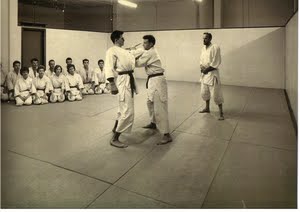
The theme or image of De Jong's ex libris speaks volumes. It is a graphic representation of his original jujutsu instructors, and reflects his love of, and identification with, the art of jujutsu. The image is based on a photo taken of his original instructors, the Saito brothers.

Zwiers was born in 1922, and would have been in his late teens when De Jong commissioned his ex libris. He went on to become a teacher of fine arts after WWII and is a respected artist utilising many mediums. There are so many stories like this associated with De Jong. Zwiers reconnected with De Jong through an amazing coincidence. They had not had any contact with each other since WWII, but, for whatever reason, in the mid 1990s, Zwiers was visiting Perth, 'the most isolated capital in the world'. He was on a train and saw a van through the window. The van had the ex libris image he'd designed 50 years ago on it, along with a phone number. He phoned the number, and, he and De Jong were reconnected nearly 50 years after their initial meeting, and half a world apart. De Jong would always try and visit Zwiers each year he visited Europe to conduct his seminars. I had the absolute pleasure of meeting Zwiers. He showed me how he created his copper engraved ex libris. He engraves them into a copper plate, backwards, and uses a hand cranked press to print off a limited edition.

The image above of De Jong's ex libris was taken from the ex libris Harry Hartman generously sent me. The fact that the ex libris are printed in a limited edition, by necessity, tells me the esteem with which De Jong held Hartman.

Zwiers is an amazing character. He looks like your traditional grandfather, albeit your traditional Dutch grandfather. But five minutes with him will tell you he is different. He is a true artist in that he has a different view of the world, but, he doesn't have to dress or act different to advertise his different perspective. He lives in this great old house, with a basement that is built into a dyke. The art on the wall of his main living room, a two story affair without the second story, was split 50:50 between his art and those that had been gifted to him by fellow artists when his wife passed away. Those artists had drawn, painted, etc their expressions of grief for a fellow artist. Amazing! And his art ... he told me the story behind many of the pieces he'd chosen to hang on his wall, the art was incredible, but the stories even more so. Obviously, I am a fan ... and I'm proud to say that I have a piece of his work taking pride of place in my home.

De Jong used his ex libris-based logo for his school from when he first started teaching in the early 1940s until 2002. He used it on his badges, as the badge that Hartman sent me shows.


He used it on the membership cards as Hartman's membership card shows from the 1950s when De Jong first started teaching in Australia.


He used it on his badges which signified his gradings rather than belts (see previous blog).


Hartmen sent me a photo where I think that De Jong is attempting to replicate the original Saito photograph.


Given I'm a business/strategy professional, I find it interesting that the new management of the Jan de Jong Self Defence School rebranded the school with a new name and identifying logo. It is now called Jan de Jong Martial Arts Fitness and thier website explains that this change was introduced in 2002 to reflect a new direction. The new direction is not expanded upon. Possibly, the new direction is reflected in the new name, Martial Arts Fitness. De Jong was only ever interested in the practicality of what he taught; fitness only facilitated the practical. I recall De Jong questioning the idea of going to the gym to become better at what you were doing. His opinion was, do what you do, and you'll become fit doing what you do by doing what you do.

It is most definitely a coincidence that the new logo is very similar to the woolblend logo; which symbolises a blend between 50% wool and synthetics. Having said that, is this an unintentional symbol of the new direction that the new management of De Jong school has taken? A blend between self defence and fitness.

Why would you change your logo when your logo has equity? Would you consider changing the Coca Cola logo? You would, if you were persuing a new direction. Putting some distance between yourself and your origins. While De Jong was present at the 2002 meeting, I would suggest that he supported rather than initiated the new direction and the symbols thereof. I recall the many discussions I had with him concerning succession planing. I'm a business/strategy professional, so of course I talked to him about succession planning. He wasn't interested. The way he saw it, what happened after he passed, happened. He lived for the moment. As I've discussed with Hartman, that's not a perspective that is uncommon for those who have experienced war.

'Don't walk behind me, I may not lead. Don't walk in front of me, I may not follow. Just walk beside me and be my friend.' That to me was De Jong, and it reflects his perspective on succession planning. He wasn't in the game to be followed; to inflate his ego. If you ever had the privilege of talking to De Jong or his former students/instructors, you'll find friendship is the concept that most often comes up. All of the old guys I've had the privilege of speaking to, focus on the relationships, the experiences, and not the quality of the instruction. This reinforces my argument that culture is the key to a successful martial arts school.

It seems appropriate that when De Jong died, the 996 Hay Street dojo was demolished. The name of his school, and his logo/symbol, his ex libris Saito brothers logo/symbol, was replaced. He wanted those who came after him, did so uniquely. He was not in the business of creating clones or librarians; he was in the business of creating teachers of a unique school of thought. But it also seems appropriate that his son, Hans de Jong, went on to use a very similar name and the symbol/logo of his father's school. After all, Hans is probably the longest serving student of his father having commenced training with him in 1955.

Saturday, March 19, 2011

Jan de Jong Pt 14 - The Mon Grades


Jan de Jong introduced the mon system at the front end of his grading system in 1978. I am of the opinion that this is the pinnacle of the Jan de Jong school of thought.

In an article written by Mike Clarke for Australasian Fighting Arts in 1991, De Jong provides the following answer to Clarke's question, 'Do you think that was a good idea, to change the system to suit the students?':

Yes. I know what you're saying, but you know you can learn all the time. And if the results are better one way than the other, why carry on in a way that gives poorer results? I'll give you an example. In 1978 a Major Greg Mawkes MBE asked me if I would go and teach the army self-defence. I said okay and soon afterwards found myself teaching members of the SAS and the Commandos. Shortly after I had started to to do this the Major and I had a discussion about things. He told me that he thought the method of fighting was really good and he was pleased with that. But he said the men were having some difficulty understanding it all. I said this was the usual way of things and that my students were the same. He then explained the army did not have unlimited time to spend on this and that what he needed was quick results.

So it was at this point I had to think things through and see what I could come up with. I looked at the usual way the army taught things and decided I would alter the way I was teaching and come more in line with the army way of doing things. Well, do you know, the people started to pick things up much faster then before, and they could do the techniques much better than before! So I had a talk with my instructors and said I thought that we should change things so that we were teaching everyone like this. And at that time we changed the way we taught the students. The techniques were the same, it was only the method of teaching them that was different. And since then things have been much better.
This answer speaks volumes for De Jong on so many levels.

Prior to the introduction of the mon grades, the first gradings were the kyu grades (see a previous blog). The kyu grades are specified defences against specified attacks, albeit graded in shinken shobu no kata format (see previous blogs). The mon gradings consist of eight grades. Students 12 years and under start at first mon, 13-15 years start at 3rd mon, and over 15 years at 9th kyu. The reference to kyu in the mon system reflects De Jong's conceptualisation that mons are for children and kyus are for adults, however, the ninth to seventh kyu grades are part of the mon system and adopt the mon format. Lets look at the final grading of the mon system, seventh kyu, as an example of this format.

Breakfalls (Ukemi Waza) - demonstrate specified breakfalls.
Wakai no Kata - demonstrate a kata De Jong designed to introduce punching, kicking, and blocking at this level.
Throwing techniques (Nage Waza) - demonstrate specified throwing techniques from specified attacks.
Bodymovements (Taisabaki) - demonstrate specified bodymovements.
Unbalancing (Kuzushi) - demonstrate specified unbalancing techniques from specified attacks.
Locking techniques (Kansetsu Waza) - demonstrate specified joint-locking or joint techniques from unspecified attacks.
Basic blocks and attacks (Uke and Atemi) - demonstrate specified blocks and punches from specified attacks.
Reflex (Shinken Shobu no Kata) - see previous blogs.

I'll speak from a jujutsu perspective, although, many of the observations are applicable to most other martial arts. A review of the jujutsu literature will quickly reveal that the art is taught as defences against attacks. As tricks, which is in fact how H. Irving Hancock and Katsukuma Higashi describe each of their defences in The Complete Kano Jiu-Jitsu.

Gerry Carr, in Biomechanics for Coaches, advises breaking down sport skills into phases. This reduces the possibility (probability) of the student being overwhelmed by the complexity and speed of the skill they are trying to learn, and makes it much easier to look for errors in their performance. He suggests that many skills can be broken down into the following four phases: (1) Preparatory movement (set up) and mental set, (2) windup, (3) force-producing movements, and (4) follow-through (or recovery).

Masatoshi Nakayama, in the classic Dynamic Karate, is a rare example of a martial artist dividing his skills into phases. When discussing the height of stances, he explains that 'the form of a particular stance is different in the ready position from its form at the time a technique is applied. The form of the stance immediately after the technique has been applied again differs from the preceding two. There is a delicate change at each stage, although the form looks almost the same.' Interestingly, for me at least, this reflects the injury science division of the injury production process by William Haddon into pre-event/pre-injury, event/injury, and post-event/post-injury phases. This is included in my book on the application of injury science and pain to the martial arts tactics and techniques.

Jigoro Kano, of course, is very well known for his division of judo throwing skills into kuzushi-tsukuri-kake, unbalancing-fitting in-execution. Tadao Otaki and Donn F. Draeger, in Judo: Formal Techniques, suggest this division is not only used for throwing techniques but also for techniques used in 'grappling situations'. However, I've never seen it used outside of throwing techniques.

What is De Jong's division of his jujutsu's skills? Based on the mon grades it is taisabaki-kuzushi-waza, bodymovement-unbalancing-technique. He had difficulty in separating the three, particularly when I discussed this division with him when writing Jan de Jong: the man, his school, and his ju jitsu system for him. But they can be divided into these three tactical components for analytical purposes (I refer to them as tactics as the technique is the end part of the tactic). Even De Jong did not fully appreciate the insights he'd achieved and the power of those insights.

We were teaching in Sweden one year and De Jong asked me what he should teach. I said bodymovments. He was very much opposed to the idea based on the grounds that the seminar participants would be bored with this 'mundane' exercise. I argued my case, and as a reflection of De Jong, he did teach bodymovements (albeit at the speed of light). At the end of the seminar we ended up with approximately ten instructors/black belt students requesting private lessons. Not in any of the techniques we'd taught, but in the bodymovements. They could see the uniqueness of this approach and the power of the division of tactics.

Another example of the utility of this approach. When living in London I attended Richard De Bordes pencak silat classes. Their pencak silat was very, very different (and highly recommended) to what I'd seen at De Jong's school. They didn't break their skills into phases of any description, however, I did. Even though they don't use the same bodymovements, nor unbalancing to any great extent, I could still apply this analytical approach to understand and study tactics taught in a relatively foreign martial art. I may not have been immediately proficient, but I knew what I was trying to do. I could practice the component parts of the tactic.

As a full-time instructor working at the Jan de Jong Self Defence School, I was engaged to teach more private lessons than any other instructor in the school. My approach in analysing and teaching techniques/tactics was taisabaki-kuzushi-waza. As Carr suggests, 'errors occurring during an early phase of a skill are bound to affect all the phases that follow. So when something goes wrong at the end of a skill, examine not only the last phase but also earlier phases to see if the root of the problem lies there.' I found that the vast majority of the corrections of a private lesson student's technique lie in the bodymovement. Fix the bodymovement and the unbalancing and technique took care of themselves. I suppose the students paid for my understanding of this methodology as much as they did in my expertise in executing these techniques.

Based on my study of the martial arts tactics and techniques, among other 'scientific' concepts and theories, for my book, I now divide the tactics of any martial art into kamae-taisabaki-kuzushi-waza, ready position-bodymovement-unbalancing-technique. This is a method of analysing the tactics, even when the tactic may not incorporate an element.

But breaking down a skill into phases is just analytical thinking. De Jong uniquely went beyond analytical thinking. Systems thinking has been described as the art of seeing the forest and the trees. According to Russell Ackoff, one of the founding fathers of the systems thinking movement, the difference between analytical and systems thinking is not that one analyses and the other doesn’t, but rather that systems thinking combines analysis with synthesis: analysis, taking things apart, and synthesis, putting things together and understanding how they work together. The fundamental assumption on which the systemic thinking concept is based is that everything is systemic. Everything interacts with (affects and is affected by) the things around it. This is not unlike the worldview adopted by many eastern philosophies.

De Jong broke his tactics down into their analytical elements in the mon grades. He would then teach exercises where the different elements were mixed. Different bodymovements were used with an unbalancing method to execute a technique. Different unbalancing methods were used with a bodymovement to execute a technique. Different techniques were executed using a bodymovement and unbalancing method. De Jong's 'thinking' evolved into systems thinking that was reflected in his mon grades.

One (nameless) instructor who now has is own school has dispensed with the mon grades. Don't throw out the baby with the bathwater. The mon grades have a degree of circularity that was influenced by Minoru Mochizuki's teachings. The kyu grades are more linear and direct, possibly reflecting the Saito brother's original approach. I would argue in favour of not going back to teaching 'tricks' but rather to embrace the systems thinking approach that De Jong adopted, even though he was unaware of it. It has to be said, the De Jong grading system is not seamless. The mon grades prepare the student for the dan grades more than they do the kyu grades. Having said that, they provide the student with the analytical and systems mindset to understand and study the 'tricks' in the kyu grades.

I've found a lot can be learnt from studing De Jong's grading system than simply studying the gradings. Even before I discovered the concept of systems thinking, I knew there was a more holistic approach being taught by De Jong. He wasn't just teaching a martial art, he was teaching a martial arts system. As Ackoff said: 'System is more than just a concept. It is an intellectual way of life, a worldview, a concept of the nature of reality and how to investigate it – a weltanschauung.'

Saturday, March 5, 2011

Respect


I came across the 1960s classic To Sir, With Love today on television and it reminded me of an article I'd read concerning respect and violence.

The article is titled Shame, Guilt, and Violence, by James Gilligan published in Social Research 70:4 2003. Gilligan is a mental health professional that has worked within the prison and prison mental hospital system for 35 years at the time of writing the article. He introduces his article by sharing his experience concerning the responses he often received when he asked prisoners or mental patients why they assaulted or even killed someone. 'Time after time, they would reply, "because he disrespected me" or "he disrespected my visitor [or wife, mother, sister, girl-friend, daughter, etc]. In fact, they used that phrase so often that they abbreviated it into the slang phrase, "He dis'ed me."' (1149). Heard that phrase before?

Gilligan writes about a running battle between prison officers and a prisoner who would assault them and they would punish him. The more they punished him the more violent he became, and the more violent he became the more they punished him. They placed him in solitary confinement, deprived him of even the last few privileges and possessions a prison inmate has until there was no further punishment to which they could subject him without becoming subject to punishment themselves, and yet he continued to assault them whenever they opened his door. At that point the officers gave up and turned to Gilligan to assist them in understanding the situation that was only harming both parties to the conflict. Gilligan points out the same mutually self-defeating vicious cycle can be observed on a national and international scale and throughout history.

When Gilligan asked the prisoner 'What do you want so badly that you are willing to give up everything else in order to get it?', he astonished him by replying with perfect clarity and a kind of simple eloquence: 'Pride. Dignity. Self-esteem.' He added, 'And I'll kill every motherfucker in that cell block if I have to in order to get it.' He went on to describe how he felt the officers were attempting to strip away his last shred of dignity and self-esteem by 'disrespecting him', and said, 'I still have my pride and I won't let them take that away from me. If you ain't got pride, you got nothin.'.

Respect is a word that is often used today, and in the past. It has taken on a particular significance in the 'gangsta' sub-culture and other similar sub-cultures in our society. These 'gangsta's' appear to hold respect in high regard, however, I'd argue that their regard is in respect (pun acknowledged) of receiving respect and not giving it.

Do you know what respect means? The Oxford Dictionary offers a number of definitions. The first - feeling of deep admiration for someone or something elicited by their abilities, qualities, or achievements - tends to reflect the idea that respect has to be earned. What happens if someone's abilities, qualities, or achievements are not all that admirable? What happens if you don't even know of the person's abilities, qualities, or achievements? What about the case where a person's abilities, qualities, or achievements are the very antithesis of admirable? Are these people undeserving of your respect?

The second meaning of respect by the dictionary is: due regard for the feelings, wishes, or rights of others. This is the respect that Sidney Poitier's character showed to his students. This is the respect that Jan de Jong and Greg Palmer showed me. This is the respect that De Jong and Palmer showed everyone they encountered. Even when the person acted in a 'disrespectful' manner or in a manner that popular convention would suggest unworthy of respect.

Respect should not be, but is often considered to be, reciprocal. In a Common Sense Guide: Working With Teens, the author refers to an answer to a question why teens show respect for some and not others as being, 'because they showed me respect'. The author then asks why should a teen have to earn respect? Why should anyone have to earn respect? The author suggests that respecting them at all times, even when disciplining them, will teach them respect. Not just the meaning of the word, but the true meaning of respect.

Logically, what a 'dumb-arse idea'. If I won't show you respect until you show me respect, and you won't show me respect until I show you respect, ...

De Jong explained that respect was not enforced by his instructors, the Saito brother. Respect was part and parcel of the culture at that time in that culture. Throughout his teaching career, aka his life, he never enforced respect in his classes. In fact, he would decry the fact that some schools/teachers would rigidly enforce 'respect' through their teaching methods. That is not true respect. De Jong showed respect for one and all, and thereby taught respect, whether he intended to or not. I saw Palmer 'disrespected' by some others within the Jan de Jong Self Defence School, and I had the instinctual urge to respond; but his self-esteem and his respect of others was not tied up with their respect of him. I recall a quote from Eleanor Roosevelt that goes: 'No one can make you feel inferior without your consent'. A wiser woman and who could be considered more deserving of your respect than her philandering presidential husband, Theodore. Palmer was a fair approximation for Poitier's character in To Sir, With Love within the Jan de Jong Self Defence School. He tried to teach me, and it would appear that he succeeded to some degree, something about the true nature of respect.

So, there is a lot to learn about respect and its effects on our behaviour. However, when applied to a potentially violent situation we should appreciate the influence of the perception of respect. We are not all as enlightened as us with respect to respect after this blog. By appearing to disrespect an individual we could be fueling a violent act. It may be irrational, we may not understand it, but nonetheless, we have to deal with a person's perceptions and the influence that their instinctive desire for 'respect' can have on their behaviour.

Respect.

Tuesday, February 22, 2011

Jan de Jong Pt 11 - His Grading System Pt 3

Recall from part two of the blogs dedicated to Jan de Jong's jujutsu grading system that his system can be divided into three parts: the mon system, kyu system, and dan system. They are not only system divisions, but, I argue, also evolutionary divisions in the development of the 'school of Jan de Jong' (see previous blog on the concept of 'school' discussed in the context of the school of Jan de Jong).

De Jong only graded students in the kyu system until the late 1970s. Apart from De Jong, all the instructors were either purple belt (2nd kyu) or black and white belt (1st kyu). He graded Piet Hesselink 1st dan during WWII, but in what is unclear. He did not grade anyone 1st dan in Perth until Robert Hymus in the late 1970s.

Why didn't De Jong grade any of the other instructors in his school 1st dan prior to Hymus? It definitely wasn't because they were not of sufficient ability. Hymus and Greg Palmer often referred to the ability of their instructors. Hymus would motivate/chastise us based on the technical excellence and efforts of his instructors. I've had the good fortune to train with some of these instructors - Warwick (Zak) Jaggard, Tony Chiffings, and Peter Canavan - and they are as good as Hymus and Palmer (and De Jong) suggested. Given my current interest in being the unoffical historian of the 'school of Jan de Jong' (until someone else would like to assume the role), I've taken the opportunity of exploring these resources when I can. Zak visited the 'land of Oz' in the mid 90s and attended an instructors class for the first time in 20 odd years. Apart from being extremely sore the next day (and impressing those who were currently training), I asked Zak if what we were doing was the same as when he was training. He said it was, apart from this 'circular shit'. A recent conversation with Hymus suggests that he has devolved De Jong's teachings to a more 'direct approach' which presumably means he has turned away from this 'circular shit'.

There are a number of people from the pre-dan days that are a little bitter and a little disillusioned. They put in as much work and were as good, if not better (according to many), as those in later years who were awarded dan grades. These jujutsuka were not even given the opportunity of attempting dan grades. Why? Various theories abound as to De Jong's motives. Economic imperative is a frequently espoused explanation. De Jong didn't want to grade anyone black because they might leave and set up their own school in competition to his, which was his livelihood after all. Some suggest it was in connection with keeping the 'secrets' of the school secret as they were contained in the dan grades. That he didn't want to relinquish his monopoly of the 'knowledge well'.

These theories/explanations do not reconcile with the man I knew as De Jong. And remember, I'm a qualified accountant, so I am big on reconciliations. After much research, analysis, and deliberation, I propose an alternate theory. De Jong didn't grade anyone black because ... he didn't have any dan grades.

This, I am sure, will be controversial. I've already received criticism from some about my chronicling of De Jong's life and work, but this is the first time I'm referring to any criticism of De Jong, and, I am looking at a 'sacred cow' - the grading system.

Some need for what we do, including the grading system, to be predominantly handed down from at the very least the Saito brothers, if not the Tsutsumi family. This need is not unprecedented as so many in the martial arts need to associate their teachings with those of the past to gain credibility and/or authority. What I'm suggesting is that we don't need this link. In fact, what I'm suggesting is that one of De Jong's greatest achievements, one of his greatest legacies, is his grading system. It is a thing to celebrate, to study, and not simply something to be taken for granted (as it is).

De Jong's kyu grading system is only remarkable in that it uses the shinken shobu no kata method. What we refer to as the 'reflex' method. The use of shinken shobu no kata is a major 'point of differentiation' with other schools/systems. Most gradings/teachings are demonstration (technique or kata) based and/or randori (free fighting, sparring) based. Shinken shobu no kata combines elements of both. The kyu gradings contain specified defences against specified attacks, hence the kata element. However, where the uniqueness comes in, where the 'reality based' element comes in that so many emphasise these days, is that the attacks are randomly presented. This is the randori element.

During the grading, the student stands with their back to the examiner(s). The chief examiner signals an attack which is then executed. The candidate must defend themselves against the attack. Minimum, the candidate must defend themselves. If the candidate defends themselves with the required response, marks are awarded based on technical merit. If the candidate defends them self with another defence, the attack will come again. If the candidate fails to defend them self, they fail that 'question'.

Shinken shobu no kata is not just used as a grading method. It also used as a training method. Brazilian jiu-jitsu refer to 'drills' in which they train techniques, and then they rely on randori to train a person for combat. Jan de Jong jutsu uses 'drills' but then rely on shinken shobu no kata to train a person for combat. Each class usually ends with shinken shobu no kata, except that unlike a grading, no defence is specified against any specified attack. This method is also used in many different ways to train the student. It is modified by specifying an attack but requiring the student to respond with only one specified response. Alternatively, the response is specified but the attack is chosen at random. This is not unlike the story told in The Fighting Spirit of Japan were the jujutsuka/judoka would go into the red light district to confront individual yokuza and limit themselves to only one technique.

Major Greg Mawkes MBE (retired) had this to say on this method of training when working with De Jong to develop a close combat system, including training system, for the Australian Army including the SAS (Special Air Service Regiment):
What was created during the months of early morning starts and hard work is a system of unarmed combat that has Tsutsumi ju jitsu as its cornerstone. The reflex method of training and testing is particularly appropriate to the instinctive reactions that must be developed in unarmed combat exponents. (Jan de Jong: the man, his school, and his ju jitsu system)
Given the limited attention span that most of us are suppose to have in this electronic/world wide web age, and given what I consider to be one of De Jong's major legacies, this subject will be continued in future blogs.

Thursday, December 23, 2010

Jan de Jong Pt 8.1 - Filling in the gaps

Recall from my previous blog that I was investigating certain details concerning Jan de Jong's gradings and his involvement with the Australian Ju Jitsu Association (AJJA). Brierley Bailey OAM (7th Dan), Secretary and Treasurer of the AJJA, was kind enough to contact me and fill in some of the gaps. Many thanks Brierley.

De Jong was awarded 4th and 6th Dan by the World Ju Jitsu Federation(WJJF). He was awarded 4th Dan in 1980 and 6th Dan in 1982. The WJJF obviously thought highly of him as Alan Campbell explains:
In February 2002, Alan visited Jan de Jong Self Defence School in Perth who was regarded as a highly respected member of the World Ju-jitsu Federation. Regrettably, Jan de Jong has since passed away but his Self Defence School will continue to be considered an honorary member of the World Ju-Jitsu Federation. Jan de Jong's efforts will always be recognised by the World Ju-Jitsu Federation, in particular his efforts in promoting martial arts within Australia.
Brierley explained that the AJJA did not award De Jong complimentary gradings as had been previously thought by some. He pointed out the AJJA was only formed in 1985. Brierley thought very highly of De Jong as his forward in the Jan de Jong Self Defence School's 1988-89 yearbook (Hakusho) suggests:
My first meeting with Sensei Jan de Jong was at a Victorian dojo in 1985. As I approached the dojo I wondered what I could expect from a man that I had only read about, a man with a worldwide repuation and amongst the finest in the Martial Arts. ...He greeted me with a warm welcome and I felt that we had known each other for years. Sensei de Jong has the uncanny ability to put a person at ease rather quickly. ...

I feel that it is his presence within the Australian Ju Jitsu Association that has brought Ju Jitsu together around this vast country of ours, and also moved Ju Jitsu in Australia forward in world circles.

Sensei de Jong I consider to be a humble man, a man who has set his direction in the best possible way, is always seeking ways of gaining more knowledge through the study of martial arts and also passing on knowledge to Ju Jitsuans who come in contact with him.
Brierley informed me it was the AJJA who awarded De Jong his 8th and 9th Dans in 1989 and 1996 respectively. Mystery solved! ... thanks to Brierley. De Jong had received many higher Dan grades from various individuals and organisations:
I have got several certificates for 10th Dan. The [xxxx] and [yyyy] Associations gave me a 9th Dan. They sent me a belt, it was very nice but I never wore the thing - only in the photographs.('Shihan Jan de Jong: Fifty years of teaching in Australia: 1952-2002' Australian Blitz, Robert Hymus)
I was present at a seminar in Europe when an uninvited '10th Dan' instructor took over the seminar. He awarded De Jong a 10th Dan at the end of the seminar. De Jong did not reject the grading, which is not to say that he accepted it. He was always careful to not cause others to 'lose face' in a very Indonesian/Japanese way. It is quite telling that the only higher grades that he acknowledged were those awarded to him by the WJJF and then the AJJA.

The photograph at the top of this blog is of De Jong performing a stick technique on his son, Hans de Jong. Hans was awarded a 6th Dan by the AJJA in the years since De Jong passed away. The higher grading is in recognisition of the depth of Hans' knowledge and experience. When you read the tributes on his school's website (http://www.hansdejong.biz/sensei.htm) you will quickly see that he is following in his father's footsteps in more ways than just in terms of martial arts expertise.
I have always found Sensei Hans de Jong to be a true practitioner of the art of Ju Jitsu, his knowledge of the Art is remarkable. Sensei Hans de Jong has always been able to impart his knowledge, with a great degree of ease and has the uncanny ability to hold the attention of the lower grades through to the Dan grades in whatever he is demonstrating. This Sensei is a true gentleman of the Art and has the respect of myself and other long time Instructors. Brierley Bailey OAM.
His knowledge of the art, and the way he relates to students of all levels is uncanny. Hans' love for the martial arts is evident by his involvement spanning 50 years to date. He is very highly recommended by senior instructors both Nationally and Internationally. Hans is truly one of nature's gentlemen, and without doubt, one of the finest people I have ever had the pleasure of meeting. John Beckman, AJJA President.
It is clear that he has learned from one of the greatest jujitsuka, his father Jan de Jong. Hans de Jong possess the true spirit of a martial artist which a very rare to find these days. We all know him as a warm, humorous and very skilled jujitsuka. Christian Hvidberg, 3 dan Mizo-no-kokoro ju-jitsu, Chief Instructor Aalborg selvforsvar og ju jitsu klub, Aalborg, Denmark.
Hans had the unique experience of training with his father and Yoshiaki Unno (see a previous blog) while Unno was involved with De Jong. In an interview with Blitz Magazine ('In the name of the father'), Hans explains that they trained with Unno from 7 until 9 every morning, 6 days a week for the 2 years he was involved with De Jong.

Recall from my previous blog that the AJJA logo is based on a photograph taken of three of De Jong's instructors. Brierley explained that De Jong had given permission to use this photograph as the AJJA logo. This would appear to be following the same process De Jong used to develop the logo for his own school. He used one of the photographs of the Saito brothers (see a previous blog) which Wim Zwiers, a well known Dutch artist, turned into an ex-libras which in turn became the logo of his school until shortly before he passed away. That same logo is now being used, fittingly, by Hans for his school, the Hans de Jong Self Defence School.

Wednesday, December 22, 2010

Jan de Jong Pt 8 - The Political Years

Jan de Jong returned to Europe with his family for a holiday in 1978. While he was there he took the opportunity to make contact with various jujutsu instructors. The European jujutsu community were quick to embrace and court him. He was appointed the Australian representative for the World Ju Jitsu Federation (WJJF)the same year. He would go on to be appointed Vice President of the WJJF in 1991. Alan Campbell, National Coach for WJJF, has this to say on the WJJF Australia website:
In February 2002, Alan visited Jan de Jong Self Defence School in Perth who was regarded as a highly respected member of the World Ju-jitsu Federation. Regrettably, Jan de Jong has since passed away but his Self Defence School will continue to be considered an honorary member of the World Ju-Jitsu Federation. Jan de Jong's efforts will always be recognised by the World Ju-Jitsu Federation, in particular his efforts in promoting martial arts within Australia.
In 1985, through General Eddie Nalapraya of the Indonesian Army, the man responsible for the promotion of pencak silat on behalf of the Indonesian Government, De Jong was appointed the Australian representative for the International Pencak Silat Federation. Nalapraya was one of the founding members of this organisation which goes by the acronym PERSILAT reflecting the Indonesian spelling of the organisation's name. He was appointed President of PERSILAT. In Violence and the State in Suharto's Indonesia (Benedict R. O'G. Anderson ed.), Nalapraya is described as being one of the first commanders of President Suharto's private security detail, holding high staff positions in the Jakarta District Military Command during the 1970s, and serving as Vice-Governor of Jakarta in the 1980s. He is also described as a 'long-time martial arts enthusiast'. In 2010, Nalapraya was one of ten people awarded the prestigious Mahaputra medals of honor for their services for the nation, presented by President Susilo Bambang Yudho-yono. He was awarded the Mahaputra Pratama for his services associated with PERSILAT.

The Australian Ju Jitsu Association (AJJA) was formed in 1985. One of the founding members was De Jong whose office was Director of Coaching. The logo of the AJJA is reproduced at the top of this blog. It is based on a photograph of Mike Boland executing a wrist twist on Hans De Jong and a side kick to Greg Palmer, all of whom were instructors for De Jong at the time. Jan de Jong: The man, his school, and his ju jitsu system, written under the direction of De Jong reports him being appointed President and National Coach for the AJJA in 1987. I'm in the process of confirming this along with the dates.

Brierley Bailey OAM, National Secretary of the AJJA, credits the presence of De Jong within the AJJA as having brought jujutsu together around Australia and moving it forward in world circles.

Whilst associated with the AJJA, De Jong developed a competition format to satisfy the growing desire for competition by some members of the organisation. He was not a fan of competition to any large degree so the competition was based on a kata-type format which he thought would also promote better technique. De Jong, with the assistance of Peter Clarke, developed a Dan grading system for the AJJA. When I say 'assistance', Clarke was probably mostly responsible for these gradings. The aim of this grading system was to facilitate continued learning opportunities and advancement for those wishing to do so, through a credible grading system. The grading system was very clever as it did not impose De Jong's 'style of jujutsu' onto the AJJA schools. What it did do was test their tactics and techniques using particular formats as well as introduce a systemic way of thinking about their jujutsu. A systems thinking approach is a defining feature of De Jong's jujutsu (for those who think about it rather than just 'do' it). This grading approach which De Jong and Clarke developed and which was adopted by the AJJA formed the basis for my business plan to franchise the Jan de Jong Self Defence School in response to a request by an Indonesian-Chinese entrepreneur which will be discussed in a future blog.

De Jong had been awarded 3rd dan by his original instructors (the Saito brothers) in 1939 aged 18. This was the final technical grading and all higher gradings were based on, among other things, age. De Jong had a long way to go before he would have been eligible for any honary grades. Subsequently, he was awarded the equivalent of 6th degree black belt in pencak silat when studying the art in Indonesia (see previous blogs). He was awarded 1st dan in Yoseikan aikido and Shotokan karate while he was studying under Minoru Mochizuki (see previous blogs).

De Jong celebrated 50 years of teaching in Australia in 2002. In an article written by Rob Hymus (a senior instructor of De Jong's) in relation to this milestone ('Shihan Jan de Jong: Fifty years of teaching in Austrlaia: 1952-2002', Australasian Blitz), De Jong had this to say concerning his gradings:
I came here as a 3rd dan and much, much later on people thought 3rd dan was not high enough. In the early 1980s I went to England and people asked why I was a 3rd dan? I said I had been a 3rd dan for 40 years! [(Hymas informs the reader of the age restrictions discussed above)] ... There was nobody else that was a high dan grade, but now everybody is a high dan grade. One fellow in England even said that his pupils had made him a high grade because he was teaching all the time, so they just made him a 6th dan! When I returned to England my instructors and I gave a demonstration at the WJJF conference in London in 1982. There were a lot of different jujutsu styles present and we came second in a demonstration competition. After that the WJJF awarded me a 6th dan. So I never worried about it, you just know what you know. That's all you do, you do not worry about dan grades very much.
He goes on to say that 'dan grades are not important - it is what you can give the people, that is what is important.'

De Jong was awarded 4th dan and 6th dan by the WJJF in 1980 and 1982 respectively. I'm led to believe the same gradings were awarded to De Jong by the AJJA at the same time though I'm in the process of confirming that. In writing the abovementioned book for De Jong, he advised me he was awarded 8th dan and 9th dan in 1989 and 1996 respectively. Reflecting De Jong's attitude to honorary gradings, it never occurred to me to ask who awarded him these gradings. I'm in the process of trying to obtain these details now that I'm writing this unofficial biography.

In 1990, De Jong was awarded the Order of Australia Medal (OAM) by the Governor-General of the Commonwealth of Australia for services to the martial arts.

(PS: See Jan de Jong Pt 8.1 for updated information contained in this blog)

Monday, November 8, 2010

Jan de Jong Pt 2 - The Pre-War Years


This blog is part two of the Jan de Jong Story. Unfortunately, reference to the 'pre-war' years now needs to be clarified given the number of conflicts that it is possible for a man of De Jong's age to have been involved in. The pre-war years refer to pre World War II. Much of the Jan de Jong story was derived from extensive interviews I conducted with Jan de Jong in the last 90s. I still have hours of tape recordings of these interviews which take on a poignancy now that he has passed away.

Jan de Jong was born to Dutch parents on 6 February 1921 – though where he was born is another matter. His parents told him he was born in Gorkum, Holland, however his first Netherlands Indies passport disclosed Indonesia as his place of birth. At that time there was a certain stigma to being born in the colonies. In Malaysia for instance, the British would often give birth on board a British ship in order to record a British place of birth against the infant’s name. In any case, Semarang, a sea port on the northern coast of central Java, was where he grew up.

The colonial Dutch were known for assimilating into the local culture and De Jong immersed himself in the Indonesia culture which became a large part of who he was for the rest of his life. He would often be seen around his home wearing a sarong (which he later taught us how to use as a weapon). If you were a De Jong instructor you developed an appreciation for Indonesian cuisine, of which he was well accomplished at preparing. Garlic was forever associated with his diet. Who could ever forget, as much as they tried, his 'satay' sandwiches consisting of bread, peanut butter, and slices of garlic. No need to mention his home brewed garlic wine which was occasionally inflicted upon his instructors. Always consumed in minute doses because it tasted very much as you'd think. I always imagined it was a test to see how gullible people can be when they follow someone.

De Jong commenced training jujutsu under the Saito brothers at the age of seven. The 'Saito brothers' as he never knew their first names, always referring to them individually as 'Saito Sensei'. The Saito brothers very rarely taught non-Japanese students and De Jong was only afforded the opportunity of joining their classes through his father's relationship with them. His father, an engineer, befriended one of the brothers whilst building a shed at the flower nursery of one of the brothers in the hills above Semarang. This friendship led to an invitation for both father and son to train under them. The chief instructor was a professional photographer, whilst his brother was a florist who spent most of his time at his nursery.

The above photographs are of the Saito brothers circa 1930. These are the only three photographs of them that De Jong had. He used the last photograph as the inspiration for Wim Zwiers to develop an ex libras which then went on to become the logo of his school. Zwiers would go on to become a famous artist in Holland and his work, mainly ex libras, is much sought after. I had the pleasure of meeting him and visiting his home where he worked and displayed his and other artist's art work. I am fortunate enough to have been given an ex libras he'd made of my zodiac birth sign and which is now hanging on my loungeroom wall.

Not much is known of the Saito brothers. De Jong would say the main instructor was eighth dan while his brother was seventh dan. Given dan grades were instituted by Jigoro Kano, it would be interesting to know how these grades were awarded. Did they, like so many, go over to the Kano system? The Saito's told De Jong that the style of jujutsu they were teaching was Tsutsumi Hozan Ryu. During his training with them, the dojo was visited by jujutsuka (jujutsu exponent) who were said to be training Tsutsumi Hozan Ryu in Japan.

The dojo was a small room with bamboo walls, off an alley in the centre of the town. Classes were always small in number, never having more than fifteen students at any one time and, as said before, very rarely including any non-Japanese students. Classes were conducted for two to three hours a day; seven days a week; 365 days a year. Apart from the rare bout of illness, De Jong only missed classes when his family returned to Holland for a six month holiday every five years. This occurred twice during his training under the Saitos.

The classes were conducted during the afternoon, the hottest part of the day in equatorial Indonesia. De Jong would recall that his gi (uniform) was often soaked with sweat before he even stepped onto the mats, and that sometimes during the class he would have to change into a spare gi which he’d brought along for just such a purpose.

Everyone trained together in the same class. All the students trained the same techniques, though the experienced students received more attention from the instructor than the novice. Repetition was the preferred method of instruction with the students being told to 'train slow', and that 'speed will come'. There was no enforced discipline, but rather respect and self discipline was expected and willingly accorded due to the times and culture.

An amusing anecdote De Jong shared demonstrated his attitude towards his training. His father visited his school one day to check up on his son’s academic progress only to find he hadn’t been attending school for the past six months. School hours were between 7am and 12am or 1pm and he had been using this time to do extra training before attending the jujutsu class. With a rye smile, De Jong would say that his father was not pleased.

De Jong would also say his father was not pleased when he got their pet monkey drunk on his father's best liquor. He was obviously a spirited lad. He'd tell of how they would give visiting soccer teams coconut milk at half time which would then slow them down for the second half of the game.

De Jong was in the boy scouts. He gave me a copy of his list of contacts and I wrote to people who had known him before and during WWII. I received a reply from one who also sent me a couple of small photographs of De Jong in his pre-WWII Indonesian days. There is a young De Jong in his boy scouts uniform (complete with shorts and knee high white socks) attending a jamboree in front of a hut surrounded by a tropical jungle.

De Jong said he received his third dan grading from the Saitos just before he left for Holland in 1939. This was apparently the highest technical grade and all higher grades were honorary and based on, among other things, certain age requirements. De Jong, at the age of eighteen, had some time to go before meeting those age requirements.

He left Indonesia by boat in late 1939 arriving in Holland in February 1940. He travelled to Holland in order to further his ambitions of becoming a pilot. Three months later the Nazis put paid to that ambition by invading Holland and ruthlessly occupying the country for the next five years.

In the 1994-5 I accompanied De Jong, along with his wife and daughter, on a visit to Java (the subject of a future blog itself). He took the opportunity of travelling to the places of his childhood. We found the street but no trace of the Saito dojo exists as it has been built over.

When De Jong returned to Indonesia after WWII, he tried to locate his instructors but no trace of them was ever found. This could be explained because they may have been Japanese spies. De Jong would suggest they may have been in the Japanese Army pre-WWII. This story is given a little more support when Jan Ruff-O'Hearne (50 Years of Silence) writes about her time growing up in pre-WWII Semarang: 'Our friendly Japanese photographer turned out to be a spy too. He was the most popular photographer in Semarang.' Given the time the Saitos spent in Semarang, it may be they were former military and were called upon, as islikely of all nationals living in a country which is at war with their homeland, by the Japanese military prior to their invasion.

During the Java trip, we were invited to dine at an old colonial restaurant. It was truly old colonial world with open bay doors and black and white checkered tiles on the floor. Our host knew of De Jong's fondness for Indonesian cuisine and organised a traditional rijsttafel for us. Rijsttafel is translated as 'rice table' in Dutch and it is an elaborate meal where dishes are brought to the table for the diners to choose portions from. At this time a dozen Indonesian women all dressed alike came to our table holding different dishes and filed pasted us. The setting, the rijsttafel, and the food brought back many fond memories that moved De Jong to tears. He later told me he'd actually worked in just such a restaurant in his youth.

In the years just prior to his death, De Jong would reminisce about his life with me after I'd taken him to the movies or out to dinner. It was a real 'Tuesdays with Morrie' moment (book about a former teacher reminiscing with a former student each Tuesday before dieing; and Jack Lemmon's last movie). He talked often, and lovingly, of his father and one thing always stuck with me. He'd say how he'd turned out very much like his father.