KOJUTSUKAN: The place for the study of martial art skills
Showing posts with label Unbalancing Techniques. Show all posts
Showing posts with label Unbalancing Techniques. Show all posts
Monday, March 25, 2019
Ken Tai Ichi no Kata and The Core of All Learning
The following is a link to a post on my Shihan Jan de Jong OAM 9th Dan blog where I use Yoseikan's ken tai ichi no kata to discuss the core of all learning which is the second chapter in my The Science Behind All Fighting Techniques.


Sunday, January 22, 2017
Throws and Takedowns
I'm finally finalising my book on the science behind fighting techniques.
One chapter in that book is on throws and takedowns. Despite the common meaning of the terms provided by the Oxford Dictionary, it appears the martial arts has managed to confuse the meaning of the terms as applied to marital arts techniques.
I provide a biomechancially based classification for all techniques that are designed to cause a person to fall to the ground. It's based on the biomechanics of balance and stability. A person is stable if their centre of gravity (CoG) is located over their base of support (BoS) and balanced if they possess control of their CoG with respect to their BoS.
It was interesting reviewing the literature on the throws and takedowns of various martial arts. Books dedicated to throws and takedowns of various martial arts did not distinguish between the two, and in fact often only referred to throws.
Judo, according to Kano's classification of Judo techniques, does not teach takedowns.
A throw is a technique were forces are applied to cause both of the opponent's feet to leave the ground. The biomechancial target of the applied forces is the opponent's BoS.
A takedown is a techniques were forces are applied to cause an opponent's CoG to fall outside of their BoS and a balance recovery is prevented. Takedowns can be subclassified as 'one-legged' or 'two-legged' (for want of a better description) takedowns. The biomechancial target for one-legged takedowns is a person's foot in contact with a support surface. For instance, a foot sweep is a one-legged takedown.
The biomechanical target of a two-legged takedown is an opponent's CoG. Forces are applied to cause an opponent's CoG to fall outside of their BoS and a balance recovery is prevented. A hiki-otoshi (elbow drop) is an example of a two-legged takedown.
Irimi-nage and Mukae-daoshi are good examples of the confusion held within the martial arts over this issue. Irimi-nage is 'entering throw' taught by aikido.
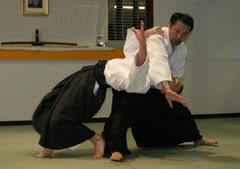
Mukae-daoshi is 'meeting takedown' taught by Yoseikan Budo/Aikido and Jan de Jong.

Using Kano's division of judo techniques (kuzushi, tsukuri, kake), the same kuzushi and tsukuri result in different kake depending on the direction of the applied forces in the kake phase. The same unbalancing and positioning results in a throw or takedown depending on the direction of the applied forces in the execution phase of the technique.
The irimi-nage/entering throw is in fact a takedown while the mukae-daoshi/meeting takdown is in fact a throw. What that also means is that the latter is entirely dependent on the momentum generated during the kuzushi phase of the technique.
It also means that the applied forces for a throw are upward whilst the applied forces for a takedown are downward. A biomechanical understanding of these techniques enables a student to know what to look for in learning and training these techniques as does the instructor. It makes better students of students and better instructors of instructors.
One chapter in that book is on throws and takedowns. Despite the common meaning of the terms provided by the Oxford Dictionary, it appears the martial arts has managed to confuse the meaning of the terms as applied to marital arts techniques.
I provide a biomechancially based classification for all techniques that are designed to cause a person to fall to the ground. It's based on the biomechanics of balance and stability. A person is stable if their centre of gravity (CoG) is located over their base of support (BoS) and balanced if they possess control of their CoG with respect to their BoS.
It was interesting reviewing the literature on the throws and takedowns of various martial arts. Books dedicated to throws and takedowns of various martial arts did not distinguish between the two, and in fact often only referred to throws.
Judo, according to Kano's classification of Judo techniques, does not teach takedowns.
A throw is a technique were forces are applied to cause both of the opponent's feet to leave the ground. The biomechancial target of the applied forces is the opponent's BoS.
A takedown is a techniques were forces are applied to cause an opponent's CoG to fall outside of their BoS and a balance recovery is prevented. Takedowns can be subclassified as 'one-legged' or 'two-legged' (for want of a better description) takedowns. The biomechancial target for one-legged takedowns is a person's foot in contact with a support surface. For instance, a foot sweep is a one-legged takedown.
The biomechanical target of a two-legged takedown is an opponent's CoG. Forces are applied to cause an opponent's CoG to fall outside of their BoS and a balance recovery is prevented. A hiki-otoshi (elbow drop) is an example of a two-legged takedown.
Irimi-nage and Mukae-daoshi are good examples of the confusion held within the martial arts over this issue. Irimi-nage is 'entering throw' taught by aikido.
Mukae-daoshi is 'meeting takedown' taught by Yoseikan Budo/Aikido and Jan de Jong.

Using Kano's division of judo techniques (kuzushi, tsukuri, kake), the same kuzushi and tsukuri result in different kake depending on the direction of the applied forces in the kake phase. The same unbalancing and positioning results in a throw or takedown depending on the direction of the applied forces in the execution phase of the technique.
The irimi-nage/entering throw is in fact a takedown while the mukae-daoshi/meeting takdown is in fact a throw. What that also means is that the latter is entirely dependent on the momentum generated during the kuzushi phase of the technique.
It also means that the applied forces for a throw are upward whilst the applied forces for a takedown are downward. A biomechanical understanding of these techniques enables a student to know what to look for in learning and training these techniques as does the instructor. It makes better students of students and better instructors of instructors.
Monday, May 27, 2013
Teach the Essence of All Martial Arts Techniques
What is the essence of all martial arts techniques? What makes them work?
Forces account for the changes in motion and shape of all things in the environment, including the body and body segments (collectively body).
Any time a body starts, stops, speeds up slows down or changes direction, a force has been applied. A change in shape refers to deformation. Deformation of body tissues can cause pain and injury. Think about all the techniques taught in any martial art and you will see that they are designed to change the motion of an opponent or deform their tissues to inflict pain or injury.
The beauty of it all is that force is a biomechanical concept that is easy for the layperson to understand and apply.
Without providing the full explanation, the following is how you teach and learn by referring to forces, the essence of all techniques:
1. Identify the points of application of the forces - all contact points between the two bodies.
2. Forces are a push or a pull. Determine if it is a push or a pull at each point of contact.
3. Determine the direction of the force.
4. Determine the relative magnitude of the force.
5. Determine the objective of the combined forces (change the motion or shape (deformation) of the opponent's body).
First teach students about forces, then consistently teach using a force based approach. Students will be taught to, and will, focus on the essence of techniques; what actually makes them work. When they come to correct errors in their performance they will go directly to the essence of the technique.
While the above might appear to have limited potential to improve on teaching striking and kicking techniques, it does not when the third law of motion is also understood. For every action there is an equal and opposite reaction. Action refers to forces. When we hit a body, that body 'hits' us back with a force that is equal in magnitude and opposite in direction.
When we hit or kick an opponent or some training devise, or block an opponent's attack, we must deal with reaction forces. What is being done in terms of posture and stance to increase our stability and ability to absorb those reaction forces?
Those martial arts that describe their stances in terms of mobility (which means less resistance to forces), what are they doing to increase stability when contact is made and forces are experienced?
Everybody understands what a push or a pull is. If a student is told to push or pull in a certain direction they will do so. If that instruction is not an accurate or complete description of the forces involved in the execution of a technique, do not be surprised if the student experiences difficulty in performing the techniques. A force-based approach 'forces' us to consider each and every point of contact where a force may be applied. All of those forces contribute to, or at times hinder, the execution of a technique. A complete analysis of the forces involved in the technique avoids these issues and demonstrates a thorough understanding of the technique. And a complete analysis of the forces involved in a technique is so simple.
Forces account for the changes in motion and shape of all things in the environment, including the body and body segments (collectively body).
Any time a body starts, stops, speeds up slows down or changes direction, a force has been applied. A change in shape refers to deformation. Deformation of body tissues can cause pain and injury. Think about all the techniques taught in any martial art and you will see that they are designed to change the motion of an opponent or deform their tissues to inflict pain or injury.
The beauty of it all is that force is a biomechanical concept that is easy for the layperson to understand and apply.
Without providing the full explanation, the following is how you teach and learn by referring to forces, the essence of all techniques:
1. Identify the points of application of the forces - all contact points between the two bodies.
2. Forces are a push or a pull. Determine if it is a push or a pull at each point of contact.
3. Determine the direction of the force.
4. Determine the relative magnitude of the force.
5. Determine the objective of the combined forces (change the motion or shape (deformation) of the opponent's body).
First teach students about forces, then consistently teach using a force based approach. Students will be taught to, and will, focus on the essence of techniques; what actually makes them work. When they come to correct errors in their performance they will go directly to the essence of the technique.
While the above might appear to have limited potential to improve on teaching striking and kicking techniques, it does not when the third law of motion is also understood. For every action there is an equal and opposite reaction. Action refers to forces. When we hit a body, that body 'hits' us back with a force that is equal in magnitude and opposite in direction.
When we hit or kick an opponent or some training devise, or block an opponent's attack, we must deal with reaction forces. What is being done in terms of posture and stance to increase our stability and ability to absorb those reaction forces?
Those martial arts that describe their stances in terms of mobility (which means less resistance to forces), what are they doing to increase stability when contact is made and forces are experienced?
Everybody understands what a push or a pull is. If a student is told to push or pull in a certain direction they will do so. If that instruction is not an accurate or complete description of the forces involved in the execution of a technique, do not be surprised if the student experiences difficulty in performing the techniques. A force-based approach 'forces' us to consider each and every point of contact where a force may be applied. All of those forces contribute to, or at times hinder, the execution of a technique. A complete analysis of the forces involved in the technique avoids these issues and demonstrates a thorough understanding of the technique. And a complete analysis of the forces involved in a technique is so simple.
Friday, December 28, 2012
Done

The book had over 170,000 words which equates to over 300 pages. The editing process over the past week has reduced that to just under 100,000 words and 265 pages with no loss of information. I expect that number to reduce even further.
The book has 17 chapters:
Chapter 1 Introduction
Chapter 2 Core of All Learning
Chapter 3 Kaizen: Analyse Tactics and Techniques
Chapter 4 Force
Chapter 5 Balance and Unbalance
Chapter 6 Stances and Motion
Chapter 7 Throwing and Takedown Techniques
Chapter 8 Joint-Locking Techniques
Chapter 9 Injury Science
Chapter 10 Striking and Kicking Techniques
Chapter 11 Blocking Techniques
Chapter 12 Nature's Breakfalling Techniques
Chapter 13 Martial Arts Breakfalling Techniques
Chapter 14 Strangulation Techniques
Chapter 15 Pain
Chapter 16 Survival Process Pt 1
Chapter 17 Survival Process Pt II
I have a friend who is the headmaster at a school helping me edit the book. He has no background nor interest in the subject matter. If he understands what I am writing about and his interest is retained, I must have done a good job. So far that has been achieved and he has informed me that he is excited by the content. That it is like no other book written for the martial arts and other activities associated with preparing a person to survive a violent encounter. He is right.
Give a man a fish and you feed him for a day. Teach a man to fish and you feed him for a lifetime.I'm still working on the title of the book.
Chinese Proverb
Facilitating the Understanding and Study of Fighting Methods is about teaching the reader how to ‘fish’ so they can feed themselves for a lifetime. It is also about teaching the reader how to teach others to fish so that they can feed themselves for a lifetime.
Facilitating the Understanding and Study of Fighting Methods is written for both teacher and student alike. It is written to assist teachers in understanding and teaching their methods. It is also written to assist students in understanding and learning the methods taught by their teachers. A fallacious assumption in our education system is that students inherently know how to learn. They may do to varying degrees but not necessarily efficiently or effectively. Greater efficiencies and efficacies are achieved when the student is first taught how to learn. Facilitating the Understanding and Study of Fighting Methods empowers students by enabling them to take responsibility for their own learning experience. It encourages students to become their own teachers or at least to manage their learning experience. In this way, Facilitating the Understanding and Study of Fighting Methods also challenges teachers to be better teachers.
Monday, October 8, 2012
Blocking Techniques

That definition, it has to be said, is a very broad and vague definition of blocking techniques. It is broad and vague by necessity given certain ambiguity surrounding blocking techniques. An ambiguity that only comes to light when the various conceptualisations of blocking techniques that are espoused by different martial arts are studied.
Moclair, in Jujutsu: A Comprehensive Guide, defines blocking techniques in terms of the use of an arm or arms to stop an attacker from striking a person with a blow from their hands, fists, knees or other parts of their body. Moclair’s definition explicitly, and with clarity, refers to the common and traditional conception of blocking techniques as being techniques that are used to stop an attacker from hitting or kicking a person.
In The Textbook of Modern Karate, Okazaki and Stricevic provide the following definition of blocking techniques: 'A block is a karate technique directed at a certain target – the opponent's hand, foot, leg or arm – for the purpose of arresting or deflecting his attack.' Okazaki and Stricevic’s definition informs us that blocking techniques are directed at the opponent's body part that is attempting to hit or kick the blocker. It also provides a description of how blocking techniques stop the opponent from hitting or kicking the blocker: by arresting or deflecting the attacking body part.
It should be noted that some martial arts or martial artists distinguish between blocking techniques and deflection or parrying. In this case, blocking techniques are isolated to those techniques that arrest an attack to avoid being hit or kicked. Deflection or parrying serve the same purpose but by a different means.
Blocking and Evasion
In Mastering Jiu-Jitsu, Gracie and Danaher distinguish between evasion and blocking to avoid being hit or kicked. Evasion does not involve contact with the opponent's attacking body part. Evasion can be basically subdivided into two types: those that involve moving the feet and those that involve moving just the upper body or head. Japanese martial arts refer to the former as taisabaki (body movement). Boxing teaches both methods with the former referred to as footwork and the latter bobbing and weaving.
If a body movement of any description is used in conjunction with a blocking (or deflection) technique, there are two questions that should always be asked. Firstly, was the body movement not sufficient to qualify as an evasion. Secondly, if the answer to the first question is affirmative, what was the purpose of the blocking technique. After all, the evasion took care of the problem of getting hit or kicked.
Blocking Possibilities
Nakayama, in the karate classic Dynamic Karate, suggests that, while blocking, you must attempt to seize the initiate and turn the opponent's attack to your advantage. He provides six methods that he suggests illustrates the various possibilities in blocking:
1. Block the opponent's arm or leg with sufficient force to discourage further attack. In a sense, this kind of block can be called an attack.
Nakayama does not define block. If we assume it involves a technique that is designed to avoid being hit or kicked, then this type of block serves two purposes. Firstly, to avoid being hit or kicked, and secondly, to apply sufficient force to cause pain and/or injury. If the block is used in conjunction with an evasive movement then it only serves the latter purpose. This is a possible answer to the question posed above.
2. Block the opponent's attack with only enough force to parry or deflect it. This
would be termed a light block in #1.
A deflection or parry changes the direction of the attack. If an evasive movement is used to avoid being hit or kicked there is no need to change the direction of the attack. If the attack is deflected in these circumstances, the question has to be asked and answered, why?
A 'brushing block' refers to a technique where the attack is brushed past the defender with no change in direction of the attack. This implies an evasive movement was used to avoid being hit or kicked. The question has to be asked as to the purpose of the brushing block.
3. Block and attack. Block the opponent's attack and immediately counter-attack. It is also possible to block and counterattack at the same instant.

4. Unbalance the opponent with your block.

The unbalancing is physical and 'mental.' The physical unbalancing involves applying forces to cause the opponent's centre of gravity to be located outside of their base of support. The 'mental unbalancing' involves applying forces that do not physically unbalance an opponent but stuns, causes sudden loss of motion, or pain. In this way, they are similar to Nakayama's blocking possibility #1.
5. Block the opponent's attack as it is about to begin. To do this you must anticipate his attack.
6. Block and then retreat to a safe position until a chance to counter presents itself.
Blocking possibility #5 is the very definition of seizing the initiative, whereas blocking possibility #6 is not so much.
Direct and Indirect Blocks
In two books dedicated to the mechanics of martial arts, Starr distinguishes between direct and indirect blocks. Direct blocks are described as being applied directly against the force of the opponent's attack. Starr suggests that this form of blocking often requires the blocker to be physically stronger than the opponent, and the risk of injury to the blocking body part is high if the opponent's attack is very powerful. Indirect blocks are described as being sometimes referred to as deflections. Starr suggests that because indirect blocks do not directly oppose the opponent’s attacking force, they require very little strength to apply and the risk of injury is minimised. Starr is correct, in so far as it goes.
Starr's examples of indirect blocks includes the standard karate, high, middle and low blocks. These blocks do not involve applying force directly against the force of the opponent's attack. They do not involve applying force in the opposite direction to the force of the opponent's attack. You will find that the vast majority of karate's blocking techniques are designed to apply force to the opponent's attacking limb at an angle to the force of the opponent's attack. They apply a force to an attacking body part at an angle which results in a deflection rather than the attack being arrested.
This is a common misconception, that and traditional blocks are designed to oppose force directly, espoused by many who attempt to extol the virtues of their soft blocking methods over hard blocking methods.
Given that deflections generally require less force than techniques designed to arrest an attack, why then do karate practice applying a great deal of force in their blocking methods. The answer's may lay in Nakayama's blocking possibilities #1 and #4.
Absorption Blocks

Karate style blocking techniques do not tend to absorb the force of the attacker's attacking body part as they are designed to apply forces to an opponent's attacking body part.
Forces
Forces cause all bodies and objects to change direction or shape. Forces applied in different ways result in different outcomes. Even when the points of contact between two bodies (defender and attacker) are similar, the direction and magnitude of the force can produce a different outcome. It is important for the martial artists to understand specifically what they are trying to achieve, and why they are trying to achieve that, in order to better understand how the forces are to be applied to achieve that outcome.
*************
PS: Dear Reader
Okazaki and Stricevic make the following statement when discussing the forces involved in blocking techniques: 'The amount of force necessary to deflect an object is generally less than the force needed to initiate its motion.'
I am having some difficulty in supporting or correcting that statement in mechanical/physics terms. If any reader has mechanical or physics background and can help out in this regard, I'd be very grateful.
Thank you.
Wednesday, July 11, 2012
Happo no Kuzushi and Kuzushi

The US Marines Close Combat manual, along with many others in the martial arts and other activities associated with preparing a person to survive a violent encounter, refer to the happo no kuzushi concept. People; happo no kuzushi is simply a device to indicate direction when explaining kuzushi techniques. It is a compass. A watch is a little more precise than the happo no kuzushi compass. And a watch is just as insightful into kuzushi as is happo no kuzushi.
Kuzushi is commonly referred to as unbalancing or off-balancing. It is not. Even though The Overlook Martial Arts Dictionary (Farkas and Corcoran) refer to the happo no kuzushi concept in their definition of kuzushi, they quite rightly translate kuzushi as 'breaking' or 'upsetting.' It is not the 'destruction' of balance as the term is so often translated.
What is balance? McLester and St Pierre (Applied Biomechanics: Concepts and Connections 2008) explain that balance implies coordination and control, and that balance is a neuromuscular reference whereas stability is a mechanical term. The reference to 'mechanical term' is a reference to a number of physical variables that can be varied to increase or decrease the degree of stability and mobility. Knudson (Fundamentals of Biomechanics 2007) explains that balance is the control of stability and the ability to move. The ability to move is the definition of mobility, so balance is the control of stability and mobility. Carr (Sport Mechanics for Coaches 2004) explains stability in terms of how much resistance a person 'puts up' against having their balance disturbed. The resistance is against destabilising forces.
Technically, unbalance refers to losing control of stability which means falling to the ground. Kuzushi is not designed to cause an opponent to fall to the ground. Nage waza (throwing techniques) and taoshi waza (takedown techniques) are designed to cause a person to fall to the ground, but kuzushi is not. Kuzushi is a facilitator. It faciliates the execution of techniques, including nage waza and taoshi waza. It facilitates the execution of techniques by destabilising the opponent, not by unbalancing them. Kuzushi applies forces to cause the opponent's centre of gravity to move outside of their base of support, but not irretrievably so. This is a subtle but important difference between kuzushi and unbalancing.
Jan de Jong and his instructors would often, as many others do, describe the 'direction of unbalance' as being the direction described by the right angle of the centre of an imaginary line drawn between the heels of both feet. This is simply the direction where the least amount of force has to be applied in order to move a person's centre of gravity outside of their base of support. A person's centre of gravity may be moved outside of their base of support in any direction. It simply means that more force has to be applied in that direction if not applied in the direction of least resistance.
Then there is the three dimensional element that the 'dynamic sphere' theory of aikido attempts to overlay on the happo no kuzushi theory. Not only are the forces applied in a linear direction, they are also applied in a three dimensional direction.
If the martial arts and all activities associated with preparing a person to survive a violent encounter are to advance their theoretical understanding of their methods, they have to move on from the naive and simplistic happo no kuzushi concept. The mechanical concepts of stability and forces provide that advancement.
Tuesday, May 8, 2012
Straight Arm Lock/Arm Bar/Ude Kujiki - Take Two
I originally posted this blog using a particular image of what appeared to be the defender stepping toward the attacker when executing the technique. I used this image as it highlighted a particular issue I wanted to explore, however, it was pointed out to me that the technique in question, while looking similar to the straight arm lock under review, was actually different and is the applied forces are intended to produce a different affect. I take that comment on board and apologise unreservedly for taking licence with that image. This blog recasts the previous with a more appropriate image. For those who have already read this blog (and there have been quite a few of you) the amendments are contained in the end part of this blog. This has also given me the opportunity of including a little more information which I neglected to include in the original of this blog.
 I've recently been contacted by a group of fellow martial artists who are interested in the biomechanics of the martial arts. The interaction reminded me of the work I commenced on understanding joint-locking techniques (kansetsu waza).
The photograph to the right is of a straight arm lock, also commonly known as an 'arm bar', and in Japanese as ude kujiki. The photograph is not the greatest, but it was taken at the late Greg Palmer's dojo with two of his former junior students. Greg was a senior instructor of Jan de Jong, was one of my instructors, had a depth of understanding and love of jujutsu possibly second to none at the Jan de Jong Self Defence School, and became a friend and training partner of mine. Out of respect and in memory of Sensei Palmer, I'll use this photograph for illustration purposes.
 The straight arm lock is a technique taught by many, if not most, martial arts. It is one of the few kansetsu waza which is permitted in judo competition, and is often seen in mixed martial arts competitions. It can be applied using the arm, as in the photograph above, or the hip while lying on your back, as in the photo to the right. It can also be applied with the leg, hip while standing, stomach, hand, forearm, shoulder, neck, head, and with weapons.
Jan de Jong included theory gradings in his dan (black belt) grades. These are oral gradings which examine the candidates knowledge of techniques and tactics, the proficiency being taken as given. If a black belt represents a teaching qualification, as it most definitely does in Jan de Jong jujutsu, the candidate's theoretical knowledge should most definitely be examined.
How do you study for this theory grading? Unfortunately biomechanics in biomechanical or martial arts texts will not be of much help. Vieten (2008) provides an overview of the English-language martial arts literature related to biomechanics. He found the percentage of biomechanics papers among the literature in martial arts is very low compared to some popular sports and suggests ‘the biomechanics of the martial arts is still in its infancy’ (562). Too true. My work is about growing that infant. This blog is about growing that infant, and possibly encouraging others more qualified than myself to take up the challenge.
 Welcome to your theory grading, or part thereof. A typical question De Jong would ask, and which Palmer often referred to when explaining the theory examination, was: What are the forces involved in ude gatame ude kujiki (arm set arm breaking; the first techique illustrated above)? This, as it turns out, was a very insightful question. The problem was that De Jong and the candidates only had a layperson's understanding of 'forces'. If they'd have had a mechanical/biomechanical understanding of forces, the answers would have not be so convoluted.
Kreighbaum and Barthels (1996; K&B) explain that 'because forces account for the motion and changes of motion of all things in the environment, including the body and the body segments, it is important for the movement specialist to understand what forces are and how we can picture them as they are applied to or by the body' (80). Firstly, 'a force is something that causes or tends to cause a change in the motion or shape of an object or body' (80). It's not just a change in motion which forces cause; they also cause a change in shape which is referred to as 'deformation' in mechanics. If the deformation of the body's tissues is significant enough, it will lead to injury. Secondly, given the preceding explanation of forces, it is important for martial arts instructors and students to understand what forces are and how they can picture them as they are applied to or by the body. The beauty of it all is that it is so easy - 'easy peesy Japanesey.'
'A force can be thought of as a push or a pull; ... a blow or impact, or gravity' (K&B 1996: 80). Forces have four unique properties: magnitude, direction, point of application, and line of action (K&B 1996). In initially answering our theory question, all we need to do is identify all of the points of application and describe their direction and whether they are a push or a pull. That is it - easy peesy Japanesey. Forces are what makes the technique work. They are the essence of the technique.
See: http://www.kojutsukan.blogspot.com.au/2011/06/using-forces-to-understand-and-explain.html
With the ude gatame ude kujiki, there are three points of application. The right hand is applying a pushing force to the back of uke's (receiver of the technique) flexed hand back towards uke; the left hand is grasping and applying a pulling force on uke's wrist away from uke; and the elbow is applying a downward force to uke's elbow. That is it - easy peesy Japanesey. Next question.
 What is the purpose of ude gatame ude kujiki, or any kansetsu waza for that matter? Kansetsu waza is a seperate class of technique. This can be seen in numerous texts and in numerous systems. For instance, the Kodokan Judo classification of techniques initially classifies all their techniques as nage waza (throwing techniques), atemi waza (striking techniques), and katame waza (grappling techniques). Katame waza is subdivided as osae komi waza (immobilisation techniques), shime waza (strangulation or choking techniques), and kansetsu waza (joint locking techniques).
 The kata gatame ude kujiki (shoulder set arm breaking) illustrated to the right can be turned into a shoulder throw. In jujutsu, throws often involve initially locking up the joint in order to throw an opponent. They are also used to take an opponent to the ground without causing both the opponent's feet to leave the ground. This is my biomechancially-based definition of a takedown technique. Kansetsu waza are often used as immobilisation techniques, as is often seen in aikido. They are also used as kuzushi* (unbalancing) techniques. They are used as pain compliance techniques, and, which is probably the first explanation that would most likely be given, they are used to disable an opponent by injuring their joint. If I was examining a candidate and they gave me the last answer, I'd immediately ask them how often is the ubiquitous wrist twist used to disable an opponent by injuring their wrist. The humble wrist twist is most often used to take an opponent to the ground (takedown technique not a throwing technique as is so often described in aikido and many jujutsu systems)in order to execute another technique, a 'finishing' technique.
Firstly, it can be seen that kansetsu waza is a class of technique which overlaps with many other classes of techniques. It has multiple personalities. Secondly, so what? So what? The technique may look the same, that is to say it has the same points of application of the forces, but the direction and magnitude of the forces will differ depending on the purpose of the technique.
What is the physiological effect of applying forces to the extended elbow when executing ude kujiki? Here there is no authoritative answer. I was astounded, when researching the science behind joint locking techniques, that I could find no detailed explanation of the effects of kansetsu waza when forces are applied and the joint is moved beyond its range of motion. If any reader knows of such information, and only authoritative information is of interest, I'd appreciate it being forwarded to me and I will duly share it with the world via this blog.
Why not refer to medical or forensic texts? I did. However, between 80% and 90% of all injuries that occur to the upper limb are the result of a fall on an outstretched hand (FOOSH injuries; see http://http://www.kojutsukan.blogspot.com.au/search/label/FOOSH). Consequently, the medical and forensic literature focuses on these types of injuries. The forces are applied in a different direction when landing on an outstretched hand compared to when forces are applied at right angles to the posterior aspect of the elbow when executing an ude kujiki.
 The bones of the elbow joint are the humerus, radius, and ulna. The olecranon of the head of the ulna fits into the olecranon fossa of the humerus which limits the hyperextension of the forearm and provides stability to the joint. Dislocation refers to the complete disruption of of a joint so that the articular surfaces are no longer in contact. Dislocation of the elbow results in, among other things, extreme pain and inability to move the elbow. Elbow dislocations are classified with reference to the position of the ulna relative to the humerus following injury. Dislocation of the elbow can be posterior or anterior:
 In layperson terms, with a FOOSH injury more than 90% of the dislocations of the elbow involve the ulna sliding up the back of the humerus because the forces are being transferred from the hand to the forearm and to the elbow. The forces are applied in a different direction when an ude kujiki technique is executed; they are applied to the posterior aspect of the elbow, which means the injury may be different. After all, Whiting and Zernicke (2008) include in their seven factors which combine to determine the nature of an injury, the tissues injured, and the severity of an injury, 'direction (where is the force directed?)'.
Anterior dislocations are often described as occurring when the elbow is flexed and it receives a blow. The olecranon can lever the humerus and slide in front of it, or, it can be fractured. This is often referred to as a 'fracture-dislocation'.
I apologise for not being able to identify the source of the following quote. It is included in my notes without reference, and I need to go back to my notebooks to identify the reference. However for the purposes of this blog I will proceed without the reference.
 What type of dislocation and injury occurs when executing ude kujiki? Given they are permitted and used in judo and mixed martial arts, you might have thought there would be information published on this issue. You might have thought wrong. If I am mistaken, I'd appreciate reader's directing me to the source that would correct my misunderstanding. This blog is, as stated above, a call to arms to encourage others to study these most basic of questions: What injuries are intended to be inflicted when a joint-locking technique is executed? In the case of ude kujiki, in my mind it is the comparatively rare anterior dislocation with a possible fracture of the olecranon
 The technique to the right is described as a 'step in arm lock.' Comment on the technique? This is a question which De Jong would often pose using photographs from books, etc? Firstly, a tactical issue. Stepping toward the opponent while applying this technique exposes the defender to the risks posed by the attacker's free hand. Secondly, stepping forward changes the forces applied by the hand at the wrist. Now it is pushing rather than pulling. This has the effect of 'close packing' the elbow joint increasing rather than decreasing its stability (increasing rather than decreasing its resistance to forces). Thirdly, I would hypothesise that should the combined forces result in a dislocation of the elbow, it would result in a posterior dislocation whereas when forces are applied to stretch the elbow joint and then forces applied to the posterior aspect of the elbow, they might result in an anterior dislocation and/or a disclocation-fracture.
Notes
*Interestingly, Jigoro Kano explains that 'the basis of kuzushi is pushing and pulling' (1986: 42). Kano, the originator of the use of biomechanics to understand and study the tactics and techniques of the martial arts - to a degree and possibly unwittingly.
References
Kano, J. (1986). Kodokan Judo. Tokyo: Kondansha International
Kreighbaum, E. and K.M. Barthels. (1996). Biomechanics: A qualitative approach for studying human movement. 4th edn. Boston, Massachusetts: Allyn and Bacon.
Vieten, M.M. (2008). Application of biomechanics in martial art training. In Handbook of biomechanics and human movement science, edited by Y. Hong and R. Bartlett. Abingdon, Oxon: Routledge.
Whiting, W.C. and R.F. Zernicke. (2008). Biomechanics of musculoskeletal injury.2nd edn. Champaign, Illinois: Human Kinetics.

The photograph to the right is of a straight arm lock, also commonly known as an 'arm bar', and in Japanese as ude kujiki. The photograph is not the greatest, but it was taken at the late Greg Palmer's dojo with two of his former junior students. Greg was a senior instructor of Jan de Jong, was one of my instructors, had a depth of understanding and love of jujutsu possibly second to none at the Jan de Jong Self Defence School, and became a friend and training partner of mine. Out of respect and in memory of Sensei Palmer, I'll use this photograph for illustration purposes.

Jan de Jong included theory gradings in his dan (black belt) grades. These are oral gradings which examine the candidates knowledge of techniques and tactics, the proficiency being taken as given. If a black belt represents a teaching qualification, as it most definitely does in Jan de Jong jujutsu, the candidate's theoretical knowledge should most definitely be examined.
How do you study for this theory grading? Unfortunately biomechanics in biomechanical or martial arts texts will not be of much help. Vieten (2008) provides an overview of the English-language martial arts literature related to biomechanics. He found the percentage of biomechanics papers among the literature in martial arts is very low compared to some popular sports and suggests ‘the biomechanics of the martial arts is still in its infancy’ (562). Too true. My work is about growing that infant. This blog is about growing that infant, and possibly encouraging others more qualified than myself to take up the challenge.

Kreighbaum and Barthels (1996; K&B) explain that 'because forces account for the motion and changes of motion of all things in the environment, including the body and the body segments, it is important for the movement specialist to understand what forces are and how we can picture them as they are applied to or by the body' (80). Firstly, 'a force is something that causes or tends to cause a change in the motion or shape of an object or body' (80). It's not just a change in motion which forces cause; they also cause a change in shape which is referred to as 'deformation' in mechanics. If the deformation of the body's tissues is significant enough, it will lead to injury. Secondly, given the preceding explanation of forces, it is important for martial arts instructors and students to understand what forces are and how they can picture them as they are applied to or by the body. The beauty of it all is that it is so easy - 'easy peesy Japanesey.'
'A force can be thought of as a push or a pull; ... a blow or impact, or gravity' (K&B 1996: 80). Forces have four unique properties: magnitude, direction, point of application, and line of action (K&B 1996). In initially answering our theory question, all we need to do is identify all of the points of application and describe their direction and whether they are a push or a pull. That is it - easy peesy Japanesey. Forces are what makes the technique work. They are the essence of the technique.
See: http://www.kojutsukan.blogspot.com.au/2011/06/using-forces-to-understand-and-explain.html
With the ude gatame ude kujiki, there are three points of application. The right hand is applying a pushing force to the back of uke's (receiver of the technique) flexed hand back towards uke; the left hand is grasping and applying a pulling force on uke's wrist away from uke; and the elbow is applying a downward force to uke's elbow. That is it - easy peesy Japanesey. Next question.


Firstly, it can be seen that kansetsu waza is a class of technique which overlaps with many other classes of techniques. It has multiple personalities. Secondly, so what? So what? The technique may look the same, that is to say it has the same points of application of the forces, but the direction and magnitude of the forces will differ depending on the purpose of the technique.
What is the physiological effect of applying forces to the extended elbow when executing ude kujiki? Here there is no authoritative answer. I was astounded, when researching the science behind joint locking techniques, that I could find no detailed explanation of the effects of kansetsu waza when forces are applied and the joint is moved beyond its range of motion. If any reader knows of such information, and only authoritative information is of interest, I'd appreciate it being forwarded to me and I will duly share it with the world via this blog.
Why not refer to medical or forensic texts? I did. However, between 80% and 90% of all injuries that occur to the upper limb are the result of a fall on an outstretched hand (FOOSH injuries; see http://http://www.kojutsukan.blogspot.com.au/search/label/FOOSH). Consequently, the medical and forensic literature focuses on these types of injuries. The forces are applied in a different direction when landing on an outstretched hand compared to when forces are applied at right angles to the posterior aspect of the elbow when executing an ude kujiki.

- posterior – the forearm bones are displaced posterior to the distal part of the humerusand accounts for the majority of all elbow dislocation injuries.
- anterior - the forearm bones are displaced anterior to the distal part of the humerus and are extremely rare. Consequently the data on these types of injury are likewise rare.

Anterior dislocations are often described as occurring when the elbow is flexed and it receives a blow. The olecranon can lever the humerus and slide in front of it, or, it can be fractured. This is often referred to as a 'fracture-dislocation'.
I apologise for not being able to identify the source of the following quote. It is included in my notes without reference, and I need to go back to my notebooks to identify the reference. However for the purposes of this blog I will proceed without the reference.
Given elbow dislocations are the one joint technique allowable in judo (wrist, shoulder, and knee techniques were forbidden due to the risks of injury associated with the techniques), a sport practiced around the world for a century, and there is no reference I can find in the literature on extreme elbow injuries as in the case of a fracture-dislocation in judo, I might hypothesise that the abovementioned dislocations without fractures are not uncommon when an external force is applied to the posterior aspect of the elbow.

 The technique to the right is described as a 'step in arm lock.' Comment on the technique? This is a question which De Jong would often pose using photographs from books, etc? Firstly, a tactical issue. Stepping toward the opponent while applying this technique exposes the defender to the risks posed by the attacker's free hand. Secondly, stepping forward changes the forces applied by the hand at the wrist. Now it is pushing rather than pulling. This has the effect of 'close packing' the elbow joint increasing rather than decreasing its stability (increasing rather than decreasing its resistance to forces). Thirdly, I would hypothesise that should the combined forces result in a dislocation of the elbow, it would result in a posterior dislocation whereas when forces are applied to stretch the elbow joint and then forces applied to the posterior aspect of the elbow, they might result in an anterior dislocation and/or a disclocation-fracture.
Notes
*Interestingly, Jigoro Kano explains that 'the basis of kuzushi is pushing and pulling' (1986: 42). Kano, the originator of the use of biomechanics to understand and study the tactics and techniques of the martial arts - to a degree and possibly unwittingly.
References
Kano, J. (1986). Kodokan Judo. Tokyo: Kondansha International
Kreighbaum, E. and K.M. Barthels. (1996). Biomechanics: A qualitative approach for studying human movement. 4th edn. Boston, Massachusetts: Allyn and Bacon.
Vieten, M.M. (2008). Application of biomechanics in martial art training. In Handbook of biomechanics and human movement science, edited by Y. Hong and R. Bartlett. Abingdon, Oxon: Routledge.
Whiting, W.C. and R.F. Zernicke. (2008). Biomechanics of musculoskeletal injury.2nd edn. Champaign, Illinois: Human Kinetics.
Monday, April 9, 2012
Three-inch Punch vs Reverse Punch
 I'm currently writing an article I'm planning to submit to Journal of Asian Martial Arts (JAMA): 'Injury Science: The Science Behind Striking and Kicking Techniques.'
JAMA is a semi-academic journal which means it provides serious scholarly work instead of just the 'pulp' that most martial arts magazines provide.
The article I'm writing explains the science behind striking and kicking techniques, and commences with examples of explanations that have been provided within the martial arts literature that at the very best is simply science for the sake of science, and at worst actually misdirects readers.
My research involves reading articles buried in academic journals that normally never see the light of day, unfortunately. This is the norm for most real-world activities but more so in the martial arts which is a bastion of anti-intellectualism.
One article I came across yesterday is, 'A comparison of the reverse punch and power punches in oriental martial arts' by J.K. Gulledge and J. Dapena in Journal of Sports Sciences 2008 26(2): 189-196.
 The power punch is the infamous three-inch punch popularised by Bruce Lee. We also have the even more infamous one-inch punch. The idea behind these punches is that they only travel three or one inches to the target/opponent and they are 'powerful'.
The aim of the study was to compare the power punch with the reverse punch in regard to potency and to effectiveness in throwing the opponent offbalance.
The study used twelve 'expert' martial artists with six representing Chinese kungfu, three Japanese karate, and three Korean taekwondo.
The results were:
Similar impulses were exerted on the target with both punches, but the maximum amount of force exerted with the reverse punch was almost twice that exerted with the power punch. Therefore, the reverse punch was by far the more potent of the two.The power/one-inch/three-inch punch is dead. Long live the power/one-inch/three-inch punch. The amount of nonsense that is written and taught about these types of punches is amazing; well it would be if the martial arts was not characterised by ego and gullibility.
An understanding of the science behind striking techniques would immediately suggest the power punch is significantly less powerful than a reverse punch, in fact, any other punch. An understanding that has not been provided in the martial arts literature todate despite the many attempts at using science to understand striking techniques in the martial arts literature.
Disabling the opponent through a potent impact may not be the only goal of a martial arts punch; another possible goal is to throw the opponent off balance. The effectiveness of a punch towards the achievement of this second goal may be measured best through the total impulse exerted on the opponent, and in this regard the power punch performed well. Although the reverse punch exerted a larger maximum force than the power punch, the force decreased more slowly in the power punch, and therefore the impulses exerted on the target were not very different in the two types of punch. In fact, the cumulative impulse exerted on the target during the first 0.20 s of contact was somewhat larger in the power punch than in the reverse punch. This supports the concept of the power punch as a push rather than a punch, ....
 Firstly, forces can cause a change in motion or a change in shape. A change in motion can offbalance an opponent. A change in shape can injure an opponent. Secondly, relating the academic study to practice, the power punch applies a force that is more like a push rather than a potentially injurious punch. It applies forces that are more likely to change the motion of an opponent than it is to deform their tissues causing an injury.
The suggestion that striking is used to offbalance an opponent is interesting. Another study buried in another academic journals that studied the biomechanics/physics of karate suggested that 'the primary purpose in striking an opponent is to maximise the deformation damage at the area of contact, and it is only rarely that moving the opponent’s body as a whole is desired.' I'm not suggesting strikes and kicks are not used to offbalance an opponent. The taekwondo pushing kick is specifically designed to do just that. But what form of offbalancing are we referring too? The aforementioned pushing kick, and the power punch referred to in the study, physically offbalance an opponent. However in many jujutsu/aikido systems, striking is often used and referred to as 'mental unbalancing.' They are used to stun or distract in order to facilitate the execution of a finishing technique. They apply forces that are designed to deform the opponent's tissues and not to change their motion, but not deform those tissues sufficiently to cause an injury.
Return to the top of this blog and look at Bruce Lee's demonstration of his one-inch/three-inch punch. Note the punch receiver's stance. It is a parallel stance, which means it is less stable to forces applied from the front or rear - the direction of the 'power punch.' Would the same dramatic effect have resulted if the receiver had stood in a staggered stance, as in a boxer's stance or zenkutsu-dachi, which is more stable to forces applied in those directions? Note Lee's leaning forward when executing the punch. The one-inch or three-inches only refers to the starting distance between the fist and the receiver. The distance actually travelled by the fist is further because he leaned in, putting more bodyweight behind the punch which results in a greater 'pushing' force being applied to the receiver. Lee's demonstrations were contrived and designed for dramatic effect.
Lee's demonstrations always involved pushing and not injuring the receiver of his punch. How anyone can suggest the power punch can cause injury given Lee's demonstrations is beyond me. Next we'll be talking about a 'death touch'; oh wait, we do talk about a death touch in the martial arts.
Given these characteristics, several conclusions can be drawn with regard to the use of the two punches in combat or sport. The power punch will be slightly more effective than the reverse punch when the goal is to throw the opponent offbalance.That conclusion is a bit sweeping. A reverse punch can also offbalance an opponent rather than injury them, or simply deform their tissues without injuring. However, a power punch does not possess the kinetic energy to injury in the vast majority of cases.
In addition, it may provide the advantage of surprise, since it requires less time for its execution. It is also possible that the power punch might be the most effective for the delivery of a disabling blow when only limited amounts of space and time are available for the delivery of a punch. However, when sufficient space and time are available, it is clear that the reverse punch will be the most potent.Now they are simply contradicting themselves when suggesting the power punch could ever be a disabling blow under any circumstances. It simply does not possess the kinetic energy to cause damage.
Note I referred to kinetic energy above. Why didn't I refer to momentum like so many others do when attempting to explain the science behind striking and kicking techniques? That is a question I cover in my article.
The study used a force plate to measure the force applied by the punches. So do some other studies regarding punches and kicks. What a brilliant training aid. A training aid that is currently not used in most, if any, martial art. Can you imagine being able to quantitatively measure the force applied by a student's punch or kick. No more 'feel', now we could quantitatively measure the progress (or not) in a student's punch or kick. I'm currently sourcing a force plate and will advise in the near future.
A force plate would also provide a definitive answer to questions raised concerning the efficacy of different striking and kicking techniques, and those of different martial arts. Wing chun tends to make some pretty extravegant claims concerning the power of their punching techniques, even though they travel relatively small distances similar to a power punch. Do they apply as much force as wing chun exponents claim? If so, how, given they do not travel any large distance that is required to build kinetic energy? Considering these questions leads you to understand the essense behind the efficacy of these techniques.
Tuesday, June 7, 2011
Ubiquitous Forces and All Martial Arts Methods - Summary
 The past couple of blogs have been associated with the ubiquitous nature of forces within the physical techniques taught within the martial arts and used in violence generally. Admittedly, these blogs have not been as focused as they could be. This is a reflection of the process I go through when writing about a particular subject. It starts out lengthy, often over quoting resources, and is not focused. As I rework the work, and my understanding increases and the application of the theory to understand and study the methods of the martial arts crystallises, the focus sharpens. I've deleted the last two blogs on this subject and now present the following that the majority of the repertoire of techniques taught within the martial arts. The theory is equally applicable to armed and unarmed techniques.
Forces are ubiquitous within the martial arts and physical violence. Forces are involved in every physical method taught within every martial art and used in violence generally. They are the principle driving force behind the development of all the physical methods taught within every martial art.
Forces are the universal theory of martial arts methods that applies at all times in every situation that Jigoro Kano was searching for with respect to jujutsu techniques.
The effects of forces is to cause a change in motion or change in shape (deformation) of something to which forces have been applied. Think about all the physical techniques taught within the martial arts and you'll see forces are involved.
Balance. Applegate suggests that balance is the most basic fundamental principle of all in hand-to-hand combat. He advises that 'physical balance must be retained by the attacker and destroyed in the opponent.'
Carr (Sport Mechanic for Coaches) explains that athletes with great balance are able to neutralise those forces that would otherwise disrupt their performances. In this case the athlete is the combatant and the performance is the execution of effective offensive and defensive techniques. The forces to which Carr refers is any external force: gravity, friction, and forces applied by an opponent. Ways and means have been developed to neutralise those forces that threaten an exponent's balance. Ways and means have been developed within the martial arts to utilise the forces that threaten an opponent's balance so balance is destroyed in the opponent.
Stance. Okazaki and Stricevic (The Textbook of Karate) explain that stances are unique body positions taken to provide stability, balance, or mobility. Knudson (Fundamentals of Biomechanics) defines balance as the 'control of stability and the ability to move.' The ability to move is the definition of mobility. So, balance is the control of stability and mobility.
Carr describes stability as specifically referring to how much resistance a person puts up against having their balance disturbed. The more stable a person, the more resistance that person puts up to having their balance disturbed. Knudson explains that 'highly stable postures allow a person to resist changes in position, while the initiation of movement (mobility) is facilitated by the adoption of a less stable posture.' Highly stable postures provide more resistance to having a person's balance disturbed by external forces. Kreighbaum and Barthels (Biomechanics: A Qualitative Approach for Studying Human Movement) explain that 'forces account for the motion and changes of motion of all things in the environment.' Movement is facilitated by adopting a less stable posture which provides less resistance to the forces that cause a change in motion. This latter capacity is sometimes referred to as mobility.
Stability and mobility are inversely related. The more stable a person is, the less mobile they are, and vice versa. The less mobile a person, the less resistance that person puts up to having their balance disturbed by external forces, and vice versa. This inverse relationship can be envisioned as a stability-mobility continuum.
For every action there is an equal and opposite reaction. The disruptive forces applied by an opponent refer to both action and reaction forces. Action forces are forces applied directly by an opponent. Reaction forces are those generated when action forces are applied to an opponent when executing a technique on them. For instance, Watkins (An Introduction to Biomechanics of Sport and Exercise) suggests 'the boxer needs to ensure that he has adequate stability so that he can apply a large force without losing his balance as a result of the equal and opposite force exerted on his fist.' Stances are developed to deal with both action and reaction forces applied by an opponent.
Stances are designed to provide more or less resistance to forces depending on the tactical imperative. Many martial arts teach one stance (e.g. standard boxer's stance) that is a compromise between stability and mobility. Nakayama (Dynamic Karate) is unique in teaching different forms of a particular stance during the three stages in the execution of a technique. His stages can be made more generic in referring to contact with the opponent rather than executing a technique. Forces are applied to or by an opponent when contact is made, which requires stability to neutralise their disruptive potential. Before and after contact is made with an opponent, mobility is the imperative to evade an attack by an opponent and/or to move into position to attack the opponent. Of course we should not neglect the strategy of retreating which avoids the ever present risks associated with violence. Retreating emphasises mobility.
(How many types of stances are there? All stances when standing taught within the martial arts can be classified as either one-legged or two-legged stances. The two-legged stances can then be subdivided into parallel or staggered stances. All stances taught within the marital arts fit within this simple classification system, despite the often convoluted explanations associated with stances.)
Friction. Friction is a force that can potentially disrupt balance. The stances of some styles of pencak silat (Indonesian fighting art) emphasise stability during all three stages of contact with an opponent due to the slippery, muddy, low friction terrain. This then influences the 'footwork' or methods of moving, and the tactics and techniques taught by these styles because of the constant emphasis on stability within their stances.
Footwork or Methods of Moving. Walking has been described as a series of falls or series of falls and catches. Walking involves shifting from a stable to an unstable position (fall)when taking a step before shifting back to a stable position (catch) when the swinging foot makes contact with the ground again. The martial arts have developed ways of moving that reduce or eliminate the unstable/falling periods.
There are two basic ways of moving - shuffling or stepping. Carr explains that 'shuffling steps increase stability because they limit time spent on one foot.'
With regards to stepping, karate teaches a method of moving that shifts a person's centre of gravity over a platform foot before lifting their nonweight-bearing foot of the ground. This foot is then drawn close toward the platform foot in a 'C' movement before the centre of gravity and moving leg is 'propelled' forward (Nakayama). In this way the unstable phase of walking is reduced by half as the centre of gravity is located over a base of support until the propulsion forward. Tai chi, because of its very slow movements, teaches ways of moving whereby the centre of gravity is always located over a base of support, completely eliminating the unstable phase where the forces of gravity could disrupt their performance. The abovementioned styles of pencak silat also teach this type of movement due to the low friction provided by the terrain.
Unbalancing. Jujutsu and its derivative martial arts of judo and aikido teach unbalancing methods called kuzushi. Recall from above that Carr included forces applied by an opponent as being a cause of the disruption of a person's balance. In this case, the forces applied to an opponent are designed to disrupt their balance. In fact, Kano describes kuzushi in terms of forces. Adrian and Cooper (Biomechanics of Human Movement), in their chapter dedicated to the biomechanics of combatives, refer to the combinations of forces that Kano referred to as 'force-application patterns'.
Principles of Nonresistance. The principles of ju and ai in jujutsu and judo, and aikido respectively are based on nonresistance to forces being applied or attempted to be applied by an opponent. What is little appreciated is that in order to unbalance and control the opponent using their own force after their force has not been resisted necessitates forces being applied to the opponent.
Throwing Techniques. Adrian and Cooper explain that 'since judo throws are rotational, they rely on the development of torque.' Torque is the turning effect produced by a force. Sacripanti (Advances in Judo Biomechanics Research) provides a classification of judo throwing techniques based on torque. This classification is based on objective biomechanical principles and remedies the deficiencies inherent in the classification provided by Kano and others.
Takedown Techniques. Throwing techniques and takedown techniques are different types of techniques. A fact that is not generally understood even though both terms are used extensively in the martial arts. Both types of techniques cause a person to fall to the ground, but the forces applied to achieve that result are different. I explain the difference between these two types of techniques based on mechanical principles, including forces, in my draft Throwing Techniques and Takedown Techniques of ALL Martial Arts. I also develop a classification of takedown techniques for the very first time that is based on biomechanical principles, including forces.
Percussion Techniques. In addition to causing changes in motion, forces also cause deformation or changes in shape. Deformation of tissues beyond their limits is the definition of injury. Forces are applied to deform tissues when percussion techniques are executed. If the forces applied exceed the tissues tolerance levels, injury results. However, if the forces applied approach the tolerance levels, pain is often experienced without an injury being inflicted. Either way, percussion techniques involve the application of forces.
Blocking Techniques. Blocking techniques are designed to stop or deflect an opponent's percussion techniques. As stated above, forces cause changes in motion which includes stopping or changing the direction of something, in this case the opponent's attack.
Joint-locking Techniques. Jan de Jong would ask questions like, 'What are the forces involved in a straight arm lock?', in his black belt theory gradings. Unbeknown to De Jong himself, he was applying forces to understand, study, and explain joint-locking techniques. The discussion regarding injury and pain above apply equally to joint-locking techniques, and involves the application of forces. The answer's to De Jong's questions would have been far more succinct, focused, and accurate if the mechancial concept of force was understood and applied.
Strangulation Techniques. Strangles involve the application of a compressive force to the structures of the neck. Shime waza are techniques taught within jujutsu and its derivative arts that are designed to compress the structures of the neck using the exponent's arms or the opponent's clothing. Forces are applied to the opponent's neck by the exponent's arms or opponent's clothing. In the latter case, forces are applied by the exponent to the opponent's clothing which in turn applies forces to the opponent's neck.
Visualisation of Forces - A Necessary Skill. Kreighbaum and Barthels suggest that 'because forces account for the motion and changes of motion of all things in the environment, including the body and the body segments, it is important for the movement specialist to understand what forces are and how we can picture them as they are applied to or by a body.' They suggest the visualisation of forces is a necessary skill for, among others, teaches and coaches. Because forces account for changes in motion and changes in shape (deformation) of all things in the environment (don't forget that injury and pain results from deformation of bodily tissues) an understanding of what forces are and how we can picture then as they are applied to or by a body is a very useful skill for teachers and students of the martial arts. It provides the opportunity of understanding and studying all the techniques based on what actually makes them work. It focuses the explanation and attention to the factors that make them work, and provides the opportunity of clarifying the often convoluted explanations of these techniques.
And the beauty of it all is that the concept of forces is relative uncomplicated and easy to understand. I'll demonstrate this in the next blog.
Saturday, March 19, 2011
Jan de Jong Pt 14 - The Mon Grades

Jan de Jong introduced the mon system at the front end of his grading system in 1978. I am of the opinion that this is the pinnacle of the Jan de Jong school of thought.
In an article written by Mike Clarke for Australasian Fighting Arts in 1991, De Jong provides the following answer to Clarke's question, 'Do you think that was a good idea, to change the system to suit the students?':
Yes. I know what you're saying, but you know you can learn all the time. And if the results are better one way than the other, why carry on in a way that gives poorer results? I'll give you an example. In 1978 a Major Greg Mawkes MBE asked me if I would go and teach the army self-defence. I said okay and soon afterwards found myself teaching members of the SAS and the Commandos. Shortly after I had started to to do this the Major and I had a discussion about things. He told me that he thought the method of fighting was really good and he was pleased with that. But he said the men were having some difficulty understanding it all. I said this was the usual way of things and that my students were the same. He then explained the army did not have unlimited time to spend on this and that what he needed was quick results.This answer speaks volumes for De Jong on so many levels.
So it was at this point I had to think things through and see what I could come up with. I looked at the usual way the army taught things and decided I would alter the way I was teaching and come more in line with the army way of doing things. Well, do you know, the people started to pick things up much faster then before, and they could do the techniques much better than before! So I had a talk with my instructors and said I thought that we should change things so that we were teaching everyone like this. And at that time we changed the way we taught the students. The techniques were the same, it was only the method of teaching them that was different. And since then things have been much better.
Prior to the introduction of the mon grades, the first gradings were the kyu grades (see a previous blog). The kyu grades are specified defences against specified attacks, albeit graded in shinken shobu no kata format (see previous blogs). The mon gradings consist of eight grades. Students 12 years and under start at first mon, 13-15 years start at 3rd mon, and over 15 years at 9th kyu. The reference to kyu in the mon system reflects De Jong's conceptualisation that mons are for children and kyus are for adults, however, the ninth to seventh kyu grades are part of the mon system and adopt the mon format. Lets look at the final grading of the mon system, seventh kyu, as an example of this format.
Breakfalls (Ukemi Waza) - demonstrate specified breakfalls.
Wakai no Kata - demonstrate a kata De Jong designed to introduce punching, kicking, and blocking at this level.
Throwing techniques (Nage Waza) - demonstrate specified throwing techniques from specified attacks.
Bodymovements (Taisabaki) - demonstrate specified bodymovements.
Unbalancing (Kuzushi) - demonstrate specified unbalancing techniques from specified attacks.
Locking techniques (Kansetsu Waza) - demonstrate specified joint-locking or joint techniques from unspecified attacks.
Basic blocks and attacks (Uke and Atemi) - demonstrate specified blocks and punches from specified attacks.
Reflex (Shinken Shobu no Kata) - see previous blogs.
I'll speak from a jujutsu perspective, although, many of the observations are applicable to most other martial arts. A review of the jujutsu literature will quickly reveal that the art is taught as defences against attacks. As tricks, which is in fact how H. Irving Hancock and Katsukuma Higashi describe each of their defences in The Complete Kano Jiu-Jitsu.
Gerry Carr, in Biomechanics for Coaches, advises breaking down sport skills into phases. This reduces the possibility (probability) of the student being overwhelmed by the complexity and speed of the skill they are trying to learn, and makes it much easier to look for errors in their performance. He suggests that many skills can be broken down into the following four phases: (1) Preparatory movement (set up) and mental set, (2) windup, (3) force-producing movements, and (4) follow-through (or recovery).
Masatoshi Nakayama, in the classic Dynamic Karate, is a rare example of a martial artist dividing his skills into phases. When discussing the height of stances, he explains that 'the form of a particular stance is different in the ready position from its form at the time a technique is applied. The form of the stance immediately after the technique has been applied again differs from the preceding two. There is a delicate change at each stage, although the form looks almost the same.' Interestingly, for me at least, this reflects the injury science division of the injury production process by William Haddon into pre-event/pre-injury, event/injury, and post-event/post-injury phases. This is included in my book on the application of injury science and pain to the martial arts tactics and techniques.
Jigoro Kano, of course, is very well known for his division of judo throwing skills into kuzushi-tsukuri-kake, unbalancing-fitting in-execution. Tadao Otaki and Donn F. Draeger, in Judo: Formal Techniques, suggest this division is not only used for throwing techniques but also for techniques used in 'grappling situations'. However, I've never seen it used outside of throwing techniques.
What is De Jong's division of his jujutsu's skills? Based on the mon grades it is taisabaki-kuzushi-waza, bodymovement-unbalancing-technique. He had difficulty in separating the three, particularly when I discussed this division with him when writing Jan de Jong: the man, his school, and his ju jitsu system for him. But they can be divided into these three tactical components for analytical purposes (I refer to them as tactics as the technique is the end part of the tactic). Even De Jong did not fully appreciate the insights he'd achieved and the power of those insights.
We were teaching in Sweden one year and De Jong asked me what he should teach. I said bodymovments. He was very much opposed to the idea based on the grounds that the seminar participants would be bored with this 'mundane' exercise. I argued my case, and as a reflection of De Jong, he did teach bodymovements (albeit at the speed of light). At the end of the seminar we ended up with approximately ten instructors/black belt students requesting private lessons. Not in any of the techniques we'd taught, but in the bodymovements. They could see the uniqueness of this approach and the power of the division of tactics.
Another example of the utility of this approach. When living in London I attended Richard De Bordes pencak silat classes. Their pencak silat was very, very different (and highly recommended) to what I'd seen at De Jong's school. They didn't break their skills into phases of any description, however, I did. Even though they don't use the same bodymovements, nor unbalancing to any great extent, I could still apply this analytical approach to understand and study tactics taught in a relatively foreign martial art. I may not have been immediately proficient, but I knew what I was trying to do. I could practice the component parts of the tactic.
As a full-time instructor working at the Jan de Jong Self Defence School, I was engaged to teach more private lessons than any other instructor in the school. My approach in analysing and teaching techniques/tactics was taisabaki-kuzushi-waza. As Carr suggests, 'errors occurring during an early phase of a skill are bound to affect all the phases that follow. So when something goes wrong at the end of a skill, examine not only the last phase but also earlier phases to see if the root of the problem lies there.' I found that the vast majority of the corrections of a private lesson student's technique lie in the bodymovement. Fix the bodymovement and the unbalancing and technique took care of themselves. I suppose the students paid for my understanding of this methodology as much as they did in my expertise in executing these techniques.
Based on my study of the martial arts tactics and techniques, among other 'scientific' concepts and theories, for my book, I now divide the tactics of any martial art into kamae-taisabaki-kuzushi-waza, ready position-bodymovement-unbalancing-technique. This is a method of analysing the tactics, even when the tactic may not incorporate an element.
But breaking down a skill into phases is just analytical thinking. De Jong uniquely went beyond analytical thinking. Systems thinking has been described as the art of seeing the forest and the trees. According to Russell Ackoff, one of the founding fathers of the systems thinking movement, the difference between analytical and systems thinking is not that one analyses and the other doesn’t, but rather that systems thinking combines analysis with synthesis: analysis, taking things apart, and synthesis, putting things together and understanding how they work together. The fundamental assumption on which the systemic thinking concept is based is that everything is systemic. Everything interacts with (affects and is affected by) the things around it. This is not unlike the worldview adopted by many eastern philosophies.
De Jong broke his tactics down into their analytical elements in the mon grades. He would then teach exercises where the different elements were mixed. Different bodymovements were used with an unbalancing method to execute a technique. Different unbalancing methods were used with a bodymovement to execute a technique. Different techniques were executed using a bodymovement and unbalancing method. De Jong's 'thinking' evolved into systems thinking that was reflected in his mon grades.
One (nameless) instructor who now has is own school has dispensed with the mon grades. Don't throw out the baby with the bathwater. The mon grades have a degree of circularity that was influenced by Minoru Mochizuki's teachings. The kyu grades are more linear and direct, possibly reflecting the Saito brother's original approach. I would argue in favour of not going back to teaching 'tricks' but rather to embrace the systems thinking approach that De Jong adopted, even though he was unaware of it. It has to be said, the De Jong grading system is not seamless. The mon grades prepare the student for the dan grades more than they do the kyu grades. Having said that, they provide the student with the analytical and systems mindset to understand and study the 'tricks' in the kyu grades.
I've found a lot can be learnt from studing De Jong's grading system than simply studying the gradings. Even before I discovered the concept of systems thinking, I knew there was a more holistic approach being taught by De Jong. He wasn't just teaching a martial art, he was teaching a martial arts system. As Ackoff said: 'System is more than just a concept. It is an intellectual way of life, a worldview, a concept of the nature of reality and how to investigate it – a weltanschauung.'
Monday, December 6, 2010
Update on Throwing Techniques and Takedown Techniques of ALL Martial Arts
You may or may not recall I'm in the process of writing a book tentively entitled Throwing Techniques and Takedown Techniques of ALL Martial Arts. Here is an update on my work and progress.
I am now 70% of the way through the first draft.
Today I completed the first draft of chapter eight 'Judo Classifications.' Jigoro Kano proposed a classification system for judo techniques including judo throwing techniques. This classification continues to be used more than 100 years later by the Kodokan and most judo organisations and has been adopted by many other martial arts which include throwing techniques in their curriculum. I was unaware that there have been many other classifications proposed over the years until I researched this book. This chapter looks at a number of these classifications. 'Why?', I hear the doubters of my work ask.
The answer to the question raised by my doubters lies within chapter two which I have completed the first draft. The identification of similarities and differences have been referred to as 'basic to human thought' and the 'core of all learning'. Cognitive science researchers have identified four main 'forms' of identifying similarities and differences which have proved highly effective: comparision, classification, creating metaphors, and creating analogies.
The different classifications which have been proposed are based on what the authors of the classification consider important shared and distinctive characteristics of these techniques. By looking at their classifications we get to see what these authoritative teachers thought to be the important characteristics of these techniques. By comparing the different classifications we get to learn more about these techniques then if we looked at them individually or looked at them through just one classification.
The draft of chapter three has also been completed. This chapter looks at how many organisations, authors, and different martial arts have distinguished between throwing techniques and takedown techniques. MOST DON'T, even though they use both terms when describing the types of techniques they teach.
Chapter four has also been drafted. This chapter looks at how to analyse a sport skill, in this case martial arts techniques including throwing techniques and takedown techniques, in order to teach and correct them. As Gerry Carr explains in Sport Mechanics for Coaches: 'If you don't have a well-planned approach, you're likely to be overwhelmed by the complexity and speed of the skill you are trying to analyse.' I'm sure we've all experienced this, and this experience can be minimised by applying the principles contained in this chapter.
Chapter five has been drafted as well and is the raison detre for the book. It definitvely distinguishes between throwing technique and takedown techniques based on biomechanical principles, and, for the first time ever, proposes a classification of takedown techniques.
Chapter seven has been drafted. It looks at unbalancing kuzushi) and specifically addresses the nebulous issue of mental unbalancing. Only one other author has attempted this to the best of my knowledge and that is George Kirby. My work builds on his which hopefully means that, as Issac Newton said, I can see further because I am standing on the shoulders of giants.
I'm now starting work on chapter ten which looks at unbalancing. I've mostly completed this chapter based on my work for my originally conceived book on the science behind the martial arts. I hope to complete this in a week. Among other things, it'll include research done on martial arts falling techniques by researchers in Holland and to which I've referred in previous blogs. It'll also contain the breakfalling techniques taught by Jan de Jong jujutsu, including the relatively rare sideways rolling technique.
Then only two more chapters to draft. Ernest Hemmingway suggests that 'the first draft of anything is shit', so, it would appear my writing work begins in earnest ( :) ) once the first draft is completed.
I am now 70% of the way through the first draft.
Today I completed the first draft of chapter eight 'Judo Classifications.' Jigoro Kano proposed a classification system for judo techniques including judo throwing techniques. This classification continues to be used more than 100 years later by the Kodokan and most judo organisations and has been adopted by many other martial arts which include throwing techniques in their curriculum. I was unaware that there have been many other classifications proposed over the years until I researched this book. This chapter looks at a number of these classifications. 'Why?', I hear the doubters of my work ask.
The answer to the question raised by my doubters lies within chapter two which I have completed the first draft. The identification of similarities and differences have been referred to as 'basic to human thought' and the 'core of all learning'. Cognitive science researchers have identified four main 'forms' of identifying similarities and differences which have proved highly effective: comparision, classification, creating metaphors, and creating analogies.
The different classifications which have been proposed are based on what the authors of the classification consider important shared and distinctive characteristics of these techniques. By looking at their classifications we get to see what these authoritative teachers thought to be the important characteristics of these techniques. By comparing the different classifications we get to learn more about these techniques then if we looked at them individually or looked at them through just one classification.
The draft of chapter three has also been completed. This chapter looks at how many organisations, authors, and different martial arts have distinguished between throwing techniques and takedown techniques. MOST DON'T, even though they use both terms when describing the types of techniques they teach.
Chapter four has also been drafted. This chapter looks at how to analyse a sport skill, in this case martial arts techniques including throwing techniques and takedown techniques, in order to teach and correct them. As Gerry Carr explains in Sport Mechanics for Coaches: 'If you don't have a well-planned approach, you're likely to be overwhelmed by the complexity and speed of the skill you are trying to analyse.' I'm sure we've all experienced this, and this experience can be minimised by applying the principles contained in this chapter.
Chapter five has been drafted as well and is the raison detre for the book. It definitvely distinguishes between throwing technique and takedown techniques based on biomechanical principles, and, for the first time ever, proposes a classification of takedown techniques.
Chapter seven has been drafted. It looks at unbalancing kuzushi) and specifically addresses the nebulous issue of mental unbalancing. Only one other author has attempted this to the best of my knowledge and that is George Kirby. My work builds on his which hopefully means that, as Issac Newton said, I can see further because I am standing on the shoulders of giants.
I'm now starting work on chapter ten which looks at unbalancing. I've mostly completed this chapter based on my work for my originally conceived book on the science behind the martial arts. I hope to complete this in a week. Among other things, it'll include research done on martial arts falling techniques by researchers in Holland and to which I've referred in previous blogs. It'll also contain the breakfalling techniques taught by Jan de Jong jujutsu, including the relatively rare sideways rolling technique.
Then only two more chapters to draft. Ernest Hemmingway suggests that 'the first draft of anything is shit', so, it would appear my writing work begins in earnest ( :) ) once the first draft is completed.
Monday, November 1, 2010
Mental Unbalancing - State of Mind

This is the second in a series of blogs I plan to post on the nebulous concept of 'mental unbalancing'.
Recall from my previous blog that, based on the Oxford dictionary definition of unbalance, mental unbalancing could be described as upsetting or disturbing the equilibrium of a person's state of mind. Colonel Rex Applegate, the father of Modern Army combatives, in Kill or Get Killed specifically referred to mental balance as a 'state of mind'.
What does 'state of mind' mean? Recall from my previous blog that I could not find a dictionary which defined this phrase, even though it is a phrase which is commonly used. If any reader can point me in the right direction for an authoritative definition of the phrase I'd be very grateful. Having said that, and based on the common usage of the term, let's look at what state of mind means to some people.
A person can have a calm or agitated, peaceful or aggressive, healthy or unhealthy, positive or negative, robust or fragile, rational or irrational state of mind. Applegate explains that mental balance is a state of mind. Pain is often described as a state of mind. So is fear. Courage is a state of mind according to Major Darryl Tong of the New Zealand Army. Success and failure, happiness and sadness, freedom and slavery, and democracy and communism have all been described as states of mind.
Defeat is a state of mind according to Bruce Lee. Texas is a state of mind according to John Steinbeck. Youth is a state of mind for Robert F. Kennedy. The Dali Lama refers to disciplined and undisciplined states of mind as causes for wholesome and unwholesome actions respectively. People’s subjective states of mind are often referred to although an auditor is suppose to have an objective state of mind.
Recklessness and negligence have been referred to as states of mind in law. So has motive. A cool state of mind has been described by a trial court as meaning that a killing was committed with a fixed design to kill, regardless of whether the person was angry or gripped with passion at the time of the act. A guilty state of mind has been described by other trial courts as meaning an act was committed deliberately or recklessly and without care about the result of the action. The English Court of Appeal argued that, for the purposes of law, consent is a state of mind when deciding whether sex was consensual or not. But what does ‘state of mind’ actually mean? In each case this question is never specifically addressed.
While I could not find a definition for state of mind, a synonym of the phrase, frame of mind, proved more successful. Based on this definition, state of mind can be thought of as the way a person thinks and feels about something at a particular time. This definition certainly applies to the conceptions of state of mind referred to above.
Therefore, mental unbalancing could be defined as upsetting or disturbing the way a person thinks and feels about something at a particular time.
When discussing the 'most basic fundamental principle in hand-to-hand combat', balance, and looking at mental balance in particular, Applegate explains that
in exciting circumstances, such as vital combat, the mental balance of the opponent can often be upset by the surprise of the attack. The use of yells, feints or deception; throwing dirt or other objects in the opponent's face; or the use of any strategy that he does not expect forces him to take time to condition his mind to a new set of circumstances.Does Applegate's mental unbalancing tactics sound like upsetting or disturbing the way a person thinks and feels about something at a particular time? The way a person thinks or feels about something, not what they are thinking about (a leading question if ever there was one).
Loren Christensen in Far Beyond Defensive Tactics lists the following tactics as mental kuzushi (unbalancing): pointing away from you, screaming, shining your flashlight in their eyes, deliberately knocking something over, saying something to an imaginary partner behind the suspect, warning a suspect about a passing car, and handing a suspect’s ID back and then dropping it to the floor just before he takes it. Shinzo Takagaki and Harold E. Sharp, in The Techniques of Judo, suggest that it is important to try to unbalance an opponent's mind in addition to unbalancing their body. They refer to the following 'tricks' as examples of ways to unbalance an opponent’s mind: shouting, slapping some part of your body, creating a sharp sound, or a jerk. Would you suggest that these tactics are designed to upset or disturb the way an opponent thinks and feels about something at a particular time?
Are not these tactics more accurately described as distraction. Distraction means to divert a person's attention away from something. Isn't this what Applegate's, Christensen's, and Takagaki and Sharp's mental unbalancing/kuzushi tactics are designed to do? Isn't distraction a more accurate and nuanced explanation of what these tactics are designed to do?
Why bother? This is a question I'm often asked when discussing my work with others (the few that I do, other than readers of my blog of course). I agree that, at least initially, many appear not to be interested in the finer detail. But then why do these same people attempt to offer explanations on why certain things are done, and done a particular way? Why don't they simply stick with explaining how to do something instead of also trying to explain why something is done? The why adds credibility to the how. The why enhances understanding of the how. The why facilitates the understanding and study of the tactics and techniques of the martial arts (the how). Most people are already referring to these concepts - the problem is they have not been studied. Those that are referring to them are often at odds to explain what is actually meant by the concept, and when they can based on their own understanding of the concept, are often at odds to explain the inconsistencies of the concept when applied to practice.
Many instructors and authors discuss unbalancing and refer to both physical unbalancing and mental unbalancing. They then go on to provide detail of the physical unbalancing and often relegate mental unbalancing to 'then of course there is also mental unbalancing' (as one unnamed author did) with no further detail. Others provide examples of mental unbalancing as referred to above, without clarifying what is actually meant by mental unbalancing. Why? Because they cannot offer an authoritative explanation of what is meant by mental unbalancing.
There is one author, George Kirby, that describes both physical and psychological off-balancing in conceptual terms and then gives examples. He does this in Advanced Jujitsu: The Science Behind the Gentle Art. Kudos to Kirby I say. At least he attempts to articulate what others simply refer to in superficial terms, with no real understanding of what they are describing. However, as will be seen in next weeks blog, Kirby's conceptualisation of psychological off-balancing shows how nebulous the concept is and how all manner of 'sin' is included under its umbrella.
It may often appear I'm taking aim at the work of other authors and the teachings of other martial arts. This is only because reference to these works provides the basis to which others can readily refer when discussing certain concepts and issues. The school I was involved in is not immune to these issues. Mental unbalancing was often referred to within the teachings of Jan de Jong jujutsu (aka Tsutsumi Hozan Ryu jujutsu). As will be seen in later blogs, the use of the phrase and concept within Jan de Jong jujutsu is just as flawed as it is in many other teachings.
I would be appreciative of any reference to any detailed discussion on mental unbalancing any reader may direct me to. Or any discussion where blocking and striking techniques are explained in terms of these techniques being mental unbalancing.
Until next time.
Subscribe to:
Comments (Atom)