Thursday, April 11, 2013

Do We Need Explicit Knowledge of Techniques?

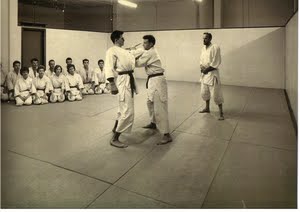
One of the shodan gradings in Jan de Jong's jujutsu grading system is a theory grading. The theory grading is an oral examination of the candidate's technical knowledge. A common question De Jong posed was: 'What are the forces involved in a tai gatame ude kujuki (body set are breaking)?' The candidate was required to answer the question verbally with no physical demonstration.

This is an example of explicit learning or explicit knowledge. The Australian Institute of Sport provide the following explanation of explicit learning which is contrasted with implicit learning:
Explicit learning can be related to traditional coaching approaches where verbal instruction is used to coach a learner about how to perform a skill. This process typically results in the learner being able to verbalise how to perform the skill, although it does not guarantee the learner can physically execute the skill. In contrast, implicit learning methods typically contain no formal instruction about how to perform the skill yet result in a learner being able to perform the skill despite being unable to verbally describe how they do it.
Do we need explicit knowledge of techniques? De Jong obviously thought so given he included an explicit knowledge grading within his shodan grades. The 'traditional' teaching method of Asian martial arts involves implicit learning where techniques are demonstrated and the student attempts to imitate them. Does the student need to be able to verbally describe techniques in addition to being able to perform them? Does the instructor?

De Jong saw his dan grades as producing instructors in addition to practitioners. He expected his instructors to possess an explicit understanding of techniques. Many others in the martial arts do not expect either their students or instructors to possess an explicit understanding of their techniques. One possible explanation for the traditional Asian martial arts teaching model being based on implicit learning may be because the instructors did/do not possess an explicit understanding of the techniques. If you come up under an implicit learning model, where do you gain the explicit knowledge?

Why would an instructor need to have an explicit understanding of techniques if they use implicit learning methods when teaching? One reason is that it provides a through understanding of the mechanics of the technique. It enables the instructor to analyse techniques and provide instruction to correct errors and improve performances. The problem is that an explicit explanation of techniques is hard to come by in the martial arts.

Let's return to De Jong's question; 'what are the forces involved ...?' De Jong intuitively knew that forces are important in understanding how a technique works. Unfortunately, neither he nor the candidates knew much about forces. My work remedies that shortcoming.

Forces are what causes every technique taught by every martial art work. The good thing is that forces is a simple concept for the layperson to understand and apply. First you identify all points of contact between the 'defender' and the 'attacker.' Next you determine if the force applied at each point of contact is a push or a pull. Then you describe the direction and relative magnitude of each of the forces. Finally you determine the intended effect of the applied net forces. This approach provides an explicit understanding of every technique taught by every martial arts.

A very good and rare example of this approach at work is with Jigoro Kano's Kodokan Judo. When you understand the concept of forces and adopt the approach described above, you'll see that Kano consistently describes all his methods in these terms. In this way, Kano focuses on the important elements in the techniques to provide an explicit understanding of judo techniques for the reader.


Friday, April 5, 2013

'Trust your instincts'

'Trust your instincts' - this is advice that is often proffered by activities associated with preparing a person to survive a violent encounter (e.g. martial arts, self defence, etc.). Sound advice, but what does it actually mean?

Instincts are often equated with intuition. Far from being a mystical, magical 'sixth-sense,' intuition is seen as being a product of knowledge and experience.

Gary Klein was commissioned by the US military to find out how experts made decision during periods of high stress. He initially studied veteran firefighters and has since gone on to study military, fighter pilots, oil riggers, air traffic controllers, nuclear power plant operators, etc, and how they make decisions during times of high anxiety-fear (although he refers to the ambiguous concept of stress). Much to his surprise, he found these experts could not tell him.

We'll take a step back. It has been found that the 'core to all learning' is the identification of similarities and differences. Four forms of identifying similarities and differences have been found to be highly effective: comparison, classification, creating metaphors, and creating analogies. Far from being literary or linguistic devices, these four forms of identifying similarities and differences are seen by cognitive theorists to be fundamental ways of thinking.

Klein found that experts, compared to novices, made decisions not through a conscious, analytical process, but rather based on 'pattern recognition.' Something in the situation they were experiencing was unconsciously matched with something from their experience which prompted a decisive action.

This pattern recognition involves comparison, classification and analogies (or metaphors which for all intents and purposes is the same thing). The expert compared the experience 'out there' with their past experiences, which have been conveniently classified (albeit unconsciously), and an analogy was drawn that enabled them to understand the unknown (the current experience) with the known (past experience).

So what? If you know the process by which experts make intuitive decisions, you can devise ways and means to expedite and enhance this process. This is precisely what Klein has done and his intuitive decision making (Recognition-Primed Decision Making) is being used by various organisations around the world (including the military of various countries) to enhance decision making during periods of high anxiety-fear.

Before I leave this post, I will make one point. The intuitive decision making model is heavily weighted in favour of experience. The more 'patterns' that a person has developed and classified, the more comparisons are available to be fitted which produces a decision. However, despite the experienced-biased proponents within the martial arts, it is not experience alone that produces faster and more high quality decisions. It is also the ability to identify similarities through comparison, classification and analogies. If we train these abilities, we leverage experience and experience produces the benefits it promises.

Tuesday, April 2, 2013

Implicit Learning vs Explicit Learning

The previous post looked at Being Taught vs Learning. This post looks a little more at learning, which an understanding of is important for both teacher and student of the martial arts.

Learning comes in two guises: explicit and implicit learning.

Explicit learning can be related to traditional coaching approaches where verbal instruction is used to coach a learner about how to perform a skill. This process typically results in the learner being able to verbalise how to perform the skill, although it does not guarantee the learner can physically execute the skill. In contrast, implicit learning methods typically contain no formal instruction about how to perform the skill yet result in a learner being able to perform the skill despite being unable to verbally describe how they do it.

Hurst, in Armed Martial Arts of Japan, suggests that in Japanese medieval times when fighting skills were still practical, the head of any martial arts school instructed his disciples in a manner analogous to that of many religious teachers. That is to say that transmission of the teachings occurred largely by example and not through verbalisation. Hurst is describing implicit learning as being the traditional model for martial arts transmission.

It has been found that athletes who are given instructions (explicit learning) were found to more likely preoccupy themselves with thoughts about how they were executing the skill, which in most sports is detrimental to performance. Under pressure, the players were found trying to consciously control normally automatic, implicit or subconscious processes, commonly termed ‘paralysis by analysis’. In other words, they were more susceptible to choking. Alternatively, players who did not have any instructions to refer to (implicit learning) were less likely to think about how to execute the skill because they did not consciously know what they actually did. That is not to say their bodies did not know what to do, they simply left the brain out of it.

The explicit-implicit distinction is not as defined in most modern day martial arts training. Instruction is provided, but that instruction focuses on the how-to with very little, if any, instruction provided as to the why-to. That is to say that instruction is provided as to how to do the technique with none provided as to why the technique works.

As with everything, there are costs and benefits. A benefit of implicit training is increased resilience to detriments in performance under pressure. A benefit of explicit training is that it is a faster way for a learner to acquire information. A cost of explicit training is the increased potential for choking. A cost of implicit training is that it does not provide the tools for a learner to self correct. I would go one step further, it does not provide the tools to teach others.

It was once explained to me that traditional teaching of Chinese or Japanese martial arts was for the teacher to provide 'one corner' and it was up to the student to find the other corners. All very mystical and philosophical, but does it not also reflect the fact that the traditional martial arts model provides the student with how-to knowledge and not why-to knowledge. That they do not understand why something does or does not work, only how to do it, and then only for them.

Most martial arts instructors can be viewed as being great tennis players. They know how to play the game. Andre Aggassi was asked to describe the wrist action of his forearm stroke. It was found with the aid of slow motion cameras that his description of his wrist action was incorrect. He could perform the action brilliantly, but he didn't understand it and couldn't verbalise the action. Who do you want to be taught by? Roger Federer or Roger Federer's coach who you've never heard of and is not an elite player?

This raises the issue of what a black belt (or any senior grade by whatever description) means. Should a black belt be able to instruct the tactics and techniques of their martial art? If so, what model do they adopt: implicit or explicit learning? By default, if they are expected to be able to teach, they must adopt the implicit learning model? They will be limited in their problem solving abilities because they have learnt the how and not the why of techniques. Looking back on my martial arts experience, I've known many instructors who knew how to do the techniques, and some who were very good at doing them, but very, very few who knew the why of techniques. They had a 'follow me' approach to teaching and were limited and less flexible in their problem solving abilities for individual students.

Related to the above question, what percentage of a black belt should be given to teaching/understanding compared to proficiency? Right now, most black belts focus on proficiency, which then fallaciously is used to suggest teaching ability. Would you award a black belt to a person who knew the why of techniques and could teach but was an average practitioner? It depends on what you think a black belt means, or what it means to you as an instructor or head of a school. What are you producing - teachers or practitioners?

This is where my work is directed. To fill that gaping chasm that is the lack of understanding of why martial arts techniques work and how to teach them.

Wednesday, March 27, 2013

Being Taught Versus Learning

What is the primary function of a teacher?
Noted systems theorist, Russell Ackoff, states that the primary function of a teacher should be to facilitate learning how to learn and motivating students to do so.

It has been my position for many years that students should first be taught how to learn before they are taught any subject. Being taught how to learn improves the efficiency and efficacy of the future learning experience.

My book is, among other things, about teaching the reader how to learn the methods taught by activities associated with preparing a person to survive a violent encounter. It empowers the student and challenges the teachers to be better teachers. It encourages the student to manager their own learning experience if not become their own teachers.

Ackoff has an interesting method of facilitating learning. He suggests that teaching is a very good way to learn a subject. That teaching others encourages and enables students to learn on their own and consolidate what they have learned. This, he suggests, is common knowledge especially among those who have taught a subject that they themselves have not been taught.

I can personally vouch for the fact that my learning and the consolidation of what I learnt in the martial arts has come from teaching. I vividly remember the night when I showed understanding rather than knowledge when I taught a technique differently than my instructors with insights I'd personally gained.

Ackoff recommends that all students should be given the opportunity to teach others. So, Instructors, this is an innovate approach to teaching your students. Get your students to teach your students. Ackoff refers to an innovative teacher in the US who did just that with primary school children with considerable success. Students in the second grade taught those in the first grade, and students in the third grade taught those in the second.

I would qualify Ackoff's statement about teaching being a very good way to learn a subject. Teaching a large class is less effective in this regard than teaching a small class or teaching one-on-one. This understanding comes from personal experience teaching many people via private lessons. Each individual is different and you have to modify your teaching to suit their individual capabilities. This truly challenges your understanding of the subject and your ability to adapt what you'd been taught to suit the individual.

Food for thought.

Monday, March 25, 2013

Be Kind, For Everyone You Meet Is Fighting A Hard Battle

'Be kind, for everyone you meet is fighting a hard battle.' This is a quote that is often attributed to Plato but some suggest is Ian Maclaren. What is the battle?

Kasey Edwards wrote an editorial in which she explains how she was sexually abused as a child. She writes that after years of therapy how she understood intellectually she was not to blame but how emotionally she still blames herself for not fighting back. In this case the battle is between intellect and emotion.

This battle is a civil war. It is between the newly evolved intellect (neocortex) and the primitive emotion (amygdala). Like all civil wars, it is complicated by the interconnectedness between the combatants. Emotion is elicited by the unconscious appraisal of a physical or psychological stimulus. Appraisal is a cognitive function. Because of the interconnectedness of the emotion process, emotion can influence appraisal and the way we see the world.

There is an article written about an elite AFL premiership footballer who suffers from anxiety that informs on this battle.

Morton said he has never played an AFL game in which he has not thrown up in the rooms beforehand, but on grand final day he vomited 10 times before running out on to the MCG. And again at quarter-time, half-time and three-quarter-time.

But Morton is still only 26 and admits that, for him, even that ultimate success was accompanied with the heightened mental anxiety which he accepts will haunt him for the rest of his life.


"Everyone has their challenges in life and this is my challenge.''

Morton does not describe his condition as depression although he has sought varying forms of treatment and medication to achieve some form of equilibrium. ''What I have couldn't be further from depression,'' he said. ''My anxiety means I don't sleep and I jump out of bed every morning and want so desperately to be as good as Chris Judd or Dane Swan or Adam Goodes.


''But I can't find a way to get there. At Richmond, it got to the point where I wanted it so much and it wasn't happening and I'd drive to training and I'd almost be regurgitating my food before every session. I'll always be a worrier because that's how I am, but it was out of control.''

Morton is engaged in a constant battle with the combatants being his intellect and emotion. The article talks of the help he's sought and his allies that are a mentor, his coach, his team, and the football club. Read the article to see how some elite sports are now treating emotional conditions seriously, employing psychologists to look after their athletes mental welfare and not just sports psychologists to improve performance.

Unfortunately I can relate to Morton's story all too well. I am in the process of better understanding my battle and my enemy, emotion. As my profile will show, I am highly qualified in both business studies and in the martial arts. I have never suffered from a lack of confidence. This confidence was not unfounded given my experience in the business and martial arts world.

I now battle with a constant feeling of doubt in my abilities and constantly feel overwhelmed. I know intellectually there is no foundation to these feelings, but the intellect cannot seem to change those feelings. You continue despite these feelings, sometimes you don't. However, understanding this battle and the enemy bolsters your resources and abilities to take on this battle (as Sun Tzu suggested the The Art of War). You may never win, as Morton explains when he accepts this condition may haunt him for the rest of his life, but you can find a way of functioning nonetheless.

I suppose this means that while you may never win, you find a way where you do not lose. Having written that, I recall that Jan de Jong used to say that fighting is not about winning, it's about not losing.

Just as with Morton on his way to training, I was battling with the urge to vomit as I travelled to the first board meeting of a charity organisation I am a director of. My anxiety levels were raging and I felt I did not have the capabilities to attend to the task as finance director and felt overwhelmed. I was gripping the steering wheel tightly, which was a metaphor for the battle I was undergoing to resist the urge to turn the car around and return home. I knew, intellectually, that I could do this job standing on my head, but my emotion refused to believe it. I couldn't change that, but just as with Morton, I fought the battle and attended the meeting despite the continued anxious feelings.

Self-talk and 'positive thinking' are weapons used by the intellect to fight emotion. Sometimes they work, sometimes they don't. A weakness in these intellectual weapons can be that in order for them to be effective they require belief, and belief comes from emotion not intellect.

Here, as I've learnt from both sides now, we need to be careful when urging others to 'think positively' and using motivational quotes to urge them to think differently. This can have the result of alienating a person or even be the cause of further distress and a feeling of shame and failure when they cannot change the way they feel. These messages are well intentioned, no doubt, but they are also uninformed.

In my chapter on the survival process, I detail six strategies that the military (and other fighting-related activities) use to deal with fear. One is will to override fear. This strategy assumes the emotion of fear is present but that intellectual will is used to counter the flight impulse and get the combatant to fight instead. Will got Morton onto the training track and the competitive arena, and will got me to and through my first directors meeting. What must be understood is that while will pushes you forward, it does not vanquish emotion. You still feel fear but you fight nonetheless; you still feel anxious but you train and play nonetheless; you still feel panicked but you attend the board meeting nonetheless.

This post is written for a number of reasons. Firstly, it is a mediation and possibly a way for me to explore this condition. Secondly, it is also designed to alert the reader to the hidden battles that many people fight. If we wish to be part of the solution rather than part of the problem, we need to better understand these battles in order to be an ally rather than another foe. This is particularly true of martial arts and self defence instructors whose students often are struggling with these hidden battles.
Be kind, for everyone you meeting is fighting a hard, often unseen, battle.

Friday, March 22, 2013

'Rapists are to blame for rape.'

'Rapists are to blame for rape' is the title of an article by Kasey Edwards published on a news site today. What I found fascinating about this article is how my work on injury science and the survival process informed this article and provided opportunities for preventing and controlling 'injury' associated with these types of events. A number of chapters in my book are dedicated to these subjects.

William Haddon developed the Haddon Matrix to analyse injury events and to develop interventions to prevent and control injury. Firstly, it has been used to study and develop interventions not only for physical injuries, but also other types of injuries such as those arising from sexual assault, as well as damage generally. Secondly, prevention and control replaces the old paradigm of simply prevention. Under the old prevention paradigm, you were on your own should prevention measures fail.

The Haddon matrix juxtaposes all the factors that contribute to an injury with the time frame over which injury occurs. The factors are: host - person at risk of being injured; vector - person responsible for injury, or vehicle - inanimate object responsible for injury; and environment - cultural and physical. The time frame is pre-, during, and post injury event.

The shame and guilt Edwards refers to the host-post injury cell. She survived her abuse but now suffers post-abuse because of her own judgements about herself. What intervention can be developed to mitigate the suffering post-event/abuse. Knowledge. An understanding of our evolved survival mechanism is one such way. 'Why didn't I fight back,' she asks. She then judges herself for not fighting back.

How corrosive are judgements? Edwards survived. Isn't that something she should be thankful for. Unfortunately, nature provided us with cognition as well as instincts. They are distinct. Edwards writes about intellectual understanding and emotion, and insightful finds they are at odds with one another. Cognition developed after emotion. We use cognition to manage emotion, but, we humans, uniquely, use cognition to inflict pain on suffering on ourselves and others. What put us on top of the food chain also causes us pain and suffering.

Those who refer to mind and body as one are simplistic. Nature provided emotion before it did cognition. Emotion is designed to be used to promote survival when thinking is too slow. It gets a little more complicated as emotion is elicited via appraisal, which is a cognitive process albeit unconscious in the case of emotion.

Why didn't I fight back? My survival process concept goes far beyond the limited fight-or-flight model (and stress). Fight and flight behaviours are severely limited. We have been provided with a vast array of instinctive survival behaviours. Nature does not judge! Nature is only interested in our survival. Nature truly cares about our survival. Fair enough, nature also messed up a bit by providing cognition that then judges nature's handiwork.

Submission is an instinctive survival behaviour. Tonic immobility is an instinctive survival behaviour. TI is an involuntary catatonic-like state that is enacted when fight and flight fail. It resembles a dead animal as the person is unable to move or vocalise. Research suggests that up to 2/3 of sexual assault survivors experience TI during their attacks. Research also suggests that understanding that TI is an instinctive, involuntary survival behaviour lessens the corrosive effects of questioning the lack of action during an assault.

Edwards article is aimed at the pre- and post-event-environment cells. To change society's views on rape in order to reduce its incidence and reduce the psychological effects due to judgements. She is doing this through knowledge.

What this model and this information does is enable one to objectively analyse an injury event and understand all the factors that interact over time to produce an injury of any description. It then provides a means where interventions in multiple areas can prevent or control injuries that can arise from these events.

Wednesday, March 20, 2013

'I asked him what I could do so that we didn't have to fight'

The linked article was published today in The Age concerning a road rage incident experienced by a lawyer. It is a wonderful example by which the survival process concept I've developed by integrating the theories of fight-or-flight, stress and emotion theory can be used to gain greater insights and understanding.

When physically confronted, the lawyer explains that 'the savage instinct of fight/flight battered against the calmer, resolution-seeking side of my mind.' Lets dissect this statement with reference to the survival process concept.

'Instinct of fight/flight' refers to our evolved survival mechanism. A stimulus is unconsciously appraised. Based on that appraisal, a feeling response is elicited which motivates an impulse to act in a particular way. At the same time, an automatic physiological response is experienced which prepares the body for the behaviour that the feeling response motivates. The behaviour is designed to deal with the stimulus. This is our evolved survival mechanism.

The lawyer, even given their training to be exact with the use of their terminology, incorrectly refers to fight/flight. Many people who refer to the fight-or-flight concept do not understand that Walter Cannon, the developer of this concept, associated fight with anger and flight with fear. So, what was the lawyer's instinctive reaction - anger or fear? The different emotions are elicited based on different appraisals and produce different action tendencies which are supported by different physiological responses designed to prepare the body for different behaviours.

The lawyer was correct in referring to it as an instinct. Emotions were developed in our evolutionary past to deal with survival problems in the environment without the time consuming cognitive process. Is the instinct 'savage'?

We are all still 'cave people in suits.' We have changed our environment, but we have not evolved to adapt to that environment. The aggressor was prepared to physically engage the lawyer because of action tendency elicited by his appraisal of the lawyer beeping his car horn at him which in turn elicited the emotion of anger. Emotions were designed by nature to deal with threats to our well-being. Honking a car horn at someone is not a threat to our well-being, but some of us have not evolved to distinguish between the two.

Why did the lawyer describe this evolved instinct, albeit misdescribed, as 'savage.' He is placing a judgement on his instincts. Technically, savage is defined by violence and aggression. Flight is not violence or aggression. Savage is also defined as being uncivilised. 'Civilised' refers to a judgement about a stage of development that is considered to be more advanced. Now this refers to (a) interventions in the appraisal process in order to elicit certain emotions in response to certain stimuli, and/or (b) the ability to manage emotions once they are elicited.

The latter is what the lawyer was referring to when he wrote about the calmer, resolution-seeking side of his mind. There is a disconnect in humans between the impulse to act and the actual behaviour. This disconnect has been described as providing the opportunity of considered other behaviours other than the feeling-motivated impulse to act. Rather than fleeing or fighting the road rager, the lawyer was provided the opportunity to consider alternative behaviours because of this disconnect.

Some people obviously have a limited disconnection between impulse to act and actual behaviour. It is said that the difference between animals and humans is the disconnect between impulse and behaviour. Animals experience the emotion process in terms of a stimulus-response chain. I suppose technically you could say that those people who react in terms of a stimulus-response chain are closer to animals than humans.

'The only sensible outcome was to talk my way out of this. Be calm, swallow my pride, engage him so as to placate him.' Be calm - all of the components of the survival process are interrelated. A stimulus is appraised as a threat which elicits a feeling of fear which motivates an impulse to flee. At the same time, a physiological response is experienced which increases both heart rate and breathing rate to increase the amount of oxygenated blood that is provided to the muscles that will aid in flight. By intervening in the physiological response by voluntarily controlling his breathing, the lawyer was able to manage his feeling of fear and its associated impulse to act, along with the other physiological reactions and even the appraisal of the stimulus.

'Swallow my pride' - now that is an interesting comment. Pride is an emotion, hence, pride is based on an appraisal and elicits a feeling which motivates an impulse to act which a physiological reaction prepares the body to enact. What does 'swallow your pride' actually mean? I'd suggest it means to deal with the emotion of humiliation which is elicited based on the appraisal of the stimulus. The question then to consider is why are you feeling humiliated?

I recently watch the classic movie with Ben Kingsley playing Gandhi. In that movie, it shows line after line of Gandhi followers moving towards the military armed with large clubs who then clubbed the passive protesters. Did they swallow their pride when they were beaten and dragged away blooded and injured. No. In fact, they were probably proud of their non-violent action. Funnily enough, armed with an understanding of pain (which is another chapter in my book), they probably experienced the 'pain' associated with the beating far differently than you or I would under different circumstances.

Listen to what people say. It often says more about them than it does about what they are talking about. 'Swallow my pride' tells me the lawyer feels bad to a certain degree about not standing up to his aggressor/attacker. There is a judgement associated with his appraisal of the situation. Take an objective view of the experience or change the way you appraise the situation, and their is no more swallowing of pride.

'Engage him so as to placate him' - emotions are evolutionarily designed to be short lived. If you can stall someone from enacting their emotionally motivated action for a short period of time, the intensity of the emotion or the emotion itself would have subsided. This then provides the opportunity for cognition to be engaged. Remember, emotion is evolutionarily designed to override cognition; the latter being a later development in human evolutionary history.

The more we understand of the survival process, the less we will judge ourselves and others, and the more we will be able to manage our emotions in emotionally excitable circumstances.